
POPULATION GROWTH LIMITING FACTORS CHARACTERISTICS OF POPULATIONS What


- Slides: 20
POPULATION GROWTH &LIMITING FACTORS
CHARACTERISTICS OF POPULATIONS What characteristics are used to describe a population? Copyright Pearson Prentice Hall
CHARACTERISTICS OF POPULATIONS Characteristics of Populations Three important characteristics of a population are its: Copyright Pearson Prentice Hall geographic distribution population density growth rate
POPULATION GROWTH Copyright Pearson Prentice Hall What factors affect population size?
POPULATION GROWTH Population Growth A population can grow when its birthrate is greater than its death rate. Copyright Pearson Prentice Hall Three factors can affect population size: the number of births the number of deaths the number of individuals that enter or leave the population
POPULATION GROWTH Copyright Pearson Prentice Hall Immigration, the movement of individuals into an area, is another factor that can cause a population to grow. Emigration, the movement of individuals exiting an area, can cause a population to decrease in size.
EXPONENTIAL GROWTH What are exponential growth and logistic growth? Copyright Pearson Prentice Hall
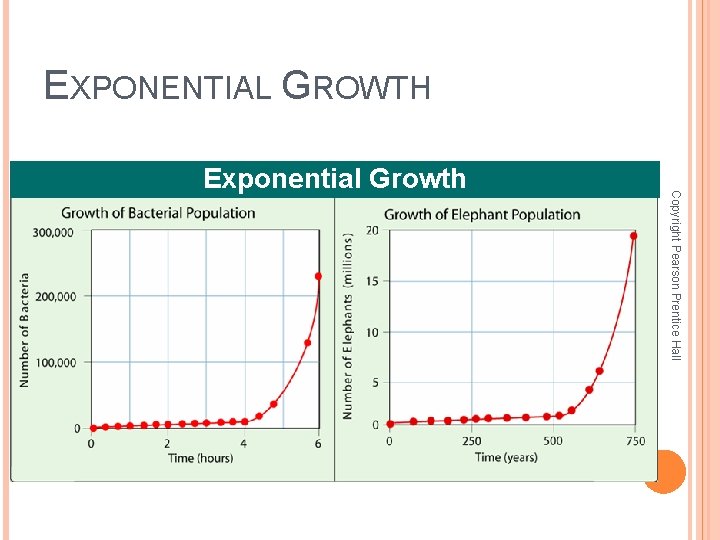
EXPONENTIAL GROWTH Exponential Growth Exponential growth occurs when the individuals in a population reproduce at a constant rate. The population becomes larger and larger until it approaches an infinitely large size. Copyright Pearson Prentice Hall Under ideal conditions with unlimited resources, a population will grow exponentially.
EXPONENTIAL GROWTH Copyright Pearson Prentice Hall Exponential Growth
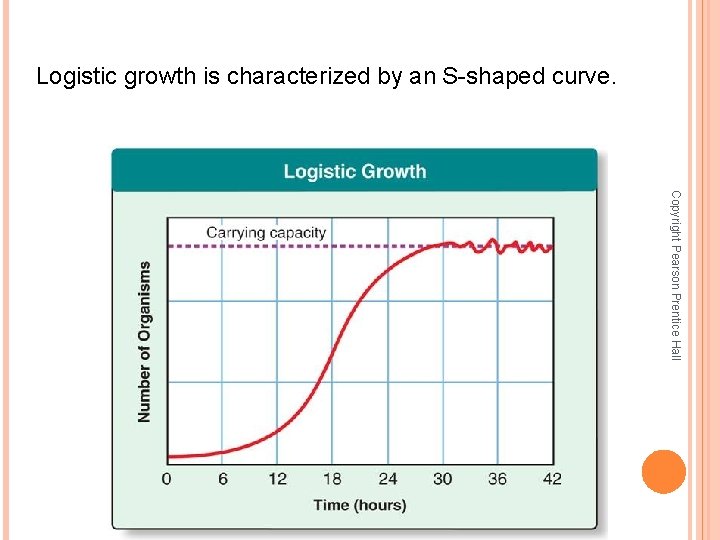
LOGISTIC GROWTH Logistic Growth Logistic growth occurs when a population's growth slows or stops following a period of exponential growth. Copyright Pearson Prentice Hall As resources become less available, the growth of a population slows or stops.
Logistic growth is characterized by an S-shaped curve. Copyright Pearson Prentice Hall
LIMITING FACTORS What factors limit population growth? Copyright Pearson Prentice Hall
LIMITING FACTORS Limiting Factors The primary productivity of an ecosystem can be reduced when there is an insufficient supply of a particular nutrient. Ecologists call such substances limiting nutrients. Copyright Pearson Prentice Hall
LIMITING FACTORS A limiting nutrient is an example of a more general ecological concept: a limiting factor. In the context of populations, a limiting factor is a factor that causes population growth to decrease. Copyright Pearson Prentice Hall
DENSITY-DEPENDENT FACTORS Density-Dependent Factors A limiting factor that depends on population size is called a density-dependent limiting factor. Copyright Pearson Prentice Hall
DENSITY-DEPENDENT FACTORS � Density-dependent limiting factors include: competition predation parasitism disease Copyright Pearson Prentice Hall
DENSITY-DEPENDENT FACTORS �Density-dependent factors operate only when the population density reaches a certain level. These factors operate most strongly when a population is large and dense. �They do not affect small, scattered populations as greatly. Copyright Pearson Prentice Hall
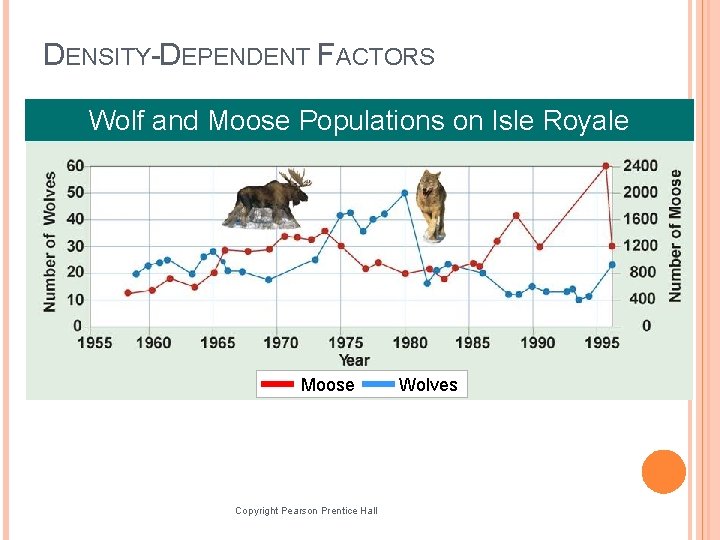
DENSITY-DEPENDENT FACTORS Wolf and Moose Populations on Isle Royale Moose Copyright Pearson Prentice Hall Wolves
DENSITY-INDEPENDENT FACTORS Density-Independent Factors Density-independent limiting factors affect all populations in similar ways, regardless of the population size. Copyright Pearson Prentice Hall
DENSITY-INDEPENDENT FACTORS � Examples of density-independent limiting factors include: unusual weather natural disasters seasonal cycles certain human activities—such as damming rivers and clear-cutting forests Copyright Pearson Prentice Hall