
Population Growth and Change Notes 2 Growth Rate
- Slides: 12
Population Growth and Change Notes 2
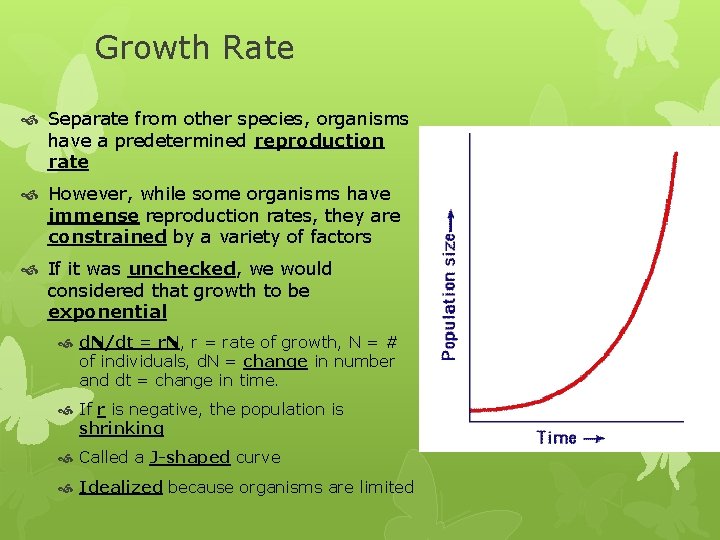
Growth Rate Separate from other species, organisms have a predetermined reproduction rate However, while some organisms have immense reproduction rates, they are constrained by a variety of factors If it was unchecked, we would considered that growth to be exponential d. N/dt = r. N, r = rate of growth, N = # of individuals, d. N = change in number and dt = change in time. If r is negative, the population is shrinking Called a J-shaped curve Idealized because organisms are limited
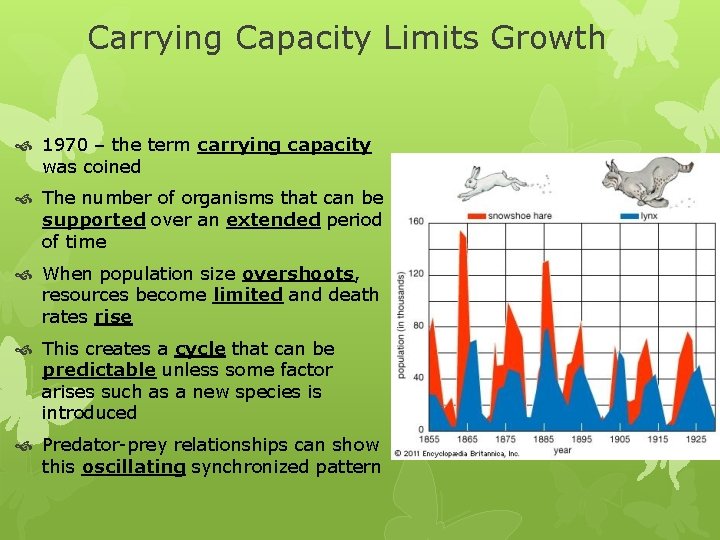
Carrying Capacity Limits Growth 1970 – the term carrying capacity was coined The number of organisms that can be supported over an extended period of time When population size overshoots, resources become limited and death rates rise This creates a cycle that can be predictable unless some factor arises such as a new species is introduced Predator-prey relationships can show this oscillating synchronized pattern
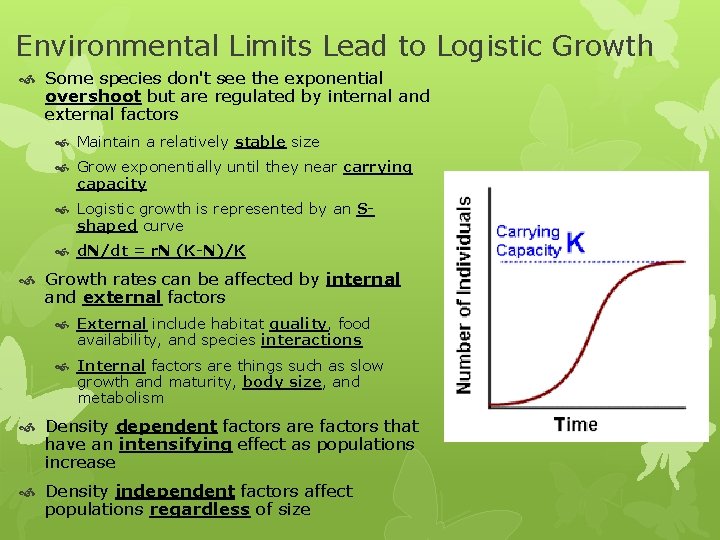
Environmental Limits Lead to Logistic Growth Some species don't see the exponential overshoot but are regulated by internal and external factors Maintain a relatively stable size Grow exponentially until they near carrying capacity Logistic growth is represented by an Sshaped curve d. N/dt = r. N (K-N)/K Growth rates can be affected by internal and external factors External include habitat quality, food availability, and species interactions Internal factors are things such as slow growth and maturity, body size, and metabolism Density dependent factors are factors that have an intensifying effect as populations increase Density independent factors affect populations regardless of size
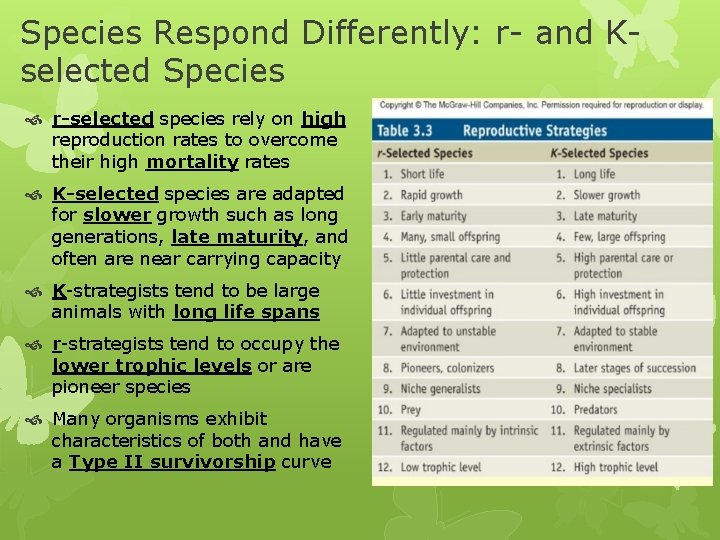
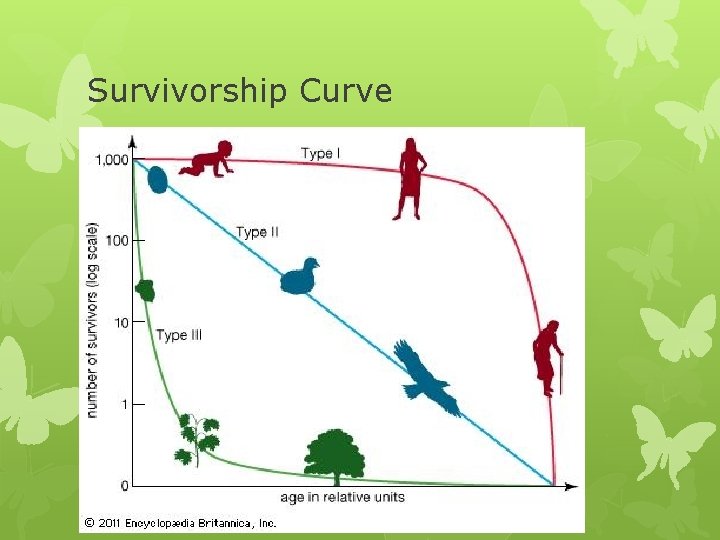
Species Respond Differently: r- and Kselected Species r-selected species rely on high reproduction rates to overcome their high mortality rates K-selected species are adapted for slower growth such as long generations, late maturity, and often are near carrying capacity K-strategists tend to be large animals with long life spans r-strategists tend to occupy the lower trophic levels or are pioneer species Many organisms exhibit characteristics of both and have a Type II survivorship curve
Survivorship Curve
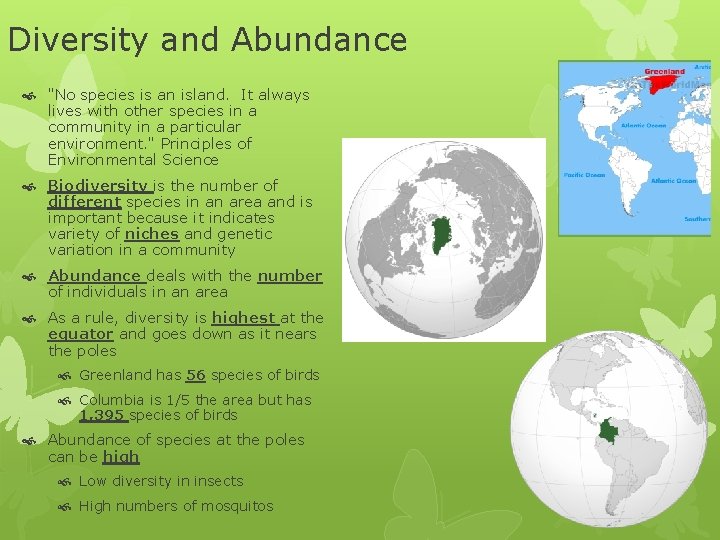
Diversity and Abundance "No species is an island. It always lives with other species in a community in a particular environment. " Principles of Environmental Science Biodiversity is the number of different species in an area and is important because it indicates variety of niches and genetic variation in a community Abundance deals with the number of individuals in an area As a rule, diversity is highest at the equator and goes down as it nears the poles Greenland has 56 species of birds Columbia is 1/5 the area but has 1, 395 species of birds Abundance of species at the poles can be high Low diversity in insects High numbers of mosquitos
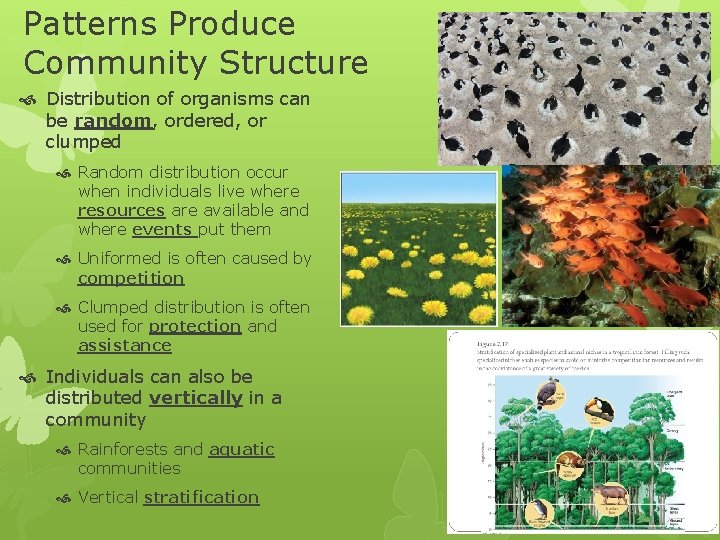
Patterns Produce Community Structure Distribution of organisms can be random, ordered, or clumped Random distribution occur when individuals live where resources are available and where events put them Uniformed is often caused by competition Clumped distribution is often used for protection and assistance Individuals can also be distributed vertically in a community Rainforests and aquatic communities Vertical stratification
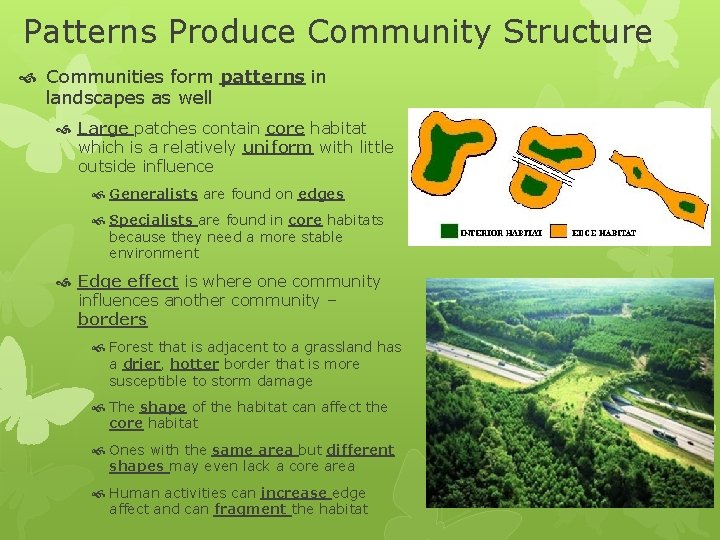
Patterns Produce Community Structure Communities form patterns in landscapes as well Large patches contain core habitat which is a relatively uniform with little outside influence Generalists are found on edges Specialists are found in core habitats because they need a more stable environment Edge effect is where one community influences another community – borders Forest that is adjacent to a grassland has a drier, hotter border that is more susceptible to storm damage The shape of the habitat can affect the core habitat Ones with the same area but different shapes may even lack a core area Human activities can increase edge affect and can fragment the habitat
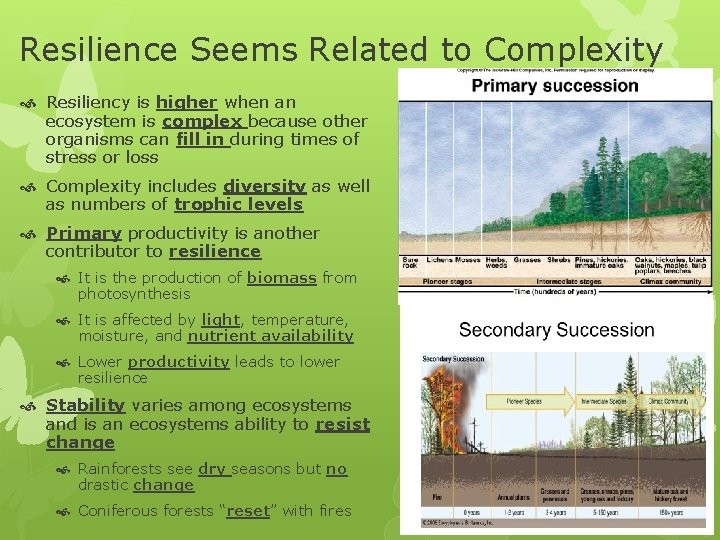
Resilience Seems Related to Complexity Resiliency is higher when an ecosystem is complex because other organisms can fill in during times of stress or loss Complexity includes diversity as well as numbers of trophic levels Primary productivity is another contributor to resilience It is the production of biomass from photosynthesis It is affected by light, temperature, moisture, and nutrient availability Lower productivity leads to lower resilience Stability varies among ecosystems and is an ecosystems ability to resist change Rainforests see dry seasons but no drastic change Coniferous forests “reset” with fires
Communities Are Dynamic J. E. B. Warming and Henry Chandler Crowles proposed that communities change in a specific sequence of stages Climax communities are the last and most developed, stable stage Primary succession there is regrowth on land devoid soil – sandbar, rock surface, lava flow Secondary succession occurs after a disturbance or abandonment In both cases, we see pioneer species populate an area Primary succession sees small, hardy organisms such as bacteria, mosses, lichens that don’t need a lot of resources Secondary succession has more complex species move in such as seeded plants and grasses Generalists are found in early succession Some communities depend on disturbance which is any force that disrupts established patterns Not all disturbances are sudden Droughts can alter ecosystems drastically Disturbances can be caused by modern technology such as roads, mining, or clear-cut logging
Communities Are Dynamic Since most times, disturbances are harmful, they have led to regulations and protection efforts Fire suppression and flood control were common management practices in 1900 s New ideas have arisen where certain conditions allow for prairie fires or flooding is allowed and beneficial It is recognized that some disturbances help keep populations in check 1988 – Yellowstone saw a fire that removed large amounts of lodgepole pines but now has a great variety of plant species Disturbance – adapted species are organisms that are hardy enough to withstand a disturbance such as a fire Some survive underground, others reseed quickly Many regions are shaped by periodic fires because some organisms need the competition to be maintained or removed