
Population Genetics The study of all the genetic
- Slides: 21
Population Genetics = The study of all the genetic traits in a population Gene Pool = combined genetic makeup all the members of a population
Genetic Equilibrium A constant state of allele frequency Population not evolving Allele frequencies remain stable This situation is also known as the: HARDY-WEINBERG PRINCIPLE
Conditions required to maintain genetic equilibrium: No natural selection – alleles must be equally favorable Random mating No migration – no new alleles brought into population No significant mutations – mutations would bring new alleles into population NOTE: Evolution is a result of disruption in genetic equilibrium
4 Ways to Disrupt Genetic Equilibrium Mutation: introducing new alleles into a population Genetic Drift Gene Flow Natural Selection: acting on variations Directional selection Stabilizing selection Disruptive selection
Genetic Drift Natural selection (AKA - survival of the fittest), is not the only source of evolutionary change. In small populations, an allele can become more or less common simply by chance. This kind of random change in allele frequency is known as GENETIC DRIFT. Because of genetic drift, a particular gene, just by chance, can become common in a population. (ie) blue eyes in humans.
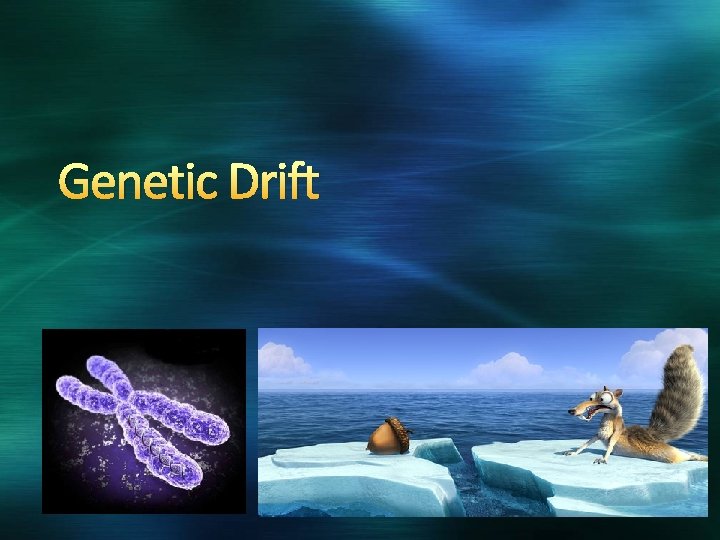
Genetic Drift
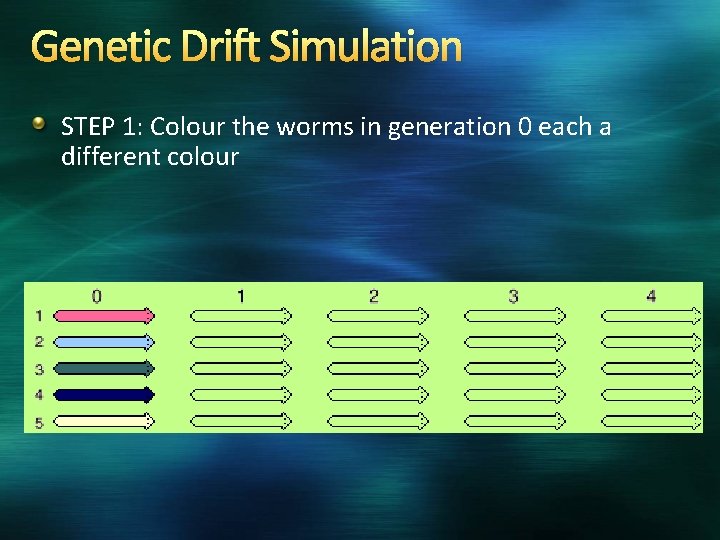
Genetic Drift Simulation STEP 1: Colour the worms in generation 0 each a different colour
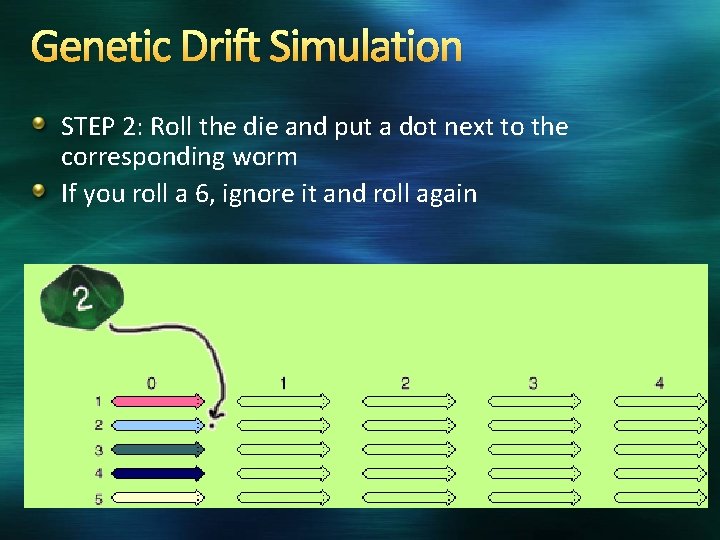
Genetic Drift Simulation STEP 2: Roll the die and put a dot next to the corresponding worm If you roll a 6, ignore it and roll again
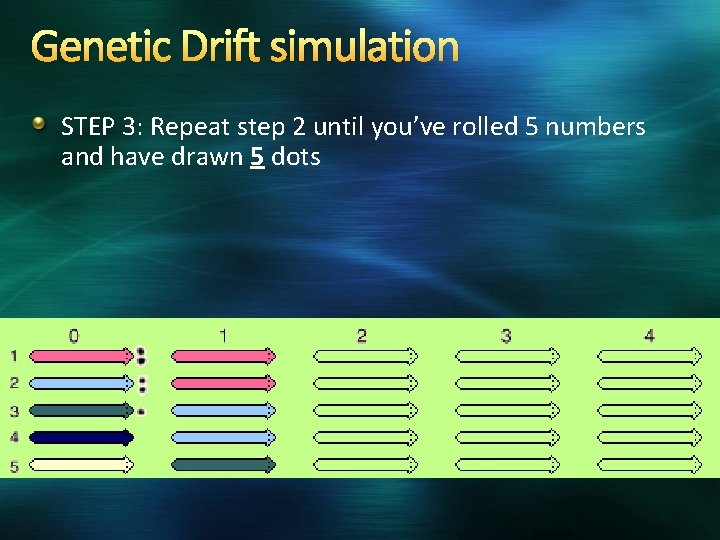
Genetic Drift simulation STEP 3: Repeat step 2 until you’ve rolled 5 numbers and have drawn 5 dots
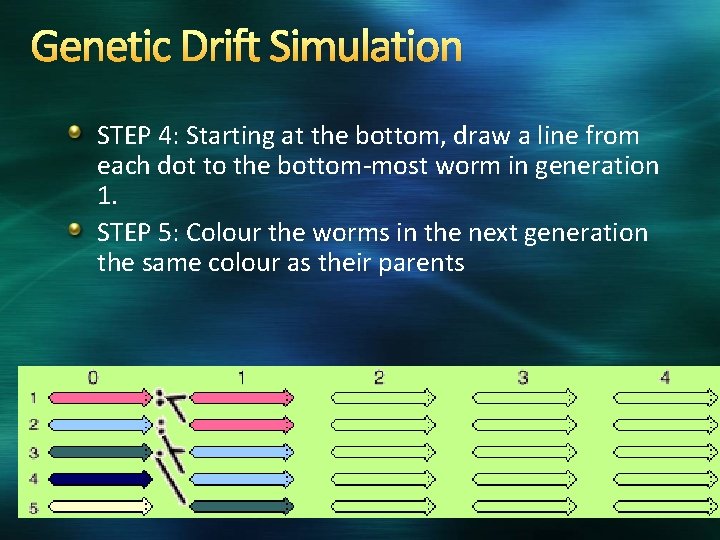
Genetic Drift Simulation STEP 4: Starting at the bottom, draw a line from each dot to the bottom-most worm in generation 1. STEP 5: Colour the worms in the next generation the same colour as their parents
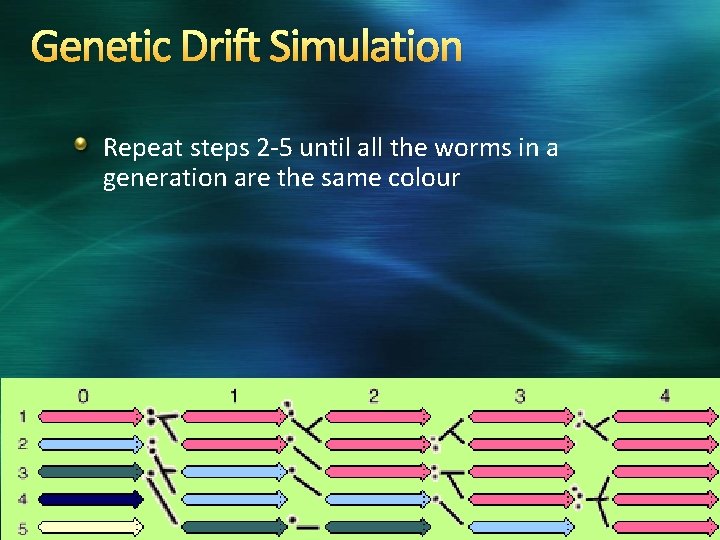
Genetic Drift Simulation Repeat steps 2 -5 until all the worms in a generation are the same colour
What do you think? What do you notice, after a few generations? If you did it again, did you get the exact same result? What would happen to your population, if you had a “new” colour appear at the end? What effect does population size have?
Genetic Drift (write!) The change in the frequency of a trait in a population, by chance events Over time, one trait may become frequent (almost!) 100% of the time, and other traits may disappear from a population altogether Has a bigger effect, in smaller populations
Gene Flow (write!) “the transport of genes through migration” If an individual leaves a population, their genes go with them! When entering a new population, could introduce new genes!
(write!) Genetic Drift Within one population, changing frequency of genes Typically reduces diversity Gene Flow Movement of genes from one population to another Both: could change a population, over many generations! (aka. Evolution!!!)
Selection and Distribution There are 3 types of selection that we can observe in different populations: 1. Directional Selection 2. Disruptive Selection 3. Stabilizing Selection
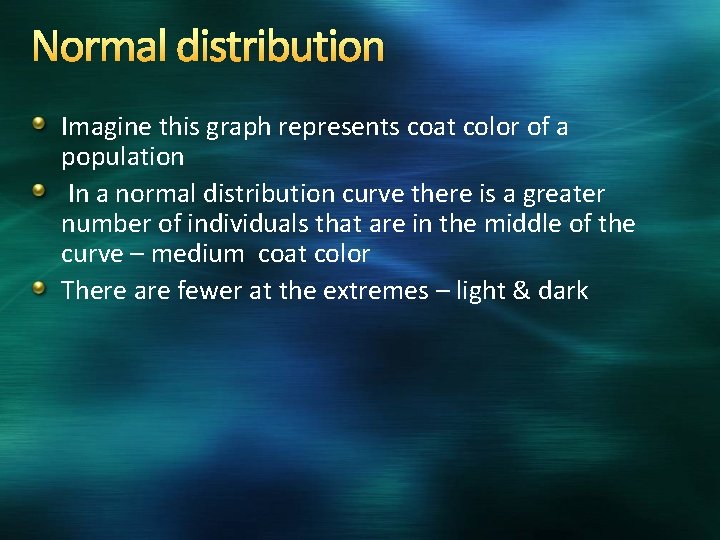
Normal distribution Imagine this graph represents coat color of a population In a normal distribution curve there is a greater number of individuals that are in the middle of the curve – medium coat color There are fewer at the extremes – light & dark
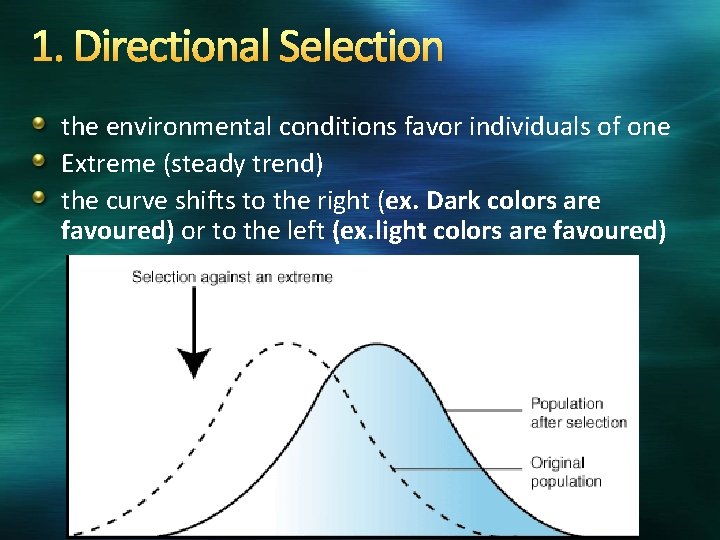
1. Directional Selection the environmental conditions favor individuals of one Extreme (steady trend) the curve shifts to the right (ex. Dark colors are favoured) or to the left (ex. light colors are favoured)
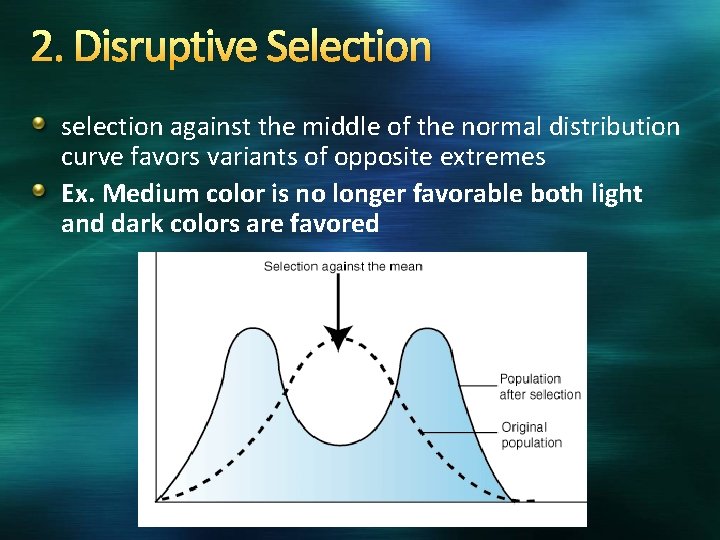
2. Disruptive Selection selection against the middle of the normal distribution curve favors variants of opposite extremes Ex. Medium color is no longer favorable both light and dark colors are favored
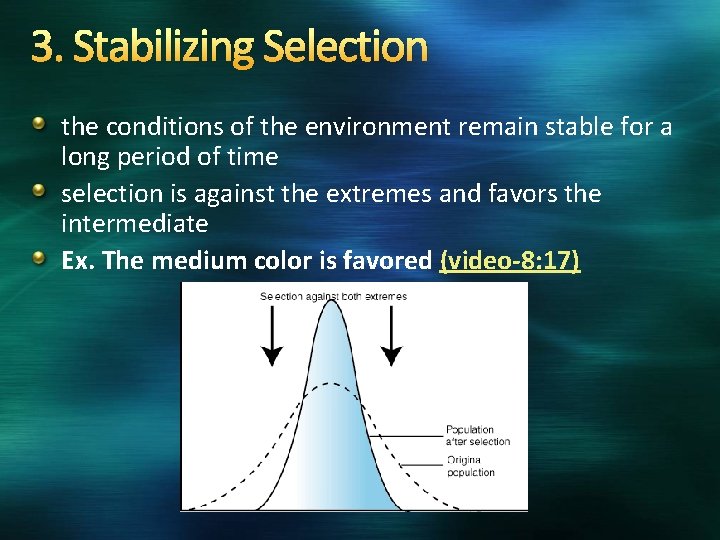
3. Stabilizing Selection the conditions of the environment remain stable for a long period of time selection is against the extremes and favors the intermediate Ex. The medium color is favored (video-8: 17)