
POPULATION GENETICS III Modern Evolutionary Biology I Population
POPULATION GENETICS III
Modern Evolutionary Biology I. Population Genetics A. Overview B. The Genetic Structure of a Population C. The Hardy-Weinberg Equilibrium Model D. Deviations From HWE: 1. Mutation 2. Migration 3. Non-Random Mating: 4. Populations of Finite Size and Sampling Error - "Genetic Drift" 5. Natural Selection: “differential reproductive success” we measure reproductive success as ‘fitness’ 1. Fitness Components:
D. Deviations From HWE: 5. Natural Selection 1. Fitness Components: Fitness = The mean number of reproducing offspring / genotype - probability of surviving to reproductive age - number of offspring - probability that offspring survive to reproductive age
D. Deviations From HWE: 5. Natural Selection 1. Fitness Components: Fitness = The mean number of reproducing offspring / genotype 2. Constraints: - probability of surviving to reproductive age - number of offspring - probability that offspring survive to reproductive age i. finite energy budgets and necessary trade-offs:
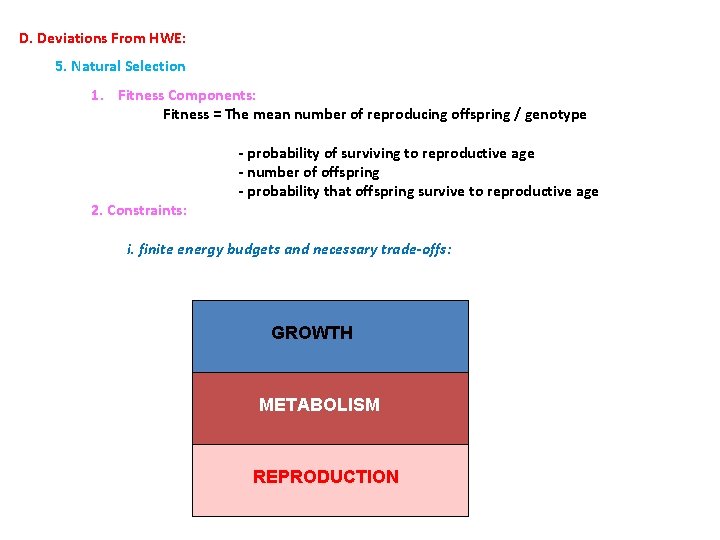
D. Deviations From HWE: 5. Natural Selection 1. Fitness Components: Fitness = The mean number of reproducing offspring / genotype 2. Constraints: - probability of surviving to reproductive age - number of offspring - probability that offspring survive to reproductive age i. finite energy budgets and necessary trade-offs: GROWTH METABOLISM REPRODUCTION
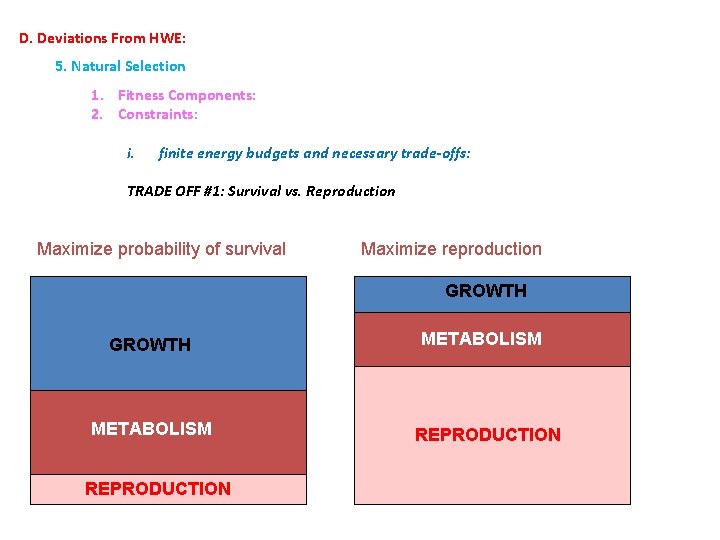
D. Deviations From HWE: 5. Natural Selection 1. Fitness Components: 2. Constraints: i. finite energy budgets and necessary trade-offs: TRADE OFF #1: Survival vs. Reproduction Maximize probability of survival Maximize reproduction GROWTH METABOLISM REPRODUCTION
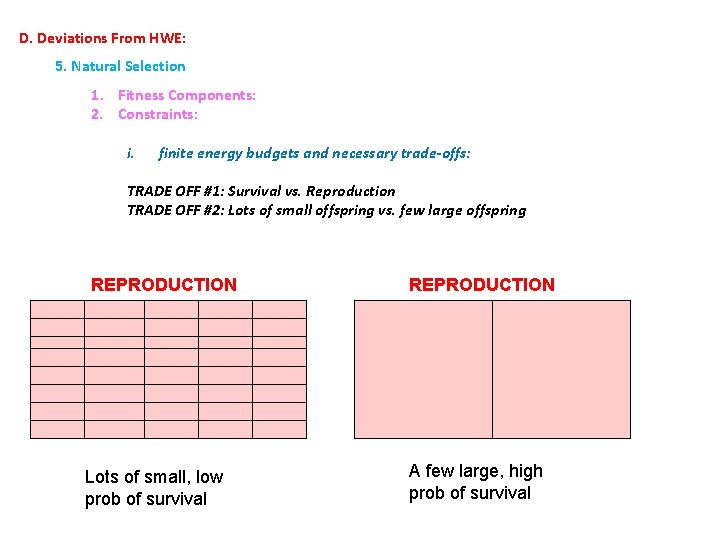
D. Deviations From HWE: 5. Natural Selection 1. Fitness Components: 2. Constraints: i. finite energy budgets and necessary trade-offs: TRADE OFF #1: Survival vs. Reproduction TRADE OFF #2: Lots of small offspring vs. few large offspring REPRODUCTION METABOLISM Lots of small, low prob of survival A few large, high prob of survival
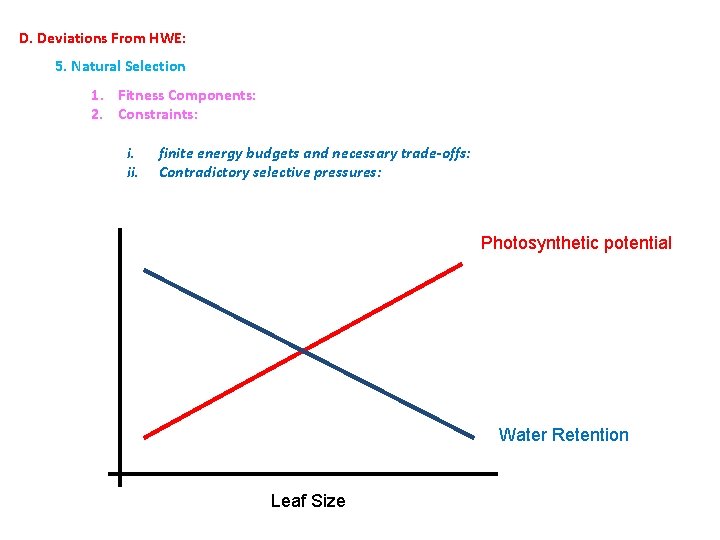
D. Deviations From HWE: 5. Natural Selection 1. Fitness Components: 2. Constraints: i. ii. finite energy budgets and necessary trade-offs: Contradictory selective pressures: Photosynthetic potential Water Retention Leaf Size
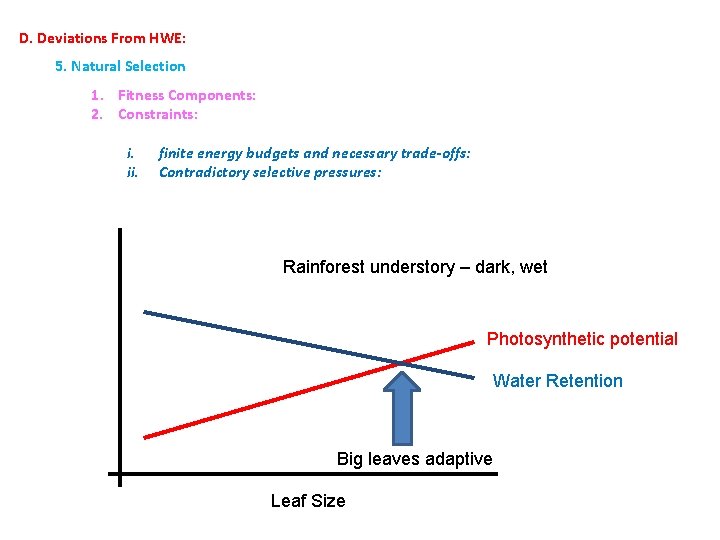
D. Deviations From HWE: 5. Natural Selection 1. Fitness Components: 2. Constraints: i. ii. finite energy budgets and necessary trade-offs: Contradictory selective pressures: Rainforest understory – dark, wet Photosynthetic potential Water Retention Big leaves adaptive Leaf Size
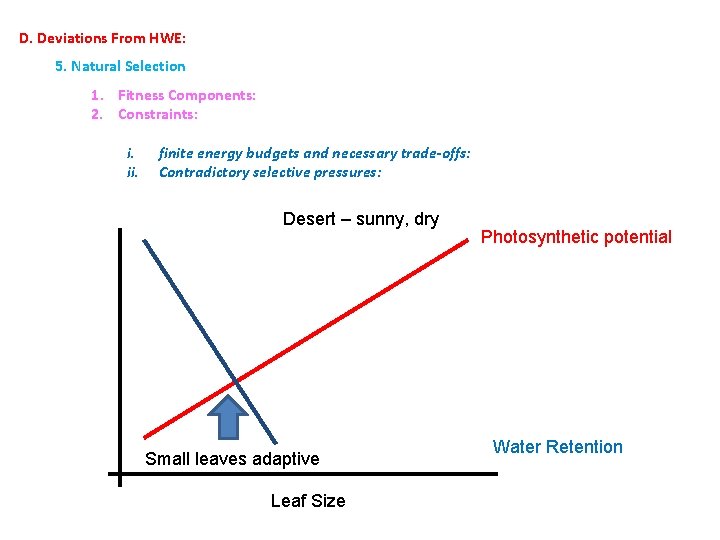
D. Deviations From HWE: 5. Natural Selection 1. Fitness Components: 2. Constraints: i. ii. finite energy budgets and necessary trade-offs: Contradictory selective pressures: Desert – sunny, dry Small leaves adaptive Leaf Size Photosynthetic potential Water Retention
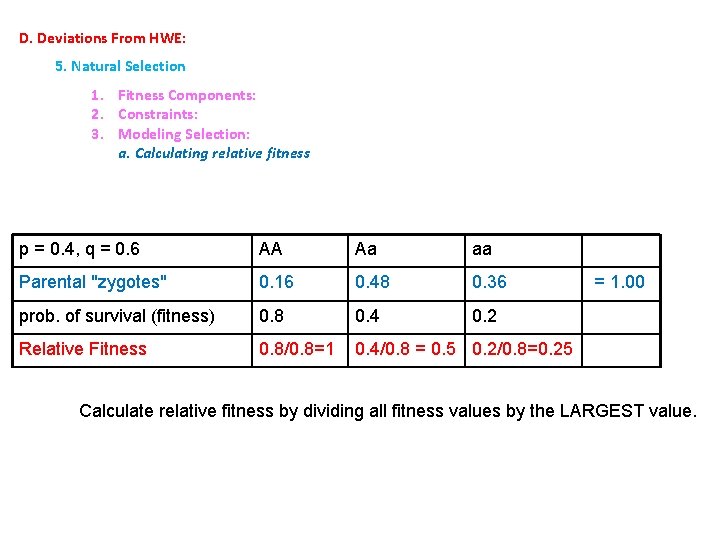
D. Deviations From HWE: 5. Natural Selection 1. Fitness Components: 2. Constraints: 3. Modeling Selection: a. Calculating relative fitness p = 0. 4, q = 0. 6 AA Aa aa Parental "zygotes" 0. 16 0. 48 0. 36 prob. of survival (fitness) 0. 8 0. 4 0. 2 Relative Fitness 0. 8/0. 8=1 0. 4/0. 8 = 0. 5 0. 2/0. 8=0. 25 = 1. 00 Calculate relative fitness by dividing all fitness values by the LARGEST value.
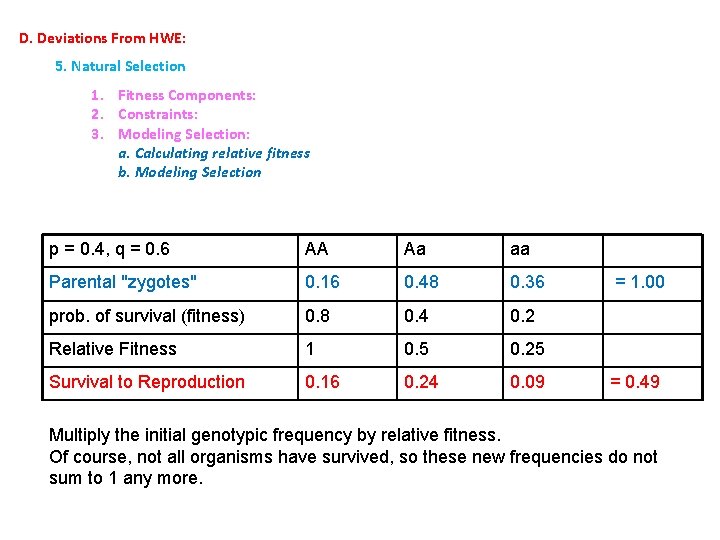
D. Deviations From HWE: 5. Natural Selection 1. Fitness Components: 2. Constraints: 3. Modeling Selection: a. Calculating relative fitness b. Modeling Selection p = 0. 4, q = 0. 6 AA Aa aa Parental "zygotes" 0. 16 0. 48 0. 36 prob. of survival (fitness) 0. 8 0. 4 0. 2 Relative Fitness 1 0. 5 0. 25 Survival to Reproduction 0. 16 0. 24 0. 09 = 1. 00 = 0. 49 Multiply the initial genotypic frequency by relative fitness. Of course, not all organisms have survived, so these new frequencies do not sum to 1 any more.
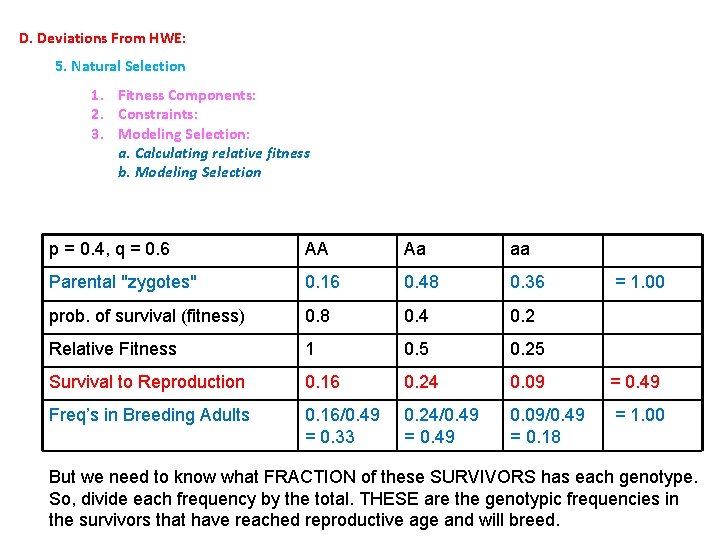
D. Deviations From HWE: 5. Natural Selection 1. Fitness Components: 2. Constraints: 3. Modeling Selection: a. Calculating relative fitness b. Modeling Selection p = 0. 4, q = 0. 6 AA Aa aa Parental "zygotes" 0. 16 0. 48 0. 36 prob. of survival (fitness) 0. 8 0. 4 0. 2 Relative Fitness 1 0. 5 0. 25 Survival to Reproduction 0. 16 0. 24 0. 09 = 0. 49 Freq’s in Breeding Adults 0. 16/0. 49 = 0. 33 0. 24/0. 49 = 0. 49 0. 09/0. 49 = 0. 18 = 1. 00 But we need to know what FRACTION of these SURVIVORS has each genotype. So, divide each frequency by the total. THESE are the genotypic frequencies in the survivors that have reached reproductive age and will breed.
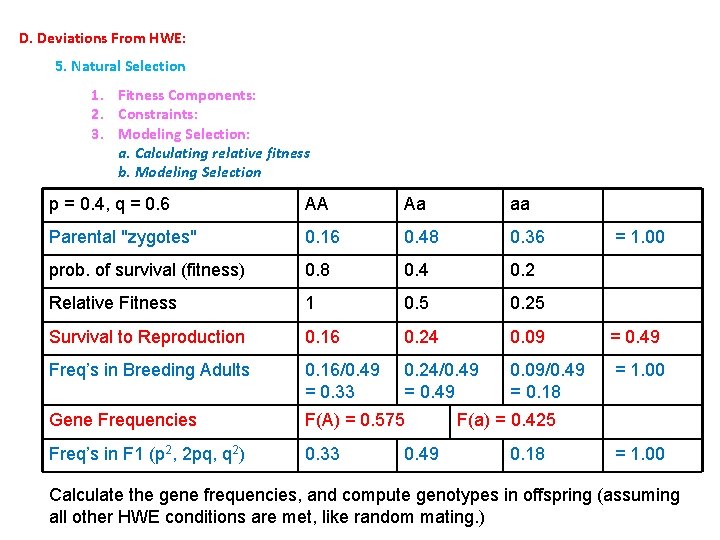
D. Deviations From HWE: 5. Natural Selection 1. Fitness Components: 2. Constraints: 3. Modeling Selection: a. Calculating relative fitness b. Modeling Selection p = 0. 4, q = 0. 6 AA Aa aa Parental "zygotes" 0. 16 0. 48 0. 36 prob. of survival (fitness) 0. 8 0. 4 0. 2 Relative Fitness 1 0. 5 0. 25 Survival to Reproduction 0. 16 0. 24 0. 09 = 0. 49 Freq’s in Breeding Adults 0. 16/0. 49 = 0. 33 0. 24/0. 49 = 0. 49 0. 09/0. 49 = 0. 18 = 1. 00 Gene Frequencies F(A) = 0. 575 Freq’s in F 1 (p 2, 2 pq, q 2) 0. 33 0. 49 = 1. 00 F(a) = 0. 425 0. 18 = 1. 00 Calculate the gene frequencies, and compute genotypes in offspring (assuming all other HWE conditions are met, like random mating. )
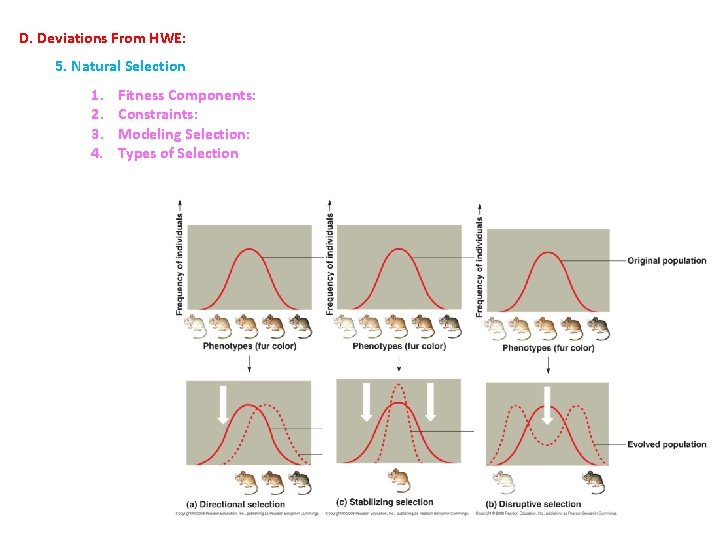
D. Deviations From HWE: 5. Natural Selection 1. Fitness Components: 2. Constraints: 3. Modeling Selection: 4. Types of Selection
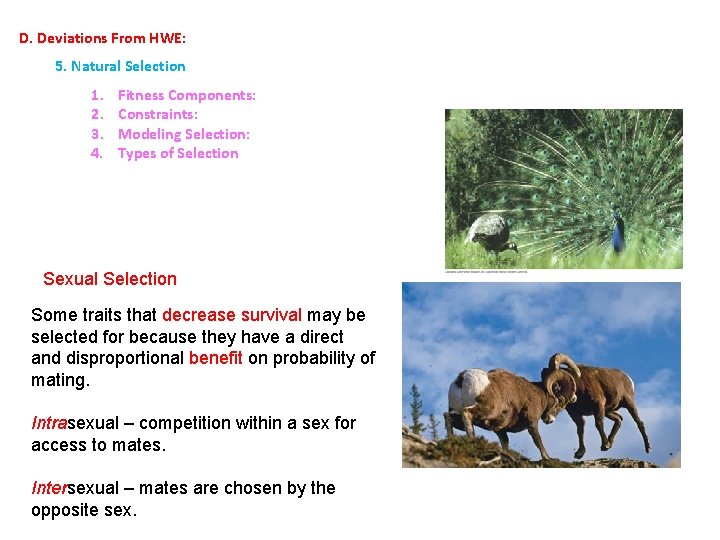
D. Deviations From HWE: 5. Natural Selection 1. Fitness Components: 2. Constraints: 3. Modeling Selection: 4. Types of Selection Sexual Selection Some traits that decrease survival may be selected for because they have a direct and disproportional benefit on probability of mating. Intrasexual – competition within a sex for access to mates. Intersexual – mates are chosen by the opposite sex.

Modern Evolutionary Biology I. Population Genetics A. Overview B. The Genetic Structure of a Population C. The Hardy-Weinberg Equilibrium Model D. Deviations From HWE E. Summary; The Modern Synthetic Theory of Evolution Agents of Change Mutation Natural Selection Recombination - crossing over - independent assortment VARIATION Sources of Variation Genetic Drift Migration Mutation Non-random Mating
- Slides: 17