
POPULATION GENETICS BS Genetics Course Dr Shagufta Naz
POPULATION GENETICS BS Genetics Course Dr. Shagufta Naz Department of Zoology 1
Population genetics: v. Study of change in frequency of allele and genotype within a population. Genetic variation: v. Difference in DNA among individuals. vmultiple sources of genetic variation • mutation • genetic recombination. 2
Genetic variations � Genetic variation can be defined as the genetic makeup of organisms within a population change. � Genes are inherited segments of DNA that containcodes for the production of proteins. � Genes exists in alternate versions, or alleles that determine distinct traits that can be passed on from parents to offspring. � Genetic variation is important to the processes of natural selection and biological evolution. � The environment determines which genetic variations are more favorable or better suited for survival. � As organisms with these environmentally selected genes survive and reproduce, more favorable traits are passed on to the population as a whole. 3
Measurement v. Genetic variation within a population is commonly measured as : v. The percentage of gene loci that are polymorphic or v. The percentage of gene loci in individuals that are heterozygous. 4

Causes of genetic variation Genetic variation occurs mainly through • DNA mutation • Gene flow (movement of genes from one population to another) • Sexual reproduction Due to the fact that environments are unstable, populations that are genetically variable will be able to adapt to changing situations better than those that do not contain genetic variation. 5
Forms v. Genetic variation can be divided into different forms v. Small-scale sequence variation (<1 kilobase, kb) v. Large-scale structural variation (>1 kb) can be either copy number variation (loss or gain), or chromosomal rearrangement (translocation, inversion, ). 6
Why Allele frequency changes? Five evolutionary forces can significantly alter the allele frequencies of a population which are given below: 1. Mutation 2. 2. Migration 3. Genetic drift 4. Non random mating 5. Selection 7
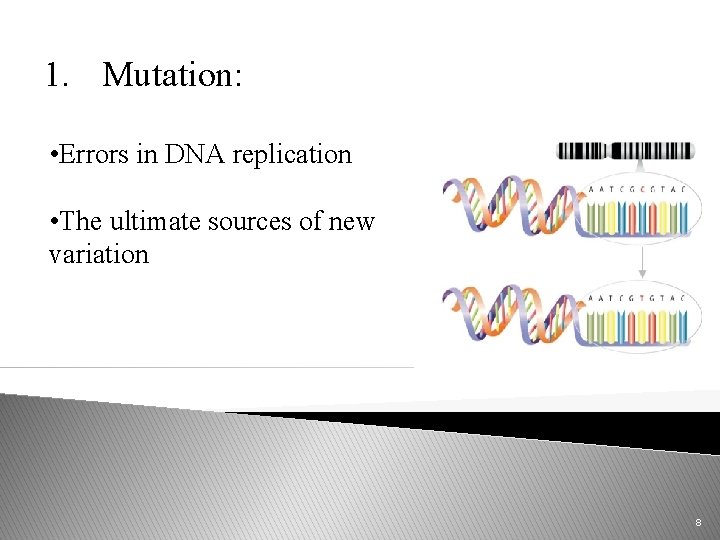
1. Mutation: • Errors in DNA replication • The ultimate sources of new variation 8
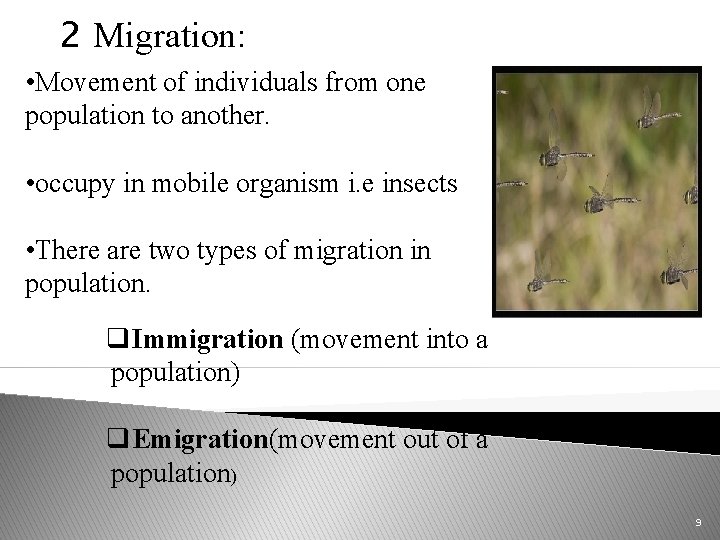
2 Migration: • Movement of individuals from one population to another. • occupy in mobile organism i. e insects • There are two types of migration in population. q. Immigration (movement into a population) q. Emigration(movement out of a population) 9
3. Genetic drift: • Random loss of alleles • More likely to occur in smaller population • Founder effect (when population is intially small) • Bottleneck effect (population drastically reduced to small) 10
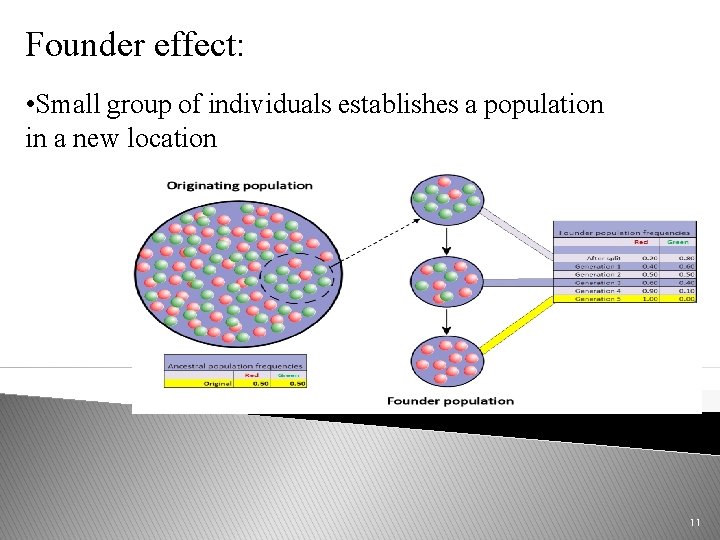
Founder effect: • Small group of individuals establishes a population in a new location 11
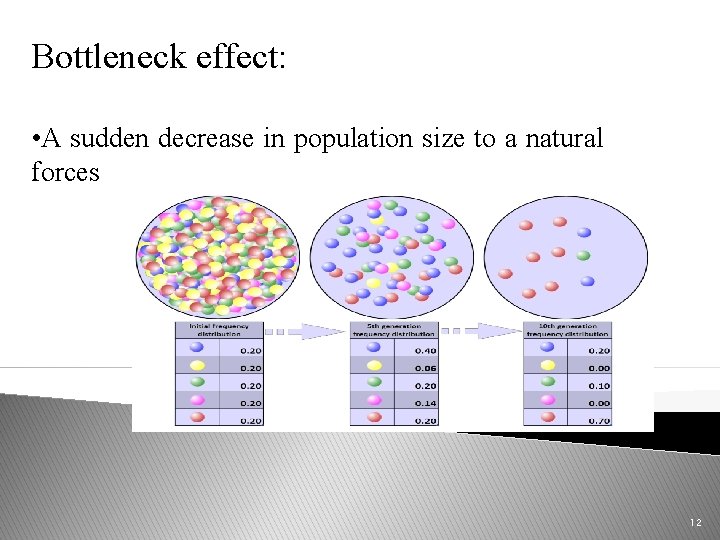
Bottleneck effect: • A sudden decrease in population size to a natural forces 12

4. Non random mating: • Mating that occurs more or less frequently than expected by chance • Inbreeding: qmating with relatives qincrease homozygosity • Out breeding: qmating with non- relatives qincrease heterozygosity 13

5. Selection: • Some individuals leave behind more offspring than others. • Artificial selection q. Breeder select for desired characteristics • Natural selection q. Environment selects for adapted characteristics 14
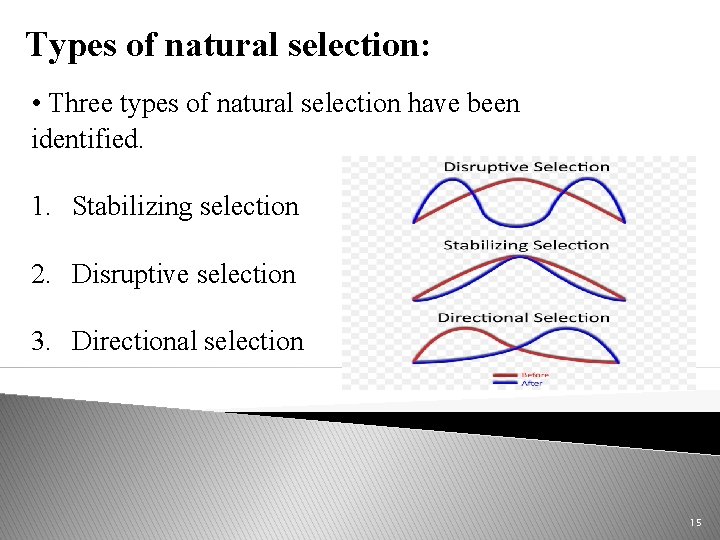
Types of natural selection: • Three types of natural selection have been identified. 1. Stabilizing selection 2. Disruptive selection 3. Directional selection 15
1. Stabilizing selection: • Genetic diversity decreases as the population stabilizes on a particular trait value. • Example: • Birth weight of human body 16
2. Disruptive selection: In Disruptive selection, describe change in population genetics in which extreme vaue for trait are favour overintermediate values. 17
3. Directional selection: • Directional selection is a mode of natural selection in which a single phenotype is favoured , causing the allele frequencies continuously shift in one direction. • Example: • industrial melanism 18
Types of variation: 1. Phenotypic variation 2. Genetic variation 19
1. Phenotypic variation: v. It’s a genetical basis morphological variation it’s sometime continuous sometime discontinuous. 2. Genetic variation: v. The variation i. e due to variation among individuals in the allele that they have, excludes environmentallycaused variation. 20
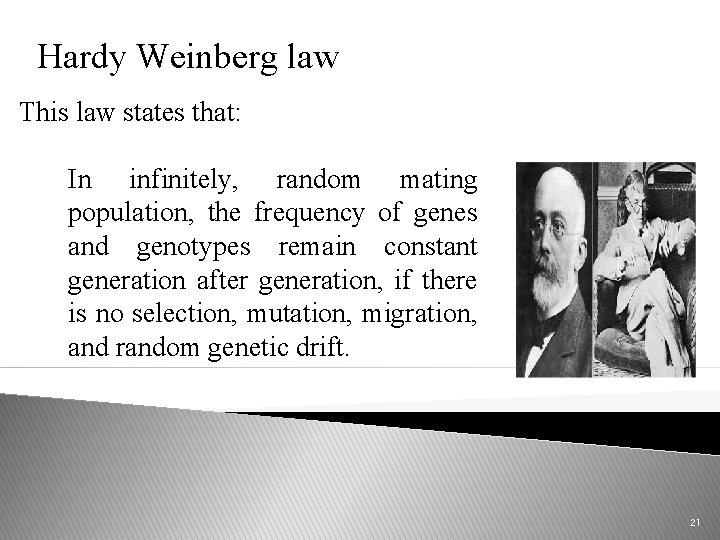
Hardy Weinberg law This law states that: In infinitely, random mating population, the frequency of genes and genotypes remain constant generation after generation, if there is no selection, mutation, migration, and random genetic drift. 21
The Hardy-Weinberg is a principle stating that the genetic variation in a population will remain constant from one generation to the next in the absence of disturbing factors. When mating is random in a large population with no disruptive circumstances, the law predicts that both genotype and allele frequencies will remain constant because they are in equilibrium. The Hardy-Weinberg equilibrium can be disturbed by a number of forces, including mutations, natural selection, nonrandom mating, genetic drift, and gene flow. For instance, mutations disrupt the equilibrium of allele frequencies by introducing new alleles into a population. 22
When a population meets all the Hardy-Weinberg conditions, it is said to be in Hardy-Weinberg equilibrium (HWE). Human populations do not meet all the conditions of HWE exactly, and their allele frequencies will change from one generation to the next, so the population evolves. How far a population deviates from HWE can be measured using the “goodness-of-fit” or chi-squared test (χ2) 23
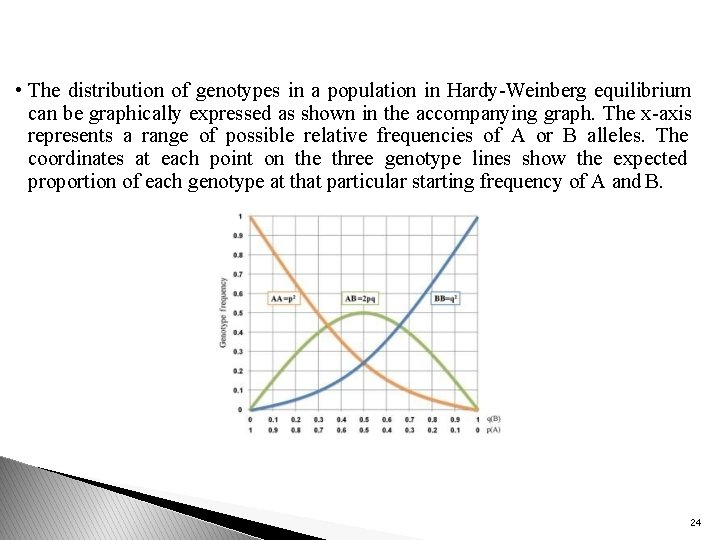
• The distribution of genotypes in a population in Hardy-Weinberg equilibrium can be graphically expressed as shown in the accompanying graph. The x-axis represents a range of possible relative frequencies of A or B alleles. The coordinates at each point on the three genotype lines show the expected proportion of each genotype at that particular starting frequency of A and B. 24
• Consider a single biallelic locus with two alleles A and B with known frequencies (allele A = 0. 6; allele B = 0. 4) that add up to 1. • Possible genotypes: AA, AB and BB • Assume that alleles A and B enter eggs and sperm in proportion to their frequency in the population (i. e. , 0. 6 and 0. 4) • Assume that the sperm and eggs meet at random (one large gene pool). 25
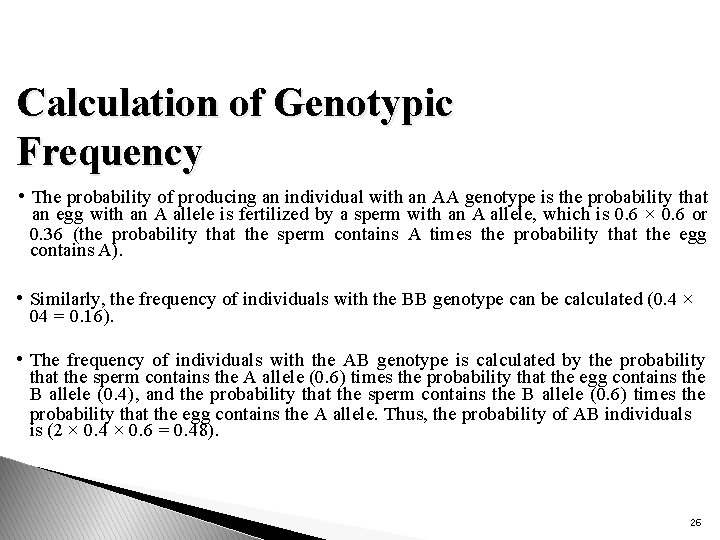
Calculation of Genotypic Frequency • The probability of producing an individual with an AA genotype is the probability that an egg with an A allele is fertilized by a sperm with an A allele, which is 0. 6 × 0. 6 or 0. 36 (the probability that the sperm contains A times the probability that the egg contains A). • Similarly, the frequency of individuals with the BB genotype can be calculated (0. 4 × 04 = 0. 16). • The frequency of individuals with the AB genotype is calculated by the probability that the sperm contains the A allele (0. 6) times the probability that the egg contains the B allele (0. 4), and the probability that the sperm contains the B allele (0. 6) times the probability that the egg contains the A allele. Thus, the probability of AB individuals is (2 × 0. 4 × 0. 6 = 0. 48). 26
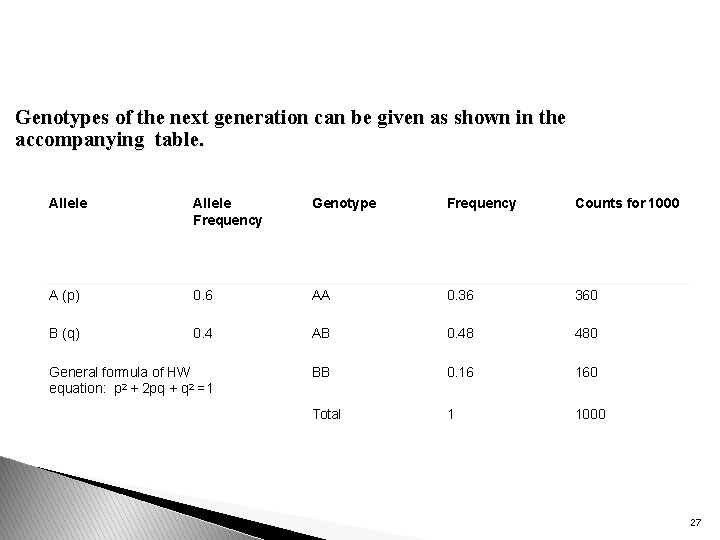
Genotypes of the next generation can be given as shown in the accompanying table. Allele Frequency Genotype Frequency Counts for 1000 A (p) 0. 6 AA 0. 36 360 B (q) 0. 4 AB 0. 48 480 General formula of HW equation: p 2 + 2 pq + q 2 = 1 BB 0. 16 160 Total 1 1000 27
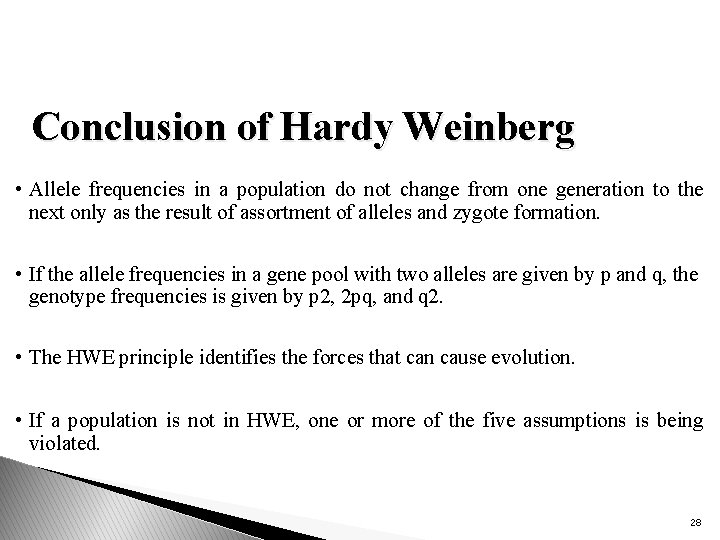
Conclusion of Hardy Weinberg • Allele frequencies in a population do not change from one generation to the next only as the result of assortment of alleles and zygote formation. • If the allele frequencies in a gene pool with two alleles are given by p and q, the genotype frequencies is given by p 2, 2 pq, and q 2. • The HWE principle identifies the forces that can cause evolution. • If a population is not in HWE, one or more of the five assumptions is being violated. 28
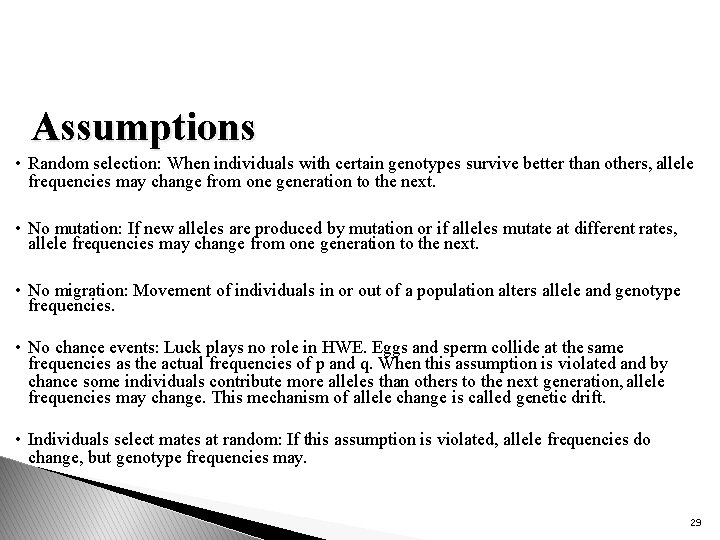
Assumptions • Random selection: When individuals with certain genotypes survive better than others, allele frequencies may change from one generation to the next. • No mutation: If new alleles are produced by mutation or if alleles mutate at different rates, allele frequencies may change from one generation to the next. • No migration: Movement of individuals in or out of a population alters allele and genotype frequencies. • No chance events: Luck plays no role in HWE. Eggs and sperm collide at the same frequencies as the actual frequencies of p and q. When this assumption is violated and by chance some individuals contribute more alleles than others to the next generation, allele frequencies may change. This mechanism of allele change is called genetic drift. • Individuals select mates at random: If this assumption is violated, allele frequencies do change, but genotype frequencies may. 29
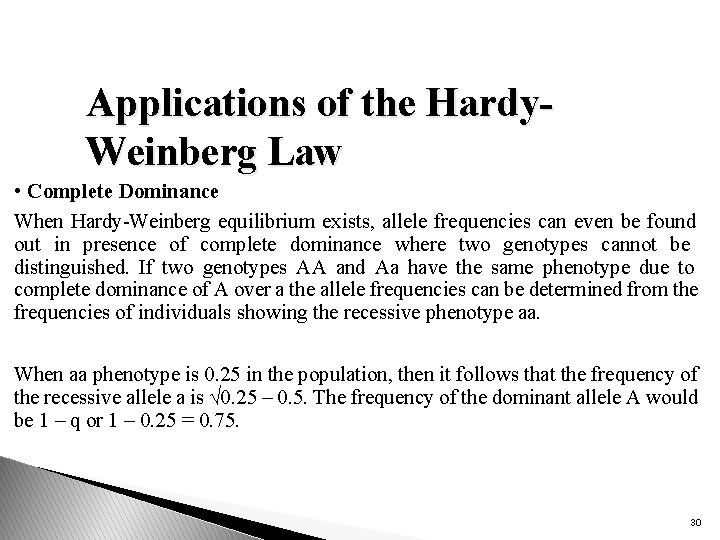
Applications of the Hardy. Weinberg Law • Complete Dominance When Hardy-Weinberg equilibrium exists, allele frequencies can even be found out in presence of complete dominance where two genotypes cannot be distinguished. If two genotypes AA and Aa have the same phenotype due to complete dominance of A over a the allele frequencies can be determined from the frequencies of individuals showing the recessive phenotype aa. When aa phenotype is 0. 25 in the population, then it follows that the frequency of the recessive allele a is √ 0. 25 – 0. 5. The frequency of the dominant allele A would be 1 – q or 1 – 0. 25 = 0. 75. 30
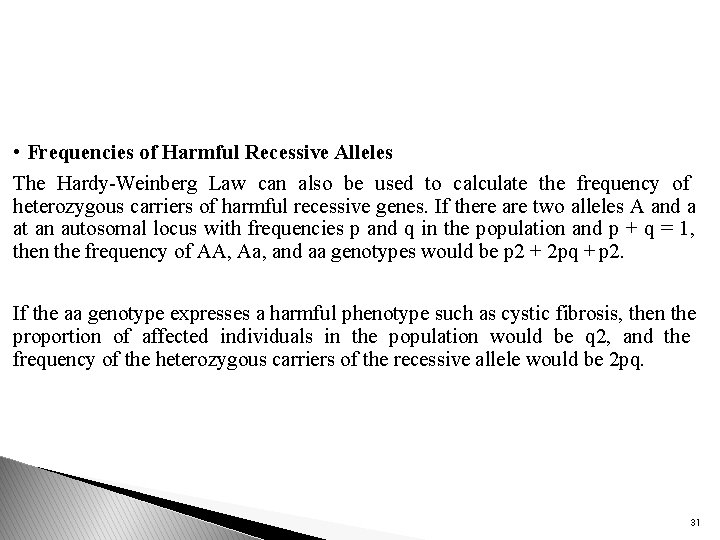
• Frequencies of Harmful Recessive Alleles The Hardy-Weinberg Law can also be used to calculate the frequency of heterozygous carriers of harmful recessive genes. If there are two alleles A and a at an autosomal locus with frequencies p and q in the population and p + q = 1, then the frequency of AA, Aa, and aa genotypes would be p 2 + 2 pq + p 2. If the aa genotype expresses a harmful phenotype such as cystic fibrosis, then the proportion of affected individuals in the population would be q 2, and the frequency of the heterozygous carriers of the recessive allele would be 2 pq. 31
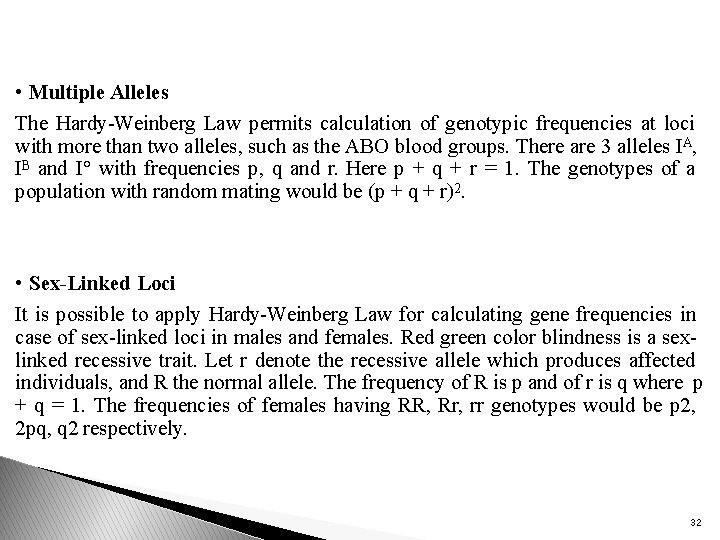
• Multiple Alleles The Hardy-Weinberg Law permits calculation of genotypic frequencies at loci with more than two alleles, such as the ABO blood groups. There are 3 alleles IA, IB and I° with frequencies p, q and r. Here p + q + r = 1. The genotypes of a population with random mating would be (p + q + r)2. • Sex-Linked Loci It is possible to apply Hardy-Weinberg Law for calculating gene frequencies in case of sex-linked loci in males and females. Red green color blindness is a sexlinked recessive trait. Let r denote the recessive allele which produces affected individuals, and R the normal allele. The frequency of R is p and of r is q where p + q = 1. The frequencies of females having RR, Rr, rr genotypes would be p 2, 2 pq, q 2 respectively. 32
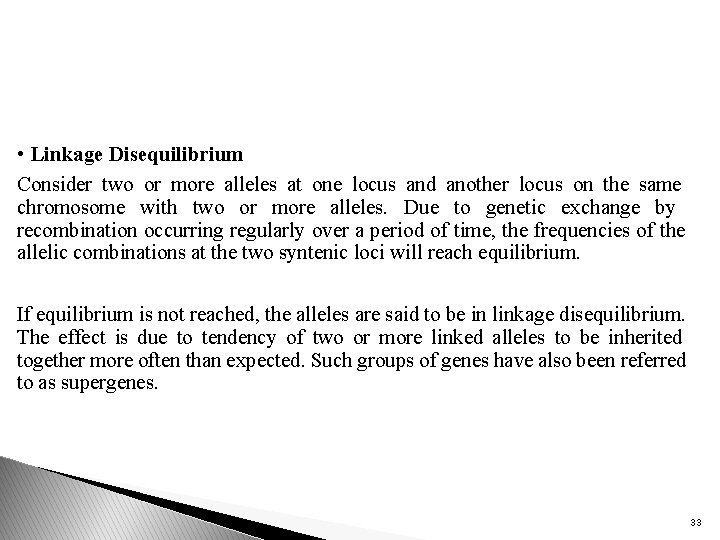
• Linkage Disequilibrium Consider two or more alleles at one locus and another locus on the same chromosome with two or more alleles. Due to genetic exchange by recombination occurring regularly over a period of time, the frequencies of the allelic combinations at the two syntenic loci will reach equilibrium. If equilibrium is not reached, the alleles are said to be in linkage disequilibrium. The effect is due to tendency of two or more linked alleles to be inherited together more often than expected. Such groups of genes have also been referred to as supergenes. 33

s k n a h T 34
- Slides: 34