
Population genetics and evolution What is evolution Population
- Slides: 55
Population genetics and evolution • What is evolution?
Population genetics and evolution • What is evolution? – Descent with modification
Population genetics and evolution • What is evolution? – Descent with modification – A change in the characteristics of a population over time
Population genetics and evolution • What is evolution? – Descent with modification – A change in the characteristics of a population over time – A change in the genetic composition of a population over time (the frequency of genes)
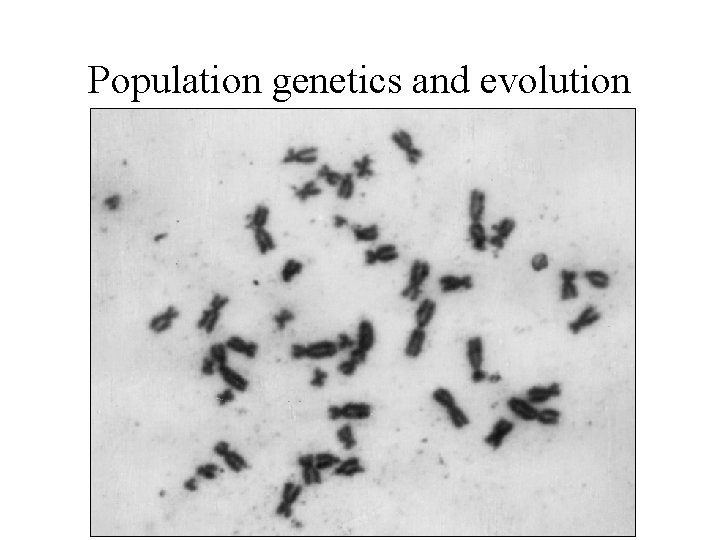
Population genetics and evolution • Some genetics terminology – Chromosomes…
Population genetics and evolution human karyotype fig here
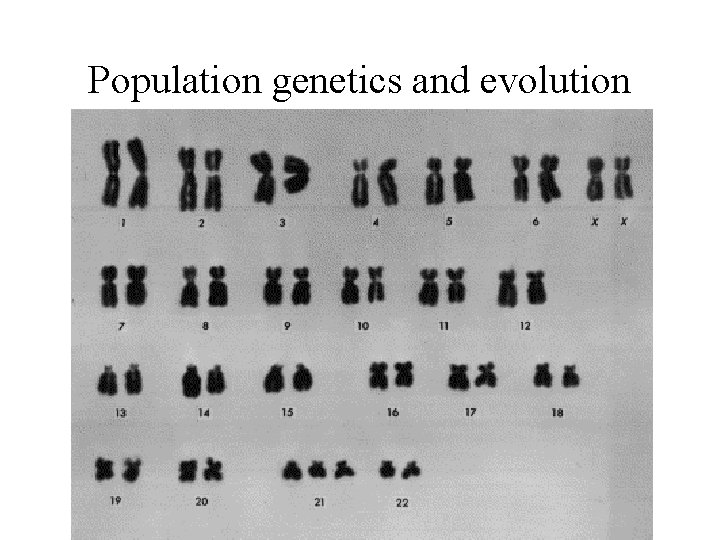
Population genetics and evolution • Some genetics terminology – Chromosomes… – Homologous chromosomes…
Population genetics and evolution human karyotype fig here
Population genetics and evolution • Some genetics terminology – Chromosomes… – Homologous chromosomes… – Locus…
Population genetics and evolution • Some genetics terminology – Chromosomes… – Homologous chromosomes… – Locus… – Alleles…
Population genetics and evolution • Alleles… • • • Hemoglobin has two A chains and two B chains The B chains have several forms… fetal adult normal adult “sickle” These are a result of “alleles” - different forms of the same gene at the same locus
Population genetics and evolution • Some genetics terminology – Alleles may be dominant and recessive
Population genetics and evolution • Some genetics terminology – Alleles may be dominant and recessive – In Biston betularia, the gene for melanism is dominant (M)
Population genetics and evolution • Some genetics terminology – Alleles may be dominant and recessive – In Biston betularia, the gene for melanism is dominant (M) – The gene for typical color is recessive (m)
Population genetics and evolution • Some genetics terminology – Alleles may be dominant and recessive – In Biston betularia, the gene for melanism is dominant (M) – The gene for typical color is recessive (m) – Each individual moth has two alleles: – MM and Mm are melanic, mm are typical
Population genetics and evolution • Gene frequencies – The frequency of all of the alleles at a particular locus in a population = 100% or 1. 0
Population genetics and evolution • Gene frequencies – The frequency of all of the alleles at a particular locus in a population = 100% or 1. 0 – If there are two alleles, the frequency of one = p and the frequency of the other = q
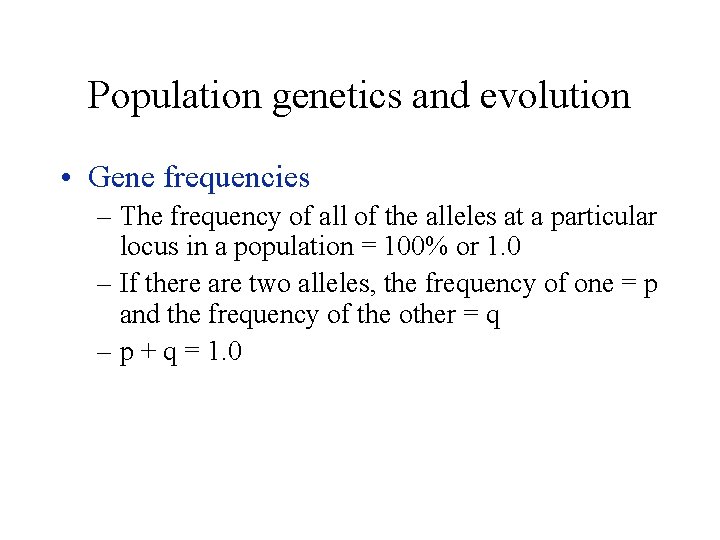
Population genetics and evolution • Gene frequencies – The frequency of all of the alleles at a particular locus in a population = 100% or 1. 0 – If there are two alleles, the frequency of one = p and the frequency of the other = q – p + q = 1. 0
Population genetics and evolution • Gene frequencies – The frequency of all of the alleles at a particular locus in a population = 100% or 1. 0 – If there are two alleles, the frequency of one = p and the frequency of the other = q – p + q = 1. 0 – Each individual has two alleles, one from each parent – With sexual reproduction, p + q alleles in the eggs are combined with p + q alleles in the sperm
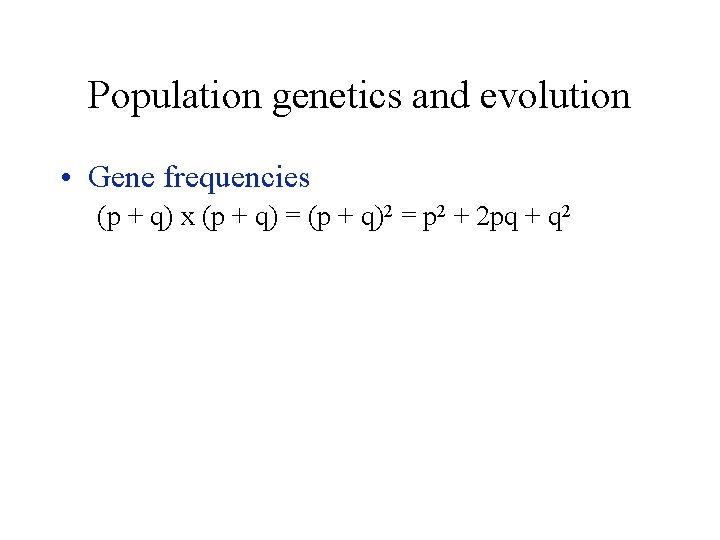
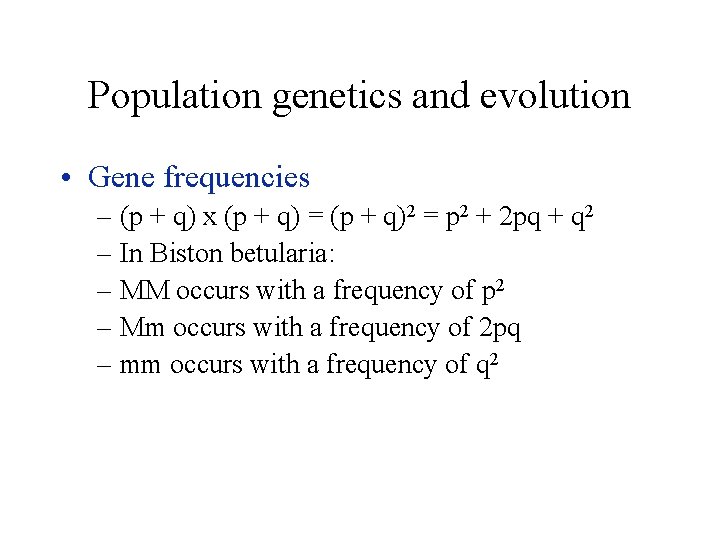
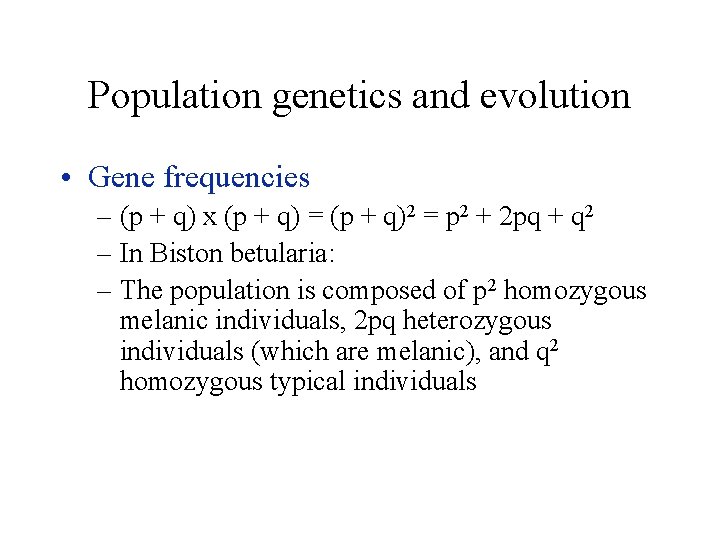
Population genetics and evolution • Gene frequencies (p + q) x (p + q) = (p + q)2 = p 2 + 2 pq + q 2
Population genetics and evolution • Gene frequencies – (p + q) x (p + q) = (p + q)2 = p 2 + 2 pq + q 2 – In Biston betularia: – MM occurs with a frequency of p 2 – Mm occurs with a frequency of 2 pq – mm occurs with a frequency of q 2
Population genetics and evolution • Gene frequencies – (p + q) x (p + q) = (p + q)2 = p 2 + 2 pq + q 2 – In Biston betularia: – The population is composed of p 2 homozygous melanic individuals, 2 pq heterozygous individuals (which are melanic), and q 2 homozygous typical individuals
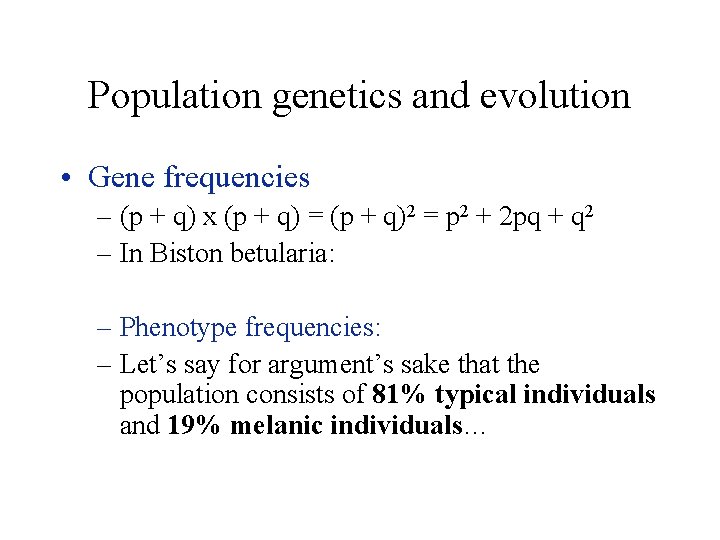
Population genetics and evolution • Gene frequencies – (p + q) x (p + q) = (p + q)2 = p 2 + 2 pq + q 2 – In Biston betularia: – Phenotype frequencies: – Let’s say for argument’s sake that the population consists of 81% typical individuals and 19% melanic individuals…
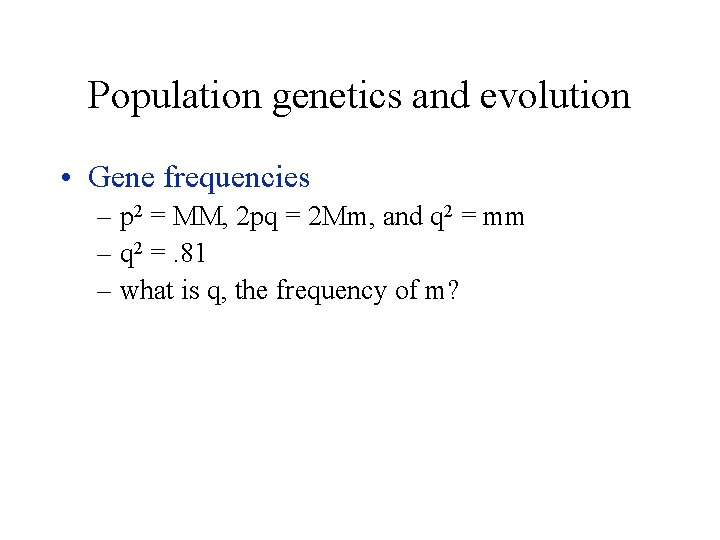
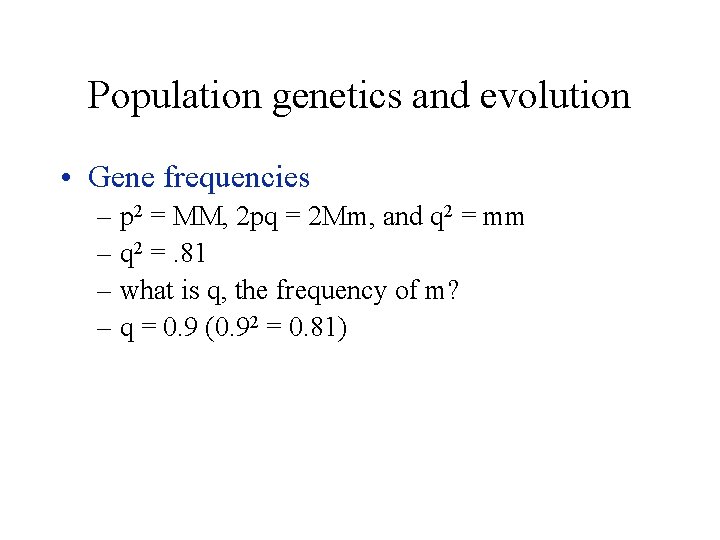
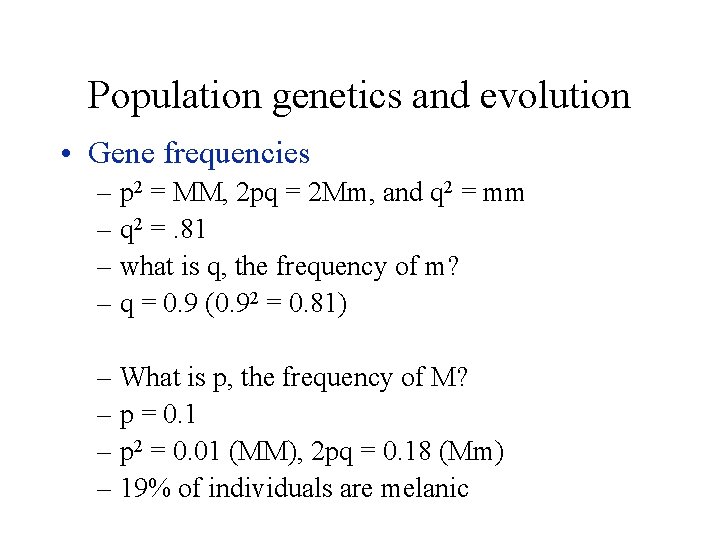
Population genetics and evolution • Gene frequencies – p 2 = MM, 2 pq = 2 Mm, and q 2 = mm – q 2 =. 81 – what is q, the frequency of m?
Population genetics and evolution • Gene frequencies – p 2 = MM, 2 pq = 2 Mm, and q 2 = mm – q 2 =. 81 – what is q, the frequency of m? – q = 0. 9 (0. 92 = 0. 81)
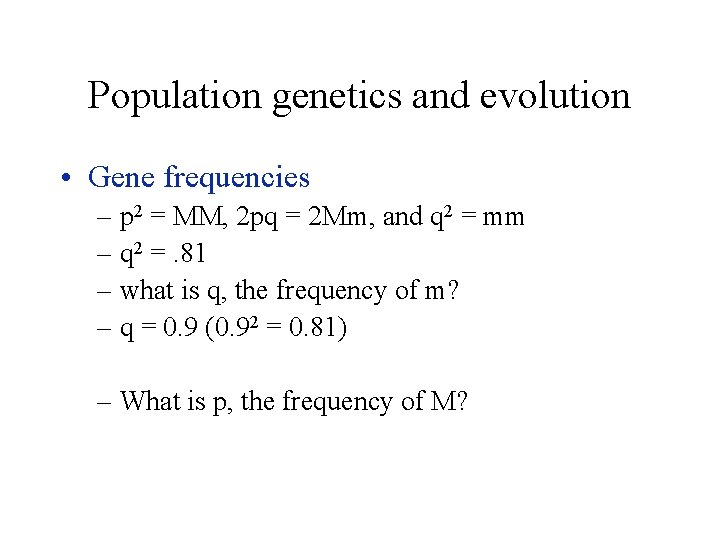
Population genetics and evolution • Gene frequencies – p 2 = MM, 2 pq = 2 Mm, and q 2 = mm – q 2 =. 81 – what is q, the frequency of m? – q = 0. 9 (0. 92 = 0. 81) – What is p, the frequency of M?
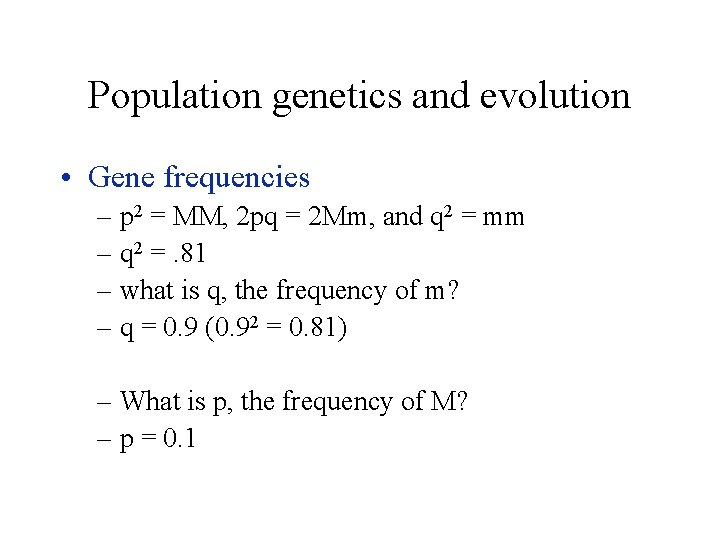
Population genetics and evolution • Gene frequencies – p 2 = MM, 2 pq = 2 Mm, and q 2 = mm – q 2 =. 81 – what is q, the frequency of m? – q = 0. 9 (0. 92 = 0. 81) – What is p, the frequency of M? – p = 0. 1
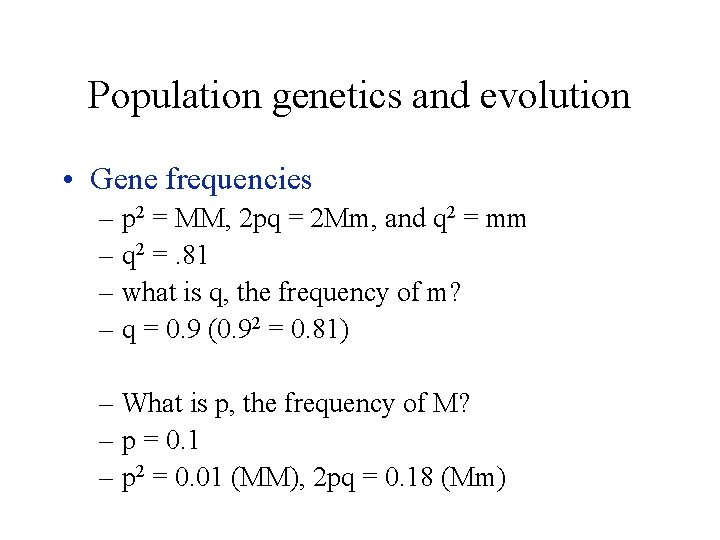
Population genetics and evolution • Gene frequencies – p 2 = MM, 2 pq = 2 Mm, and q 2 = mm – q 2 =. 81 – what is q, the frequency of m? – q = 0. 9 (0. 92 = 0. 81) – What is p, the frequency of M? – p = 0. 1 – p 2 = 0. 01 (MM), 2 pq = 0. 18 (Mm)
Population genetics and evolution • Gene frequencies – p 2 = MM, 2 pq = 2 Mm, and q 2 = mm – q 2 =. 81 – what is q, the frequency of m? – q = 0. 9 (0. 92 = 0. 81) – What is p, the frequency of M? – p = 0. 1 – p 2 = 0. 01 (MM), 2 pq = 0. 18 (Mm) – 19% of individuals are melanic
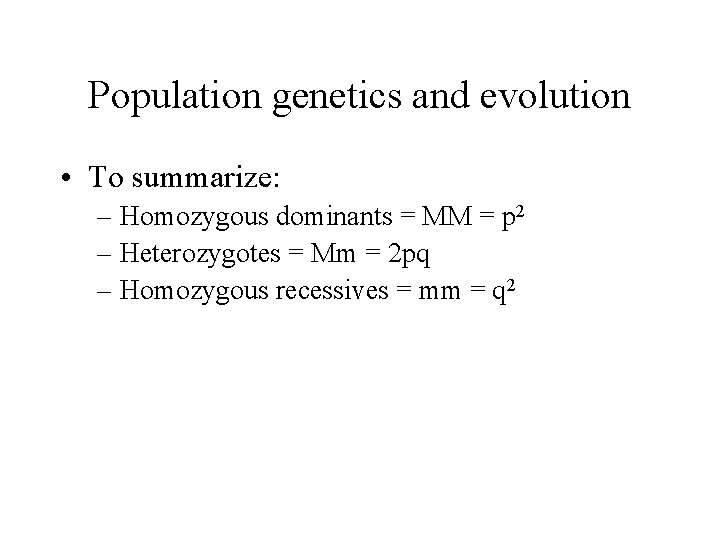
Population genetics and evolution • To summarize: – Homozygous dominants = MM = p 2 – Heterozygotes = Mm = 2 pq – Homozygous recessives = mm = q 2
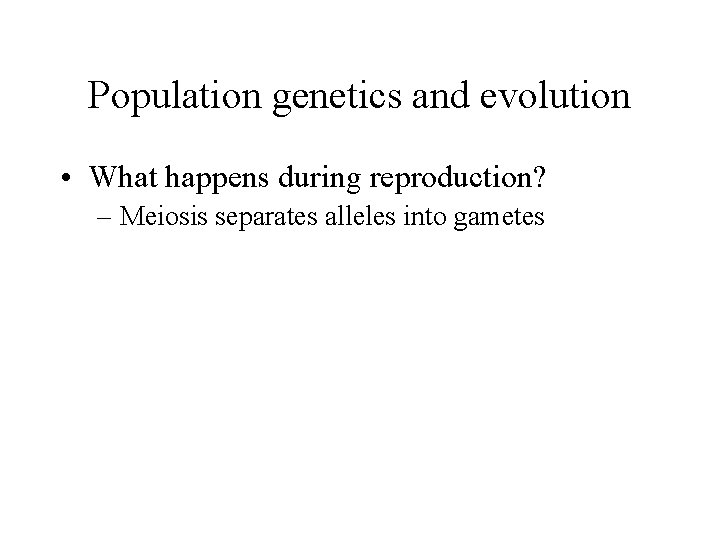
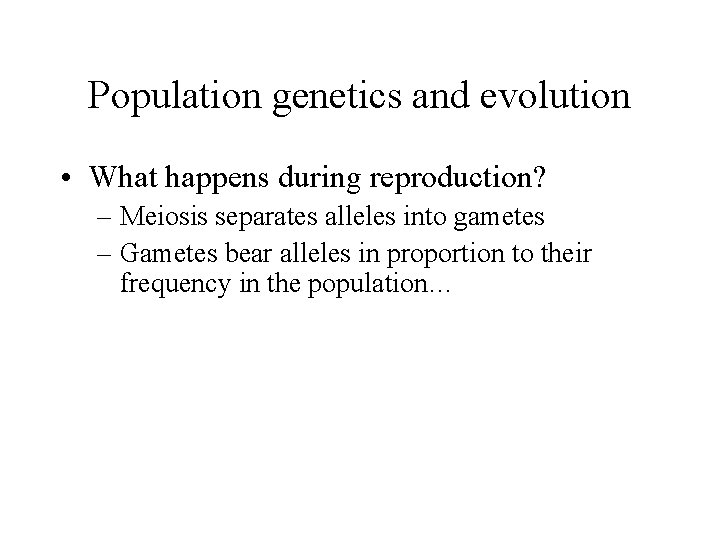
Population genetics and evolution • What happens during reproduction? – Meiosis separates alleles into gametes
Population genetics and evolution • What happens during reproduction? – Meiosis separates alleles into gametes – Gametes bear alleles in proportion to their frequency in the population…
Population genetics and evolution • What happens during reproduction? – Meiosis separates alleles into gametes – Gametes bear alleles in proportion to their frequency in the population… – there are p sperm with M and q sperm with m
Population genetics and evolution • What happens during reproduction? – Meiosis separates alleles into gametes – Gametes bear alleles in proportion to their frequency in the population… – there are p sperm with M and q sperm with m – there are p eggs with M and q eggs with m
Population genetics and evolution • What happens during reproduction? – Meiosis separates alleles into gametes – Gametes bear alleles in proportion to their frequency in the population… – there are p sperm with M and q sperm with m – there are p eggs with M and q eggs with m – Eggs and sperm combine to form zygotes…
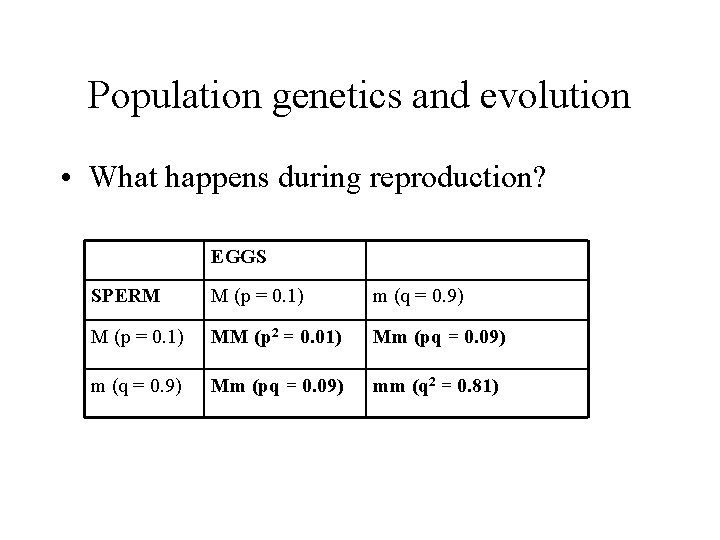
Population genetics and evolution • What happens during reproduction? EGGS SPERM M (p = 0. 1) m (q = 0. 9) M (p = 0. 1) MM (p 2 = 0. 01) Mm (pq = 0. 09) m (q = 0. 9) Mm (pq = 0. 09) mm (q 2 = 0. 81)
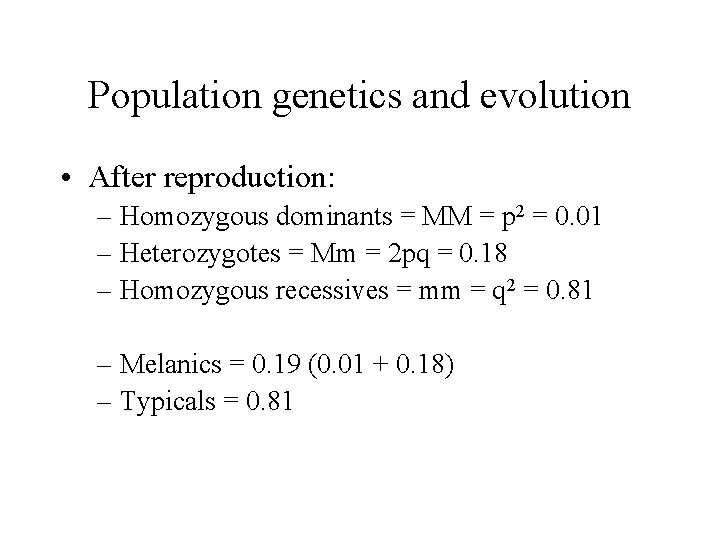
Population genetics and evolution • After reproduction: – Homozygous dominants = MM = p 2 = 0. 01 – Heterozygotes = Mm = 2 pq = 0. 18 – Homozygous recessives = mm = q 2 = 0. 81 – Melanics = 0. 19 (0. 01 + 0. 18) – Typicals = 0. 81
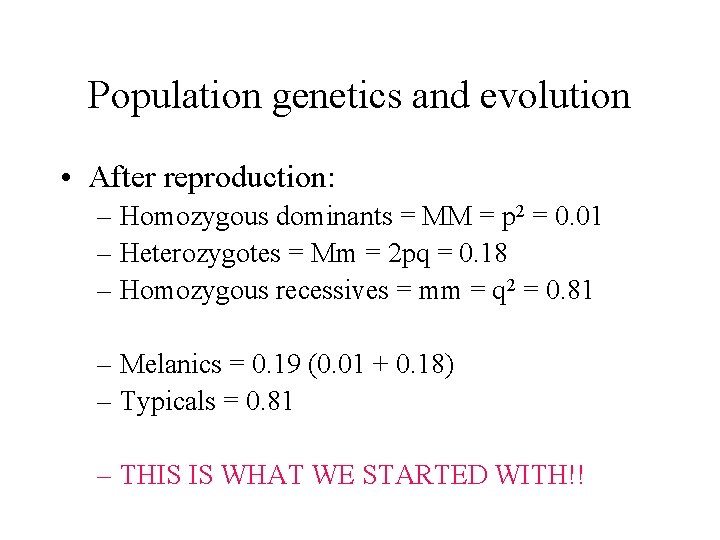
Population genetics and evolution • After reproduction: – Homozygous dominants = MM = p 2 = 0. 01 – Heterozygotes = Mm = 2 pq = 0. 18 – Homozygous recessives = mm = q 2 = 0. 81 – Melanics = 0. 19 (0. 01 + 0. 18) – Typicals = 0. 81 – THIS IS WHAT WE STARTED WITH!!
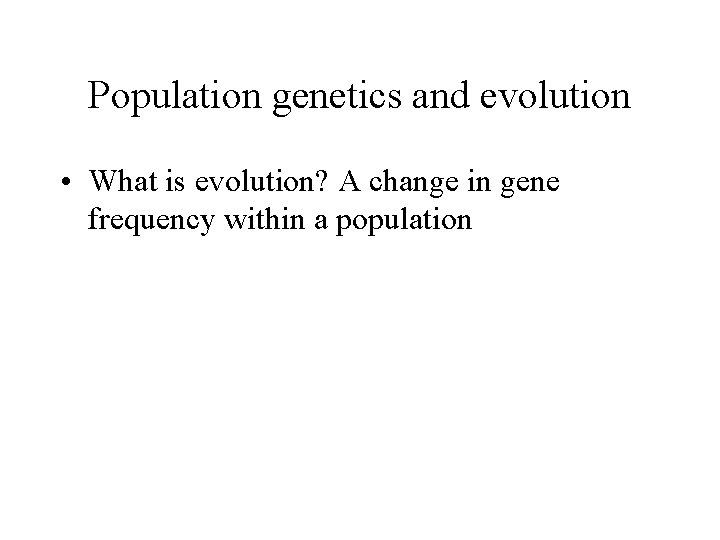
Population genetics and evolution • What is evolution? A change in gene frequency within a population
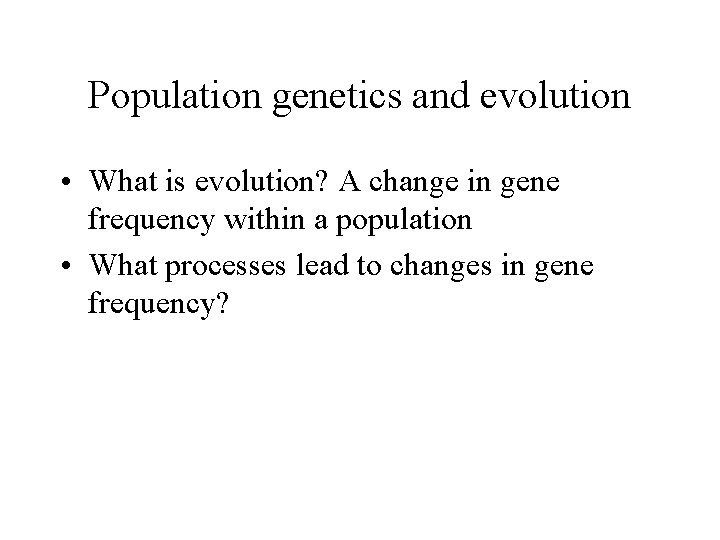
Population genetics and evolution • What is evolution? A change in gene frequency within a population • What processes lead to changes in gene frequency?
Population genetics and evolution • processes that lead to changes in gene frequency:
Population genetics and evolution • processes that lead to changes in gene frequency: – Mutation (the ultimate source of all genetic variation)
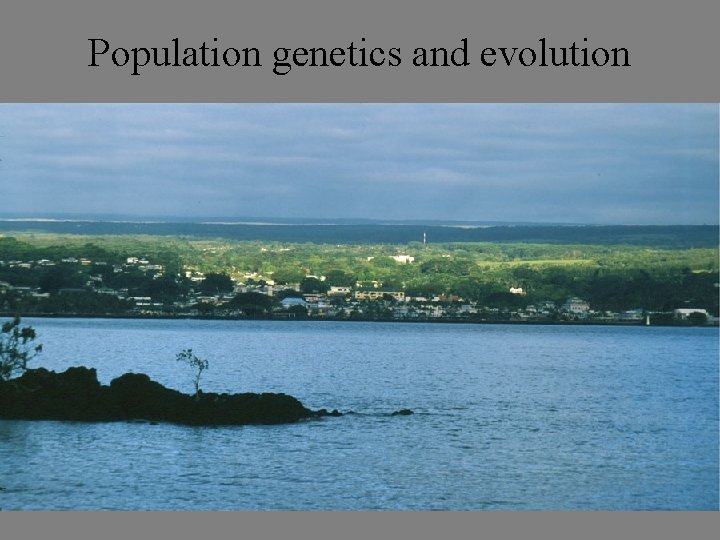
Population genetics and evolution • processes that lead to changes in gene frequency: – Mutation – Gene flow (usually accomplished by migration of individuals from one population to another)
Population genetics and evolution
Population genetics and evolution • processes that lead to changes in gene frequency: – Mutation – Gene flow – Non-random mating
Population genetics and evolution • processes that lead to changes in gene frequency: – Mutation – Gene flow – Non-random mating – Selection (the most powerful agent of evolutionary change)
Population genetics and evolution • processes that lead to changes in gene frequency: – Mutation – Gene flow – Non-random mating – Selection – Genetic drift (changes in gene frequency in small populations due to random sampling error)
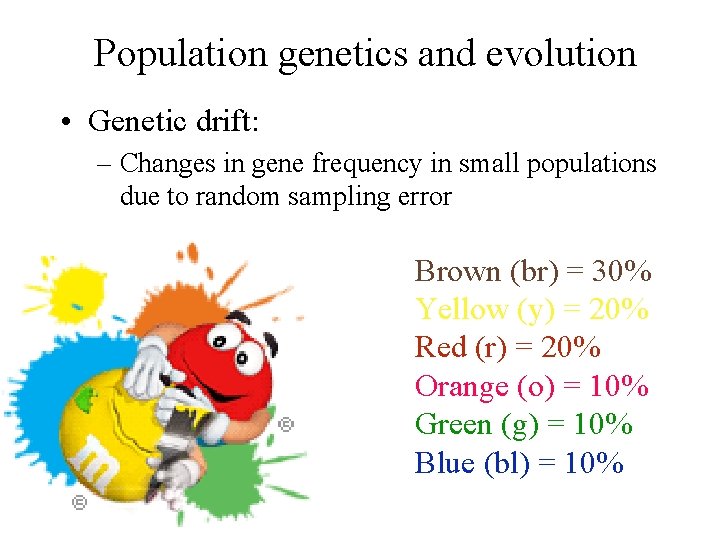
Population genetics and evolution • Genetic drift: – Changes in gene frequency in small populations due to random sampling error Brown (br) = 30% Yellow (y) = 20% Red (r) = 20% Orange (o) = 10% Green (g) = 10% Blue (bl) = 10%
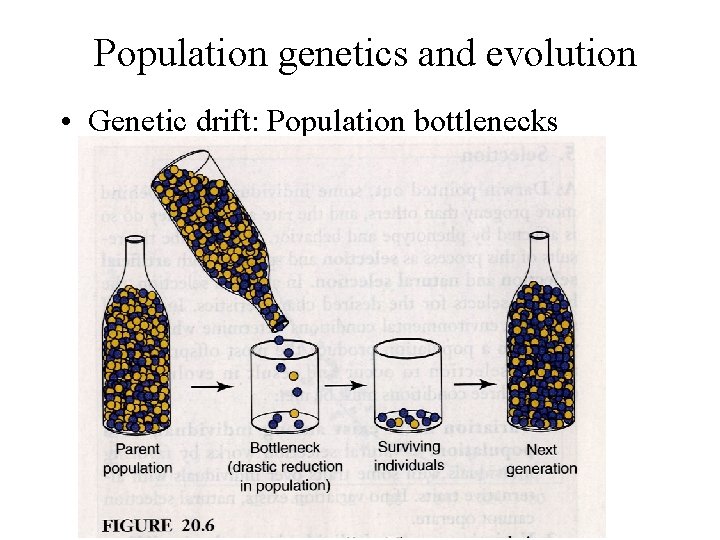
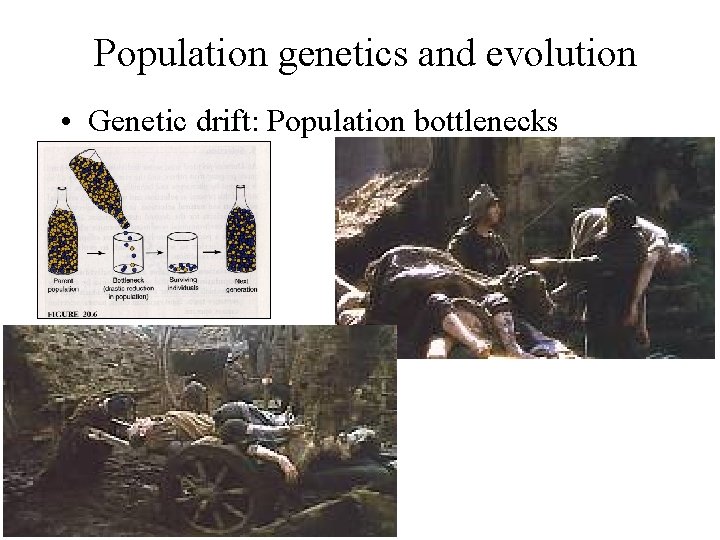
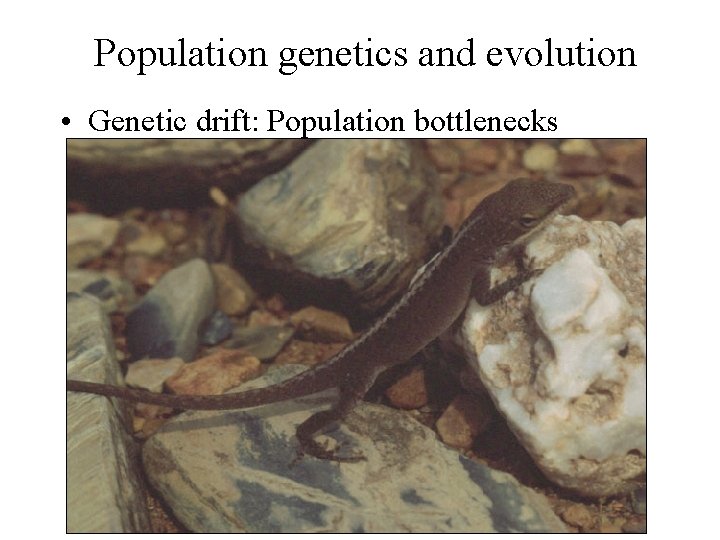
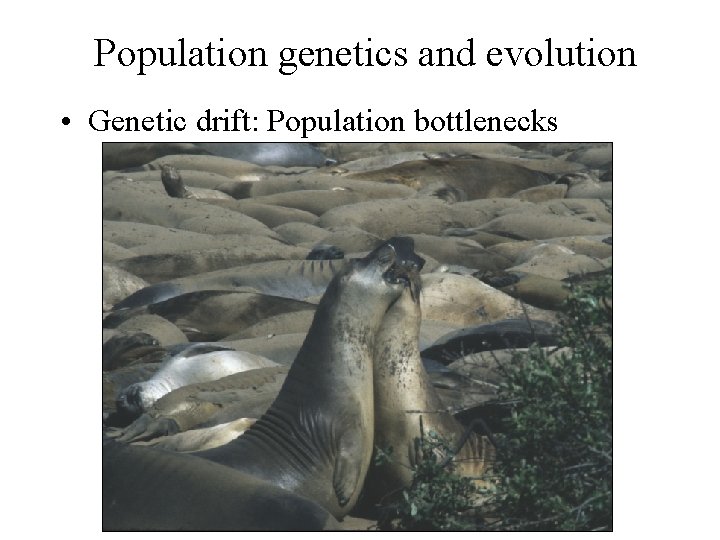
Population genetics and evolution • Genetic drift: – Population bottlenecks - reduction of population size results in loss of genetic variation and potentially in the loss of alleles from the population – Reduction of population size must be catastrophic and non-selective
Population genetics and evolution • Genetic drift: Population bottlenecks
Population genetics and evolution • Genetic drift: Population bottlenecks
Population genetics and evolution • Genetic drift: Population bottlenecks
Population genetics and evolution • Genetic drift: Population bottlenecks
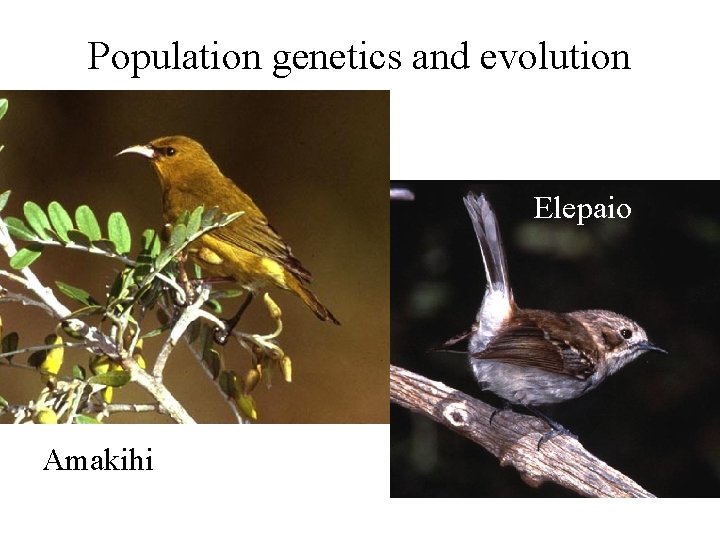
Population genetics and evolution • Genetic drift: – The Founder Effect - a small population disperses from a larger population, and founds a new population in another geographic location. The gene frequencies in the founding population are not representative of the larger population. – Especially important in speciation on archipelagoes
Population genetics and evolution Elepaio Amakihi