
Population Genetics and Evolution Mr Nichols PHHS Cartoons


- Slides: 47
Population Genetics and Evolution Mr. Nichols PHHS
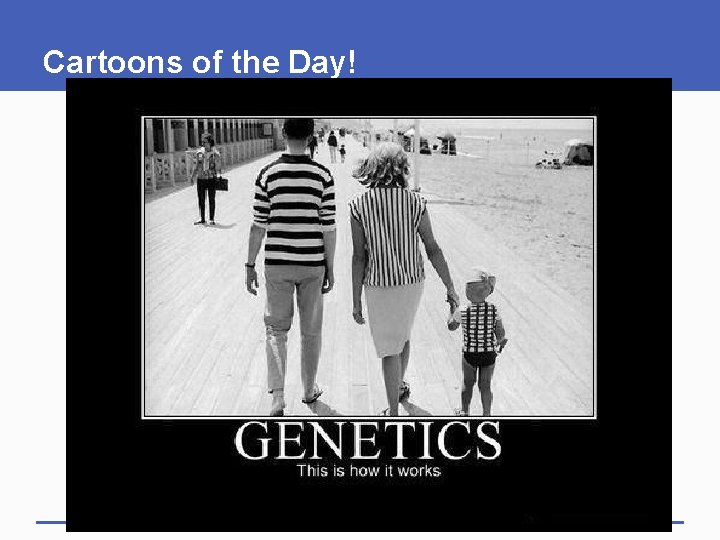
Cartoons of the Day!
Cartoons of the Day!
Cartoons of the Day!
The Population as a Genetic Reservoir § Humans are not distributed randomly across the world, but are clustered into discrete populations
Populations § Populations • Local groups of organisms belonging to a single species, sharing a common gene pool § Populations can be described by age structure, geography, birth and death rates, and allele frequencies
Population Diversity § Populations are more diverse than individuals • Only a group can carry all the alleles for traits such as blood types A, B, AB, and O • All the alleles in a population are the gene pool § Gene pool • The set of genetic information carried by the members of a sexually reproducing population
Allele Frequency § Allele frequency • The frequency with which alleles of a particular gene are present in a population § The frequency of alleles in a population may change from generation to generation • Changes in allele frequency can cause change in phenotype frequency; long-term change in allele frequency is evolutionary change
How Can We Measure Allele Frequencies in Populations? § Population genetics studies allele frequencies in populations, not offspring of single matings § In some cases allele frequency in a population can be measured directly § In other cases, the Hardy-Weinberg Law is used to estimate allele frequencies within populations
Codominant Allele Frequencies Can Be Measured Directly § Codominant allele frequencies can be measured directly by counting phenotypes • Phenotypes are equivalent to genotypes § Example: The MN blood group • LM and LN alleles are codominant and produce three phenotypes, M, N, and MN
Recessive Allele Frequencies Cannot Be Measured Directly § With recessive alleles, there is no direct relationship between phenotype and genotype • Heterozygotes and dominant homozygotes have the same phenotype § Hardy and Weinberg independently developed a mathematical formula to determine frequency of alleles when one or more alleles are recessive • Under certain specified conditions
The Hardy-Weinberg Law Measures Allele and Genotype Frequencies § Hardy-Weinberg Law • Allele and genotype frequencies remain constant from generation to generation when the population meets certain assumptions • There is a difference between how a trait is inherited and the frequency of recessive and dominant alleles in a population
Brachydactyly: A Dominant Trait § What is the relationship between allele frequency and phenotype frequency?
Assumptions of the Hardy-Weinberg Law § The population is large enough that there are no errors in measuring allele frequencies § All genotypes are equally able to reproduce § Mating in the population is random § Other factors that change allele frequency (mutation and migration) can be ignored
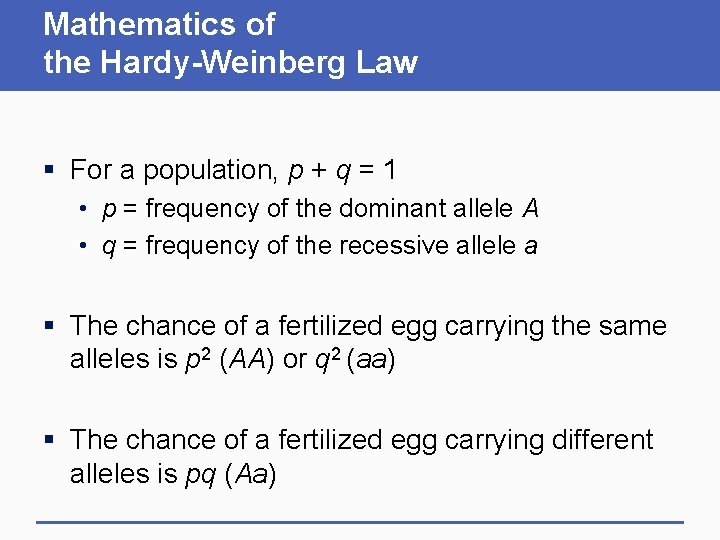
Mathematics of the Hardy-Weinberg Law § For a population, p + q = 1 • p = frequency of the dominant allele A • q = frequency of the recessive allele a § The chance of a fertilized egg carrying the same alleles is p 2 (AA) or q 2 (aa) § The chance of a fertilized egg carrying different alleles is pq (Aa)
Determining the Frequency of Alleles in a New Generation § Depends on the frequency of dominant and recessive alleles in the parental generation
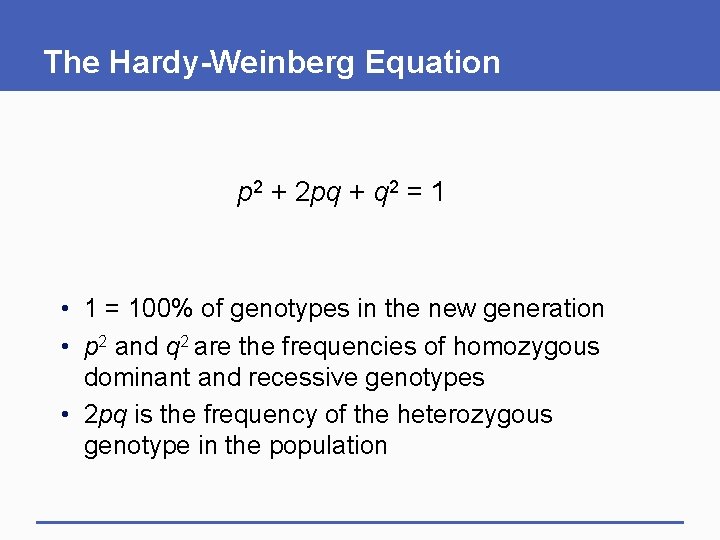
The Hardy-Weinberg Equation p 2 + 2 pq + q 2 = 1 • 1 = 100% of genotypes in the new generation • p 2 and q 2 are the frequencies of homozygous dominant and recessive genotypes • 2 pq is the frequency of the heterozygous genotype in the population
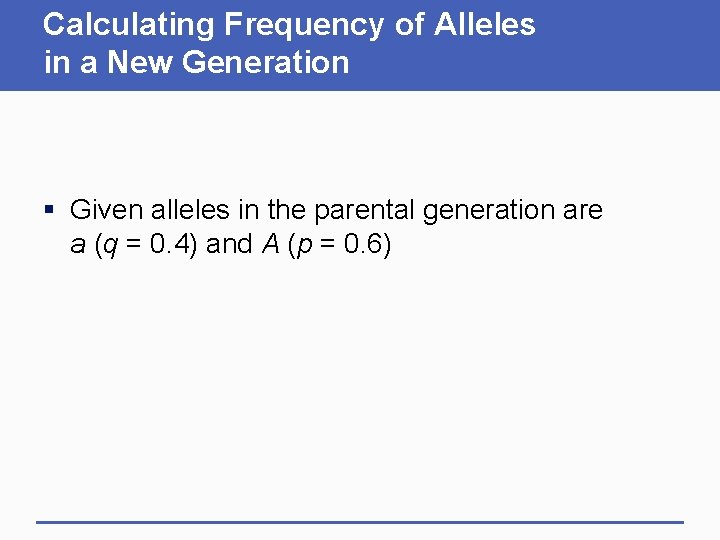
Calculating Frequency of Alleles in a New Generation § Given alleles in the parental generation are a (q = 0. 4) and A (p = 0. 6)
Populations Can Be in Genetic Equilibrium § Genetic equilibrium • When the allele frequency for a particular gene remains constant from generation to generation • Equilibrium in a population explains why dominant alleles do not replace recessive alleles § In equilibrium populations, Hardy-Weinberg law can be used to measure allele and genotype frequencies from generation to generation
Keep In Mind § The frequency of recessive alleles in a population cannot be measured directly
Using the Hardy-Weinberg Law in Human Genetics § The Hardy-Weinberg Law can be used to • Estimate frequencies of autosomal dominant and recessive alleles in a population • Detect when allele frequencies are shifting in a population (evolutionary change) • Measure the frequency of heterozygous carriers of deleterious recessive alleles in a population
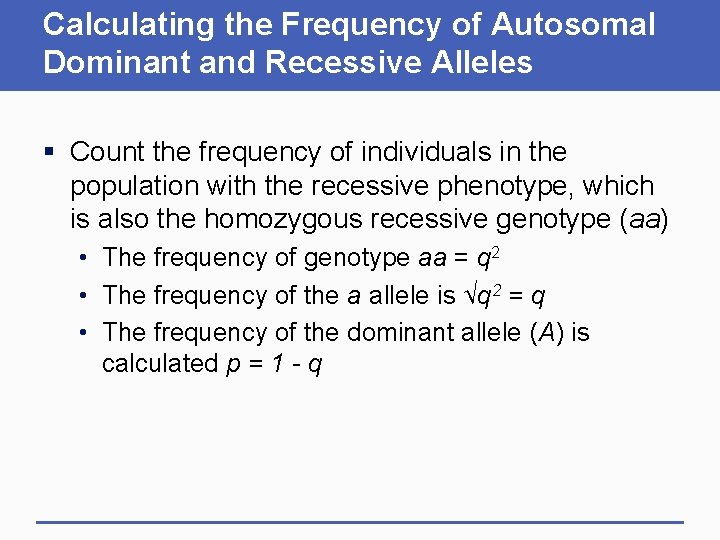
Calculating the Frequency of Autosomal Dominant and Recessive Alleles § Count the frequency of individuals in the population with the recessive phenotype, which is also the homozygous recessive genotype (aa) • The frequency of genotype aa = q 2 • The frequency of the a allele is √q 2 = q • The frequency of the dominant allele (A) is calculated p = 1 - q
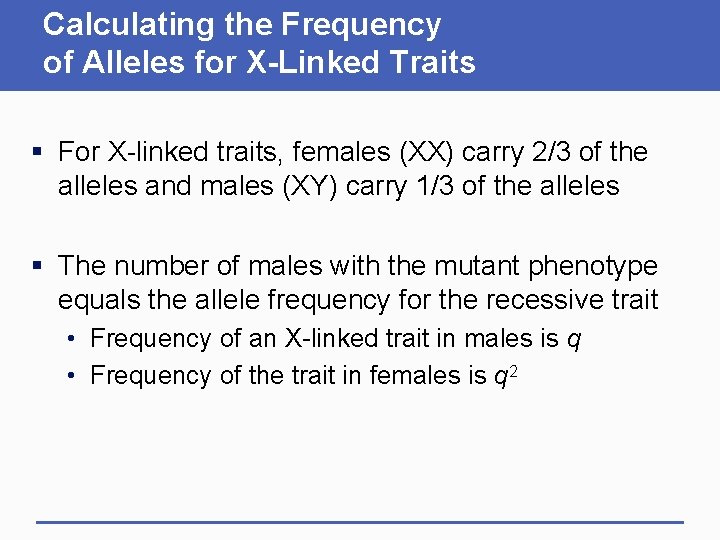
Calculating the Frequency of Alleles for X-Linked Traits § For X-linked traits, females (XX) carry 2/3 of the alleles and males (XY) carry 1/3 of the alleles § The number of males with the mutant phenotype equals the allele frequency for the recessive trait • Frequency of an X-linked trait in males is q • Frequency of the trait in females is q 2
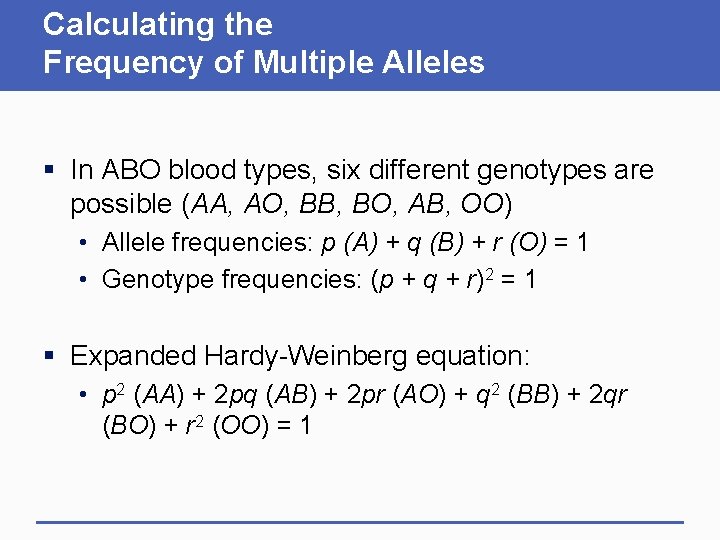
Calculating the Frequency of Multiple Alleles § In ABO blood types, six different genotypes are possible (AA, AO, BB, BO, AB, OO) • Allele frequencies: p (A) + q (B) + r (O) = 1 • Genotype frequencies: (p + q + r)2 = 1 § Expanded Hardy-Weinberg equation: • p 2 (AA) + 2 pq (AB) + 2 pr (AO) + q 2 (BB) + 2 qr (BO) + r 2 (OO) = 1
Frequencies of Heterozygotes § For a genetic disorder inherited as a recessive trait, most disease-causing alleles are carried by heterozygotes § The frequency of heterozygous carriers of deleterious recessive alleles in a population is used to calculate risk of having an affected child
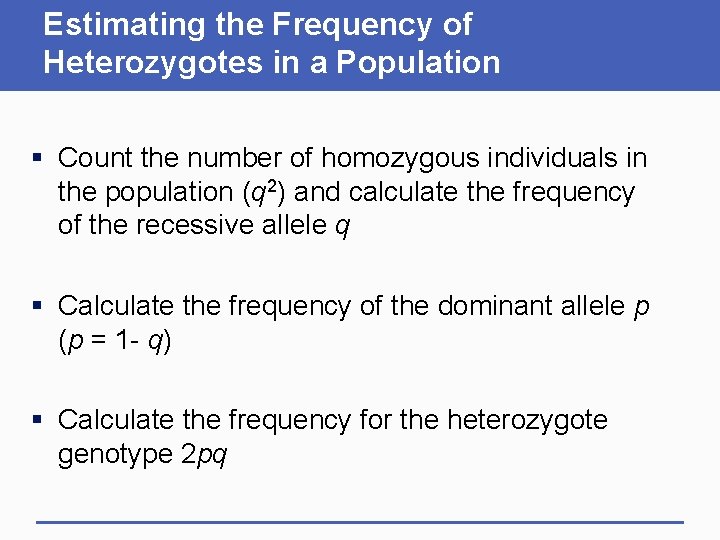
Estimating the Frequency of Heterozygotes in a Population § Count the number of homozygous individuals in the population (q 2) and calculate the frequency of the recessive allele q § Calculate the frequency of the dominant allele p (p = 1 - q) § Calculate the frequency for the heterozygote genotype 2 pq
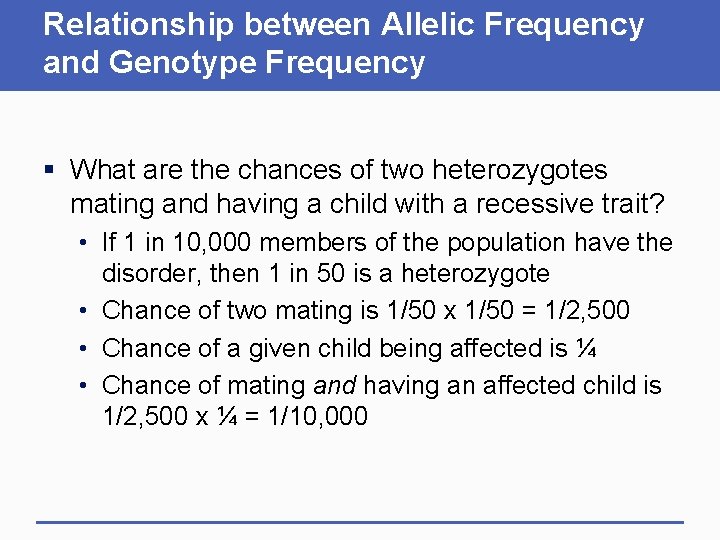
Relationship between Allelic Frequency and Genotype Frequency § What are the chances of two heterozygotes mating and having a child with a recessive trait? • If 1 in 10, 000 members of the population have the disorder, then 1 in 50 is a heterozygote • Chance of two mating is 1/50 x 1/50 = 1/2, 500 • Chance of a given child being affected is ¼ • Chance of mating and having an affected child is 1/2, 500 x ¼ = 1/10, 000
Keep In Mind § Estimating the frequency of heterozygotes in a population is an important part of genetic counseling
Measuring Genetic Diversity in Human Populations § Human populations carry a large amount of genetic diversity § Mutation generates new alleles, but has little impact on allele frequency § If the mutation rate for a gene is known, the change in allele frequency resulting from new mutations in each generation can be calculated
Replacement of a Recessive Allele by Mutation Alone § Mutation alone has a minimal impact on the genetic variability present in a population
Genetic Drift Can Change Allele Frequencies § Forces such as genetic drift act on the genetic variation in the gene pool to change the frequency of alleles in the population § Genetic drift • Random fluctuations of allele frequencies from generation to generation that take place in small, isolated populations such as island populations or socioreligious groups
Founder Effects § Occasionally, populations start with a small number of individuals (founders) § Founder effects • Allele frequencies established by chance in a population that is started by a small number of individuals (perhaps only a fertilized female)
Tristan da Cuhna § An island population founded by a single family
Tristan da Cuhna § Residents of the island of Tristan da Cuhna are an example of isolation and inbreeding • Show increased homozygosity for recessive traits such as clinodactyly § Clinodactyly • An autosomal dominant trait that produces a bent finger
Selection § Wallace and Darwin identified selection as the primary force that leads to evolutionary divergence and the formation of new species § Selection increases the reproductive success of fitter genotypes
Natural Selection Acts on Variation in Populations § Natural selection acts on genetic diversity in populations and is the major force in driving evolution § Natural selection • Differential reproduction shown by some members of a population that is the result of differences in fitness
Fitness § Better-adapted individuals have an increased chance of leaving more offspring § Fitness • A measure of the relative survival and reproductive success of a specific individual or genotype
The Relationship between Sickle-Cell Anemia and Malaria § The allele for sickle-cell anemia is present in very high frequencies in certain populations • Many recessive homozygotes die in childhood § The sickle-cell allele confers resistance to the parasite Plasmodium, which causes malaria • Selection favors survival and differential reproduction of heterozygotes
Keep In Mind § Mutation generates all new alleles, but drift, migration, and selection determine the frequency of alleles in a population
Natural Selection Affects the Frequency of Genetic Disorders § Rare lethal or deleterious recessive alleles survive because the vast majority of them are carried in the heterozygous condition § Other factors can cause differential distribution of alleles in the human population • Migration, founder effects, mutations, selection
Lethal Alleles § Almost all individuals with Duchenne muscular dystrophy (DMD) die before reproducing § The mutation rate for DMD is high, introducing more DMD alleles § The frequency of the DMD allele in a population is balanced between alleles introduced by mutation and those removed by deaths
Heterozygote Advantage § The high frequency of genetic disorders in some populations is the result of selection that often confers increased fitness on heterozygotes • A single sickle-cell allele confers resistance to malaria • A single Tay-Sachs allele confers resistance to tuberculosis
Genetics in Society: Lactose Intolerance and Culture § The enzyme lactase converts lactose (milk sugar) into glucose and galactose • Lactase production slows or stops after childhood § Some populations have a gene for adult lactose metabolism (LA) • The cultural practice of keeping dairy herds was a selective factor that provided an advantage for the LA genotype
Keep In Mind § Survival and differential reproduction are the basis of natural selection
Genetic Variation in Human Populations § The biological concept of race changed from an emphasis on phenotypic differences to an emphasis on genotypic differences § Mutation introduces genetic variation § Natural selection and drift are the primary mechanisms that spread alleles through local population groups
How Can We Measure Gene Flow Between Populations? § Gene flow between populations is used to reconstruct the origin and history of populations § Example: Gene flow into the American black population from Europeans • West African populations have blood group FY*O • Europeans have blood groups FY*A and FY*B • In northern US cities, about 20% of genes in the black population are derived from Europeans
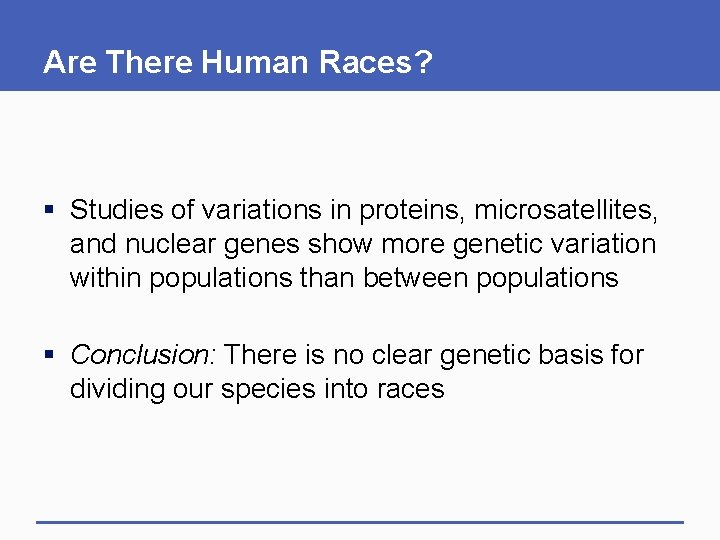
Are There Human Races? § Studies of variations in proteins, microsatellites, and nuclear genes show more genetic variation within populations than between populations § Conclusion: There is no clear genetic basis for dividing our species into races