
Population Ecology PACKET 80 CHAPTER 52 Introduction Review



- Slides: 29
Population Ecology PACKET #80 CHAPTER #52
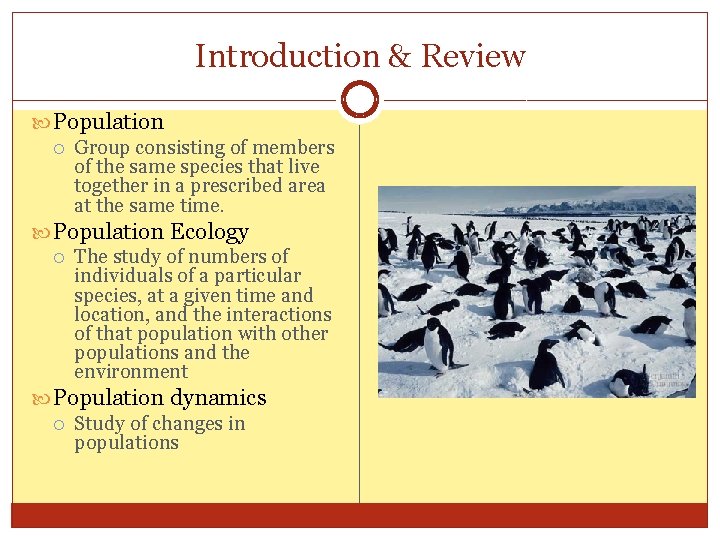
Introduction & Review Population Group consisting of members of the same species that live together in a prescribed area at the same time. Population Ecology The study of numbers of individuals of a particular species, at a given time and location, and the interactions of that population with other populations and the environment Population dynamics Study of changes in populations
Population Ecology IMPORTANT FEATURES OF POPULATIONS
Population Density This is how population size is expressed The number of individuals of a species per unit space
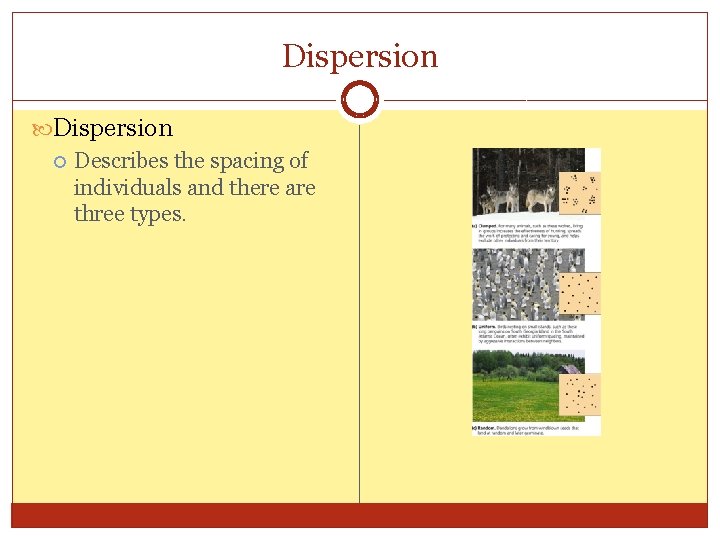
Dispersion Describes the spacing of individuals and there are three types.
Types of Dispersion Uniform Dispersion Individuals are evenly distributed Clumped (Aggregated) Dispersion Most common type Individuals are concentrated in specific parts of the habitat Patchiness Occurs as a result of distribution of resources or by asexual reproduction Random dispersion Occurs when individuals of a population are spaced throughout an area in a manner that is unrelated to the presence of others Least common; hardest to observe Results from a lack of interaction between individuals or a homogenous environment
Population Ecology MATHEMATICAL MODELS
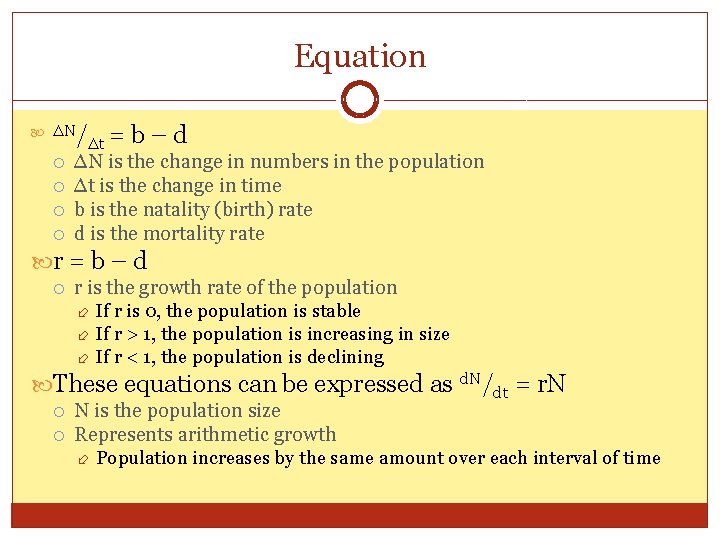
Equation ∆N /∆t = b – d ∆N is the change in numbers in the population ∆t is the change in time b is the natality (birth) rate d is the mortality rate r = b – d r is the growth rate of the population If r is 0, the population is stable If r > 1, the population is increasing in size If r < 1, the population is declining These equations can be expressed as d. N/dt = r. N N is the population size Represents arithmetic growth Population increases by the same amount over each interval of time
Population Ecology TYPES OF GROWTH RATES
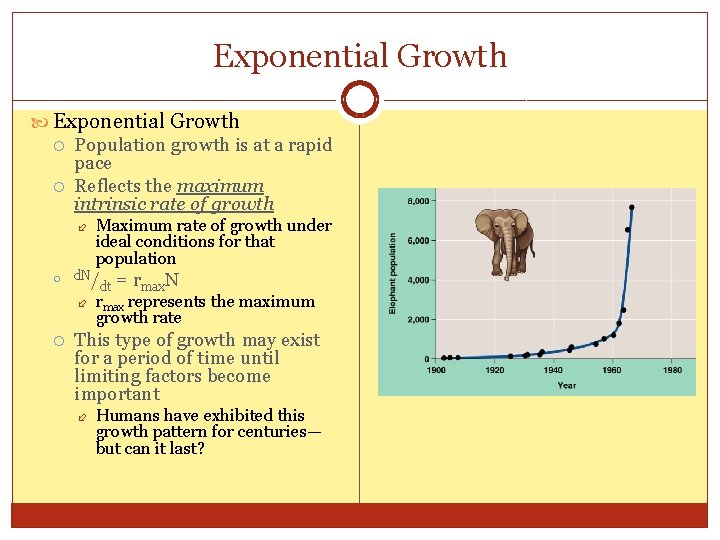
Exponential Growth Population growth is at a rapid pace Reflects the maximum intrinsic rate of growth d. N/ Maximum rate of growth under ideal conditions for that population dt = rmax. N rmax represents the maximum growth rate This type of growth may exist for a period of time until limiting factors become important Humans have exhibited this growth pattern for centuries— but can it last?
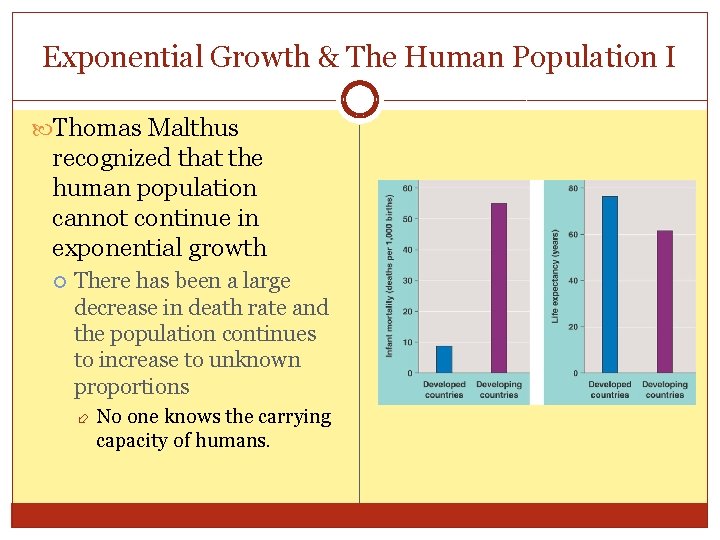
Exponential Growth & The Human Population I Thomas Malthus recognized that the human population cannot continue in exponential growth There has been a large decrease in death rate and the population continues to increase to unknown proportions No one knows the carrying capacity of humans.
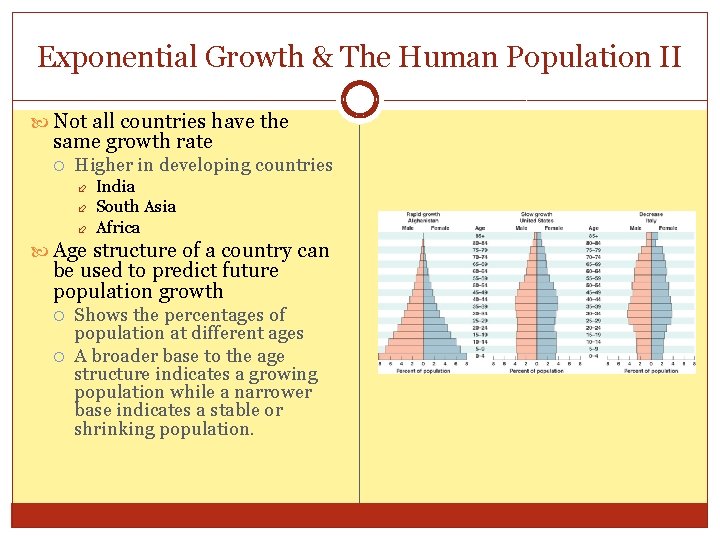
Exponential Growth & The Human Population II Not all countries have the same growth rate Higher in developing countries India South Asia Africa Age structure of a country can be used to predict future population growth Shows the percentages of population at different ages A broader base to the age structure indicates a growing population while a narrower base indicates a stable or shrinking population.
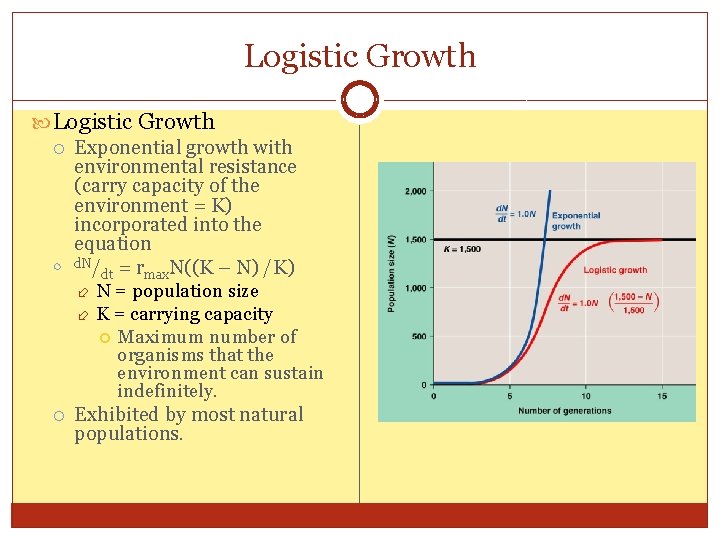
Logistic Growth Exponential growth with environmental resistance (carry capacity of the environment = K) incorporated into the equation d. N/ dt = rmax. N((K – N) /K) N = population size K = carrying capacity Maximum number of organisms that the environment can sustain indefinitely. Exhibited by most natural populations.
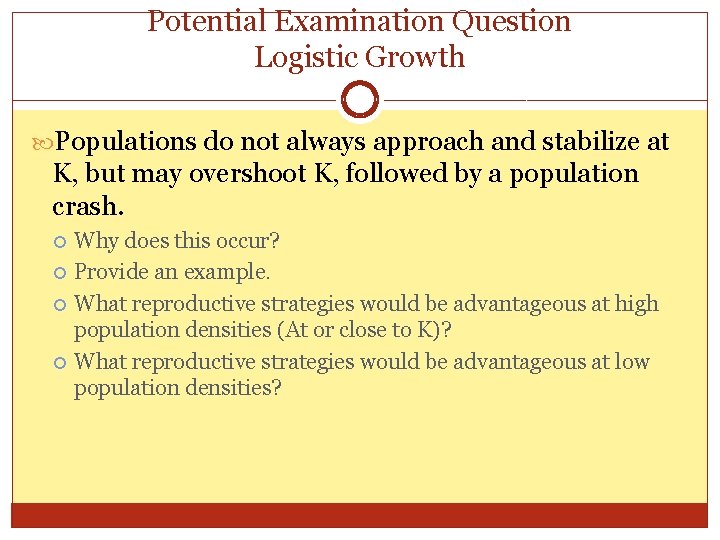
Potential Examination Question Logistic Growth Populations do not always approach and stabilize at K, but may overshoot K, followed by a population crash. Why does this occur? Provide an example. What reproductive strategies would be advantageous at high population densities (At or close to K)? What reproductive strategies would be advantageous at low population densities?
Population Ecology FACTORS INFLUENCING POPULATION SIZE
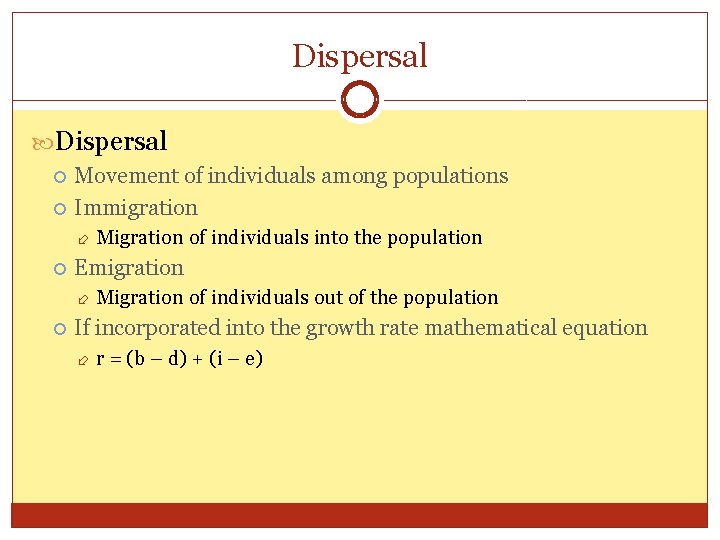
Dispersal Movement of individuals among populations Immigration Emigration Migration of individuals into the population Migration of individuals out of the population If incorporated into the growth rate mathematical equation r = (b – d) + (i – e)
Density Dependent Factors Regulate population size and is difficult to access in nature and are limiting factors that increase in intensity as population size increases
Density Dependent Factors II Predation Disease Increases when contact with toxic waste, produced by population itself, increases with population size. Competition Intraspecific Competition between members of the same species Interspecific Competition between members of different species
Density Independent Factors Limit population size and are factors that do not increase in intensity as the population size increases. Most density-independent factors have some relationship to population density. Many climatic factors are density-independent.
Density Independent Factors Climatic factors Sunlight Rainfall Temperature All have impacts no matter what the population size Climatic and seasonal factors, monsoon season for example, can severely decrease populations
Population Ecology LIFE “HISTORY” TRAITS OF POPULATIONS
Introduction Life history traits, products of natural selection, are traits that affect an organism’s schedule of reproduction and survival. Birth Reproduction Death
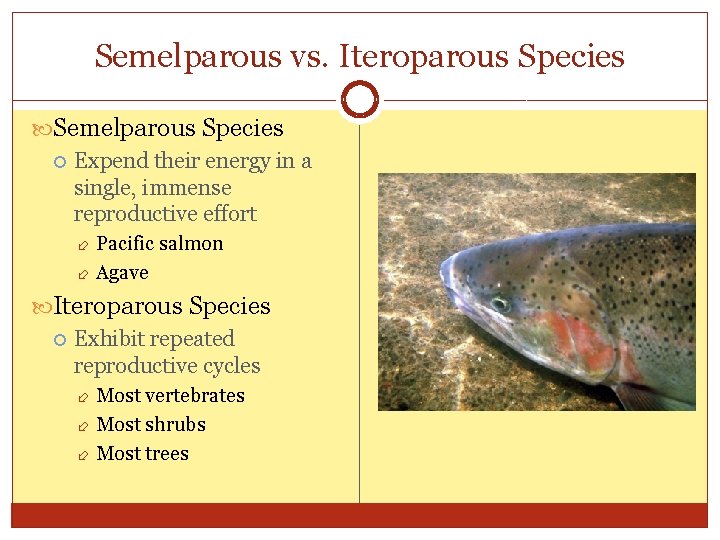
Semelparous vs. Iteroparous Species Semelparous Species Expend their energy in a single, immense reproductive effort Pacific salmon Agave Iteroparous Species Exhibit repeated reproductive cycles Most vertebrates Most shrubs Most trees
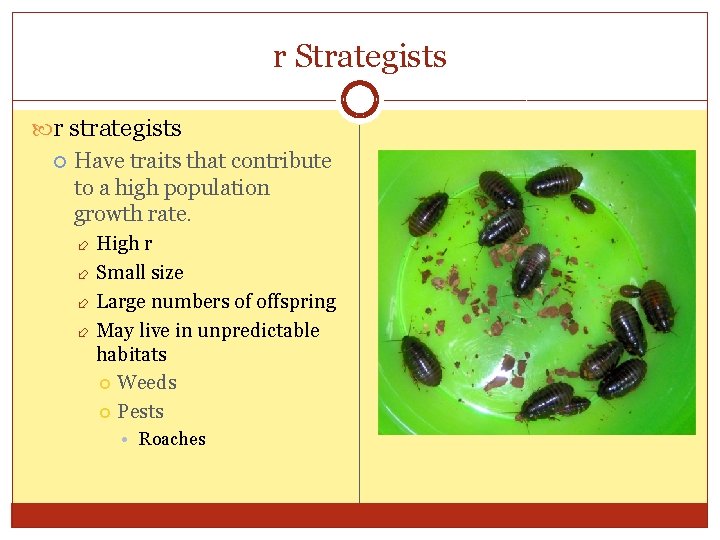
r Strategists r strategists Have traits that contribute to a high population growth rate. High r Small size Large numbers of offspring May live in unpredictable habitats Weeds Pests • Roaches
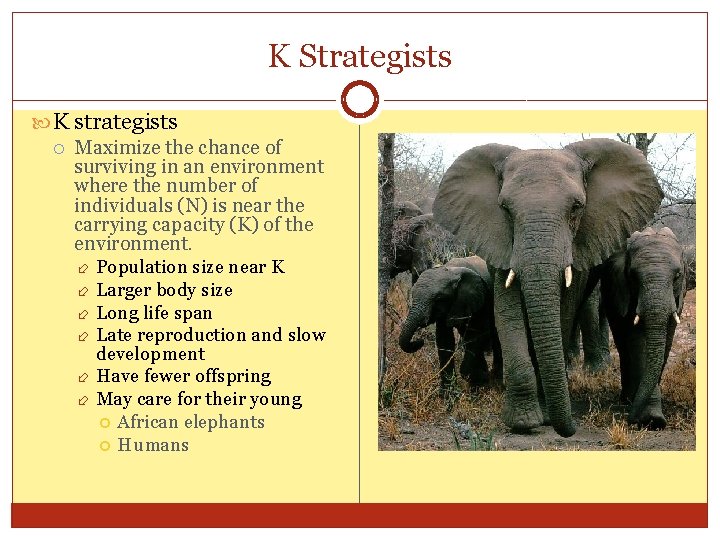
K Strategists K strategists Maximize the chance of surviving in an environment where the number of individuals (N) is near the carrying capacity (K) of the environment. Population size near K Larger body size Long life span Late reproduction and slow development Have fewer offspring May care for their young African elephants Humans
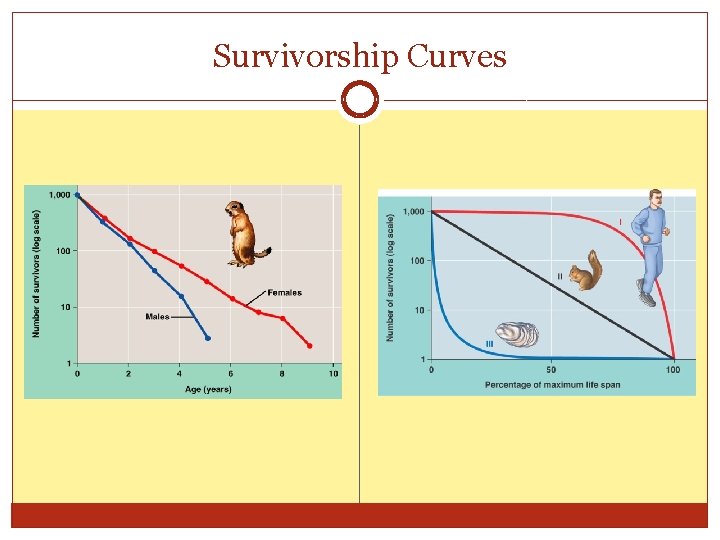
Survivorship is related to r and k selection Type I Survivorship Typical of K-selected organisms High mortality rate later in life Type II Survivorship Characterized by constant mortality rate over time Birds and lizards Type III Survivorship r selected organisms. Characterized by high mortality rate early in life
Survivorship Curves
Review
Review Students are encouraged to place their own questions and charts on following slides.