
Population Ecology Limits to Population Growth Limiting Factors
- Slides: 8
Population Ecology Limits to Population Growth
Limiting Factors • The primary productivity of an ecosystem can be reduced when there is an insufficient supply of a particular nutrient • Such a nutrient is called a limiting nutrient • A limiting nutrient is an example of a limiting factor any factor that causes population growth to decrease • Limiting factors may be density-dependent or density-independent
What limits population growth? • Limiting factors may be density-dependent factors like: a) competition b) predation c) parasitism d) disease
Competiton • Organisms compete for food, space, water, sunlight and other resources • Competition can occur between species and within species • Within species, competition can lead to evolutionary change
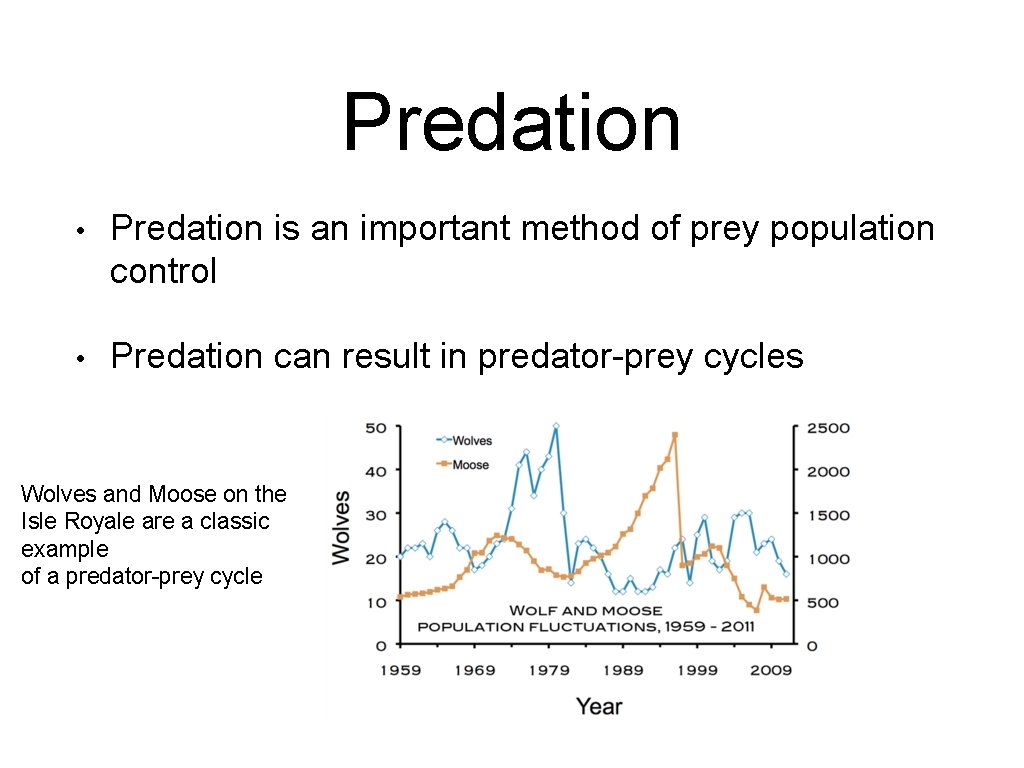
Predation • Predation is an important method of prey population control • Predation can result in predator-prey cycles Wolves and Moose on the Isle Royale are a classic example of a predator-prey cycle
Parasitism • Parasites can also regulate host populations, by causing the death of their host(s) or effecting their ability to successfully reproduce
Disease • Infectious diseases are more easily transmitted when population densities are high
Density-Independent Factors • These factors affect all populations in similar ways regardless of population size Examples: • unusual weather • natural disasters • seasonal cycles • certain human activities—such as damming rivers and clear-cutting forests