
POPULATION ECOLOGY Graphs Math SURVIVORSHIP CURVES 3 Types
- Slides: 11
POPULATION ECOLOGY Graphs & Math
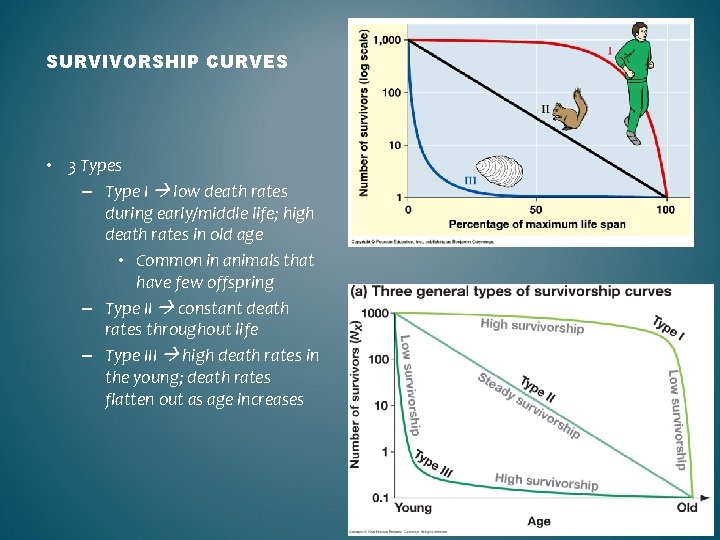
SURVIVORSHIP CURVES • 3 Types – Type I low death rates during early/middle life; high death rates in old age • Common in animals that have few offspring – Type II constant death rates throughout life – Type III high death rates in the young; death rates flatten out as age increases
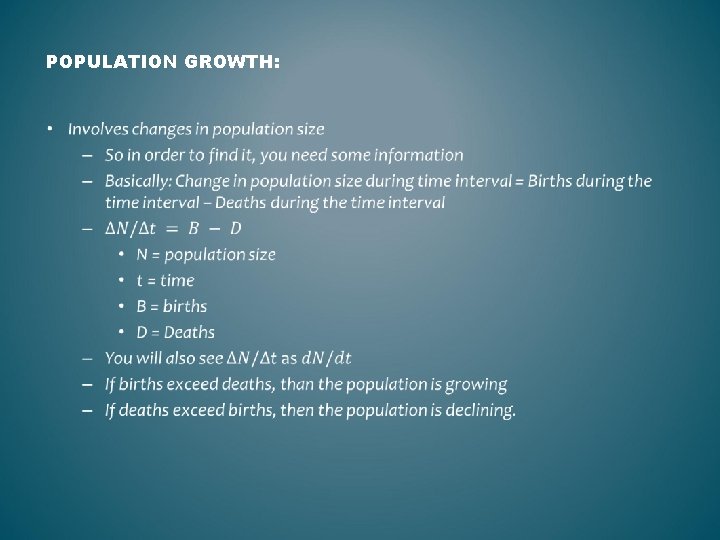
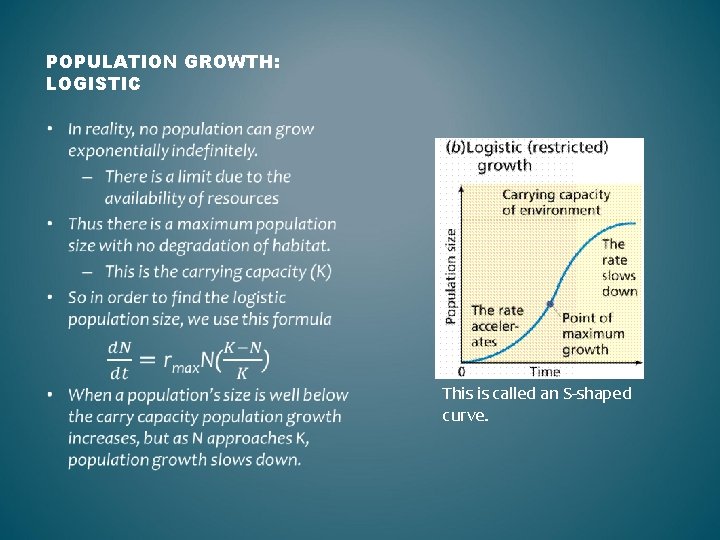
POPULATION GROWTH: •
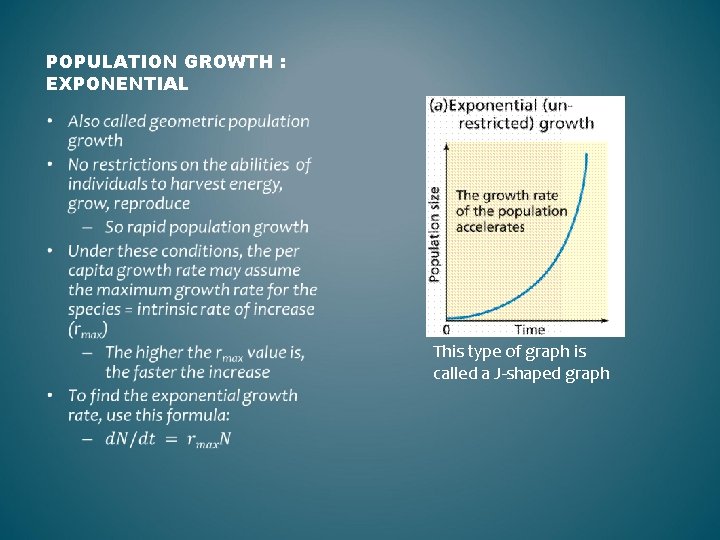
POPULATION GROWTH : EXPONENTIAL • This type of graph is called a J-shaped graph
POPULATION GROWTH: LOGISTIC • This is called an S-shaped curve.
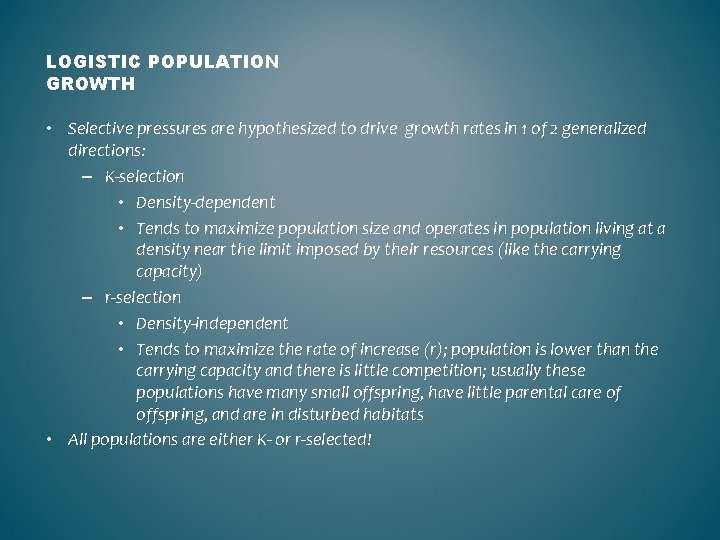
LOGISTIC POPULATION GROWTH • Selective pressures are hypothesized to drive growth rates in 1 of 2 generalized directions: – K-selection • Density-dependent • Tends to maximize population size and operates in population living at a density near the limit imposed by their resources (like the carrying capacity) – r-selection • Density-independent • Tends to maximize the rate of increase (r); population is lower than the carrying capacity and there is little competition; usually these populations have many small offspring, have little parental care of offspring, and are in disturbed habitats • All populations are either K- or r-selected!
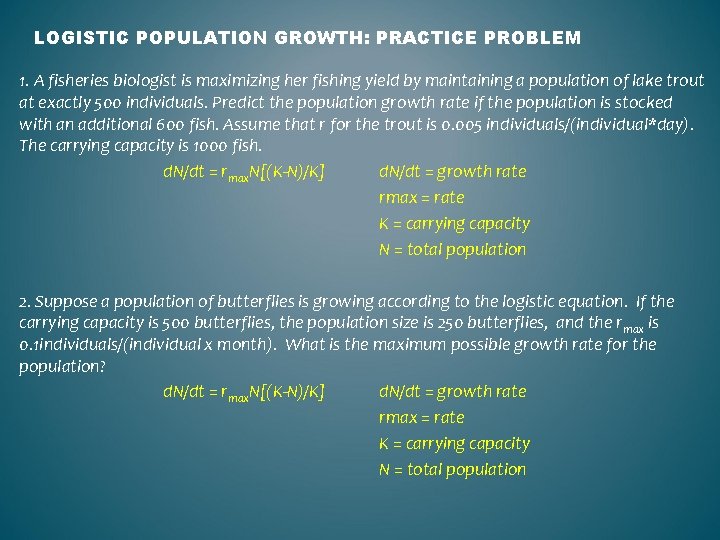
LOGISTIC POPULATION GROWTH: PRACTICE PROBLEM 1. A fisheries biologist is maximizing her fishing yield by maintaining a population of lake trout at exactly 500 individuals. Predict the population growth rate if the population is stocked with an additional 600 fish. Assume that r for the trout is 0. 005 individuals/(individual*day). The carrying capacity is 1000 fish. d. N/dt = rmax. N[(K-N)/K] d. N/dt = growth rate rmax = rate K = carrying capacity N = total population 2. Suppose a population of butterflies is growing according to the logistic equation. If the carrying capacity is 500 butterflies, the population size is 250 butterflies, and the r max is 0. 1 individuals/(individual x month). What is the maximum possible growth rate for the population? d. N/dt = rmax. N[(K-N)/K] d. N/dt = growth rate rmax = rate K = carrying capacity N = total population
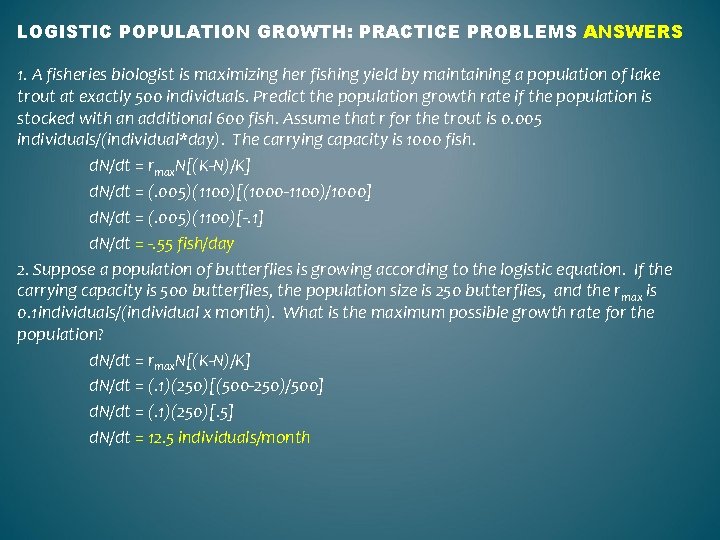
LOGISTIC POPULATION GROWTH: PRACTICE PROBLEMS ANSWERS 1. A fisheries biologist is maximizing her fishing yield by maintaining a population of lake trout at exactly 500 individuals. Predict the population growth rate if the population is stocked with an additional 600 fish. Assume that r for the trout is 0. 005 individuals/(individual*day). The carrying capacity is 1000 fish. d. N/dt = rmax. N[(K-N)/K] d. N/dt = (. 005)(1100)[(1000 -1100)/1000] d. N/dt = (. 005)(1100)[-. 1] d. N/dt = -. 55 fish/day 2. Suppose a population of butterflies is growing according to the logistic equation. If the carrying capacity is 500 butterflies, the population size is 250 butterflies, and the r max is 0. 1 individuals/(individual x month). What is the maximum possible growth rate for the population? d. N/dt = rmax. N[(K-N)/K] d. N/dt = (. 1)(250)[(500 -250)/500] d. N/dt = (. 1)(250)[. 5] d. N/dt = 12. 5 individuals/month
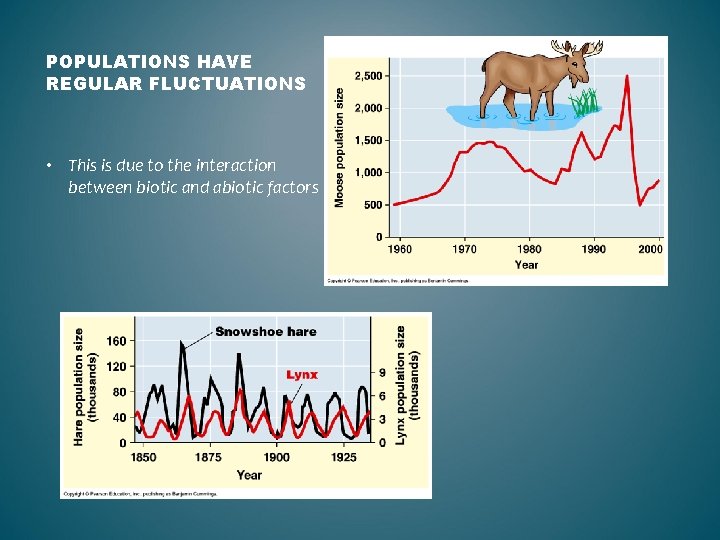
POPULATIONS HAVE REGULAR FLUCTUATIONS • This is due to the interaction between biotic and abiotic factors
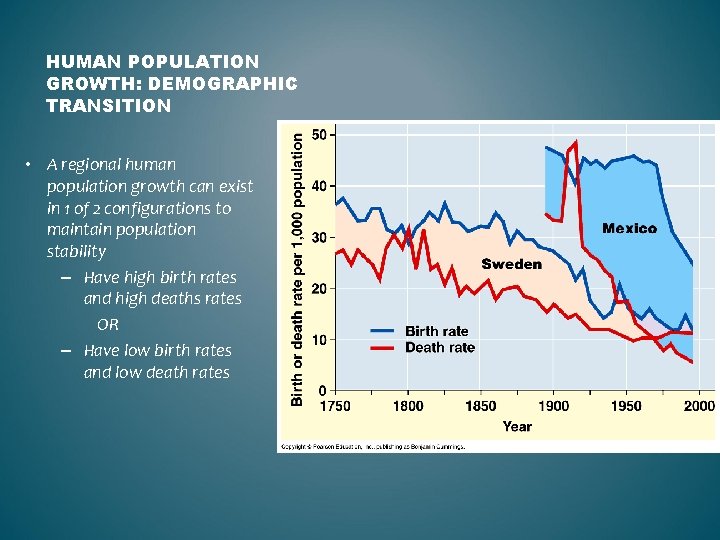
HUMAN POPULATION GROWTH: DEMOGRAPHIC TRANSITION • A regional human population growth can exist in 1 of 2 configurations to maintain population stability – Have high birth rates and high deaths rates OR – Have low birth rates and low death rates
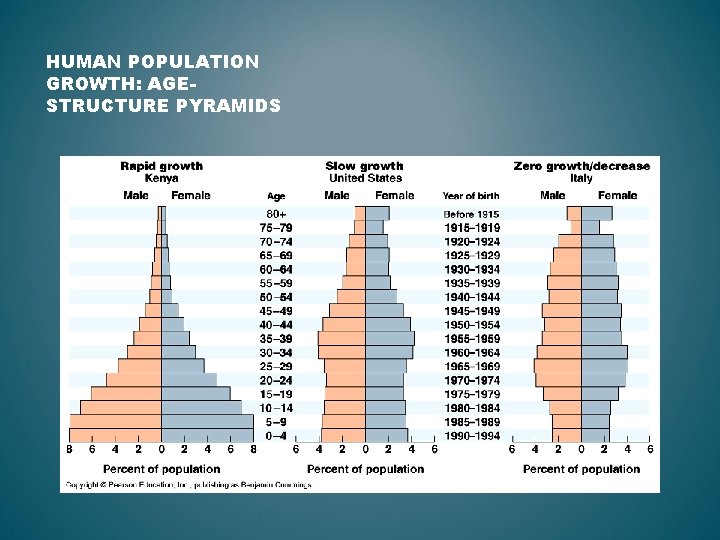
HUMAN POPULATION GROWTH: AGESTRUCTURE PYRAMIDS