
Population Ecology Food Web 6 c Students know
Population Ecology & Food Web 6 c. Students know how fluctuations in population size in an ecosystem are determined by the relative rates of birth, immigration, emigration, and death. 6 d. Students know how water, carbon, and nitrogen cycle between abiotic resources and organic matter in the ecosystem and how oxygen cycles through photosynthesis and respiration. 6 e. Students know a vital part of an ecosystem is the stability of its producers and decomposers. 6 f. Students know at each link in a food web some energy is stored in newly made structures but much energy is dissipated into the environment as heat. This dissipation may be represented in an energy pyramid.
Energy flow and chemical cycling are the two fundamental processes in ecosystems A community interacts with abiotic factors, forming an ecosystem Energy flows from the sun, through plants, animals, and decomposers, and is lost as heat Chemicals are recycled between air, water, soil, and organisms
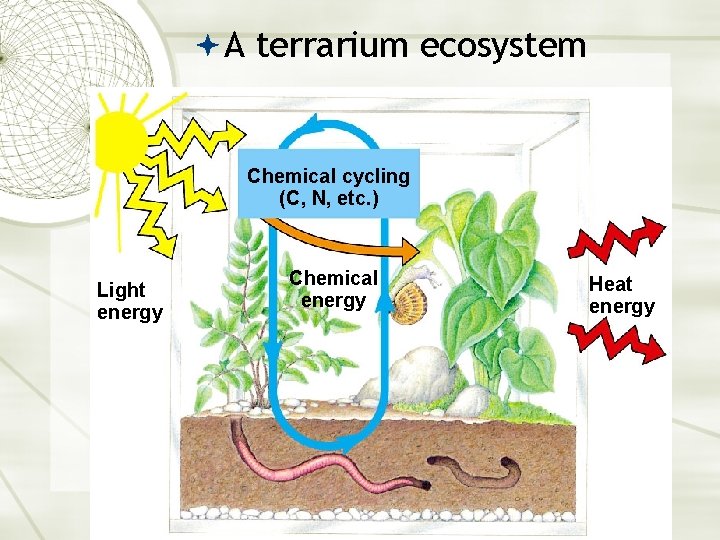
A terrarium ecosystem Chemical cycling (C, N, etc. ) Light energy Chemical energy Heat energy
Trophic structure is a key factor in ecosystem dynamics A food chain is the stepwise flow of energy and nutrients from plants (producers) to herbivores (primary consumers) to carnivores (secondary and higherlevel consumers)

TROPHIC LEVEL Quaternary consumers Carnivore Tertiary consumers Carnivore Secondary consumers A TERRESTRIAL FOOD CHAIN Carnivore Primary consumers Herbivore Zooplankton Producers Plant Phytoplankton AN AQUATIC FOOD CHAIN

Decomposition is the breakdown of organic compounds into inorganic compounds • Decomposition is essential for the continuation of life on Earth • Detritivores decompose waste matter and recycle nutrients – Examples: animal scavengers, fungi, and prokaryotes

Food chains interconnect, forming food webs A food web is a network of interconnecting food chains It is a more realistic view of the trophic structure of an ecosystem than a food chain
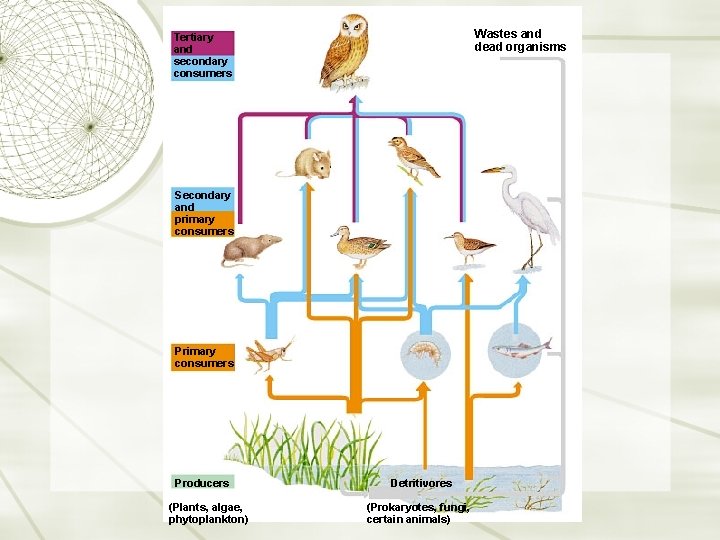
Wastes and dead organisms Tertiary and secondary consumers Secondary and primary consumers Producers (Plants, algae, phytoplankton) Detritivores (Prokaryotes, fungi, certain animals)
Energy supply limits the length of food chains Biomass is the amount of living organic material in an ecosystem Primary production is the rate at which producers convert sunlight to chemical energy The primary production of the entire biosphere is about 170 billion tons of biomass per year
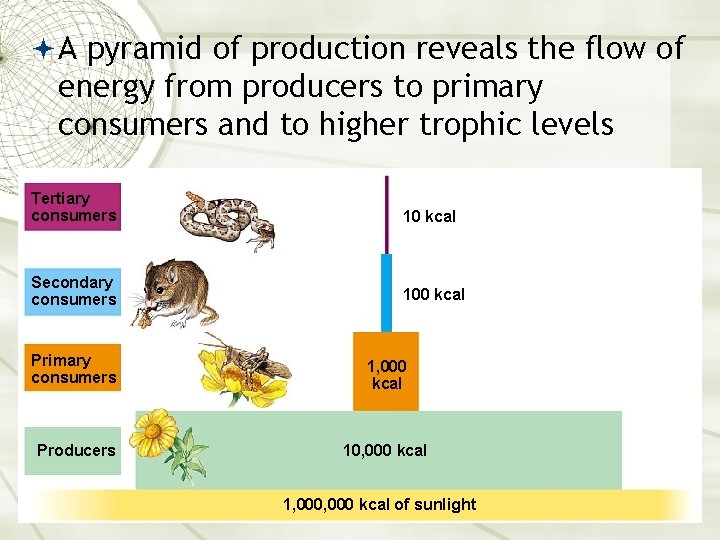
A pyramid of production reveals the flow of energy from producers to primary consumers and to higher trophic levels Tertiary consumers 10 kcal Secondary consumers 100 kcal Primary consumers 1, 000 kcal Producers 10, 000 kcal 1, 000 kcal of sunlight
Only about 10% of the energy in food is stored at each trophic level and available to the next level – This stepwise energy loss limits most food chains to 3 - 5 levels – There is simply not enough energy at the very top of an ecological pyramid to support another trophic level
Connection: A production pyramid explains why meat is a luxury for humans The dynamics of energy flow apply to the human population as much as to other organisms When we eat grain or fruit, we are primary consumers When we eat beef or other meat from herbivores, we are secondary consumers When we eat fish like trout or salmon (which eat insects and other small animals), we are tertiary or quaternary consumers
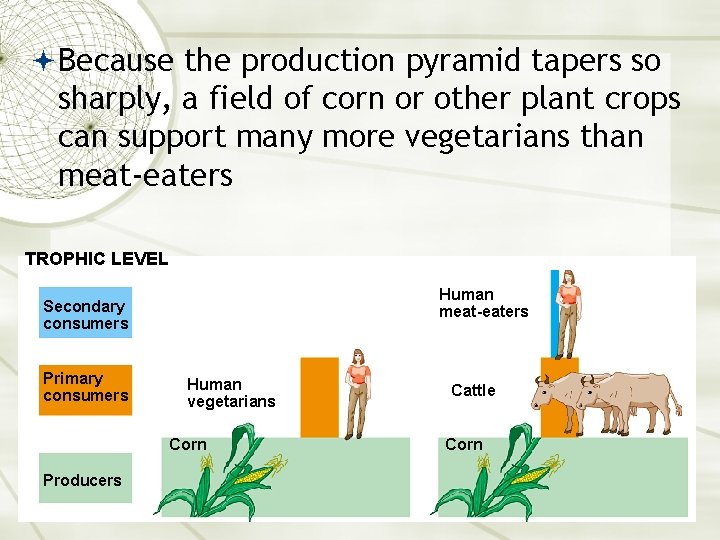
Because the production pyramid tapers so sharply, a field of corn or other plant crops can support many more vegetarians than meat-eaters TROPHIC LEVEL Human meat-eaters Secondary consumers Primary consumers Human vegetarians Corn Producers Cattle Corn
Chemicals are recycled between organic matter and abiotic reservoirs Ecosystems require daily infusions of energy The sun supplies the Earth with energy But there are no extraterrestrial sources of water or other chemical nutrients Nutrients must be recycled between organisms and abiotic reservoirs Abiotic reservoirs are parts of the ecosystem where a chemical accumulates
There are four main abiotic reservoirs – Water cycle – Carbon cycle – Nitrogen cycle – Phosphorus cycle
Water moves through the biosphere in a global cycle Heat from the sun drives the global water cycle Precipitation Evaporation Transpiration
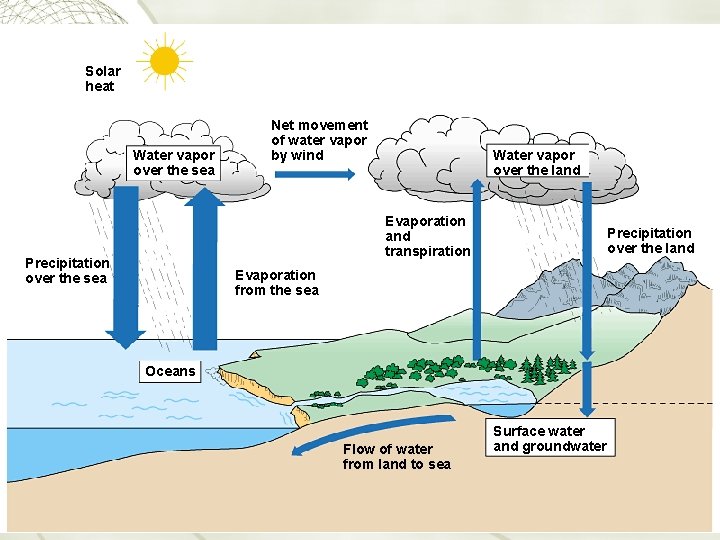
Solar heat Water vapor over the sea Net movement of water vapor by wind Water vapor over the land Evaporation and transpiration Precipitation over the sea Precipitation over the land Evaporation from the sea Oceans Flow of water from land to sea Surface water and groundwater
The carbon cycle depends on photosynthesis and respiration Carbon is taken from the atmosphere by photosynthesis It is used to make organic molecules It is returned to the atmosphere by cellular respiration
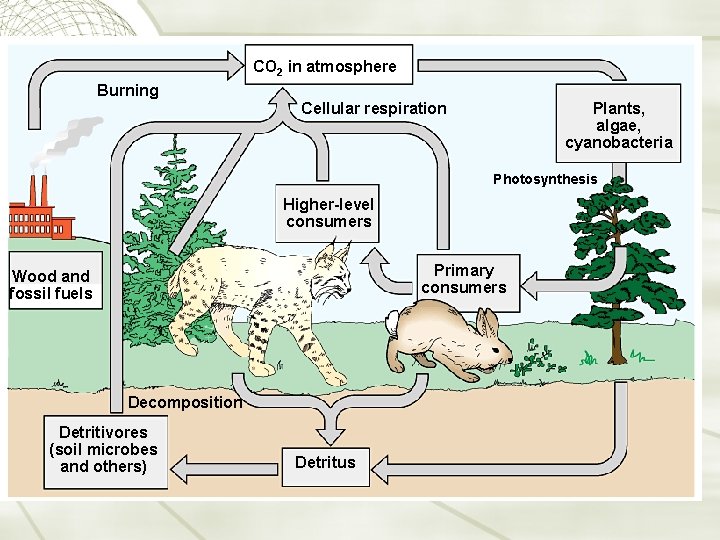
CO 2 in atmosphere Burning Cellular respiration Plants, algae, cyanobacteria Photosynthesis Higher-level consumers Primary consumers Wood and fossil fuels Decomposition Detritivores (soil microbes and others) Detritus
The nitrogen cycle relies heavily on bacteria Nitrogen is plentiful in the atmosphere as N 2 But plants cannot use N 2 Various bacteria in soil (and legume root nodules) convert N 2 to nitrogen compounds that plants can use Ammonium (NH 4+) and nitrate (NO 3–)
Some bacteria break down organic matter and recycle nitrogen as ammonium or nitrate to plants • Other bacteria return N 2 to the atmosphere
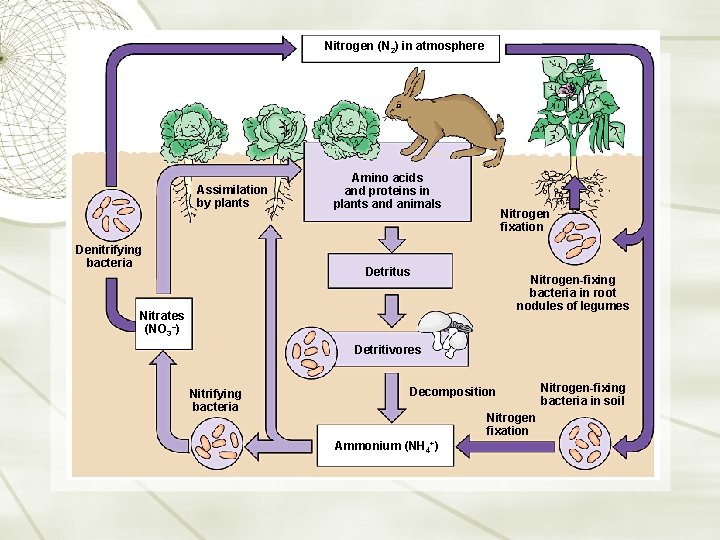
Nitrogen (N 2) in atmosphere Assimilation by plants Denitrifying bacteria Amino acids and proteins in plants and animals Nitrogen fixation Detritus Nitrogen-fixing bacteria in root nodules of legumes Nitrates (NO 3–) Detritivores Nitrifying bacteria Decomposition Nitrogen fixation Ammonium (NH 4+) Nitrogen-fixing bacteria in soil
- Slides: 22