
Population Dynamics Ch 8 Big Picture Populations can
Population Dynamics Ch. 8

Big Picture: Populations can be described by Distribution Numbers Age structure Density Populations cannot grow indefinitely (r) because there are limited by resources and habitats (k= carrying capacity).

Distribution Clumping Uniform dispersion Random dispersion
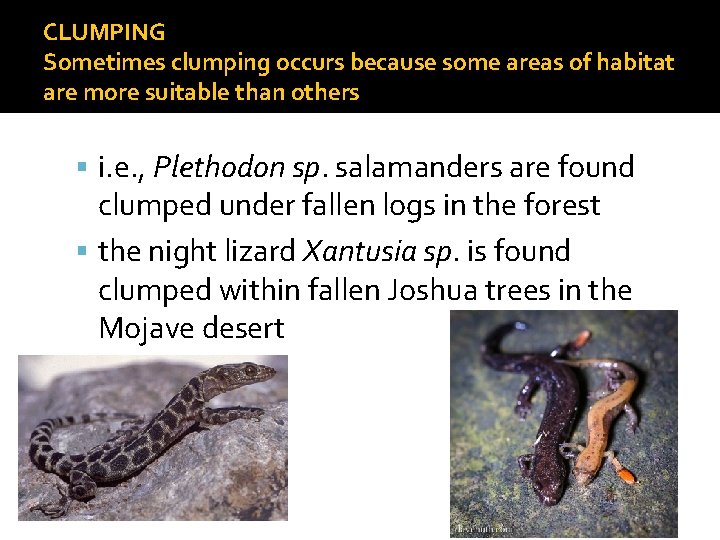
CLUMPING Sometimes clumping occurs because some areas of habitat are more suitable than others i. e. , Plethodon sp. salamanders are found clumped under fallen logs in the forest the night lizard Xantusia sp. is found clumped within fallen Joshua trees in the Mojave desert
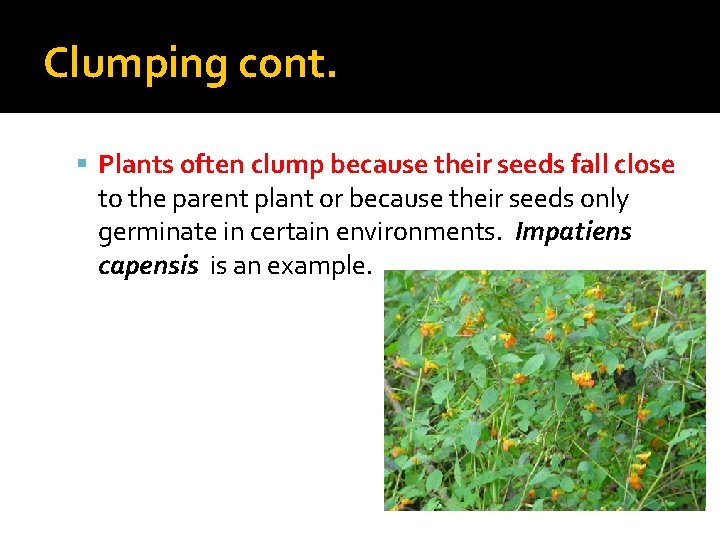
Clumping cont. Plants often clump because their seeds fall close to the parent plant or because their seeds only germinate in certain environments. Impatiens capensis is an example.
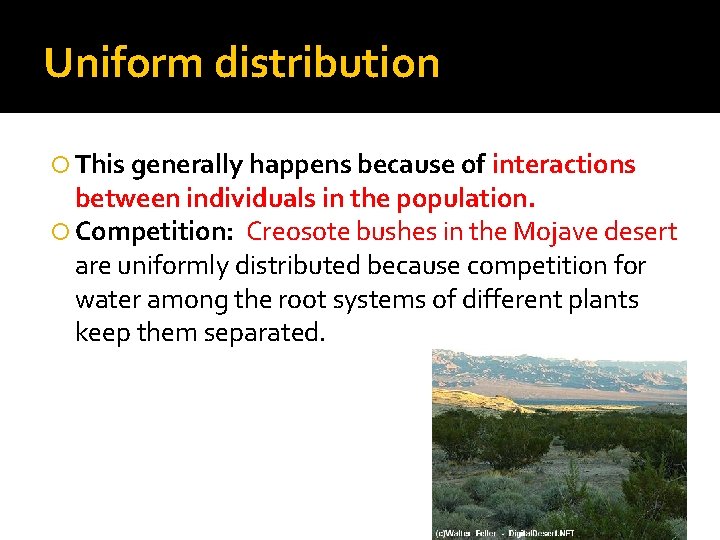
Uniform distribution This generally happens because of interactions between individuals in the population. Competition: Creosote bushes in the Mojave desert are uniformly distributed because competition for water among the root systems of different plants keep them separated.
Uniform cont. Territoriality: The desert lizard Uta sp. maintains somewhat regular distribution via fighting and territorial behavior Human Intervention: I. e. , the spacing of crops.
Random dispersion This pattern occurs in the absence of strong attraction or repulsion among individuals. It is uncommon. For example, fig trees in the amazon rain forest. This random distribution might be due to seed dispersal by bats.
Population Description: Size/Numbers Simply the number of individuals in the population at any given time. Sometimes called abundance.
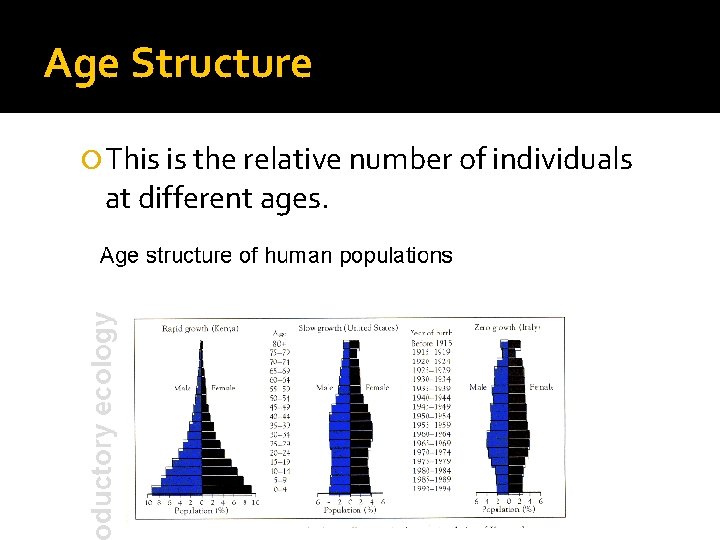
Age Structure This is the relative number of individuals at different ages.
Age Structures Broken down by: Prereproductive age Reproductive age Postreproductive age Which population structure would lead to stable growth? Which leads to an increase in population? Decrease? Which types of countries do you think follow a stable growth? Increasing? Decreasing?
Density The number of individuals in the population per unit area or unit volume. For many organisms, it is the density of a population rather than its actual numbers, that exerts a real effect on the organism.
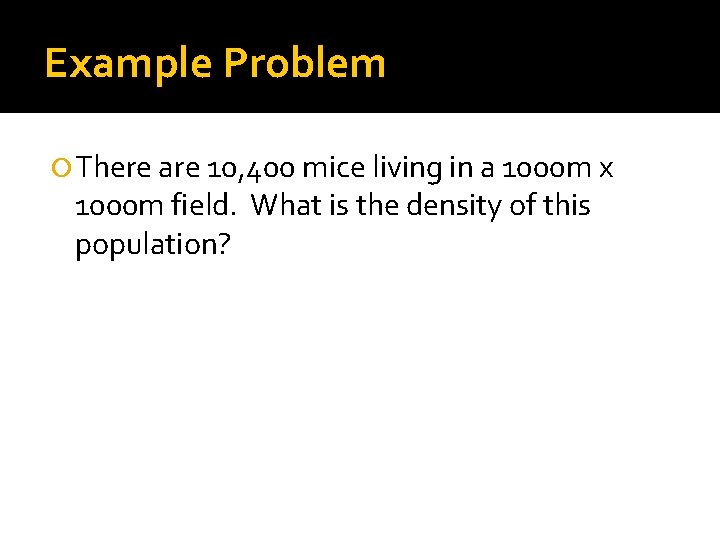
Example Problem There are 10, 400 mice living in a 1000 m x 1000 m field. What is the density of this population?
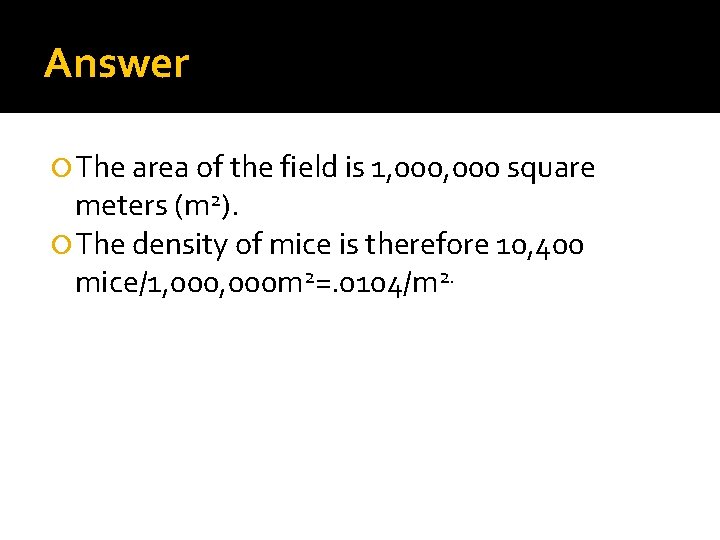
Answer The area of the field is 1, 000 square meters (m 2). The density of mice is therefore 10, 400 mice/1, 000 m 2=. 0104/m 2.
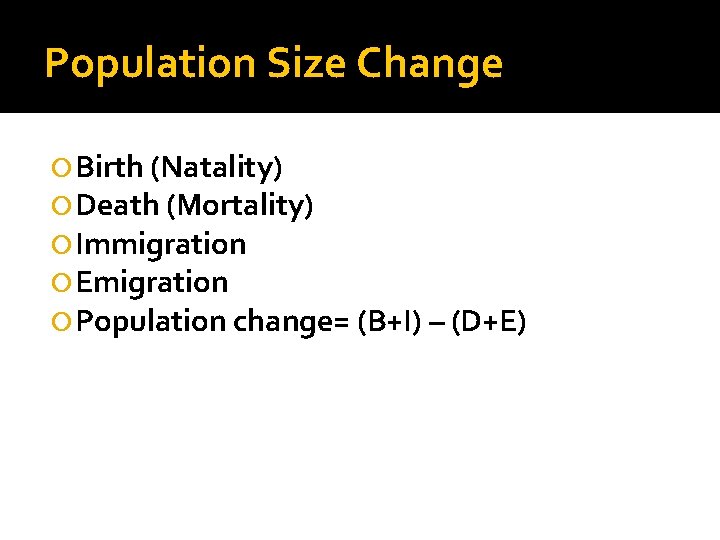
Population Size Change Birth (Natality) Death (Mortality) Immigration Emigration Population change= (B+I) – (D+E)
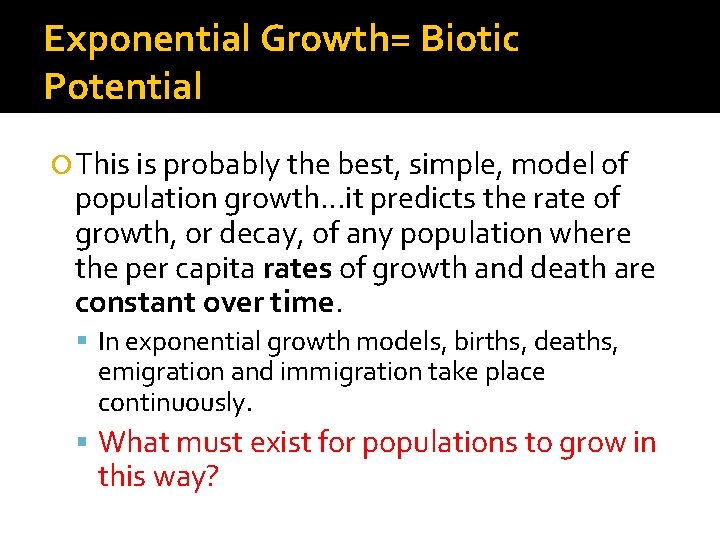
Exponential Growth= Biotic Potential This is probably the best, simple, model of population growth…it predicts the rate of growth, or decay, of any population where the per capita rates of growth and death are constant over time. In exponential growth models, births, deaths, emigration and immigration take place continuously. What must exist for populations to grow in this way?
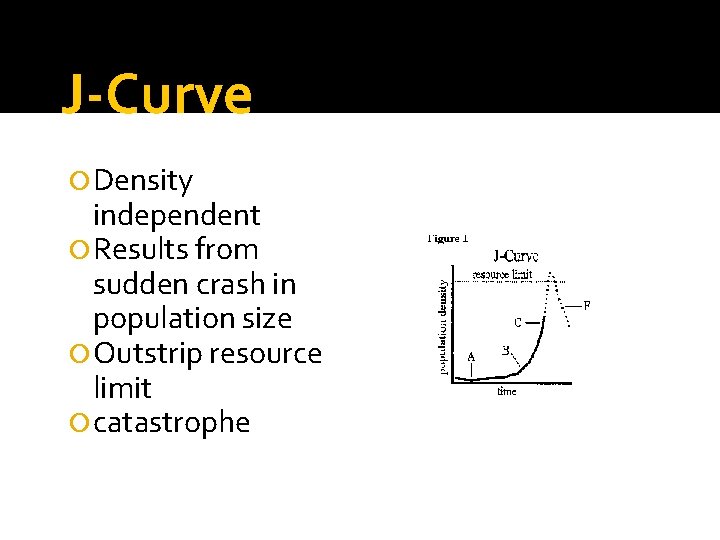
J-Curve Density independent Results from sudden crash in population size Outstrip resource limit catastrophe
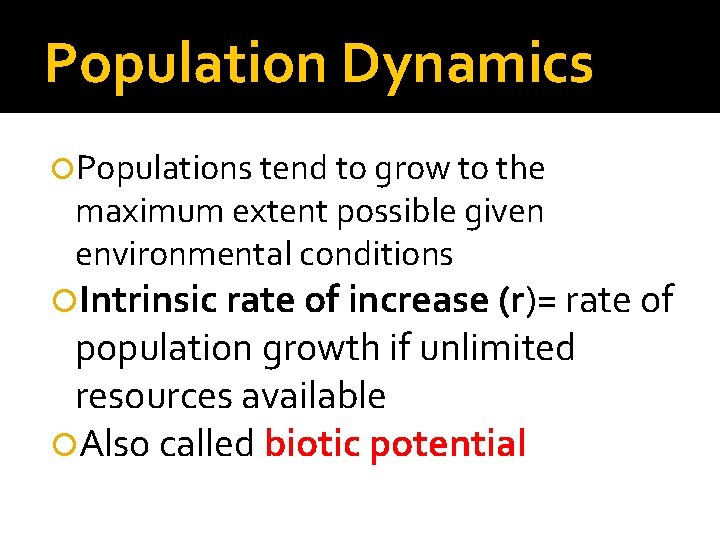
Population Dynamics Populations tend to grow to the maximum extent possible given environmental conditions Intrinsic rate of increase (r)= rate of population growth if unlimited resources available Also called biotic potential
Not Sustained Biotic potential cannot be sustained Environmental resistance Negative feedback ▪ Snowshoe hare and lynx
Carrying Capacity= k Populations grow until one or several limiting resources become rare enough to inhibit reproduction so that the population no longer grows. Eventually, every population reaches its carrying capacity, this is the maximum number of individuals a given environment can sustain.
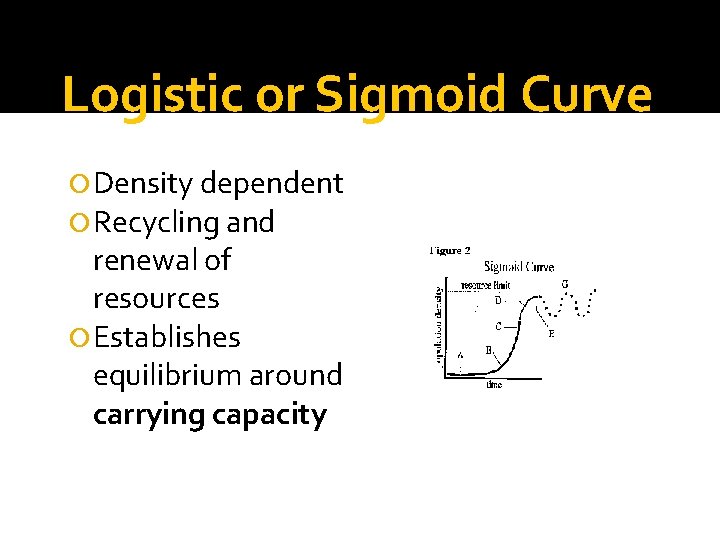
Logistic or Sigmoid Curve Density dependent Recycling and renewal of resources Establishes equilibrium around carrying capacity
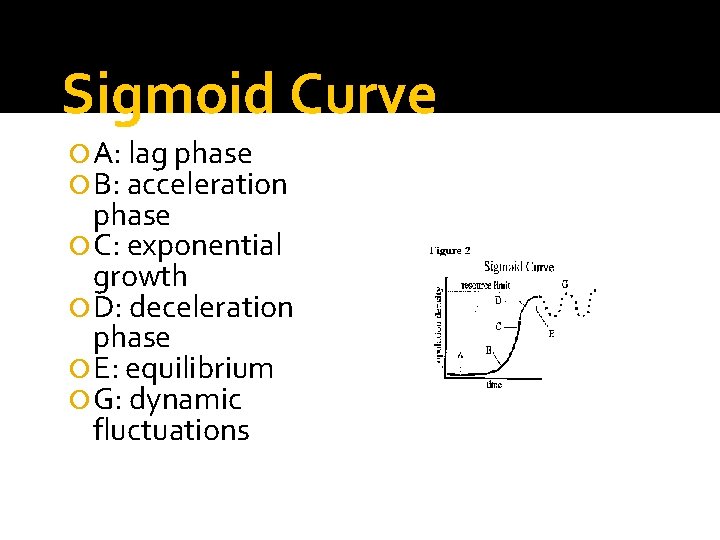
Sigmoid Curve A: lag phase B: acceleration phase C: exponential growth D: deceleration phase E: equilibrium G: dynamic fluctuations
Changing the carrying capacity Adaptive traits Technological advances How have we changed the carrying capacity for human population growth to continue?
Dynamic Fluctuation Phase Density- dependent factors Intraspecific competition Predation Disease Density-independent factors Natural disasters Pollution Habitat destruction (deforestation)
What is an example of a density dependent and independent factor?
Examples Examples: For Neodiprion sawflies, winter surviorship is greatly affected by the weather, which is density-independent. During the summer, however, parasitic wasps impose very high density-dependent mortality. Pacific mussels, Mytillus sp. , are largely limited by density-dependent competition for space on rocky outcrops. Occasionally, density -independent disturbance by floating logs decimates populations.
Patterns of population size Stable Rainforest species Irruptive Insects Cyclic- (boom and bust) Lemmings ▪ http: //www. youtube. com/watch? v=p. Dql. Zjp. SJCc Wolf-moose interactions Irregular Due to catastropies
Deer Population Study Why are deer referred to as an “edge species”? What are controls to deer population? What is the deer dilemma?
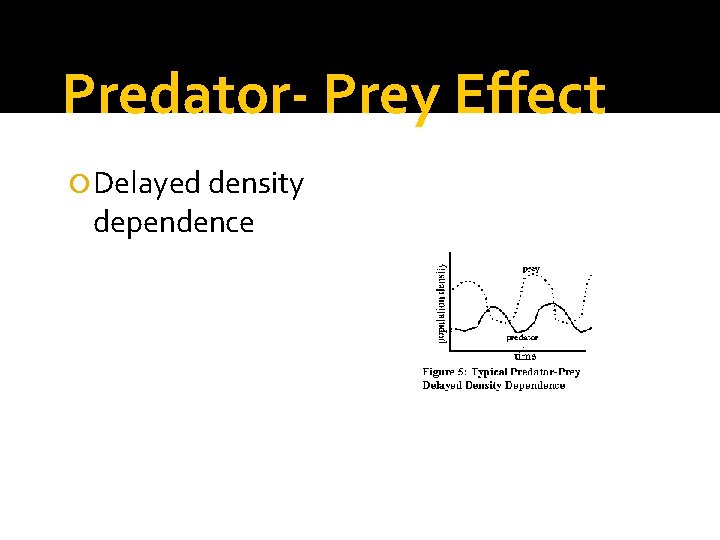
Predator- Prey Effect Delayed density dependence
Reproduction SEXUAL What are pros and cons to this type of reproduction? ASEXUAL What are pros and cons to this type of reproduction?
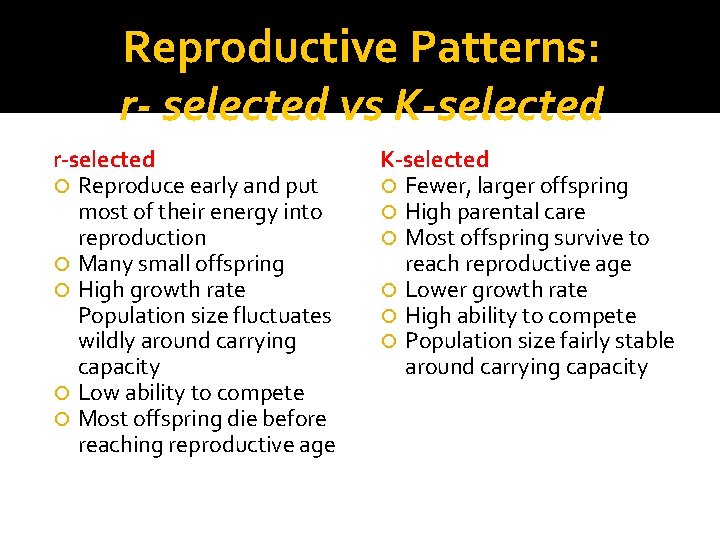
Reproductive Patterns: r- selected vs K-selected r-selected Reproduce early and put most of their energy into reproduction Many small offspring High growth rate Population size fluctuates wildly around carrying capacity Low ability to compete Most offspring die before reaching reproductive age K-selected Fewer, larger offspring High parental care Most offspring survive to reach reproductive age Lower growth rate High ability to compete Population size fairly stable around carrying capacity
Factors that Influence Population Dynamics Positive: enhance population growth Negative: reduce population growth
Biological Controls to population growth Predators Diseases Pheromones
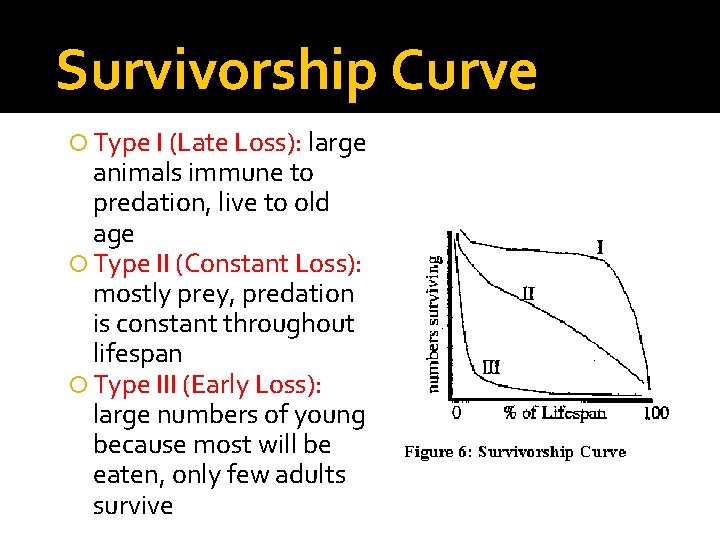
Survivorship Curve Type I (Late Loss): large animals immune to predation, live to old age Type II (Constant Loss): mostly prey, predation is constant throughout lifespan Type III (Early Loss): large numbers of young because most will be eaten, only few adults survive
- Slides: 34