
Population Consumption 1Trends Patterns Structure of Populations 2Indicators

- Slides: 20
Population & Consumption 1)Trends & Patterns & Structure of Populations 2)Indicators of Measurement 3)Sociological Explanations: Malthusian & Neo. Malthusian 4)Counter Arguments to Malthusian (Marxist, Socialist, and Dependency) 5) Review 6) Essay Planning
Population & Consumption • Getting us thinking: Hans Rosling TED Talk https: //www. youtube. com/watch? v=f. Tzn. EIZRk. Lg
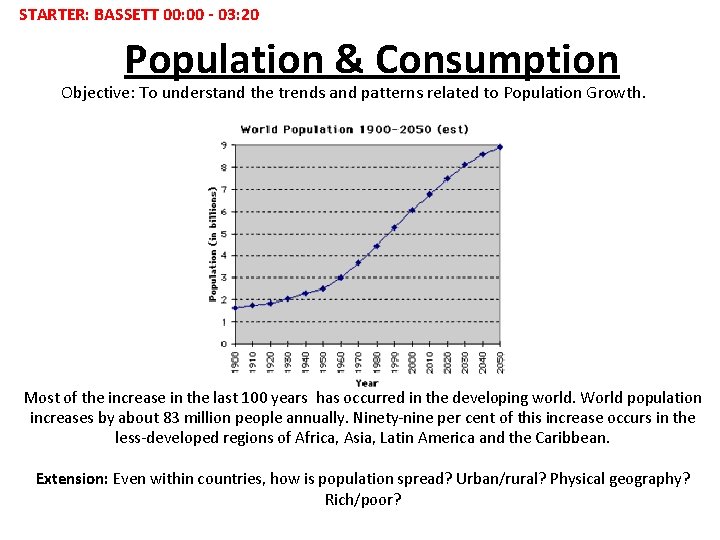
STARTER: BASSETT 00: 00 - 03: 20 Population & Consumption Objective: To understand the trends and patterns related to Population Growth. Most of the increase in the last 100 years has occurred in the developing world. World population increases by about 83 million people annually. Ninety-nine per cent of this increase occurs in the less-developed regions of Africa, Asia, Latin America and the Caribbean. Extension: Even within countries, how is population spread? Urban/rural? Physical geography? Rich/poor?
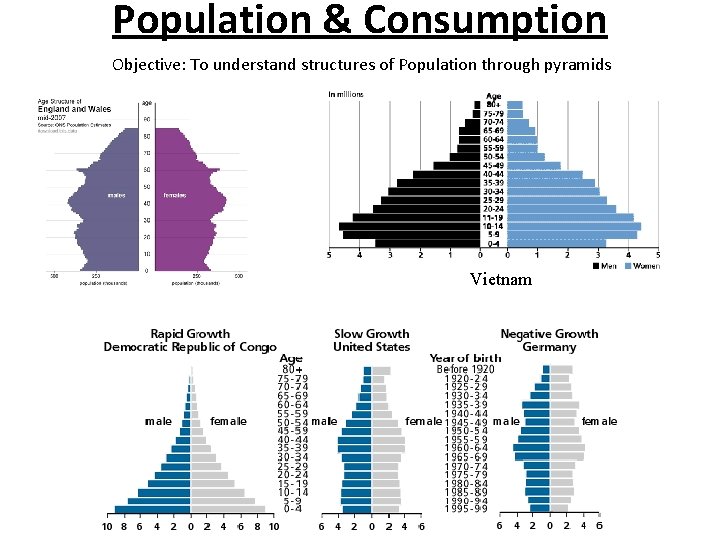
Population & Consumption Objective: To understand structures of Population through pyramids Vietnam
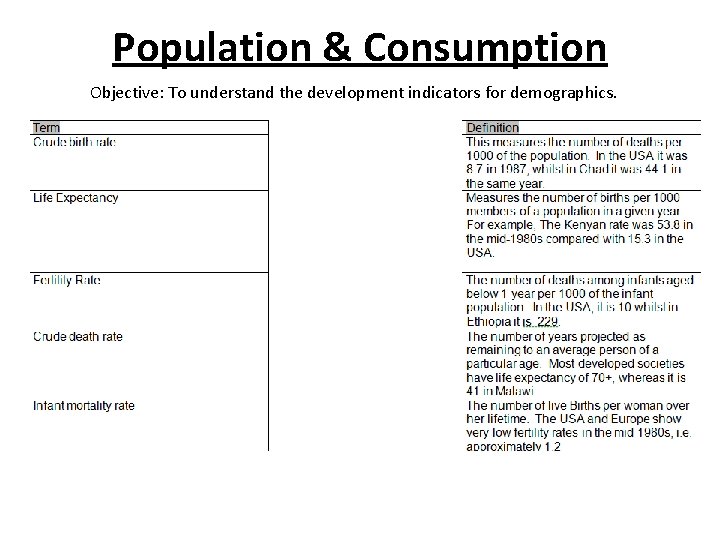
Population & Consumption Objective: To understand the development indicators for demographics.
Population & Consumption STARTER: BASSETT 03: 20 - 05: 40 Objective: To analyse and evaluate Malthusian & Neo. Malthusian Modernisation Theorists Worksheet Provided if necessary
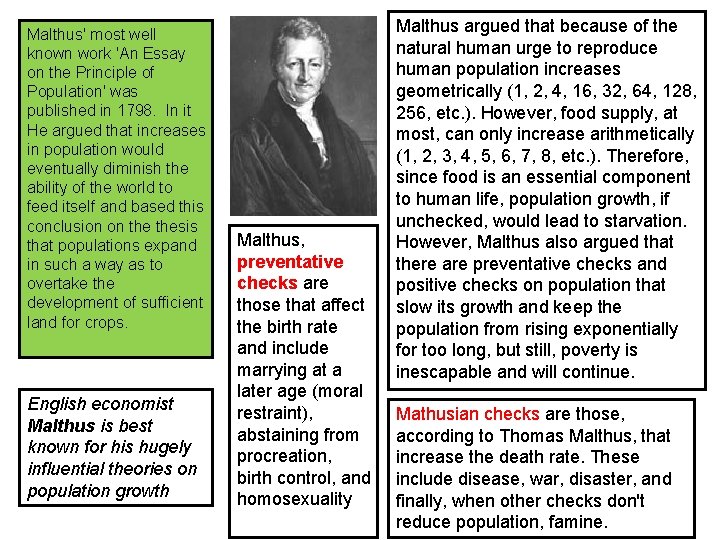
Malthus' most well known work 'An Essay on the Principle of Population' was published in 1798. In it He argued that increases in population would eventually diminish the ability of the world to feed itself and based this conclusion on thesis that populations expand in such a way as to overtake the development of sufficient land for crops. English economist Malthus is best known for his hugely influential theories on population growth Malthus, preventative checks are those that affect the birth rate and include marrying at a later age (moral restraint), abstaining from procreation, birth control, and homosexuality Malthus argued that because of the natural human urge to reproduce human population increases geometrically (1, 2, 4, 16, 32, 64, 128, 256, etc. ). However, food supply, at most, can only increase arithmetically (1, 2, 3, 4, 5, 6, 7, 8, etc. ). Therefore, since food is an essential component to human life, population growth, if unchecked, would lead to starvation. However, Malthus also argued that there are preventative checks and positive checks on population that slow its growth and keep the population from rising exponentially for too long, but still, poverty is inescapable and will continue. Mathusian checks are those, according to Thomas Malthus, that increase the death rate. These include disease, war, disaster, and finally, when other checks don't reduce population, famine.
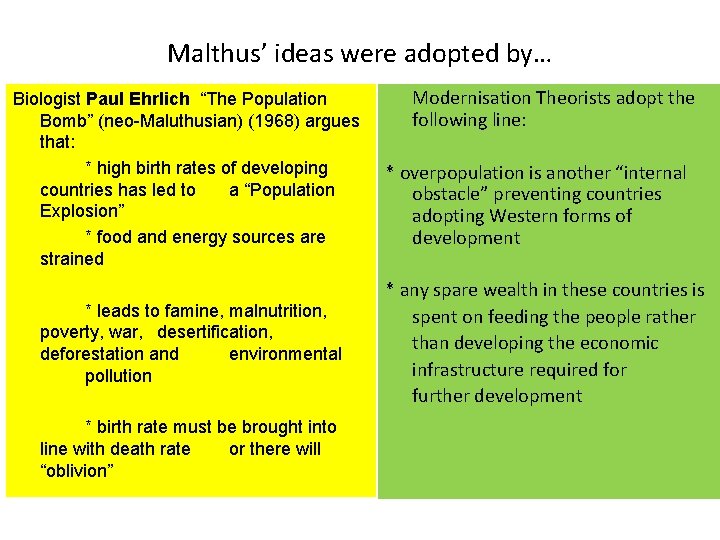
Malthus’ ideas were adopted by… Biologist Paul Ehrlich “The Population Bomb” (neo-Maluthusian) (1968) argues that: * high birth rates of developing countries has led to a “Population Explosion” * food and energy sources are strained * leads to famine, malnutrition, poverty, war, desertification, deforestation and environmental pollution * birth rate must be brought into line with death rate or there will “oblivion” Modernisation Theorists adopt the following line: * overpopulation is another “internal obstacle” preventing countries adopting Western forms of development * any spare wealth in these countries is spent on feeding the people rather than developing the economic infrastructure required for further development
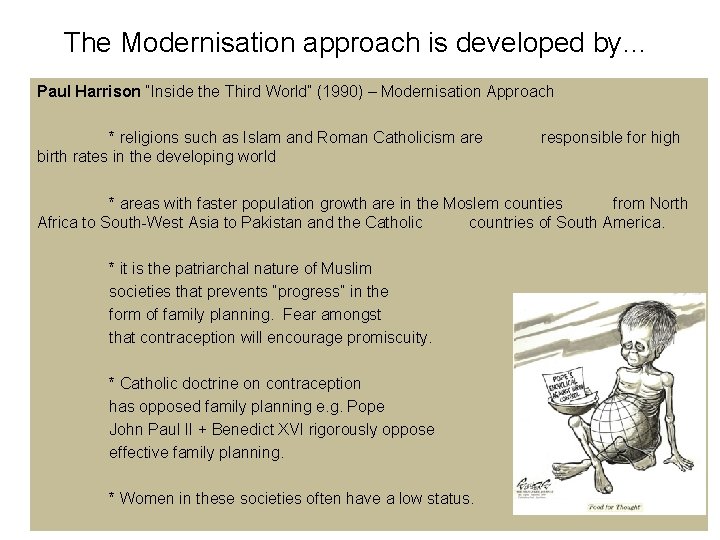
The Modernisation approach is developed by… Paul Harrison “Inside the Third World” (1990) – Modernisation Approach * religions such as Islam and Roman Catholicism are birth rates in the developing world responsible for high * areas with faster population growth are in the Moslem counties from North Africa to South-West Asia to Pakistan and the Catholic countries of South America. * it is the patriarchal nature of Muslim societies that prevents “progress” in the form of family planning. Fear amongst that contraception will encourage promiscuity. * Catholic doctrine on contraception has opposed family planning e. g. Pope John Paul II + Benedict XVI rigorously oppose effective family planning. * Women in these societies often have a low status.
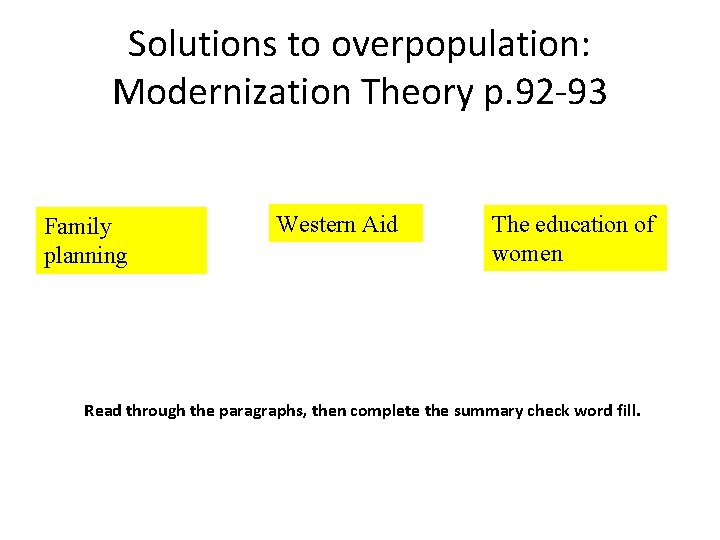
Solutions to overpopulation: Modernization Theory p. 92 -93 Family planning Western Aid The education of women Read through the paragraphs, then complete the summary check word fill.
Answers 1. 2. 3. 4. 5. 6. The work of Malthus and Ehrlich has been used by modernisation theorists who argue that over-population in the developing world is one of the biggest obstacles to development. Any economic surplus has to be spent on feeding the population and building an infrastructure to cope with increased population, instead of on industry. Modernisation theorists argue that the solution is to persuade governments to promote birth control and for Western governments and international agencies to fund birth control programmes. Modernisation theorists also suggest that money should be spent on educating women because educated women tend to have fewer babies. Ehrlich has even suggested that men in the developing world who have had 3 children or more should be sterilised. USAID (The United States Agency for International Development) currently spends around US $425 million a year on family planning programmes worldwide. Countries like China and Singapore have used legal restrictions and economic incentives to encourage their citizens to have fewer children.
Criticisms of Neo-Malthusianism • • • Cohen and Kennedy point out that predictions are usually based on current trends, however these may be un-reliable in the long term as ‘ people change their conduct in response to earlier plausible warnings. ’ e. g. annual growth rate in 1980 = 2%, 2000 = 1. 5%. Ehrlich’s predictions assumed that food and water supplies were at their limits in 1960 - however, food production not only increased, but increased faster than population growth because of advances in technology. Some governments/ regions e. g. the EU encourage overproduction and then the destroying of crops – Ehlrich = selective bias. (Carnell) Criticisms of Modernisation • analysis based on statistics may be flawed – unreliable data/recording difficulties • analysis may be distorted – people change their behaviour • scientific developments have greatly reduced death rates and hence population size – too much emphasis on birth rate factors
Population & Consumption STARTER: BASSETT 05: 40 - END Objective: To analyse and evaluate Marxist, Socialist & Dependency theories. Worksheet Provided if necessary
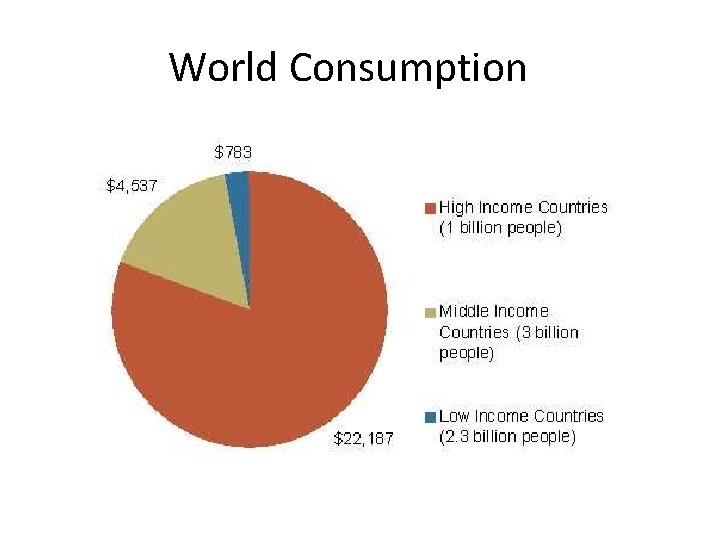
Dependency theory and population Dependency theory is critical of the idea that the LDCs’ populations are out of control and the idea that high population is responsible for the problems faced by LDCs today. First, Harrison points out that birth rates in the LDCs have not dramatically changed in the last 200 years. High population growth is mainly due to a dramatic decline in the death rate, especially the infant-mortality rate, which, ironically, is due to Western intervention in the fields of public hygiene, the processing of food and medical advances in the eradication of diseases such as smallpox and malaria. Second, there is little evidence that the world’s food resources are under strain. Food production has actually increased this century due to advances in technology. Moreover, European farmers are actually paid by the EC not to produce food because of surpluses in the West. A third argument suggests that the real cause of famine and its related problems is inequalities in access to land (and therefore food) rather than high population. Famine may occur where food production is high but land use is controlled by local élites and multinationals for cash-crop production. Such inequality causes high population because children are seen as economic assets by parents. They bring in extra income and can be a source of welfare support when their parents can no longer work. Therefore the decision to have large families may be rational. Dependency theory argues that the real problem is not population but the unequal global distribution of resources and power between the developed nations and the LDCs. It is pointed out that the world has the space, the wealth, the resources and productive capacity to provide a decent standard of living for all, but that the West monopolises the consumption of food and energy resources. For example, the USA has 6% of the world’s population but consumes 40% of its resources. In their lifetime, an average person in the West will consume 30 times the resources that an average person in the Third World consumes. This means that the 16 million babies born a year in the West put more strain on the world’s resources than the 119 million babies born in the Third World. Finally, dependency theory claims that high population in the LDCs suits Western interests because it keeps the LDCs in a constant state of dependency and distracts from the real causes of Third-World problems such as inequalities in
Dependency Summary Fill in the Gap 2 Answers • There’s not a lot of evidence that food resources aren’t coping. Food production has increased, and the world has the capacity to produce more food than it produces now, although it might be difficult to do this sustainably. Boserup (1965) said that population increase determines environmental change, so that agricultural production always keeps up with the population. • Dependency theorists argue that the West continues to take the very best resources a developing nation has, leaving the inhabitants with little land of any quality. Land reform and redistribution to the poor would be a better solution than agricultural control. • Adamson (1986) says focusing on population growth can distract us from the real causes of poverty and starvation. He believes the real causes are an unfair distribution of resources. We should look at the developed world’s contribution to these problems, e. g. overconsumption, environmental damage and economic exploitation of the developing world. (Adamson points out that in 1986, an American used up on average 300 times more energy than a Bangladeshi) • Adamson also suggests that poverty causes high population. Poverty faces parents to see children as economic assets who will bring money into the household and support them in old age. Where there are high levels of infant mortality parents have more children to increase the chances of at least one surviving into childhood.
Socialist / Marxist / Dependency Explanations for World Population Growth Socialist /Marxist approach: * Mamdani (1996) believes that economic inequalities within developing countries are neglected. * these inequalities are the legacies of colonialism e. g. in S. America 47% the land is owned by 2% of the pop. * land is also monopolised by western multinationals in order to produce cash crops for export – even when malnutrition is high in own country. * poverty is the real concern not overpopulation * economic prosperity will slow down birth rates as costs of supporting a child will increase * birth control programmes will fail if poverty is not tackled – children will always provide an alternative income source * development is the best contraceptive * improved living standards, better public health will decrease death and infant-mortality rates * children more likely to survive with better education and move towards urbanisation Dependency theorist Adamson (1986) believes: * unequal distribution of resources –food/energyare major cause of poverty * focus should be on over-consumption and waste in the West *average American consumes 300 times as much energy as average Bangladeshi * USA with 6% of worlds pop. Consumes 40% of its resources * oversupply of food takes place and is controlled by Western governments to maintain economic stability rather than tackle shortages in the LDC’s FURTHER NOTES USING p. 94 -95
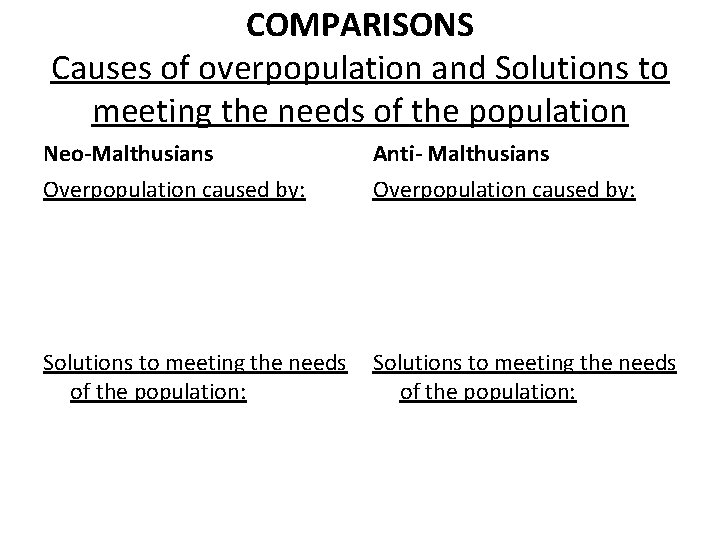
COMPARISONS Causes of overpopulation and Solutions to meeting the needs of the population Neo-Malthusians Overpopulation caused by: Anti- Malthusians Overpopulation caused by: Solutions to meeting the needs of the population:
COMPARISONS Causes of overpopulation and Solutions to meeting the needs of the population Neo-Malthusians Anti- Malthusians Overpopulation caused by: High birth rate Patriarchal control of women Religious influence Overpopulation caused by: Poverty Improved Healthcare Inequality (Class systems) Solutions to meeting the needs of the population: Education Sterilisation Family Planning Solutions to meeting the needs of the population: Eradication of poverty Land reform Healthcare improvement Reform of West’s ownership/consumption of resources
World Consumption
Sociological theories test – Population and consumption Who was Malthus? • Outline Malthusian theory • Who was Paul Ehrlich? • What did Ehrlich believe would happen to the population? • What is the view of modernisation theorists to population growth? • What are some of the suggested solutions to population growth? • Which religions are responsible for high population growth and why? • Which areas of the world have a fast rate of population growth and why? • What are some of the critiques of modernisation theory and population growth? * Summarise the opinions from Anti-Malthusian theorists.