
Population and migration Mindjog One of the concepts
- Slides: 33
Population and migration
Mindjog • One of the concepts studied in this unit was Thomas Malthus. Explain what Malthus believed, when studying population and migration.
Demographic Transition Model • the transition from high birth and death rates to lower birth and death rates as a country or region develops from a pre-industrial to an industrialized economic system. • suggests that a country's total population growth rate cycles through stages as that country develops economically.
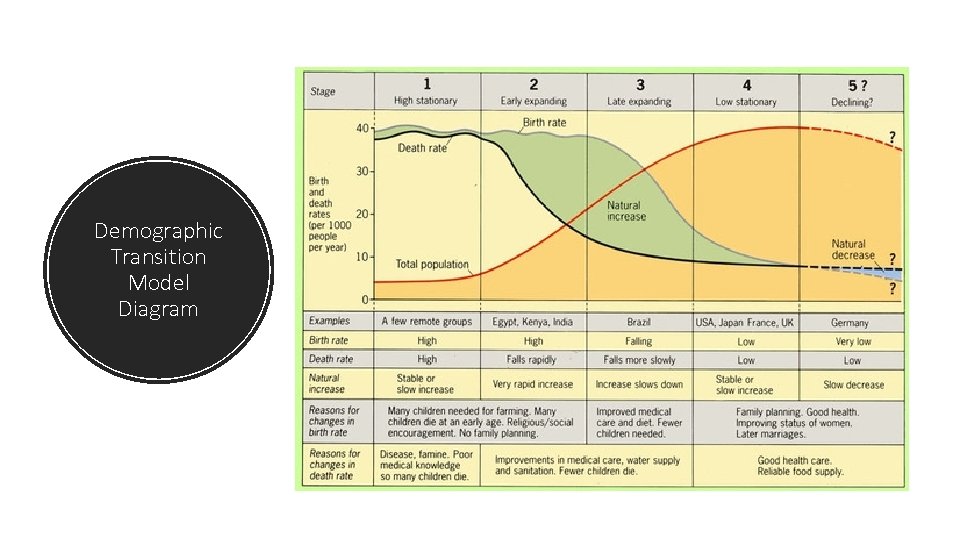
Demographic Transition Model Diagram
Stage 1 • High stationary • A few remote groups • High birth rate - many children needed to work in farms, many children die at an early age, religious/ social encouragement, no family planning • High death rate - disease, famine, poor medical knowledge • Natural increase rate is relatively stable
Stage 2 • Early expanding • High birth rate • Death rate falls dramatically -improved medical care, water supply, and sanitation • Natural increase rate increases rapidly -many children needed to work in farms, many children die at an early age, religious/ social encouragement, no family planning • Examples: Egypt, Kenya, India
Stage 3 • Late expanding • Example: Brazil • Birth rate decreasing -improved medical care and diet, fewer children needed • Death rate decreasing (at a slower rate than birth rate) -improved medical care, water supply, and sanitation • Natural increase rate slows down
Stage 4 • Low stationary • Examples: USA, Japan, France, UK • Low birth rate -family planning, good health, improved status of women, later marriages • Low death rate -good health care, reliable food supply • Stable or slow increase in natural increase rate
Stage 5 • Decline • Example: Germany • Birth rate is very low • Death rate is low • Slow decrease in natural increase rate
Epidemiological Transition Stages • Epidemiology is a branch of medical science that studies the distribution of disease in human populations • As the Epidemiological Transition moves forward through the four stages, the life expectancy increases over time • Coincides with the demographic transition model
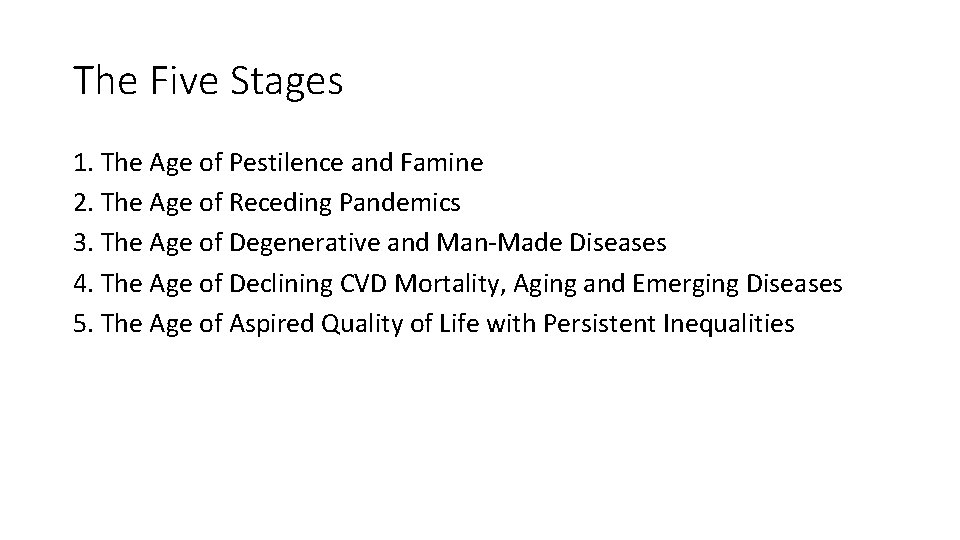
The Five Stages 1. The Age of Pestilence and Famine 2. The Age of Receding Pandemics 3. The Age of Degenerative and Man-Made Diseases 4. The Age of Declining CVD Mortality, Aging and Emerging Diseases 5. The Age of Aspired Quality of Life with Persistent Inequalities
Pestilence and Famine • infectious and parasitic diseases are principal causes of human deaths as well as accidents/attacks by animals and other humans • Mortality rate is high and fluctuating • Average life expectancy after birth is low (20 to 40 years) • The Black Plague was the most violent of the epidemics of this stage • Sustained population growth • An increase in infectious diseases, mal-nutrition and famine • Experienced in the Neolithic Age
Receding Pandemics • pandemics are widespread and highly affecting diseases, decreased by improved sanitation, nutrition, medicine • Mortality progressively decreases • Average life expectancy increases (30 to 50 years) • Population growth is sustained (begins to be exponential)
Degenerative and Man-Made Diseases • decrease in death by infectious disease and increase in chronic disorders associated with aging (heart attacks, cancer, cardiovascular diseases) • Mortality continues to decline and eventually approaches stability at a relatively low level
Declining CVD Mortality, Aging and Emerging Diseases • Low but increasing crude death rate • Same causes of death as stage 3 • Medical advances extend lifespan
Aspired Quality of Life with Persistent Inequalities • infectious diseases evolve and return or emerge • spread easier in poor areas with unsanitary conditions (LDCs) • improved transportation allows for spread of disease • Death rate becomes higher than birth rate • Negative population growth (not an immediate effect)
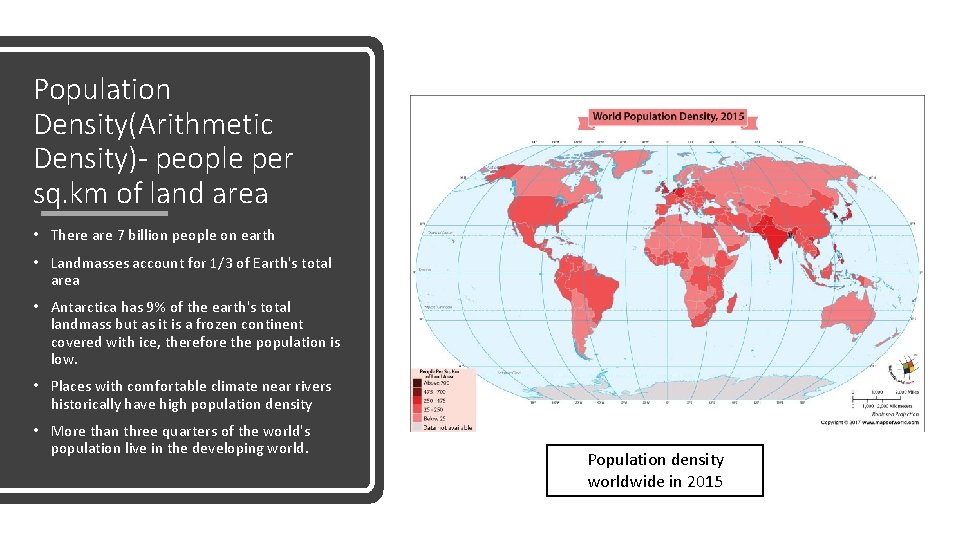
Population Density(Arithmetic Density)- people per sq. km of land area • There are 7 billion people on earth • Landmasses account for 1/3 of Earth's total area • Antarctica has 9% of the earth's total landmass but as it is a frozen continent covered with ice, therefore the population is low. • Places with comfortable climate near rivers historically have high population density • More than three quarters of the world's population live in the developing world. Population density worldwide in 2015
• The countries with the highest population don't always have the highest population density. The # of people is relative to the size or space they occupy. • Asia has some of the most densely populated countries within it. Europe has the second highest population density in the world. It accounts for 6% of Earth's landmass and 11% of earth's population • Africa has a low population density, although it is the second largest continent. • Bangladesh is the country with the highest population density because it has 1034 people per square kilometer. Most and least populous places • Typically, areas with deserts and high mountains have a low population density. • Mongolia is a very large country with a very low population density • Iceland, Surinam, Botswana and Namibia also have low population density Population concentrations The five largest population clusters South Asia East Asia Southeast Asia Europe North America
• Ecumene- the portion of the earth with permanent human settlement • Ecumene expansion: Expansion of human habitation into historically sparsely populated regions • Dry Lands • Wet lands • Cold Lands • High Lands • Physiological Density: • Total number of people divided by the arable land of the country • The higher the physiological density the greater the pressure that people place on the land to produce food.
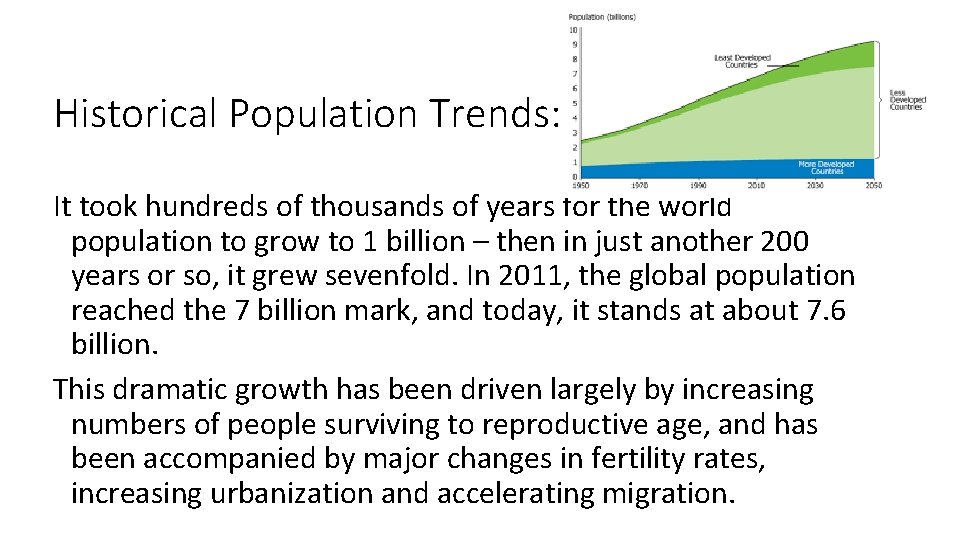
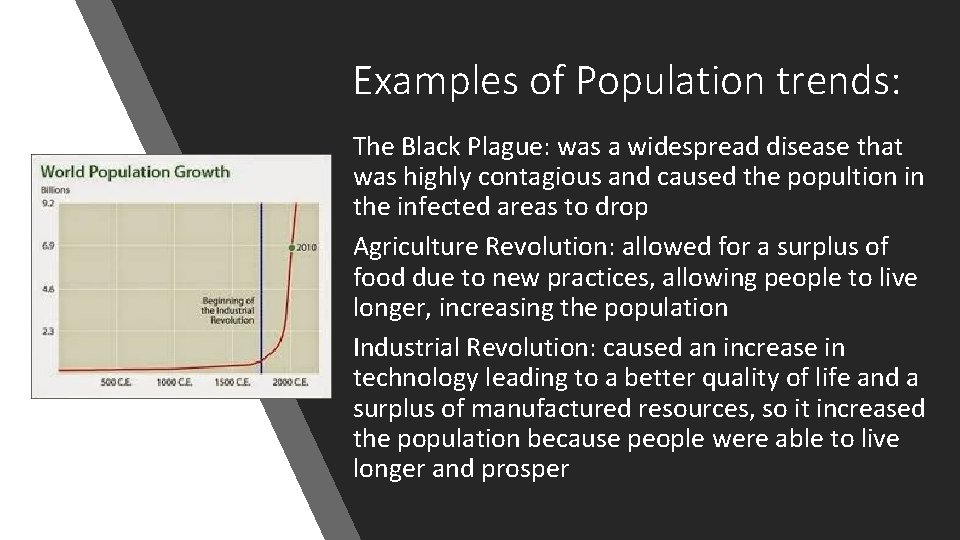
Historical Population Trends: It took hundreds of thousands of years for the world population to grow to 1 billion – then in just another 200 years or so, it grew sevenfold. In 2011, the global population reached the 7 billion mark, and today, it stands at about 7. 6 billion. This dramatic growth has been driven largely by increasing numbers of people surviving to reproductive age, and has been accompanied by major changes in fertility rates, increasing urbanization and accelerating migration.
Examples of Population trends: The Black Plague: was a widespread disease that was highly contagious and caused the popultion in the infected areas to drop Agriculture Revolution: allowed for a surplus of food due to new practices, allowing people to live longer, increasing the population Industrial Revolution: caused an increase in technology leading to a better quality of life and a surplus of manufactured resources, so it increased the population because people were able to live longer and prosper
Movement Cyclic movement: commuting, nomadic, seasonal, shorter period of time away Periodic movement: return home, migrant labor, military service, longer period of time away
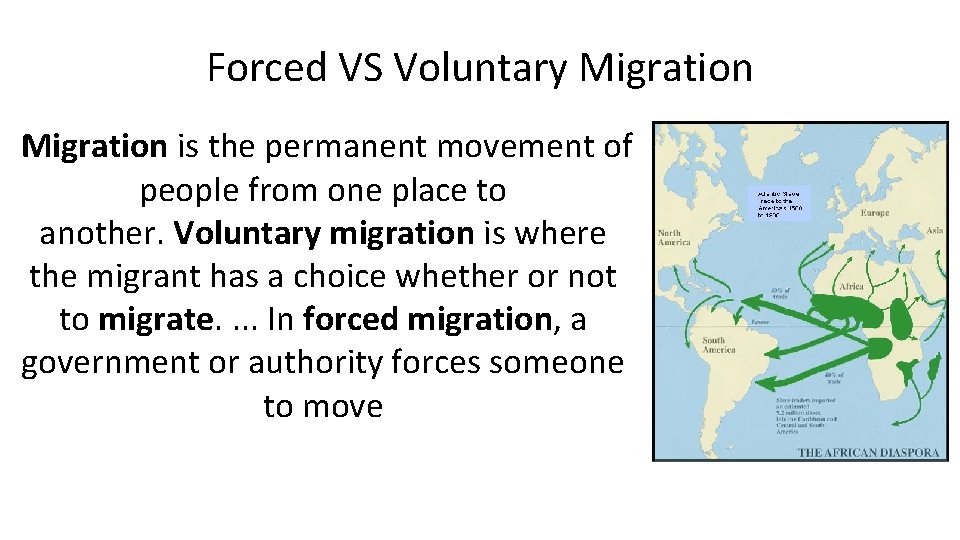
Forced VS Voluntary Migration is the permanent movement of people from one place to another. Voluntary migration is where the migrant has a choice whether or not to migrate. . In forced migration, a government or authority forces someone to move
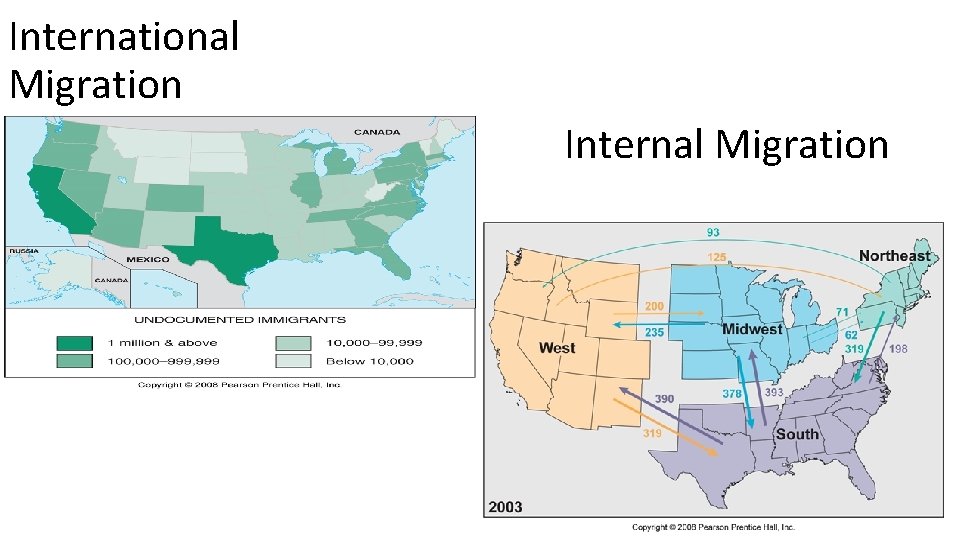
International Migration Internal Migration
Ravenstein's Laws • Every migration flow generates a return or counter migration • Majority of migrants move a short distance • Migrants who move longer distances tend to choose big city destinations
Ravenstein's Laws • Urban residents are less migratory than inhabitants are rural areas • Families are less likely to make international moves than young adults
Types of Push and Pull Factors • Economic conditions (great depression, move away from the poverty) • Political circumstances (you don’t like your president, you move away) • Armed conflict and civil war (civil war in your country, move for safety) • Enviromental conditions (move to Miami because its warm) • Culture and traditions • Technological advances (move to America because you want better technology)
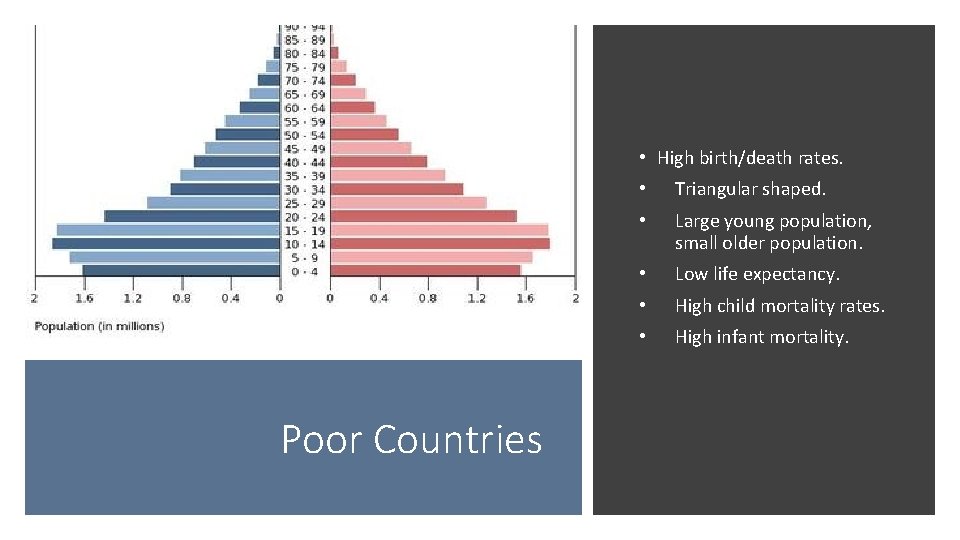
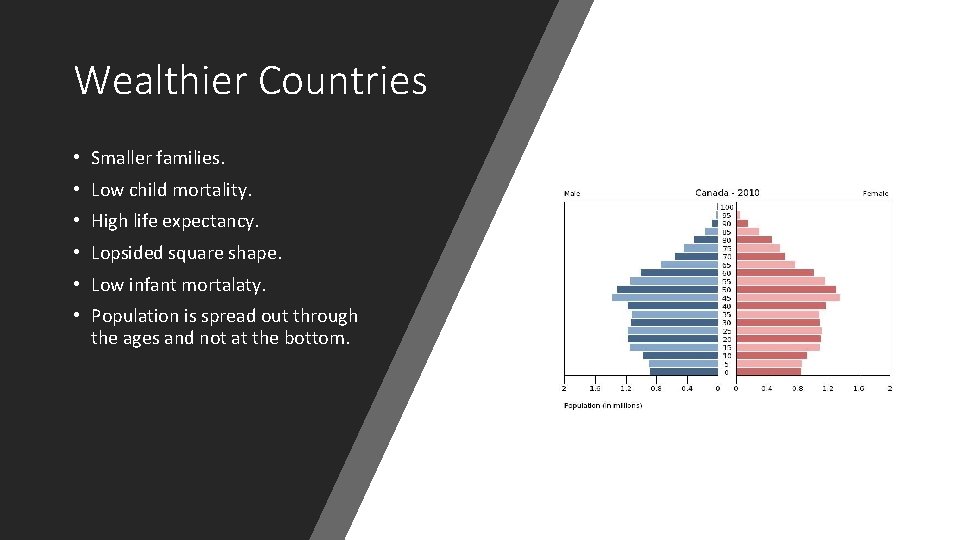
The configuration of a population based on age, and gender, as well as education. Population Pyramids When studying age and gender in a population, geographers use the population to have a visual representation of the data.
• High birth/death rates. Poor Countries • Triangular shaped. • Large young population, small older population. • Low life expectancy. • High child mortality rates. • High infant mortality.
Wealthier Countries • Smaller families. • Low child mortality. • High life expectancy. • Lopsided square shape. • Low infant mortalaty. • Population is spread out through the ages and not at the bottom.
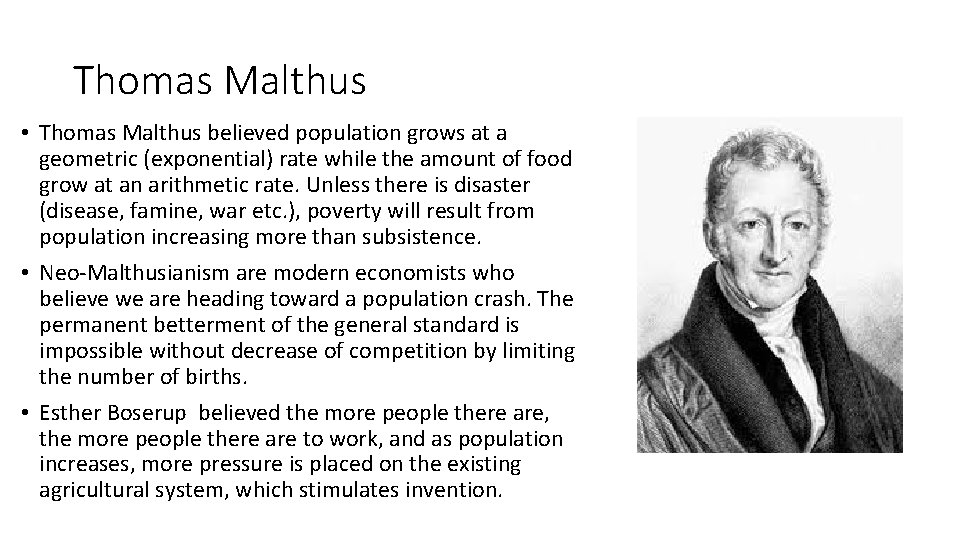
Thomas Malthus • Thomas Malthus believed population grows at a geometric (exponential) rate while the amount of food grow at an arithmetic rate. Unless there is disaster (disease, famine, war etc. ), poverty will result from population increasing more than subsistence. • Neo-Malthusianism are modern economists who believe we are heading toward a population crash. The permanent betterment of the general standard is impossible without decrease of competition by limiting the number of births. • Esther Boserup believed the more people there are, the more people there are to work, and as population increases, more pressure is placed on the existing agricultural system, which stimulates invention.
Population Growth and Decline • Crude Birth Rate is the total number of live births in a year for every 1000 people alive in the society. Higher statistics in less developed countries. • Crude Death Rate is the total number of deaths in a year for every 1000 people alive in the society. High rates in Eastern Europe and Central Africa. • Infant Mortality Rate is the total number of deaths in a year among infants under one year old for every 1000 people in a society. The highest rate is in Angola (96/1000) and the lowest is in Japan and Finland (2. 3/1000).
• Total Fertility Rate is the average number of children that could be born to a woman over her lifetime in a given population. • Natural Increase Rate is the percentage growth of a population in a year. This is measured by subtracting the equation Crude Birth Rate – Crude Death Rate= NIR • Zero Population Growth is the decline in the total fertility rate to the point where the natural increase rate equals zero. For the increase rate to be zero every woman must have 2. 1 children.