
Population An Introduction Population defined A population is
- Slides: 17
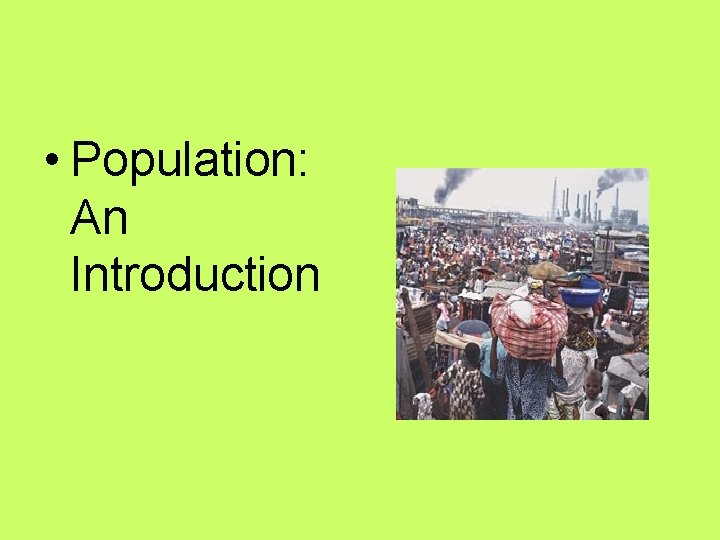
• Population: An Introduction
Population -- defined • A population “is a group of people living within a particular region or space with well -established boundaries” (from Falk, 2005) • Population can also be the total number of people who live in a particular region – for example, • Canada -- 34, 755, 634 • British Columbia 4, 606, 451 • Fort St. James 1, 691
World Population – Ultra-Rapid Growth • World’s population is growing exponentially • This means the world’s population has grown rapidly over a short period of time • A lot of the population growth has occurred since 1800 and especially since 1900
Some Numbers … • By 1 CE, the world’s population was over 250 million • World’s population reached 1 billion by 1800 • Around 1930, the world’s population had doubled to 2 billion • In 1960, the world’s population was 3 billion • So, in just over 160 years, population had tripled
• Today, the world’s population is over 7 billion – took only 40 years to more than double from what it was in 1960 • World’s population is increasing by 80 million annually • By 2025, world’s population will be 8 billion • United Nations demographers project that the population may reach 9 billion before 2050 – in 2045
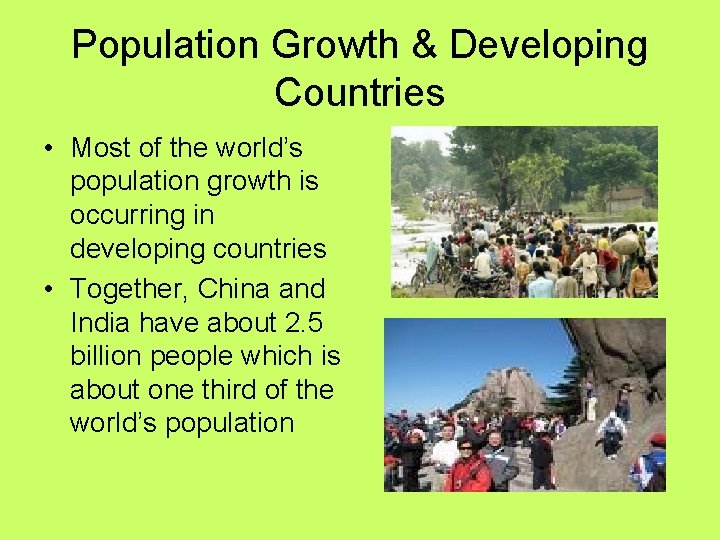
Population Growth & Developing Countries • Most of the world’s population growth is occurring in developing countries • Together, China and India have about 2. 5 billion people which is about one third of the world’s population
• 80% of the world’s people live in developing countries – many of these countries experience steady population and economic growth, but are characterized by low standards of living
Factors That Lead to Population Growth • Economic Growth – when economy is booming and its citizens are prospering, parents have the confidence that they can afford more children • Industrial Revolution of 19 th century transformed society from an agricultural society to one based on factory jobs • This led to an improved standard of living and, as a result, a rapid population increase occurred
Poverty • Population growth can result not just from economic prosperity, but also from poverty • People living in poverty tend to be less educated and less knowledgeable about birth control methods and family planning
• In developing countries, poor families may have more children out of custom or as a means to acquire status • As these poor families continue to produce large families from generation to generation, the population continues to increase at a rapid rate
Increased Life Expectancy • Advances in medical care, food production, nutrition, sanitation, and physical fitness contributed to longer life expectancy, meaning more people • Infant mortality rate has also improved • More people surviving to adulthood means there are more people to create additional babies
Major Events • Sometimes, certain major events, such as a long war, can lead to population growth • After the end of World War II, many countries experienced a baby boom • Many of the returning soldiers got married and started families shortly after the Second World War ended • The population growth was also fueled by a strong economy in the 1950 s when people began to leave the cities to settle in the suburbs
What are the limits of population growth? • The number of people the Earth can support is called its carrying capacity. • The idea that there are limits to the number of people that the Earth’s resources can support is not a new one • In the late 18 th century, economist Thomas Malthus predicted that an ever-increasing population in Britain would eventually outpace the production of food and lead to starvation
• Malthus argued that because of the natural human urge to reproduce, human population increases geometrically (1, 2, 4, 8, 16, 32, 64, 128, 256, etc. ) • However, food supply, at most, can only increase arithmetically (1, 2, 3, 4, 5, 6, 7, 8, etc. ) • Since food is essential to human life, population growth in any area or on the planet, if unchecked, would lead to starvation
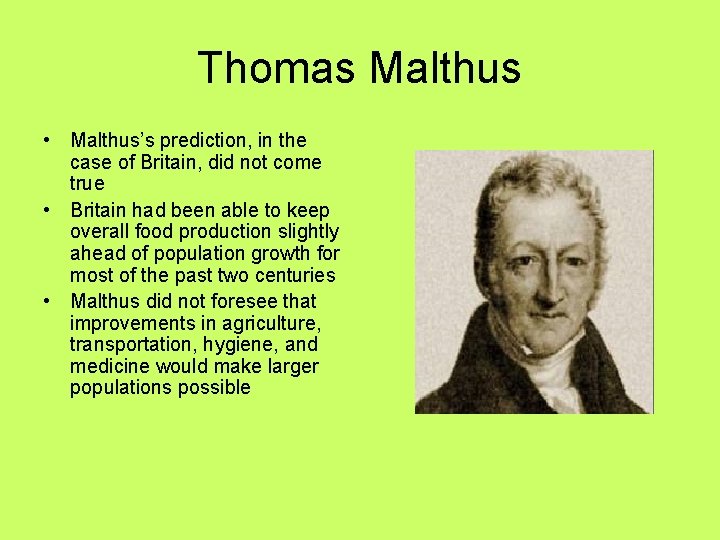
Thomas Malthus • Malthus’s prediction, in the case of Britain, did not come true • Britain had been able to keep overall food production slightly ahead of population growth for most of the past two centuries • Malthus did not foresee that improvements in agriculture, transportation, hygiene, and medicine would make larger populations possible
• However, some thinkers called neo-Malthusians argue that in the long term Malthus was right • The most pessimist of this group think that the world’s population has already exceeded a reasonable limit and we have gone beyond the point of recovery → the momentum of the world’s population explosion is too great and that the planet’s resources have been damaged irreparably
Group Work Assignment • Break into small groups • Brainstorm/write out your ideas • What are the social, economic, political and environmental problems posed by population growth? • Before you begin, let’s make sure we are clear about what we mean by social, economic, political, and environmental