
POP Model Intercomparison Studies Supported by OECD and
POP Model Intercomparison Studies Supported by OECD and EMEP Martin Scheringer Swiss Federal Institute of Technology Zürich EMEP Task Force on Measurements and Modelling Zagreb 5 April 2005
Overview F OECD model comparison study F EMEP model comparison study F Similarities and differences, outlook
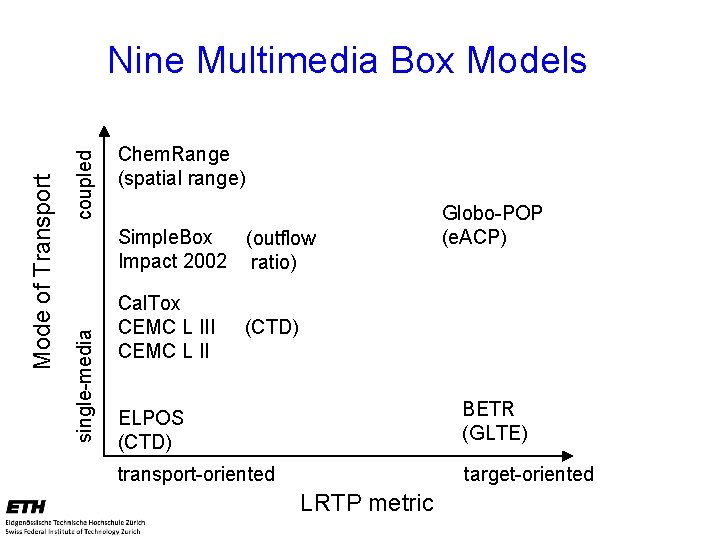
coupled Chem. Range (spatial range) Simple. Box (outflow Impact 2002 ratio) single-media Mode of Transport Nine Multimedia Box Models Cal. Tox CEMC L III CEMC L II Globo-POP (e. ACP) (CTD) ELPOS (CTD) BETR (GLTE) transport-oriented target-oriented LRTP metric
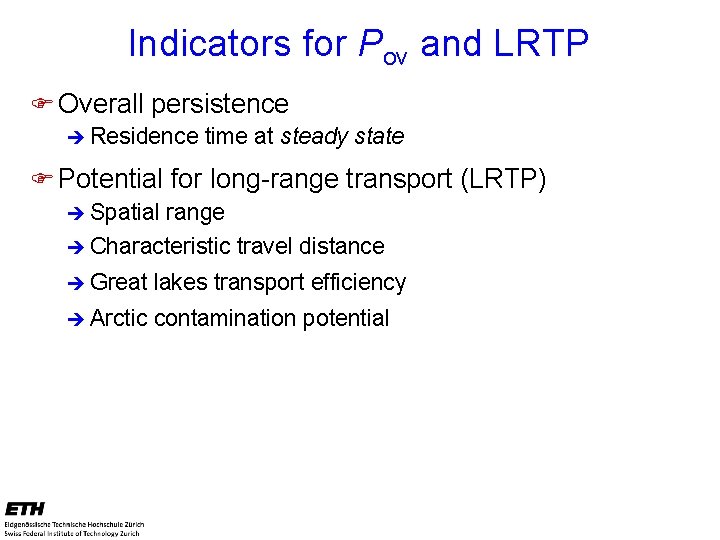
Indicators for Pov and LRTP F Overall persistence è Residence time at steady state F Potential for long-range transport (LRTP) è Spatial range è Characteristic travel distance è Great lakes transport efficiency è Arctic contamination potential
3175 Hypothetical Chemicals F Variation of è half-life in air: 5 steps from 4 h to 8760 h (1 year) è half-life in water: 5 steps from 1 day to 10 years –> half-life in soil: t 1/2, s = 2·t 1/2, w –> half-life in sediment: t 1/2, sed = 10·t 1/2, w è log Kaw from – 11 to 2 in units of 1 è log Kow from – 1 to 8 in units of 1 è additional restriction: log Koa between – 1 and 15 F Result: 3175 combinations, called hypothetical chemicals
Pov, Chem. Range t 1/2 w = 1 day atmospheric lifetime of aerosol particles t 1/2 w = 7 days t 1/2 w = 42 days t 1/2 w = 365 days t 1/2 w = 10 years a: t 1/2 a = 4 h b: t 1/2 a = 1 d c: t 1/2 a = 7 d d: t 1/2 a = 42 d e: t 1/2 a = 1 y
Results OECD Model Comparison F For many chemicals, models yield similar results. F Chemicals with strongly different results in two models: è What model environment is most appropriate for what context/purpose? è Land: freshwater and sediment; water shallow; no transport in water; high net deposition of POPs to soils è Ocean water: water much deeper; transport in water relevant; export to deep ocean relevant, net deposition of POPs to surface lower
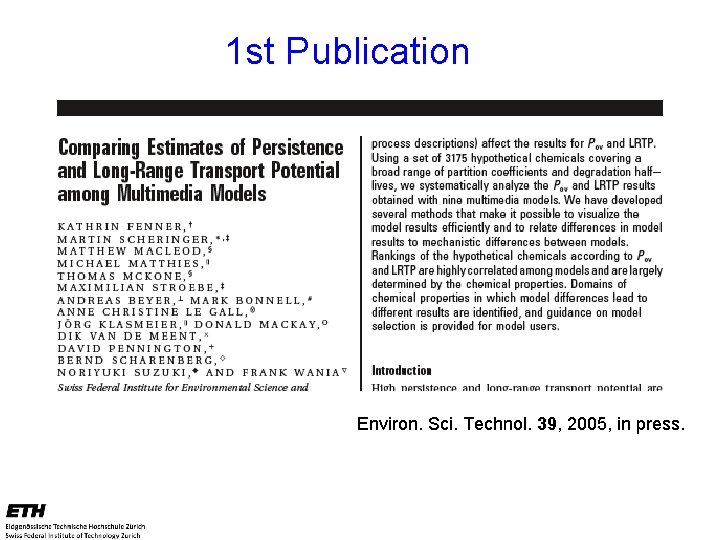
1 st Publication Environ. Sci. Technol. 39, 2005, in press.
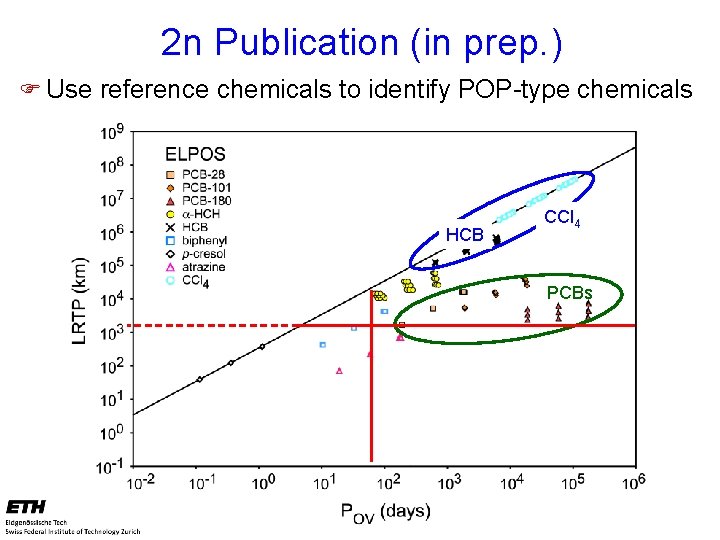
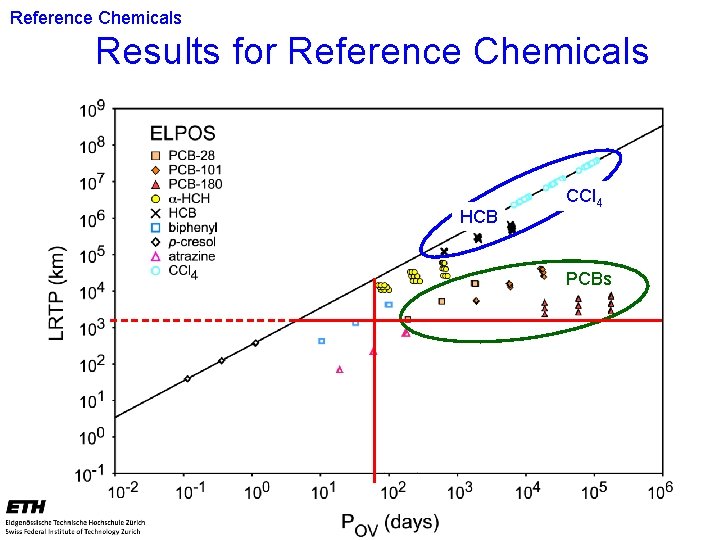
2 n Publication (in prep. ) F Use reference chemicals to identify POP-type chemicals HCB CCl 4 PCBs
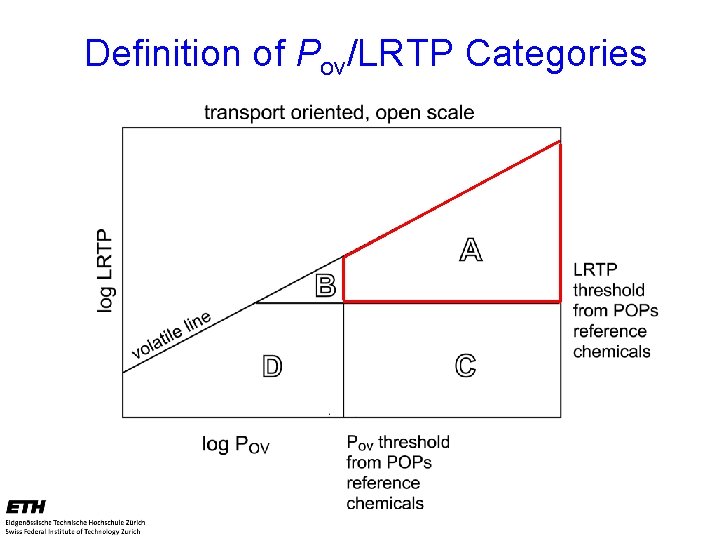
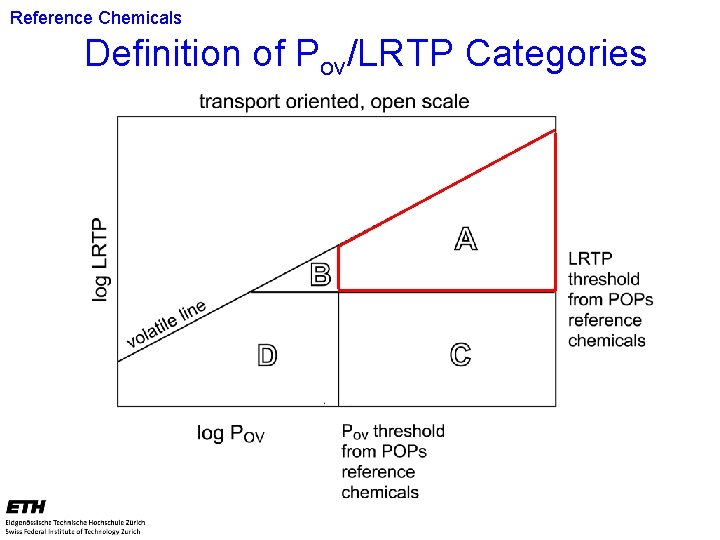
Definition of Pov/LRTP Categories
Ending of OECD Study F Workshop at ETH Zürich, 30– 31 August 2005 è Supported by Swiss and German Environmental Agencies and by OECD and UNEP è Presentation of a „unified“ multimedia box model for Pov and LRTP screening, based on the nine models of the OECD study.
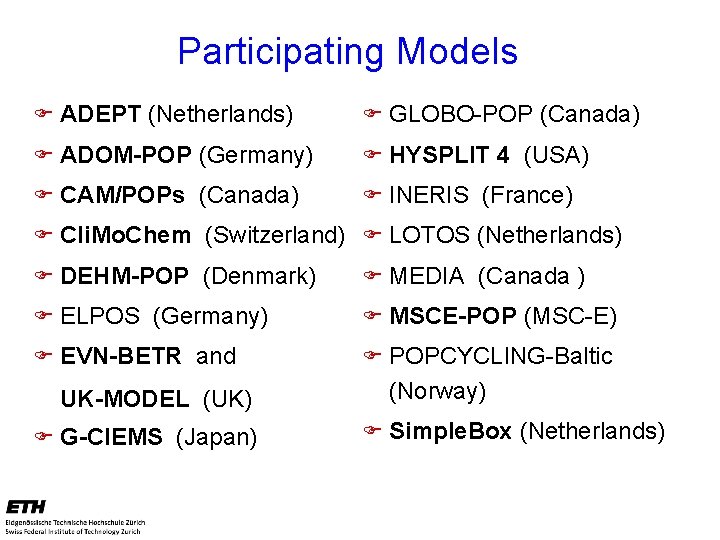
EMEP Model Intercomparison Study F 10 highly different models F Different purposes and „endpoints“ F Planned in three stages, start March 2002 (TFMM meeting Geneva) è Stage I: individual phase transfer processes è Stage II: mass balances and concentration and deposition fields; sensitivity analysis è Stage III: persistence and long-range transport potential F Three expert meetings in Moscow (2002– 2005) F Current status: stage I finished, stage II nearly finished, stage III started
Participating Models F ADEPT (Netherlands) F GLOBO-POP (Canada) F ADOM-POP (Germany) F HYSPLIT 4 (USA) F CAM/POPs (Canada) F INERIS (France) F Cli. Mo. Chem (Switzerland) F LOTOS (Netherlands) F DEHM-POP (Denmark) F MEDIA (Canada ) F ELPOS (Germany) F MSCE-POP (MSC-E) F EVN-BETR and F POPCYCLING-Baltic UK-MODEL (UK) F G-CIEMS (Japan) (Norway) F Simple. Box (Netherlands)
Stage I: Individual Processes (I) F Wet deposition concentration of PCB 153 in precipitation T, °C
Stage I: Individual Processes (II) F Air-seawater exchange concentration of PCB 153 in seawater 30 74
Stage II: Mass Balances (I) F Mass fractions of PCB 153 in soil
Stage II: Mass Balances (II) F Masses of PCB 153 in air
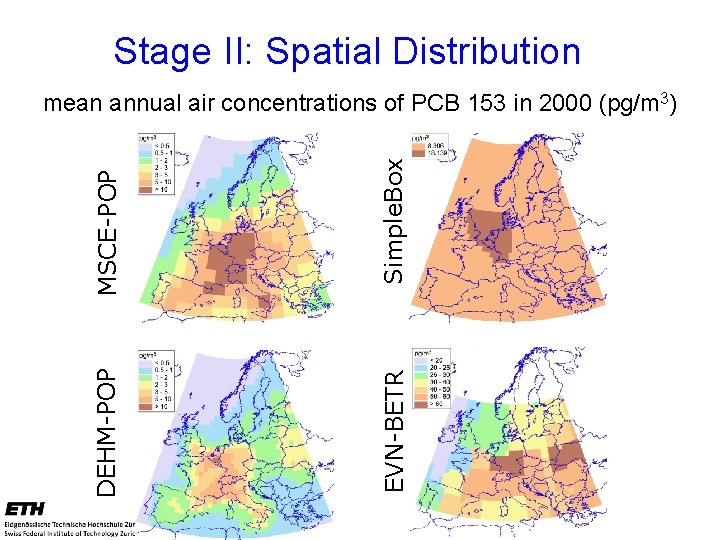
Stage II: Spatial Distribution MSCE-POP Simple. Box DEHM-POP EVN-BETR mean annual air concentrations of PCB 153 in 2000 (pg/m 3)
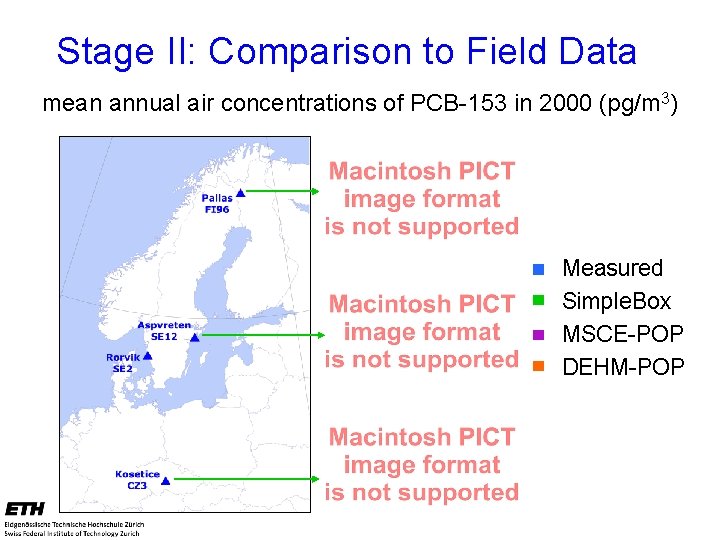
Stage II: Comparison to Field Data mean annual air concentrations of PCB-153 in 2000 (pg/m 3) Measured Simple. Box MSCE-POP DEHM-POP
Main Results, Benefits F Improved understanding of individual environmental processes è Gaseous exchange air-soil è Wet deposition è… F Consistent sets of chemical property data and of process descriptions F Understanding of similarities and differences among models (box models vs. atmospheric dispersion models) F Model improvement
Next Steps F Stage II: è Analysis of mechanistical causes of differences in mass balances, mass fluxes etc. F Stage III: è Use reference chemicals from OECD study è Rank reference chemicals according to Pov and LRTP in all models è Analyze reasons for differences
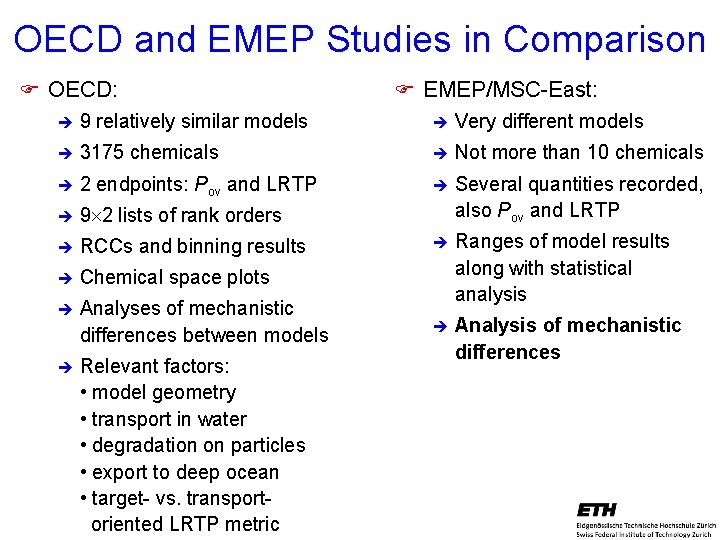
OECD and EMEP Studies in Comparison F OECD: F EMEP/MSC-East: è 9 relatively similar models è Very different models è 3175 chemicals è Not more than 10 chemicals è 2 endpoints: Pov and LRTP è è 9 2 lists of rank orders Several quantities recorded, also Pov and LRTP è RCCs and binning results è è Chemical space plots è Analyses of mechanistic differences between models Ranges of model results along with statistical analysis è è Relevant factors: • model geometry • transport in water • degradation on particles • export to deep ocean • target- vs. transportoriented LRTP metric Analysis of mechanistic differences
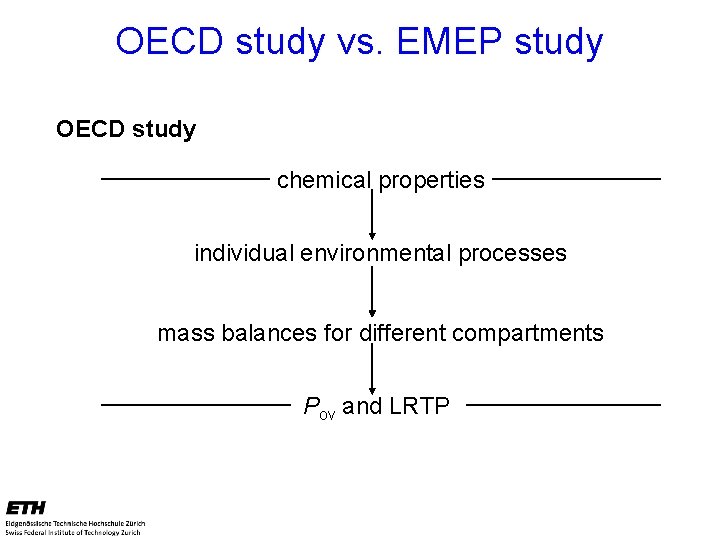
OECD study vs. EMEP study OECD study chemical properties individual environmental processes mass balances for different compartments Pov and LRTP
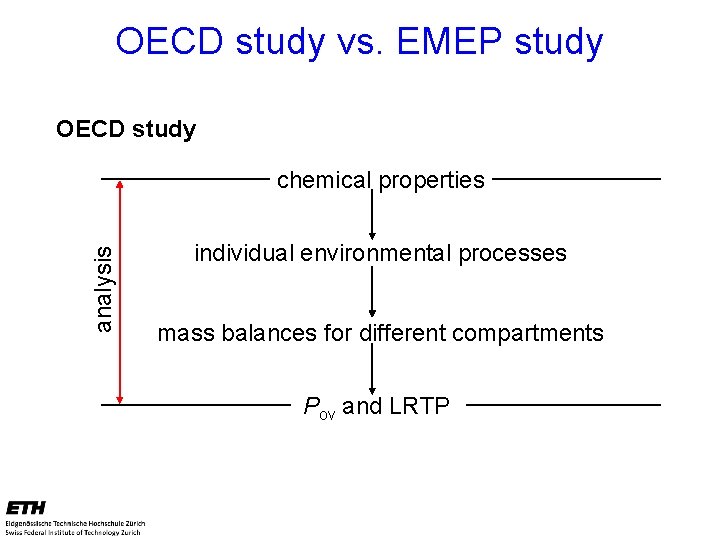
OECD study vs. EMEP study OECD study analysis chemical properties individual environmental processes mass balances for different compartments Pov and LRTP
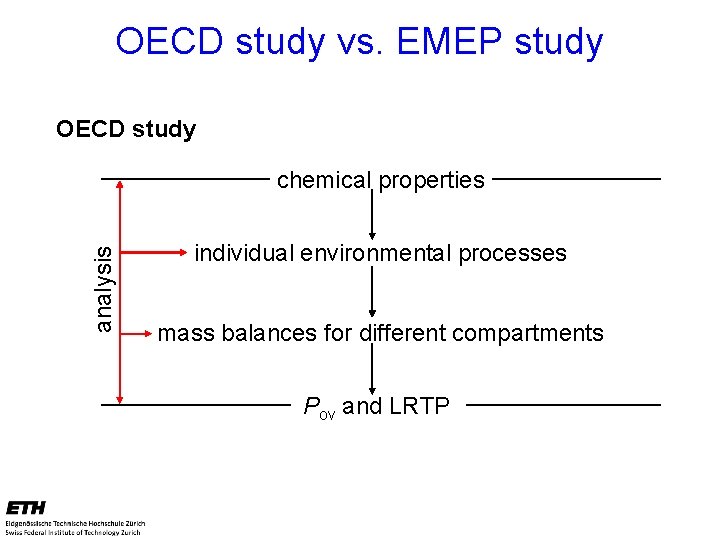
OECD study vs. EMEP study OECD study analysis chemical properties individual environmental processes mass balances for different compartments Pov and LRTP
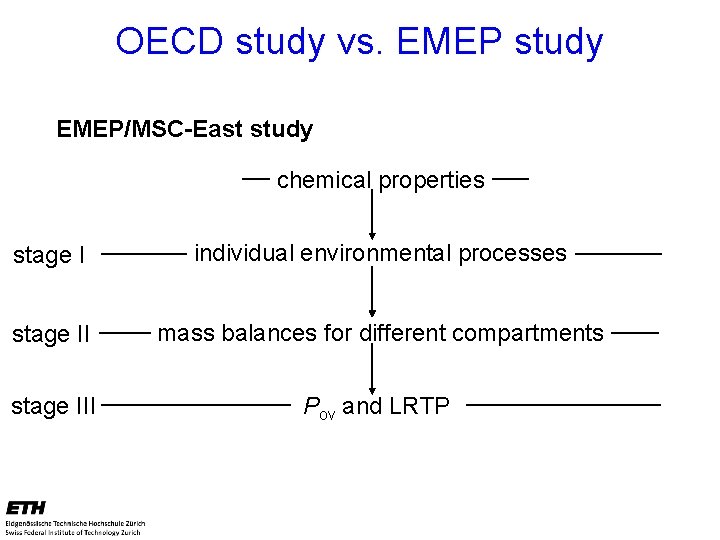
OECD study vs. EMEP study EMEP/MSC-East study chemical properties stage I individual environmental processes stage II mass balances for different compartments stage III Pov and LRTP
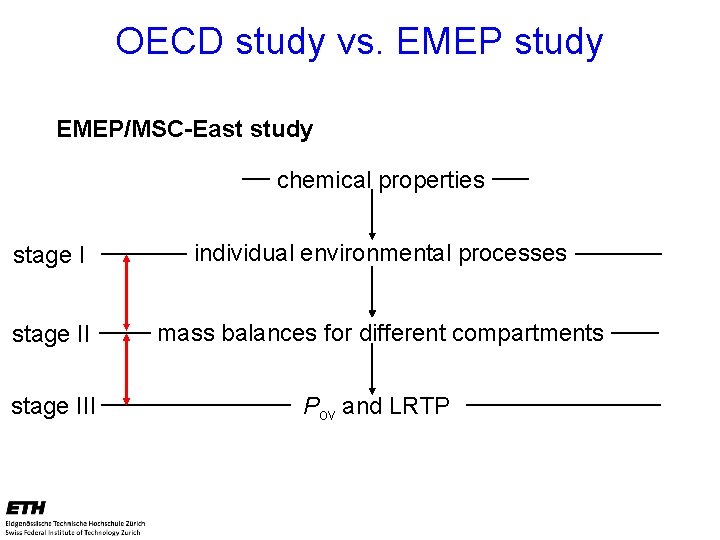
OECD study vs. EMEP study EMEP/MSC-East study chemical properties stage I individual environmental processes stage II mass balances for different compartments stage III Pov and LRTP
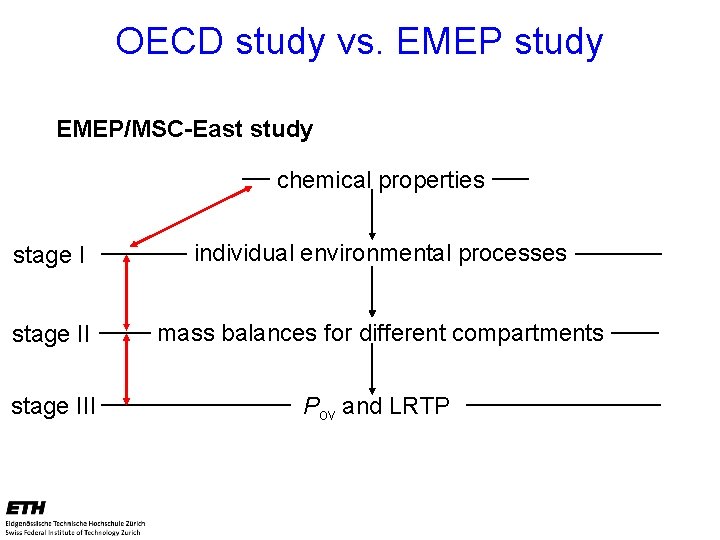
OECD study vs. EMEP study EMEP/MSC-East study chemical properties stage I individual environmental processes stage II mass balances for different compartments stage III Pov and LRTP
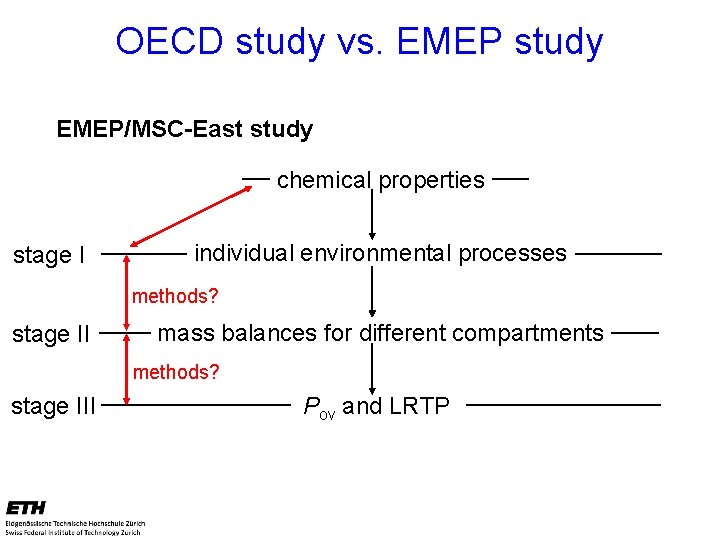
OECD study vs. EMEP study EMEP/MSC-East study chemical properties stage I individual environmental processes methods? stage II mass balances for different compartments methods? stage III Pov and LRTP

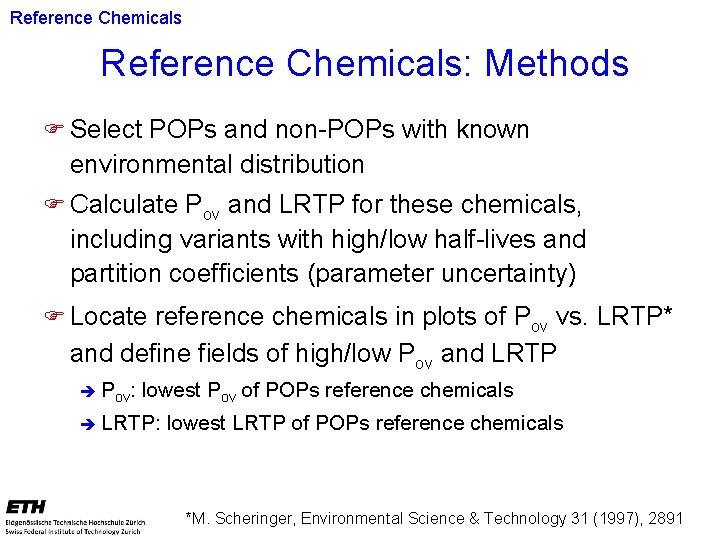
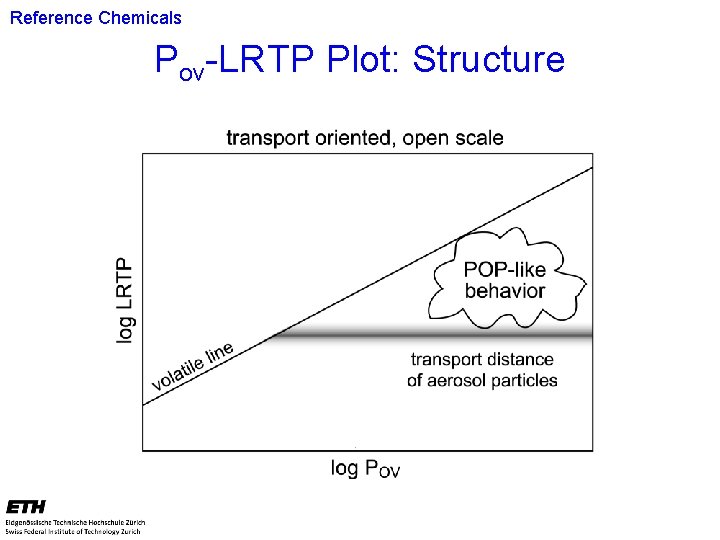
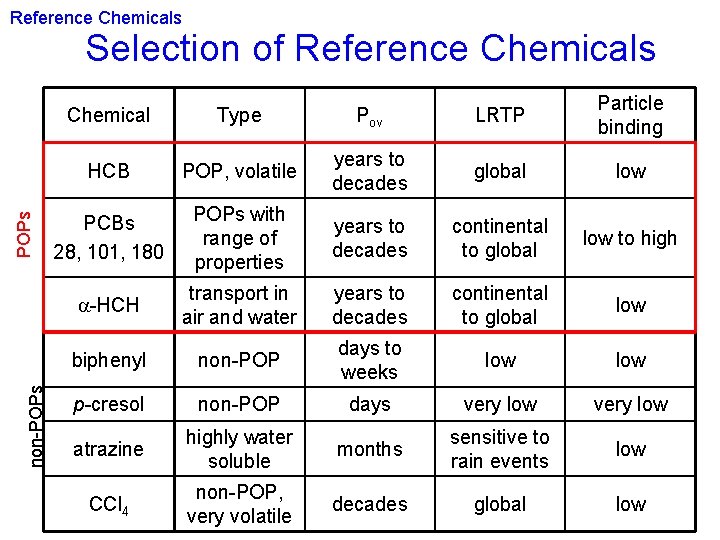
Reference Chemicals: Methods F Select POPs and non-POPs with known environmental distribution F Calculate Pov and LRTP for these chemicals, including variants with high/low half-lives and partition coefficients (parameter uncertainty) F Locate reference chemicals in plots of Pov vs. LRTP* and define fields of high/low Pov and LRTP è Pov: lowest Pov of POPs reference chemicals è LRTP: lowest LRTP of POPs reference chemicals *M. Scheringer, Environmental Science & Technology 31 (1997), 2891
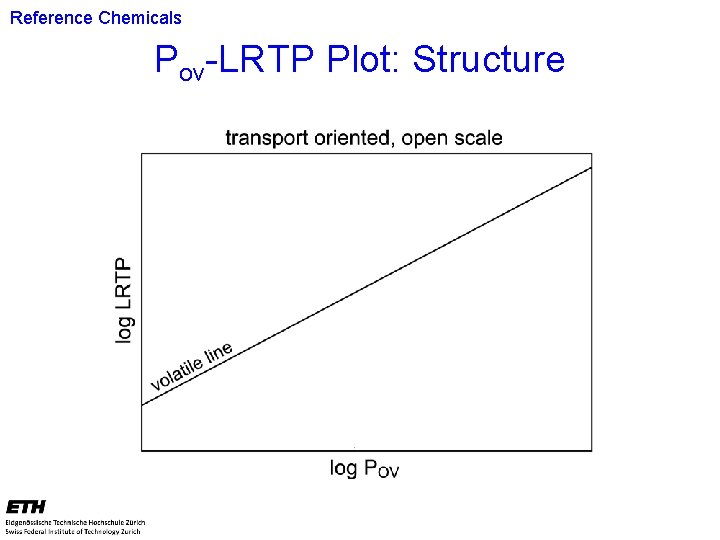
Reference Chemicals Pov-LRTP Plot: Structure
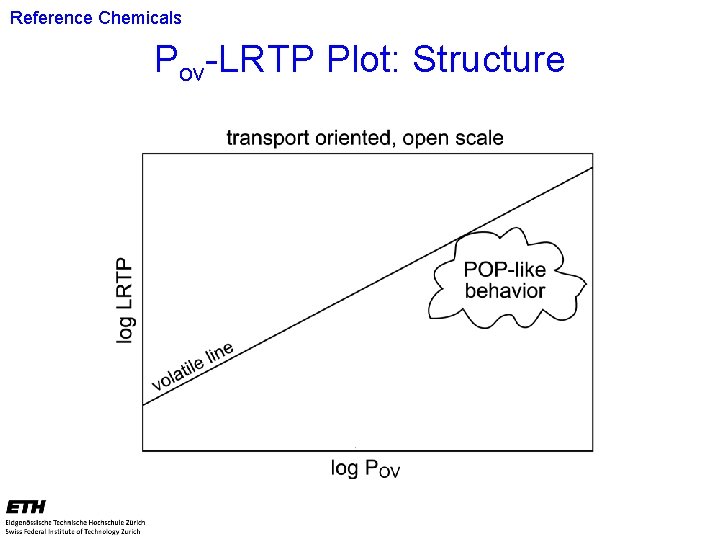
Reference Chemicals Pov-LRTP Plot: Structure
Reference Chemicals Pov-LRTP Plot: Structure
Reference Chemicals non-POPs Selection of Reference Chemicals Chemical Type Pov LRTP Particle binding HCB POP, volatile years to decades global low PCBs 28, 101, 180 POPs with range of properties years to decades continental to global low to high a-HCH transport in air and water years to decades continental to global low biphenyl non-POP days to weeks low p-cresol non-POP days very low atrazine highly water soluble months sensitive to rain events low CCl 4 non-POP, very volatile decades global low
Reference Chemicals Results for Reference Chemicals HCB CCl 4 PCBs
Reference Chemicals Definition of Pov/LRTP Categories
Reference Chemicals Results Reference Chemicals (I) F In the Pov-LRTP plot, chemicals can be characterized with respect to: è volatility line, transport distance of aerosol particles è the selected reference POPs è atrazine as a compound sensitive to continuous rain F Influence of uncertain chemical properties can be investigated.
Reference Chemicals Results Reference Chemicals (II) F Chemicals in field A should be considered as possible POPs. F Classification depends on lowest Pov and LRTP among reference POPs! F Refinement of these Pov and LRTP criteria? F Several hypothetical chemicals exceeding UNEP criteria do not fall into field A. F Some hypothetical chemicals not exceeding UNEP criteria do fall into field A.
Overall Results: Recipe for POPs Screening F Select a multimedia model that is appropriate for your purpose. F Run your chemical through the model. F Take the maximum of Pov and LRTP from the three emssion scenarios. F Insert these values into the LRTP-Pov plot. F Compare the substance to reference chemicals. F Investigate the sensitivity to uncertain substance data and variable environmental parameters. F Classify, decide, stop, repeat with another model etc.
- Slides: 40