
PONS INTERNAL STRUCTURE BY DR ZAHID SARFARAZ AP
PONS INTERNAL STRUCTURE BY DR. ZAHID SARFARAZ A/P ANATOMY KGMC
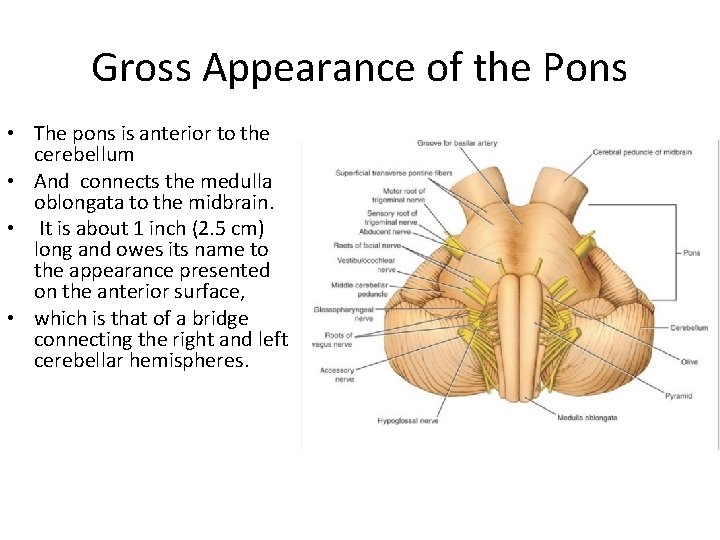
Gross Appearance of the Pons • The pons is anterior to the cerebellum • And connects the medulla oblongata to the midbrain. • It is about 1 inch (2. 5 cm) long and owes its name to the appearance presented on the anterior surface, • which is that of a bridge connecting the right and left cerebellar hemispheres.
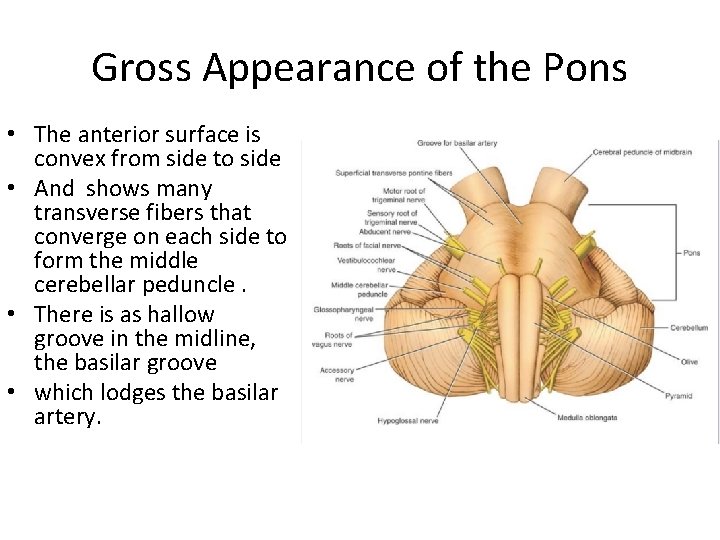
Gross Appearance of the Pons • The anterior surface is convex from side to side • And shows many transverse fibers that converge on each side to form the middle cerebellar peduncle. • There is as hallow groove in the midline, the basilar groove • which lodges the basilar artery.

Gross Appearance of the Pons • On the anterolateral surface of the pons the trigeminal nerve emerges on each side. • Each nerve consists of a smaller, medial part, known as the motor root • And a larger, lateral part, known as the sensory root. • In the groove between the pons and the medulla oblongata, there emerge, from medial to lateral, the abducent, facial, and vestibulocochlear nerves.
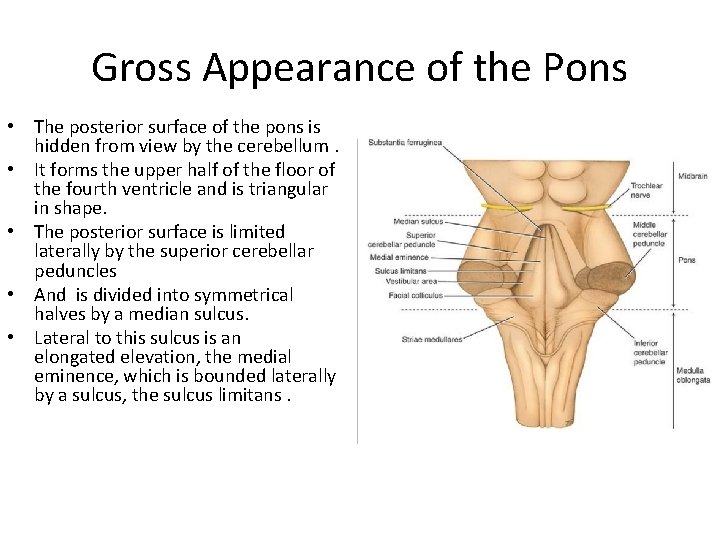
Gross Appearance of the Pons • The posterior surface of the pons is hidden from view by the cerebellum. • It forms the upper half of the floor of the fourth ventricle and is triangular in shape. • The posterior surface is limited laterally by the superior cerebellar peduncles • And is divided into symmetrical halves by a median sulcus. • Lateral to this sulcus is an elongated elevation, the medial eminence, which is bounded laterally by a sulcus, the sulcus limitans.

• The inferior end of the medial eminence is slightly expanded to form the facial colliculus • Which is produced by the root of the facial nerve winding around the nucleus of the abducent nerve. • The floor of the superior part of the sulcus limitans is bluish-gray in color and is called the substantia ferruginea • it owes its color to a group of deeply pigmented nerve cells. • Lateral to the sulcus limitans is the area vestibuli produced by the underlying vestibular nuclei

Internal Structure of the Pons • For purposes of description, the pons is commonly divided into a • Posterior part, the tegmentum • And an anterior basal part by the transversely running fibers of the trapezoid body.

Internal Structure of the Pons • The structure of the pons may be studied at two levels: (1) transverse section through the caudal part, passing through the facial colliculus, and (2) transverse section through the cranial part, passing through the trigeminal nuclei.

Transverse Section Through the Caudal Part • The medial lemniscus rotates as it passes from the medulla into the pons. • It is situated in the most anterior part of the tegmentum, with its long axis running transversely. • The medial lemniscus is accompanied by the spinal and lateral lemnisci.

Transverse Section Through the Caudal Part • The facial nucleus lies posterior to the lateral part of the medial lemniscus. • The fibers of the facial nerve wind around the nucleus of the abducent nerve, producing the facial colliculus. • The fibers of the facial nerve then pass • Anteriorly between the facial nucleus and the superior end of the nucleus of the spinal tract of the trigeminal nerve.
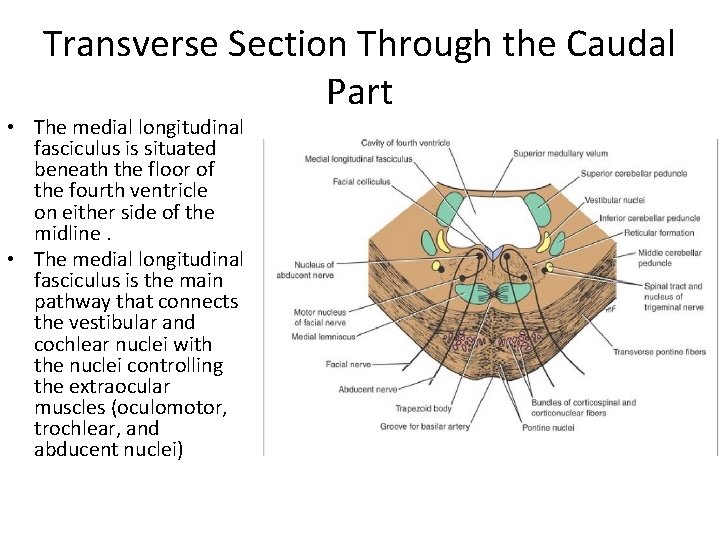
Transverse Section Through the Caudal Part • The medial longitudinal fasciculus is situated beneath the floor of the fourth ventricle on either side of the midline. • The medial longitudinal fasciculus is the main pathway that connects the vestibular and cochlear nuclei with the nuclei controlling the extraocular muscles (oculomotor, trochlear, and abducent nuclei)
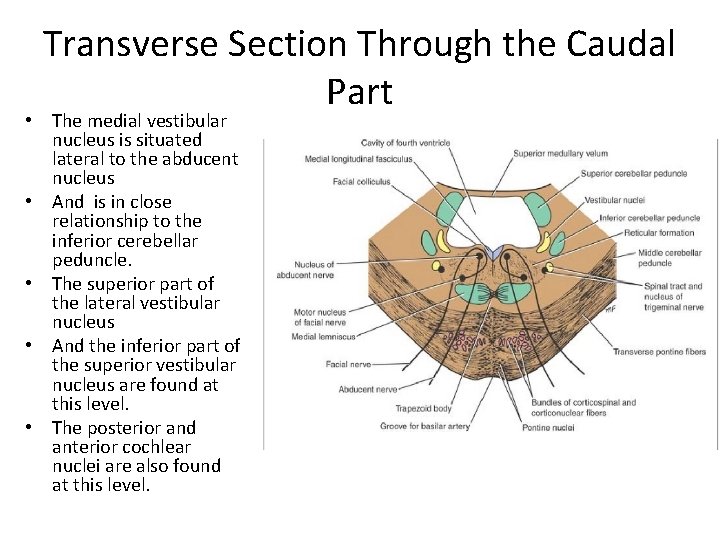
Transverse Section Through the Caudal Part • The medial vestibular nucleus is situated lateral to the abducent nucleus • And is in close relationship to the inferior cerebellar peduncle. • The superior part of the lateral vestibular nucleus • And the inferior part of the superior vestibular nucleus are found at this level. • The posterior and anterior cochlear nuclei are also found at this level.
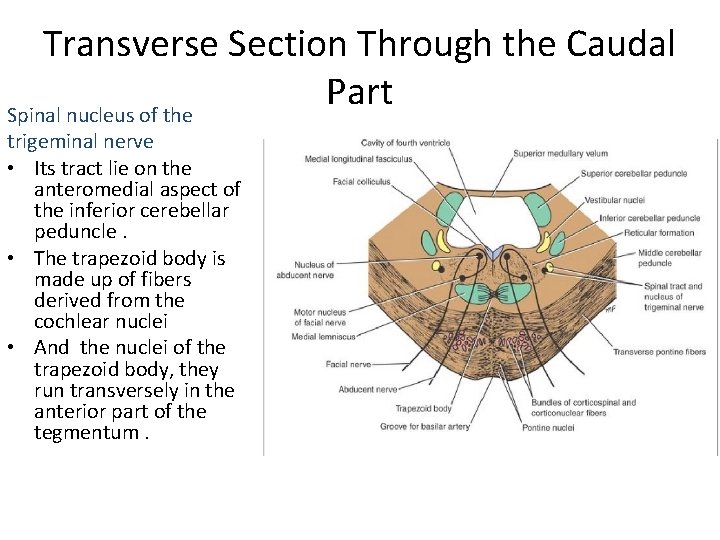
Transverse Section Through the Caudal Part Spinal nucleus of the trigeminal nerve • Its tract lie on the anteromedial aspect of the inferior cerebellar peduncle. • The trapezoid body is made up of fibers derived from the cochlear nuclei • And the nuclei of the trapezoid body, they run transversely in the anterior part of the tegmentum.
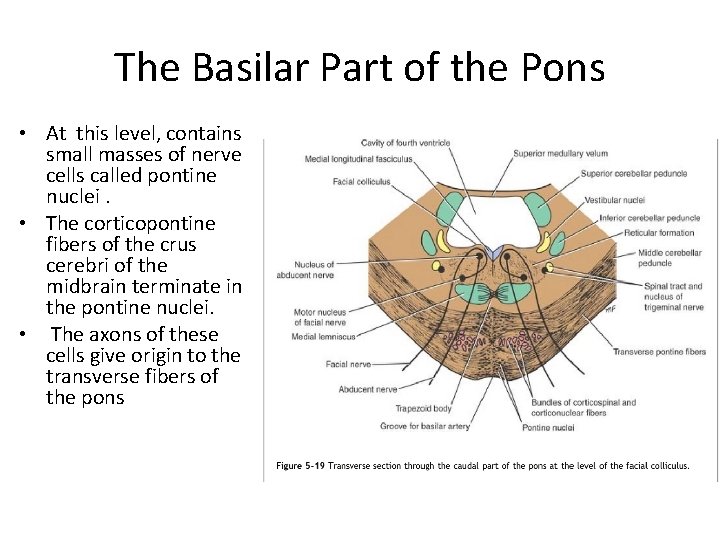
The Basilar Part of the Pons • At this level, contains small masses of nerve cells called pontine nuclei. • The corticopontine fibers of the crus cerebri of the midbrain terminate in the pontine nuclei. • The axons of these cells give origin to the transverse fibers of the pons
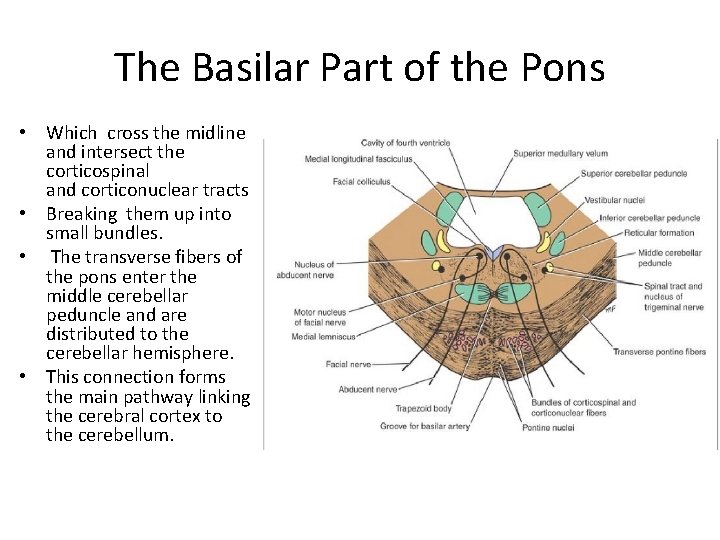
The Basilar Part of the Pons • Which cross the midline and intersect the corticospinal and corticonuclear tracts • Breaking them up into small bundles. • The transverse fibers of the pons enter the middle cerebellar peduncle and are distributed to the cerebellar hemisphere. • This connection forms the main pathway linking the cerebral cortex to the cerebellum.

Transverse Section Through the Cranial Part • The internal structure of the cranial part of the pons is similar to that seen at the caudal level • But it now contains the motor and principal sensory nuclei of the trigeminal nerve.
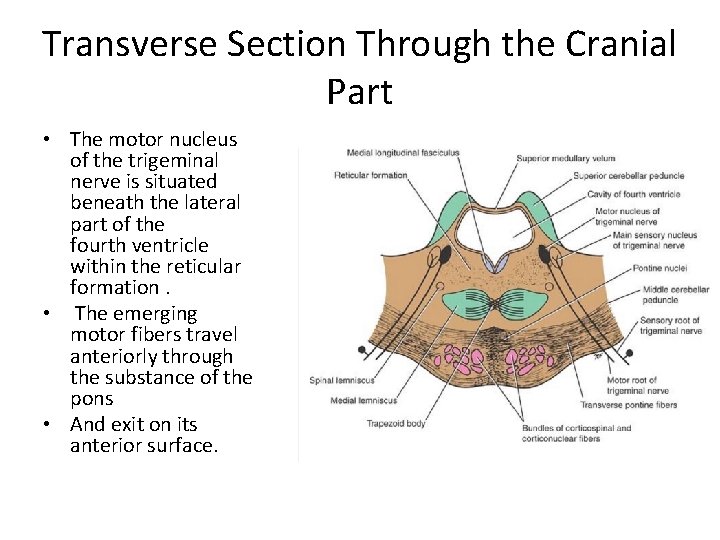
Transverse Section Through the Cranial Part • The motor nucleus of the trigeminal nerve is situated beneath the lateral part of the fourth ventricle within the reticular formation. • The emerging motor fibers travel anteriorly through the substance of the pons • And exit on its anterior surface.
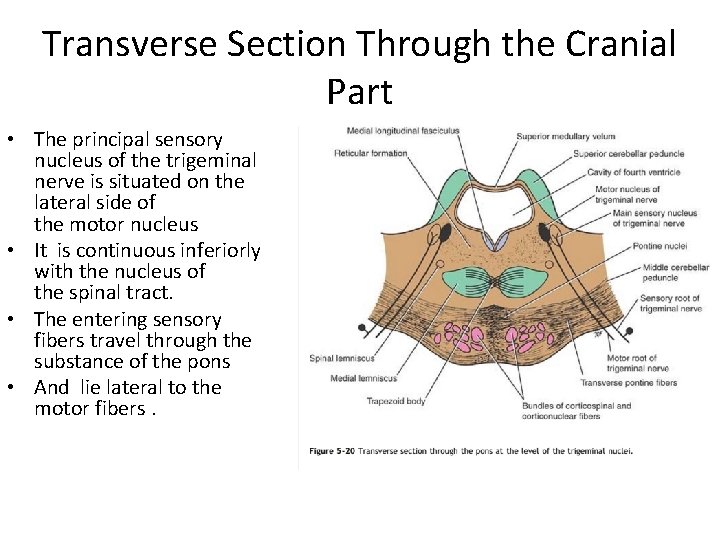
Transverse Section Through the Cranial Part • The principal sensory nucleus of the trigeminal nerve is situated on the lateral side of the motor nucleus • It is continuous inferiorly with the nucleus of the spinal tract. • The entering sensory fibers travel through the substance of the pons • And lie lateral to the motor fibers.
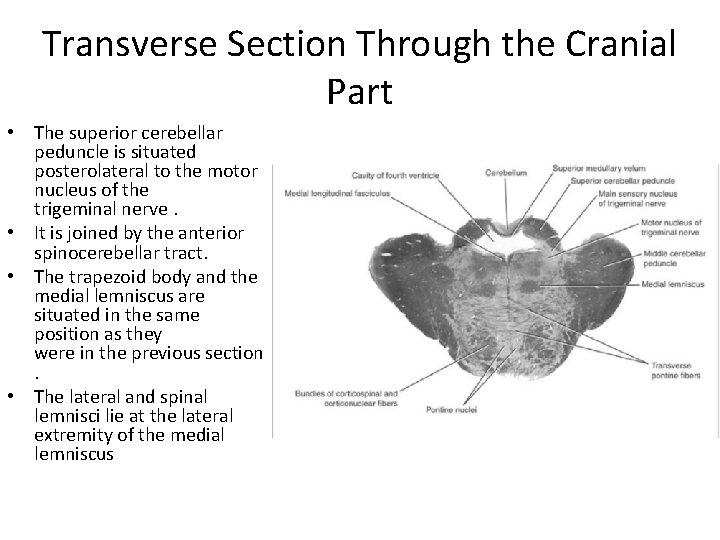
Transverse Section Through the Cranial Part • The superior cerebellar peduncle is situated posterolateral to the motor nucleus of the trigeminal nerve. • It is joined by the anterior spinocerebellar tract. • The trapezoid body and the medial lemniscus are situated in the same position as they were in the previous section. • The lateral and spinal lemnisci lie at the lateral extremity of the medial lemniscus

- Slides: 20