
Polystyrene Uses Packing n Insulation n Food containers
- Slides: 12
Polystyrene
Uses Packing n Insulation n Food containers n Disposable Cutlery n Electronic Casings n Toys n Piping n
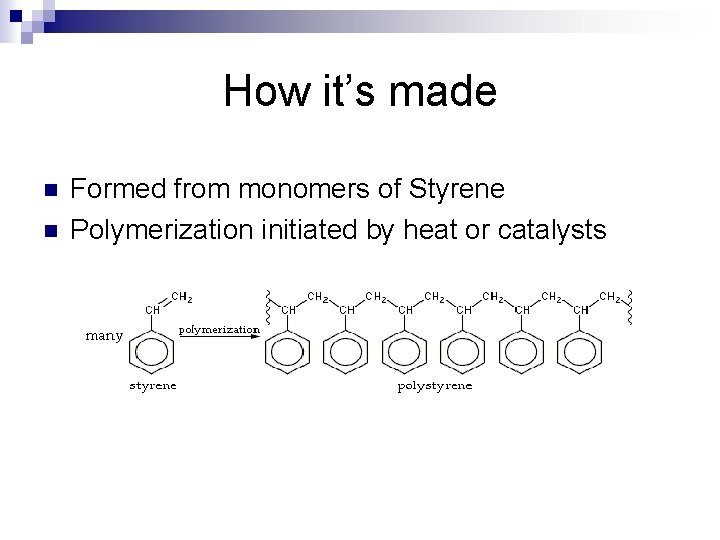
How it’s made n n Formed from monomers of Styrene Polymerization initiated by heat or catalysts
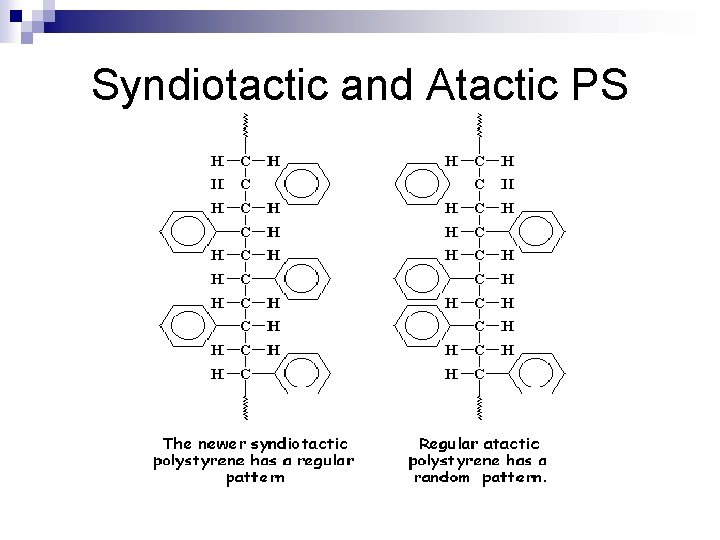
Structure n Atactic ¨ Referred n to as “Regular” Polystyrene Syndiotactic ¨ More highly ordered structure gives this form a higher melting point n Isotactic ¨ Not produced commercially
Syndiotactic and Atactic PS
Properties Pure Polystyrene is a colorless, hard, brittle plastic n Polystyrene is a Thermoplastic n ¨ Melts to liquid when heated ¨ Freezes to brittle glassy state when cooled ¨ This property allows for PS to be molded and extruded
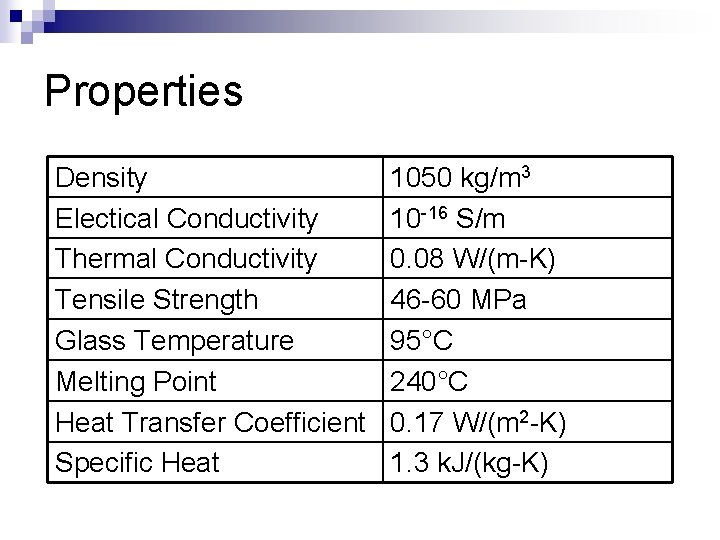
Properties Density Electical Conductivity Thermal Conductivity Tensile Strength Glass Temperature Melting Point Heat Transfer Coefficient Specific Heat 1050 kg/m 3 10 -16 S/m 0. 08 W/(m-K) 46 -60 MPa 95°C 240°C 0. 17 W/(m 2 -K) 1. 3 k. J/(kg-K)
Types of Polystyrene n Solid Foam ¨ Expanded n Polystyrene Extruded Foam ¨ Styrofoam n Copolymers ¨ High Impact Polystyrene
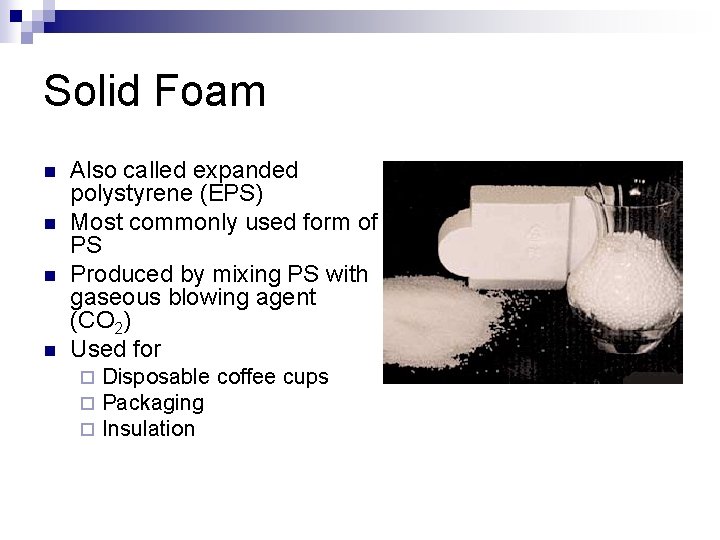
Solid Foam n n Also called expanded polystyrene (EPS) Most commonly used form of PS Produced by mixing PS with gaseous blowing agent (CO 2) Used for ¨ ¨ ¨ Disposable coffee cups Packaging Insulation
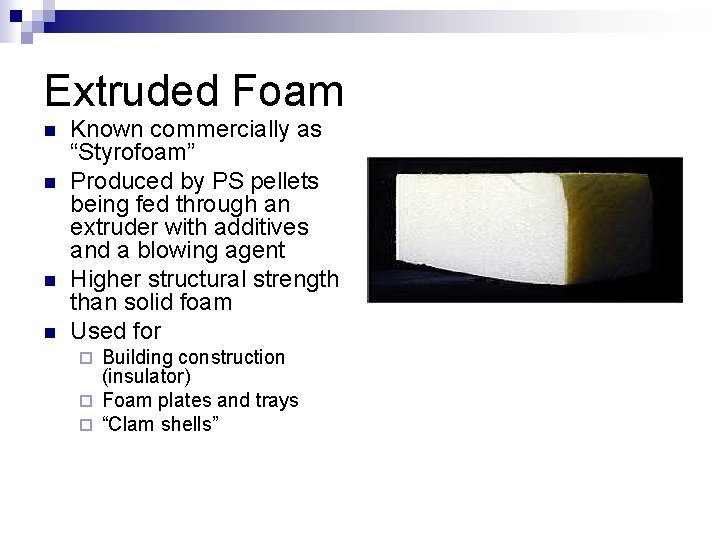
Extruded Foam n n Known commercially as “Styrofoam” Produced by PS pellets being fed through an extruder with additives and a blowing agent Higher structural strength than solid foam Used for Building construction (insulator) ¨ Foam plates and trays ¨ “Clam shells” ¨
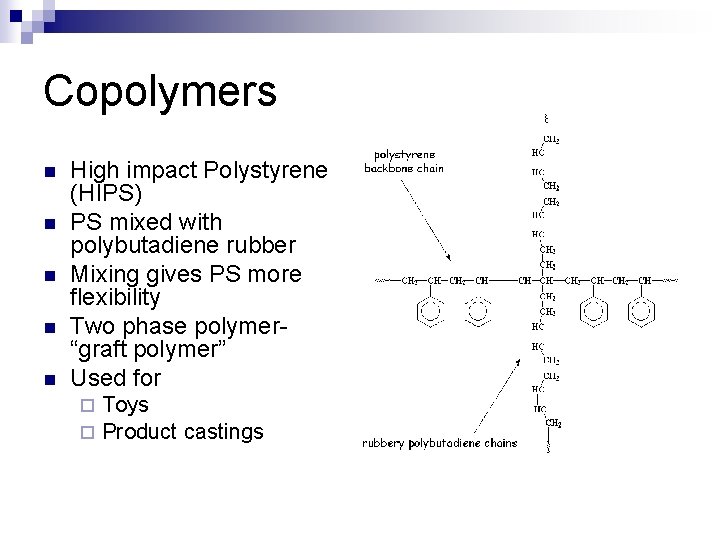
Copolymers n n n High impact Polystyrene (HIPS) PS mixed with polybutadiene rubber Mixing gives PS more flexibility Two phase polymer“graft polymer” Used for ¨ ¨ Toys Product castings
Questions?