
Polysomnography Sleep Scoring John Shaw Lancaster University Procedure


- Slides: 30
Polysomnography & Sleep Scoring John Shaw Lancaster University
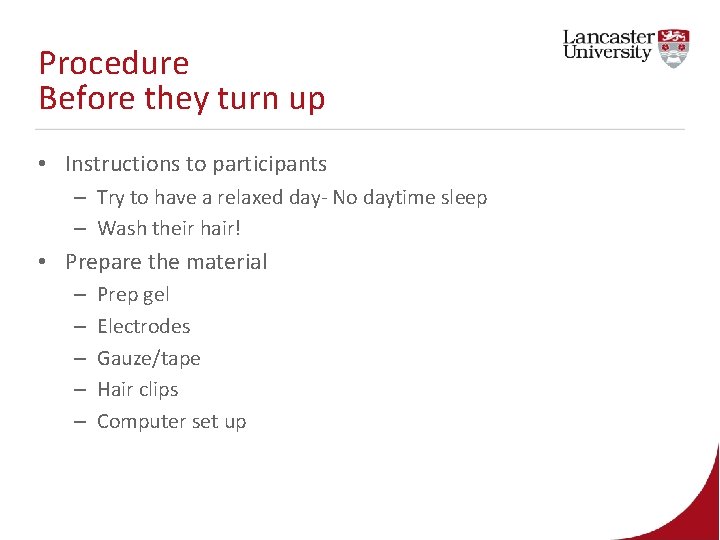
Procedure Before they turn up • Instructions to participants – Try to have a relaxed day- No daytime sleep – Wash their hair! • Prepare the material – – – Prep gel Electrodes Gauze/tape Hair clips Computer set up
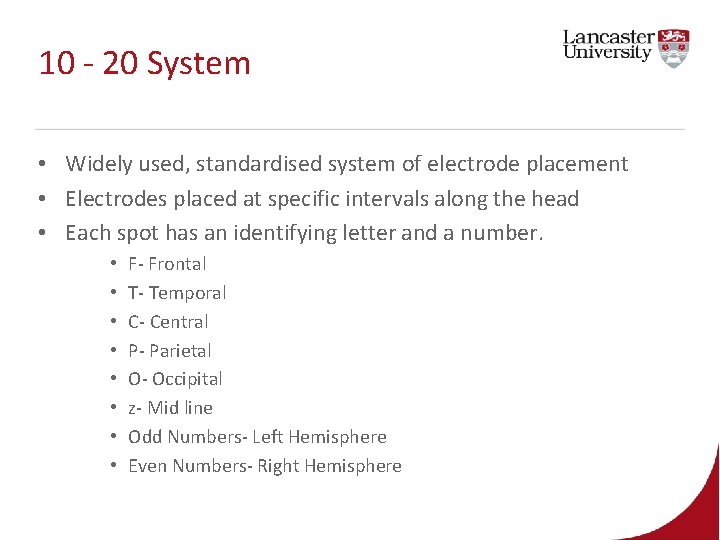
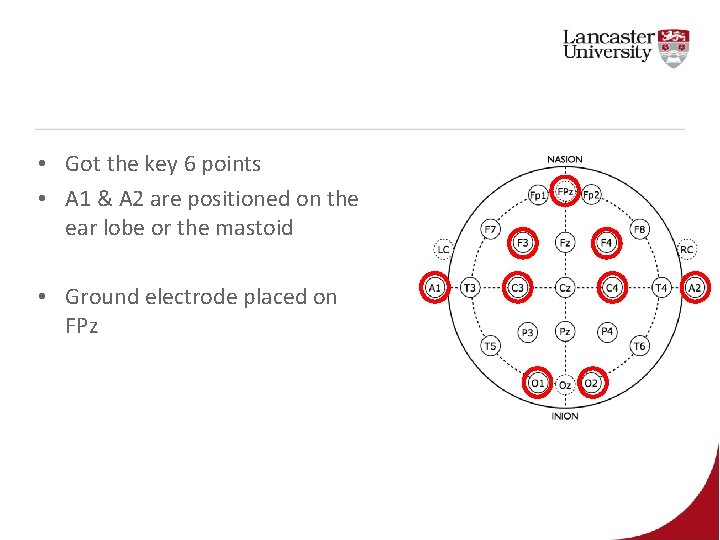
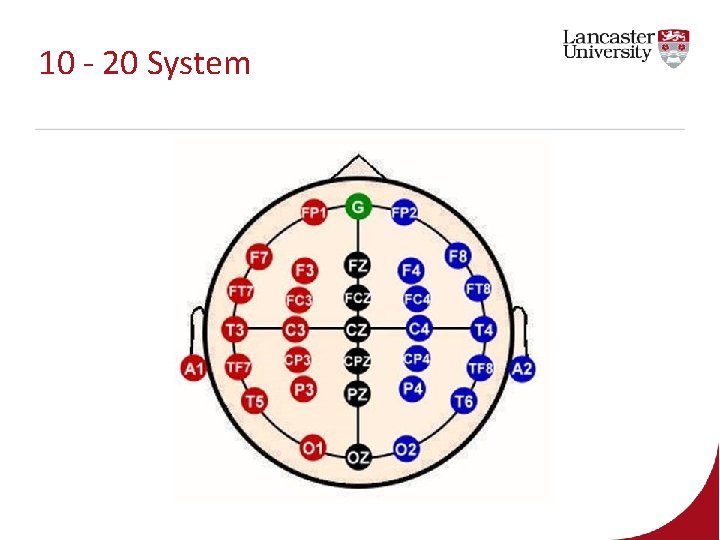
10 - 20 System • Widely used, standardised system of electrode placement • Electrodes placed at specific intervals along the head • Each spot has an identifying letter and a number. • • F- Frontal T- Temporal C- Central P- Parietal O- Occipital z- Mid line Odd Numbers- Left Hemisphere Even Numbers- Right Hemisphere
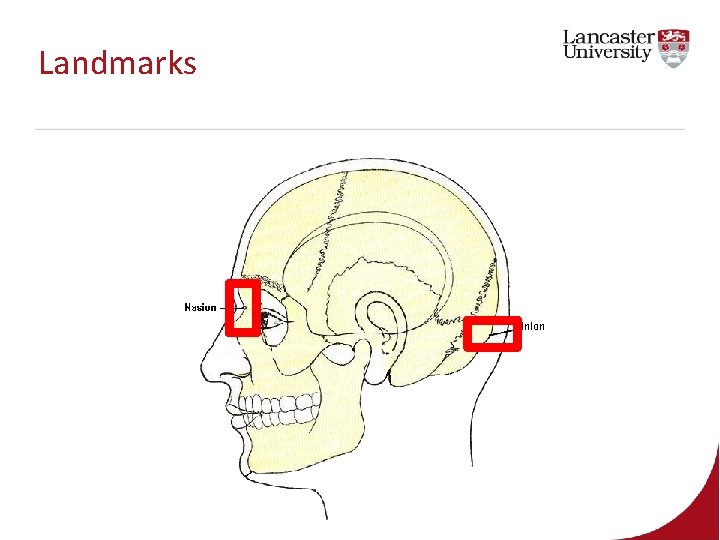
Landmarks
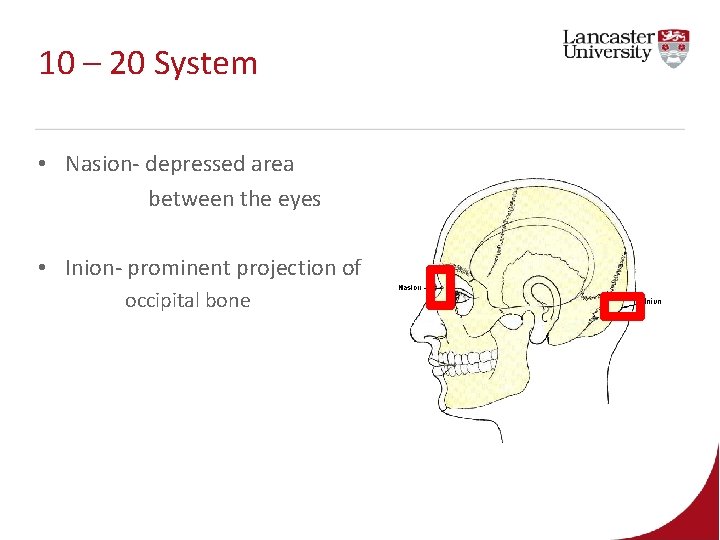
10 – 20 System • Nasion- depressed area between the eyes • Inion- prominent projection of occipital bone
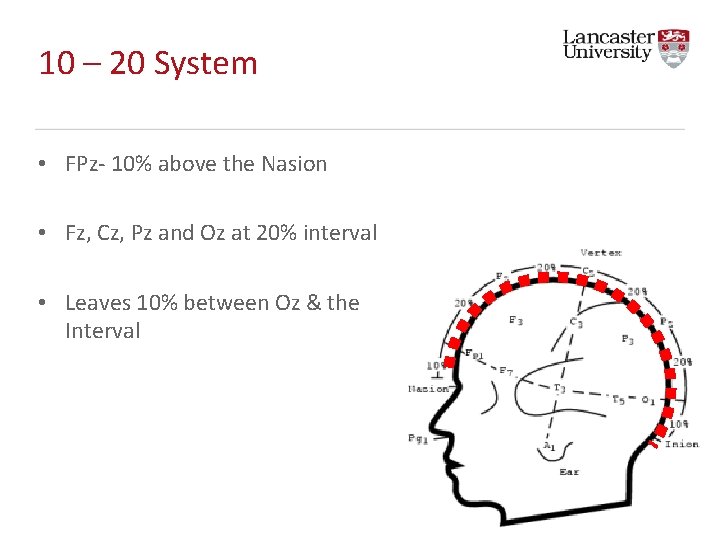
10 – 20 System • FPz- 10% above the Nasion • Fz, Cz, Pz and Oz at 20% interval • Leaves 10% between Oz & the Interval
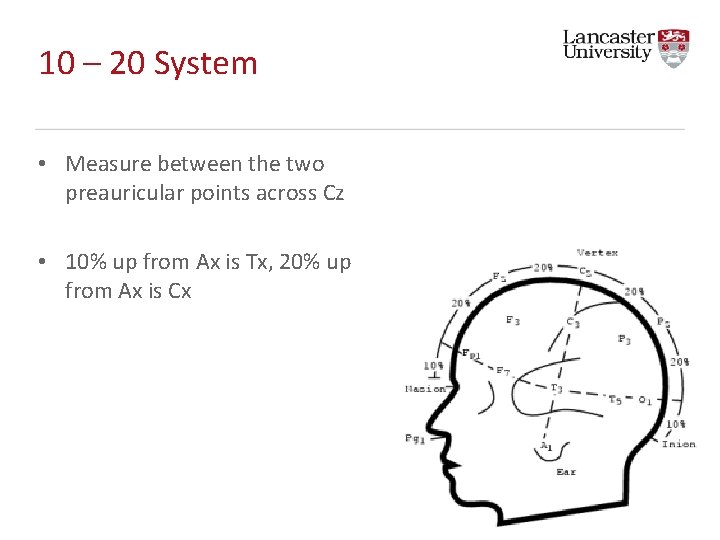
10 – 20 System • Measure between the two preauricular points across Cz • 10% up from Ax is Tx, 20% up from Ax is Cx
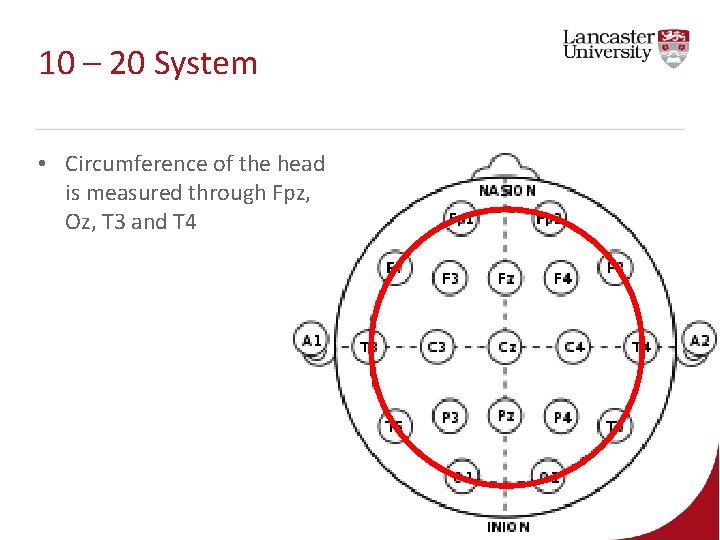
10 – 20 System • Circumference of the head is measured through Fpz, Oz, T 3 and T 4
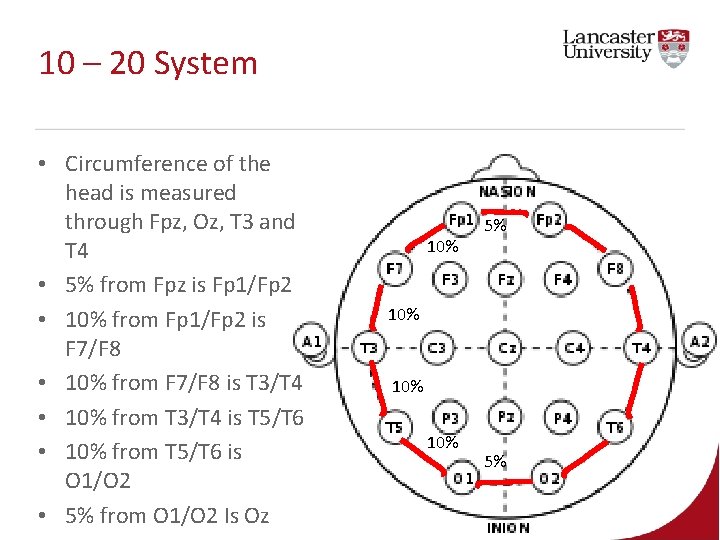
10 – 20 System • Circumference of the head is measured through Fpz, Oz, T 3 and T 4 • 5% from Fpz is Fp 1/Fp 2 • 10% from Fp 1/Fp 2 is F 7/F 8 • 10% from F 7/F 8 is T 3/T 4 • 10% from T 3/T 4 is T 5/T 6 • 10% from T 5/T 6 is O 1/O 2 • 5% from O 1/O 2 Is Oz 10% 5% 10% 10% 5%
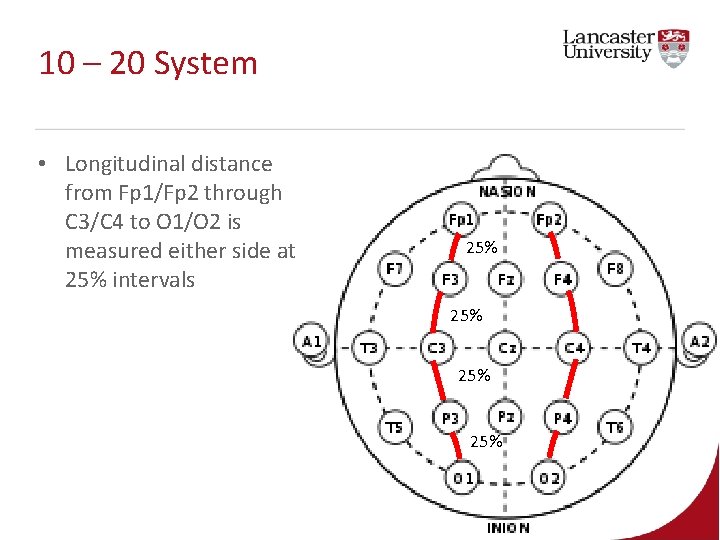
10 – 20 System • Longitudinal distance from Fp 1/Fp 2 through C 3/C 4 to O 1/O 2 is measured either side at 25% intervals 25% 25%
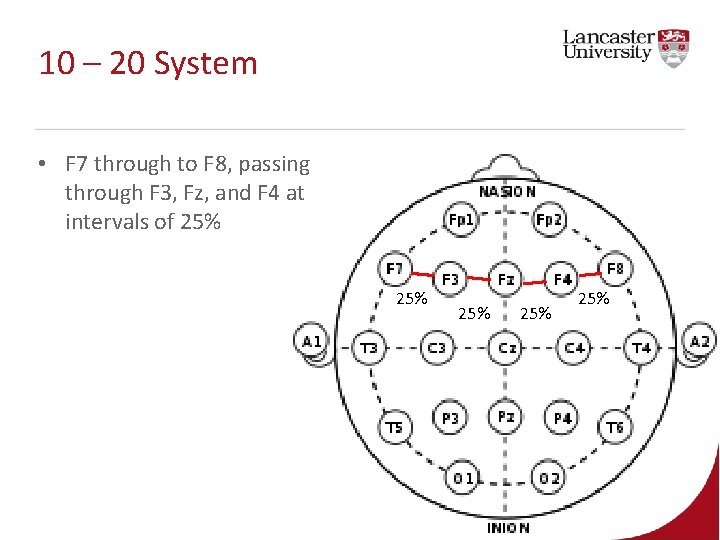
10 – 20 System • F 7 through to F 8, passing through F 3, Fz, and F 4 at intervals of 25% 25% 25%
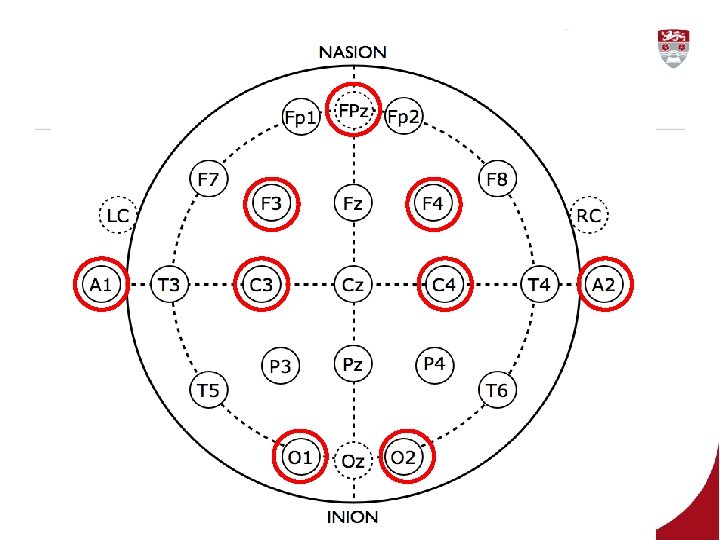
• Got the key 6 points • A 1 & A 2 are positioned on the ear lobe or the mastoid • Ground electrode placed on FPz
10 - 20 System
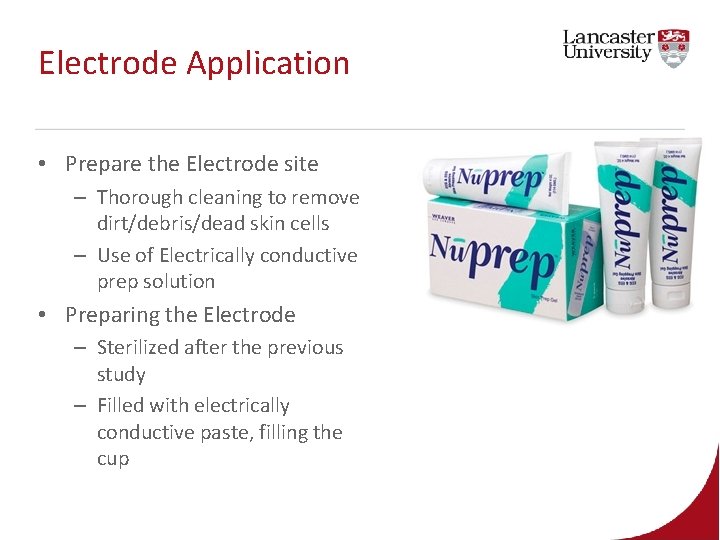
Electrode Application • Prepare the Electrode site – Thorough cleaning to remove dirt/debris/dead skin cells – Use of Electrically conductive prep solution • Preparing the Electrode – Sterilized after the previous study – Filled with electrically conductive paste, filling the cup
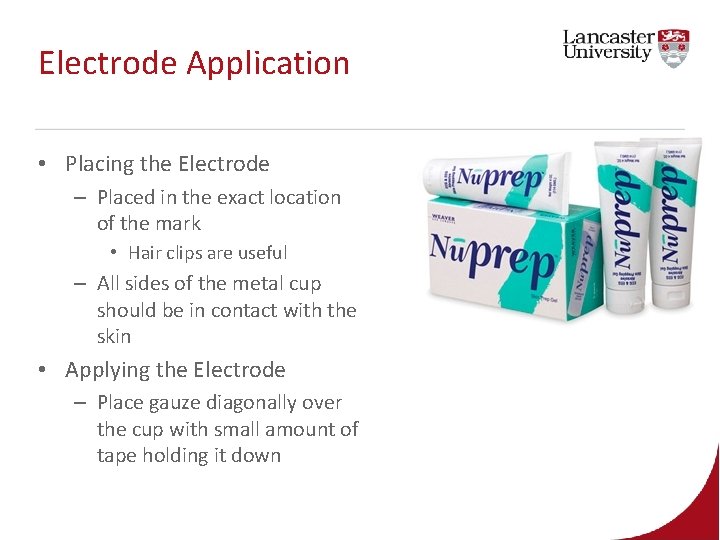
Electrode Application • Placing the Electrode – Placed in the exact location of the mark • Hair clips are useful – All sides of the metal cup should be in contact with the skin • Applying the Electrode – Place gauze diagonally over the cup with small amount of tape holding it down
Impedance Checks • Impedances are measures of electrical resistance • High impedance = signal distortion • Maximum electrical impedance should be 5000 Ohms – If over this, remove sensor and go through the steps again
Sleep Scoring
Sleep Scoring • Monitor the 8 channels outlined earlier – – – – F 3 F 4 C 3 C 4 O 1 O 2 M 1 (Reference) M 2 (Reference) • Paper speed of 10 mm/Sec, defined as an Epoch
Sleep Scoring • Rechtschaffen and Kales (1967) – Introduced a manual for sleep scoring for different stages
Sleep Stages • Stage W • NREM (70 -80%) • Stage 1 (10 -12%) • Stage 2 (45 -55%) • SWS (15 -20%) • REM (20 -25%) • Sleep starts with NREM, enters REM sleep after about 60 mins – NREM-REM cycles every 90 mins – Typically 4 -6 cycles per major sleep episode – Sleep qualitatively changes during the night
Sleep Scoring- Stage W • Participant is awake • Movement artifacts obscure most behaviour • Occipital channels display alpha activity when eyes are closed
Sleep Scoring- Stage N 1 • Low voltage, mixed frequency EEG pattern, typically 4 -7 Hz • First sleep stage entered from Wakefulness • The ‘Transitional stage’ – People can still hear noises in the room and think they are awake
Sleep Scoring- Stage N 2 • Comprises about 50% of total sleep time in healthy adults • N 2 is characterised by the presence of sleep spindles and K complexes and begins at the first instance of sleep spindles or K complexes • Absence of slow waves
Sleep Scoring- Spindles & Kcomplexes • Spindles – Brief bursts of activity appearing in the central channel – Most commonly associated with Stage N 2 sleep – Associated with transference of memories from the hippocampal store to the neocortex in consolidation of skills • K-complexes – Sharp negative wave followed by a slower positive component
Sleep Scoring- Stage N 3 • Replaces delta sleep (Stages 3 & 4) from Rechtschaffen & Kales • Epoch is scored as N 3 when at least 20% contains slow waves • Typically be between 0. 5 -2 Hz in frequency, prominently seen in frontal/central locations • Most often seen during the first third of the night, reducing progressively
Sleep Scoring- Slow Waves • Low Frequency, high amplitude waves typically seen in the frontal region
Sleep Scoring- Stage R • REM sleep is highly beneficial for memory restoration. • Typically occurs 90 mins after sleep onset • Initially quite short but progressively gets longer as night progresses • Presents similar frequencies to N 1 – Sawtooth waves typically 2 -6 Hz • After 1 instance of Stage R, all subsequent epochs are coded the same until spindles/K-Complexes are present
Polysomnography & Sleep Scoring John Shaw Psychology Department Lancaster University