
POLYPLOIDY Dr H B Mahesha Yuvarajas College University

POLYPLOIDY Dr. H. B. Mahesha Yuvaraja’s College University of Mysore, Mysore 18 May 2021 www. hbmahesh. weebly. com 1
Mitotic and meiotic divisions are highly precise as a result of which the chromosome number of different species are highly stable. But a low frequency of irregularities do occur. These irregularities in chromosome number (some type) have contributed to crop evolution and (all the types) are of much use in plant breeding.
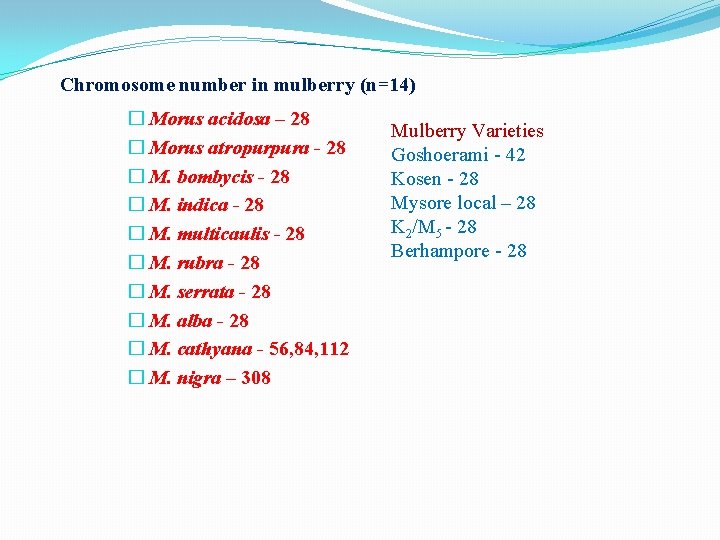
Chromosome number in mulberry (n=14) � Morus acidosa – 28 � Morus atropurpura - 28 � M. bombycis - 28 � M. indica - 28 � M. multicaulis - 28 � M. rubra - 28 � M. serrata - 28 � M. alba - 28 � M. cathyana - 56, 84, 112 � M. nigra – 308 Mulberry Varieties Goshoerami - 42 Kosen - 28 Mysore local – 28 K 2/M 5 - 28 Berhampore - 28
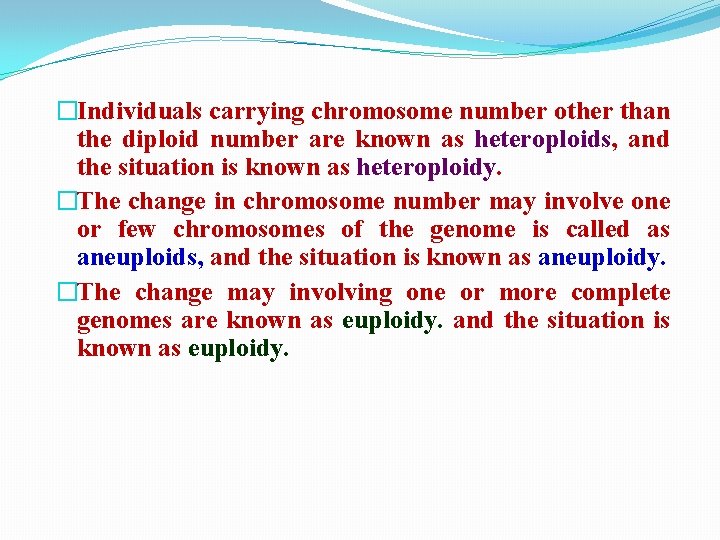
�Individuals carrying chromosome number other than the diploid number are known as heteroploids, and the situation is known as heteroploidy. �The change in chromosome number may involve one or few chromosomes of the genome is called as aneuploids, and the situation is known as aneuploidy. �The change may involving one or more complete genomes are known as euploidy. and the situation is known as euploidy.
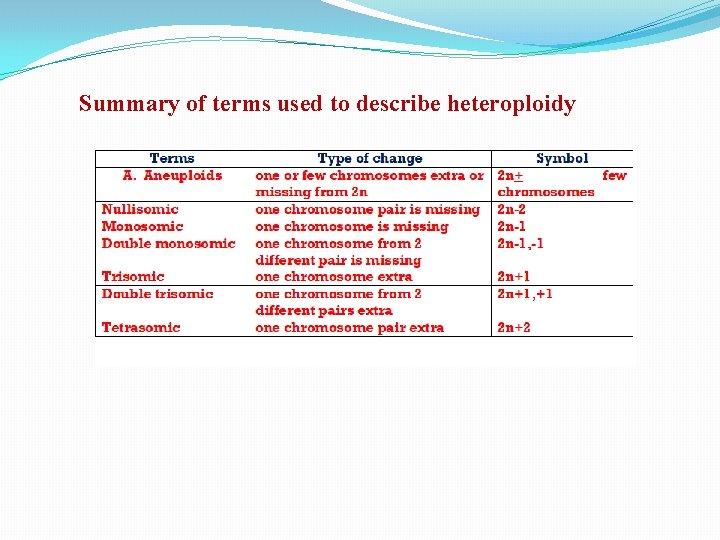
Summary of terms used to describe heteroploidy
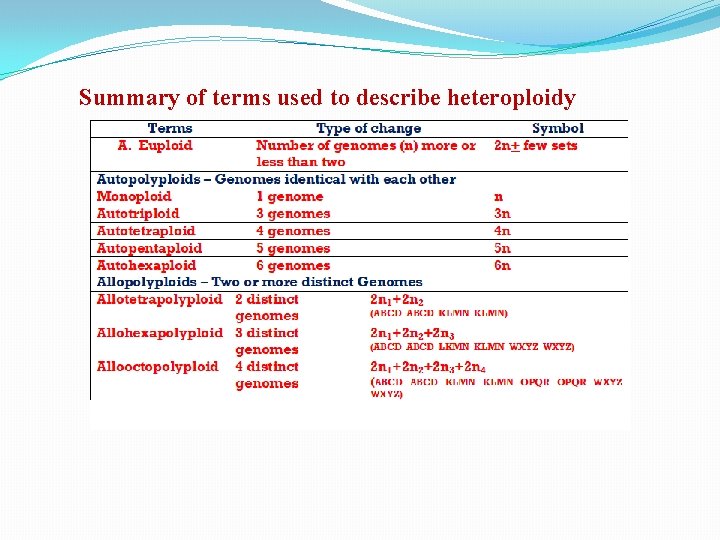
Summary of terms used to describe heteroploidy
Origin and production of aneuploids �Spontaneous: Aneuploids originate spontaneously at low frequency. Meiotic irregularities lead to formation of n+1 and n-1 gametes. eg. , in Datura about 0. 4 % pollen is likely to be n+1. �Triploid plants: Distribution of chromosomes at the first meiotic metaphase is irregular leading to production of a whole range of aneuploids in the progeny. �Tetrasomic plants: Tetrasomic plants (2 n+2) would produce n+1 gametes in considerable frequencies. Therefore when they are crossed with normal diploid (2 n) plants they produce a high frequency of trisomics.
Applications of aneuploids in crop improvement �Useful in studies on effect of loss or gain of an entire chromosome. �Useful in locating a linkage group and a gene to a particular chromosome. �Useful in identifying the chromosomes involved in translocation. �Useful in production of substitution lines.
Euploids Autopolyploids: Origin and Production � Spontaneous chromosome doubling. � Production of adventitious buds: Decapitation in some plants leads to callus development at the cut end of the stem. The callus has some polyploidy cells and some of the shoot buds regenerated from the callus may be polyploids. The frequency of polyploidy may be increased by application of 1% IAA � Physical agents: Heat or cold treatment, centrifugation and X-ray or gamma ray irradiation may produce polyploids in low frequencies. � Regeneration in vivo: polyploidy is a common feature of cells during in vitro culture.
Colchicine treatment: It is the most effective and most widely used for chromosome doubling. It has been used with great success in a large number of crop species belonging to both monocot and dicot groups. Since colchicines affects only dividing cells, it should be applied when the tissues are dividing actively.
The various methods of colchicines application varies considerably. They are �Seed treatment: May be used for 1 -10 days with concentration from 0. 001 to 1%. The seeds are generally soaked in a shallow container to facilitate aeration. �Seedlings may be treated in young stage: Germinating seeds may be inverted so that only young shoots are exposed to colchicines and roots are protected. The treatment may vary from 3 -24 hours.
Growing shoot apices: � Growing shoot tips are commonly treated with 0. 1 to 1 % Colchicine, which is applied by brush or with a dropper. The treatment is repeated once or twice daily for few days. Small cotton or wool piece may be placed at the shoot tip, which is daily soaked with the colchicines solution. Alternatively 0. 1 to 1% Colchicine mixed in lanoline paste may be smeared on the shoot apex. This treatment is repeated 2 -3 times in a week. �Several other chemicals have polyploidizing effect like Acenapthane, 8 -hydroxy quinoline, nitrous oxide etc. ,
Application of Autopolyploids �Apart from contributing to a limited extent in evolution of plant species, autopolyploids are used in developing homozygous diploid lines. �They may be useful in isolation of mutants due to expression of the gene. �Triploids are produced by hybridization between tetraploids and diploid strains. They are generally sterile. This feature is used in the production of seedless varieties of fruits.
Allopolyploids: Allopolyploids have genomes from two or more species. Introduction of allopolyploids is aimed to create new species. Allopolyploids are produced by chromosomes doubling in F 1 hybrid between two distinct species. Applications: �As bridging species in transfer its characters from one species to another. �In production of new crop species. �In widening the genetic base of the existing allopolyploid crop species.
Polyploidy in Mulberry Majority of the mulberry species are diploids (2 n=28). However, certain species are polyploids. Polyploidy in mulberry has a great economic value in the evolution of superior strains, but their leaves are not relished by the silkworms due to higher protein content and other factors. Triploids are usually produced by crossing tetraploids and diploid varieties.
Significance of Polyploidy breeding in mulberry The superior properties of the polyploids with the following characters. � Autotetraploids comparatively stronger than diploids. � The polyploids show more leaf weight and leaves are dark green and somewhat coarser. � Chemical analysis shows higher protein, carbohydrate and mineral content. � Main reasons of lesser screening of polyploidy for suitability to silkworm rearing might be due to their coarseness, poor rooting and vegetative capacity. � These deficiencies being mostly overcome in certain tetraploid T 20 and triploid verities Tr 8 and Tr 10 evolved at CSR & TI Berhampore.

Thank you
- Slides: 17