
Polynomials The Remainder and Factor Theorems The remainder
- Slides: 4
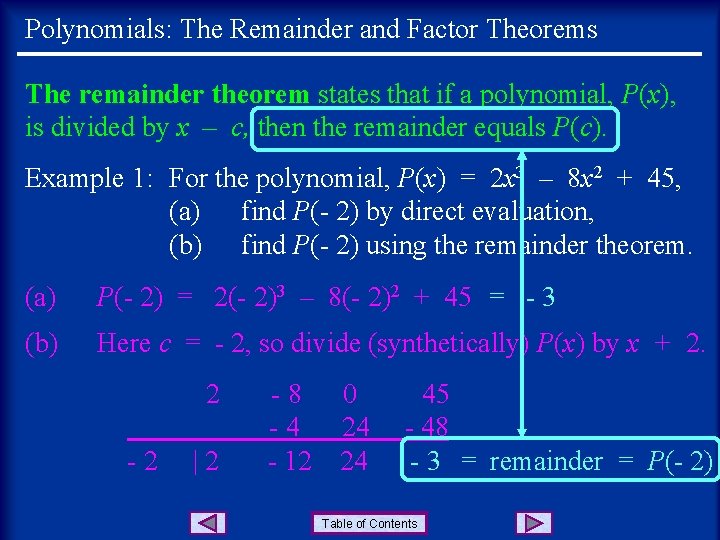
Polynomials: The Remainder and Factor Theorems The remainder theorem states that if a polynomial, P(x), is divided by x – c, then the remainder equals P(c). Example 1: For the polynomial, P(x) = 2 x 3 – 8 x 2 + 45, (a) find P(- 2) by direct evaluation, (b) find P(- 2) using the remainder theorem. (a) P(- 2) = 2(- 2)3 – 8(- 2)2 + 45 = - 3 (b) Here c = - 2, so divide (synthetically) P(x) by x + 2. 2 -2 |2 -8 -4 - 12 0 24 24 45 - 48 - 3 = remainder = P(- 2) Table of Contents
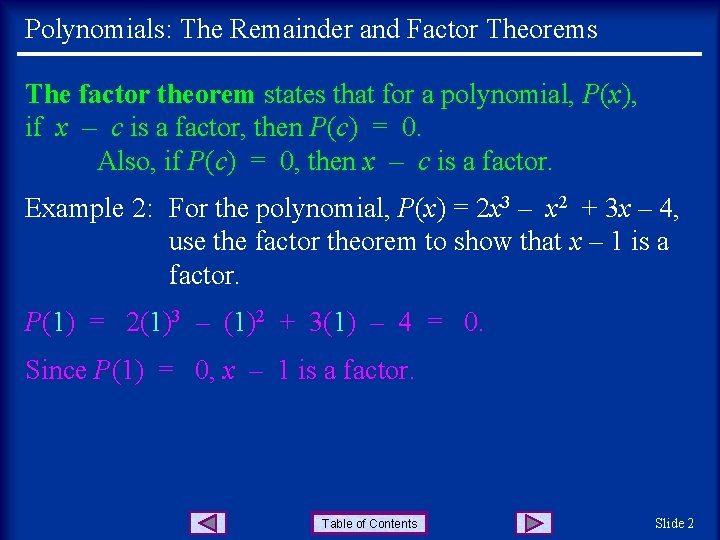
Polynomials: The Remainder and Factor Theorems The factor theorem states that for a polynomial, P(x), if x – c is a factor, then P(c) = 0. Also, if P(c) = 0, then x – c is a factor. Example 2: For the polynomial, P(x) = 2 x 3 – x 2 + 3 x – 4, use the factor theorem to show that x – 1 is a factor. P(1) = 2(1)3 – (1)2 + 3(1) – 4 = 0. Since P(1) = 0, x – 1 is a factor. Table of Contents Slide 2
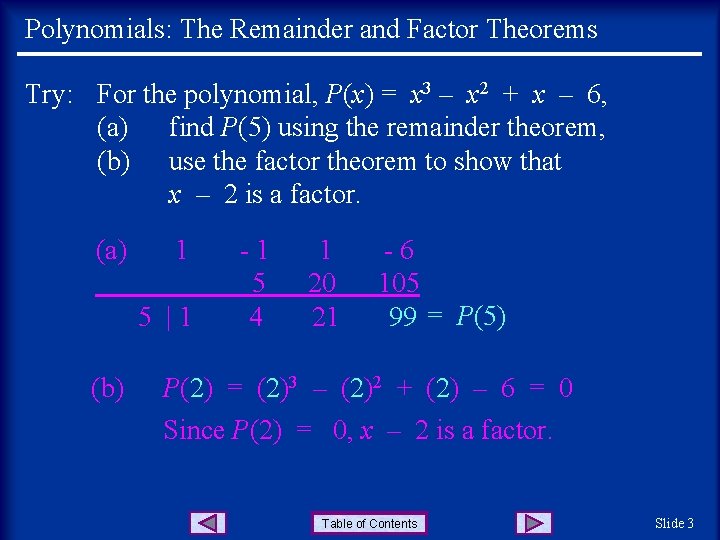
Polynomials: The Remainder and Factor Theorems Try: For the polynomial, P(x) = x 3 – x 2 + x – 6, (a) find P(5) using the remainder theorem, (b) use the factor theorem to show that x – 2 is a factor. (a) 1 5 |1 (b) -1 5 4 1 20 21 -6 105 99 = P(5) P(2) = (2)3 – (2)2 + (2) – 6 = 0 Since P(2) = 0, x – 2 is a factor. Table of Contents Slide 3
Polynomials: The Remainder and Factor Theorems Table of Contents