
POLYNITROGEN and HIGHNITROGEN CHEMISTRY Karl O Christe Ralf


![Examples of Novel Polyazides [Ga(N 3)5]2 - [In(N 3)6]3 - [Tl(N 3)6]3 - R.](https://slidetodoc.com/presentation_image/80e7539bd95e7f369d4d6751f84981f8/image-20.jpg "Examples of Novel Polyazides [Ga(N 3)5]2 - [In(N 3)6]3 - [Tl(N 3)6]3 - R.")
![Examples of Novel Polyazides contd. [Re. O 2(N 3)4]- 24 May, 2012 [OMo(N 3)5]2](https://slidetodoc.com/presentation_image/80e7539bd95e7f369d4d6751f84981f8/image-21.jpg "Examples of Novel Polyazides contd. [Re. O 2(N 3)4]- 24 May, 2012 [OMo(N 3)5]2")
![[A][Bi(N 3)4]Bi(N 3)3 + PPh 4+[N 3]- CH 3 CN [PPh 4][Bi(N 3)4] Chains](https://slidetodoc.com/presentation_image/80e7539bd95e7f369d4d6751f84981f8/image-25.jpg "[A][Bi(N 3)4]Bi(N 3)3 + PPh 4+[N 3]- CH 3 CN [PPh 4][Bi(N 3)4] Chains")
![[A][Bi(N 3)4]- contd. • lone pair is sterically active • CN 5 (7 with](https://slidetodoc.com/presentation_image/80e7539bd95e7f369d4d6751f84981f8/image-26.jpg "[A][Bi(N 3)4]- contd. • lone pair is sterically active • CN 5 (7 with")
![[A]2[Bi(N 3)5] Bi(N 3)3 + 2 A + N 3 - CH 3 CN](https://slidetodoc.com/presentation_image/80e7539bd95e7f369d4d6751f84981f8/image-27.jpg "[A]2[Bi(N 3)5] Bi(N 3)3 + 2 A + N 3 - CH 3 CN")
![[PPh 4]3[Bi(N 3)6] Bi(N 3)3 + 3 PNP+[N 3 ]- Bi(N 3)3 + 3](https://slidetodoc.com/presentation_image/80e7539bd95e7f369d4d6751f84981f8/image-28.jpg "[PPh 4]3[Bi(N 3)6] Bi(N 3)3 + 3 PNP+[N 3 ]- Bi(N 3)3 + 3")
![[PPh 4]2[bipy·Bi(N 3)5] [PPh 4]2[Bi(N 3)5] + bipy [PPh 4]2[bipy·Bi(N 3)5] bipy: 2, 2’-bipyridine](https://slidetodoc.com/presentation_image/80e7539bd95e7f369d4d6751f84981f8/image-29.jpg "[PPh 4]2[bipy·Bi(N 3)5] [PPh 4]2[Bi(N 3)5] + bipy [PPh 4]2[bipy·Bi(N 3)5] bipy: 2, 2’-bipyridine")
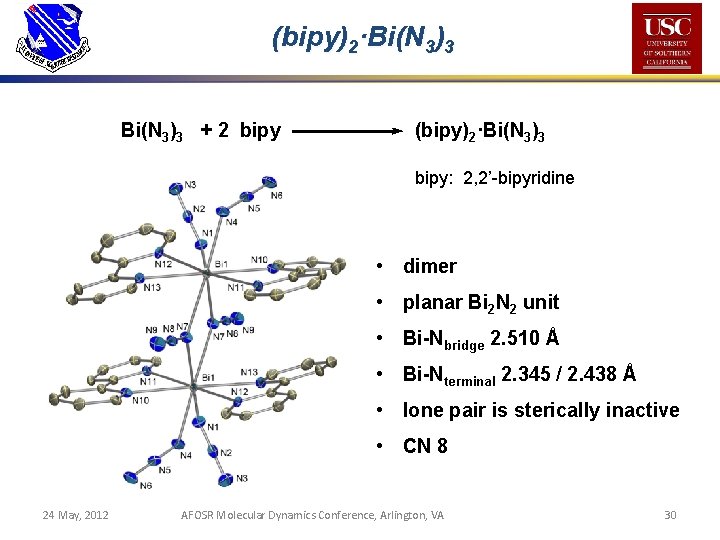
![[(bipy)2·Bi(N 3)3]2 Two pseudo-square antiprisms with a common edge. 24 May, 2012 AFOSR Molecular](https://slidetodoc.com/presentation_image/80e7539bd95e7f369d4d6751f84981f8/image-31.jpg "[(bipy)2·Bi(N 3)3]2 Two pseudo-square antiprisms with a common edge. 24 May, 2012 AFOSR Molecular")
![A[As(N 3)4] M (N 3)3 + AN 3 PPh 4[As(N 3)4] 24 May, 2012](https://slidetodoc.com/presentation_image/80e7539bd95e7f369d4d6751f84981f8/image-34.jpg "A[As(N 3)4] M (N 3)3 + AN 3 PPh 4[As(N 3)4] 24 May, 2012")
![TMA[Sb(N 3)4] (1) 57 2. 9 2. 264(1 ) Anion chain structure through m](https://slidetodoc.com/presentation_image/80e7539bd95e7f369d4d6751f84981f8/image-35.jpg "TMA[Sb(N 3)4] (1) 57 2. 9 2. 264(1 ) Anion chain structure through m")
![PPh 4[Sb(N 3)4] 2. 071(4) 4) 2. 254( 3 2. 24 4) 8( 43](https://slidetodoc.com/presentation_image/80e7539bd95e7f369d4d6751f84981f8/image-36.jpg "PPh 4[Sb(N 3)4] 2. 071(4) 4) 2. 254( 3 2. 24 4) 8( 43")
![PNP[Sb(N 3)4] 3. 024 (2) 2. 280(2) Anion dimer structure through a single m](https://slidetodoc.com/presentation_image/80e7539bd95e7f369d4d6751f84981f8/image-37.jpg "PNP[Sb(N 3)4] 3. 024 (2) 2. 280(2) Anion dimer structure through a single m")

- Slides: 39
POLYNITROGEN and HIGH-NITROGEN CHEMISTRY Karl O. Christe, Ralf Haiges, Martin Rahm, and Igor Fedorov University of Southern California 24 May, 2012 AFOSR Molecular Dynamics Conference, Arlington, VA
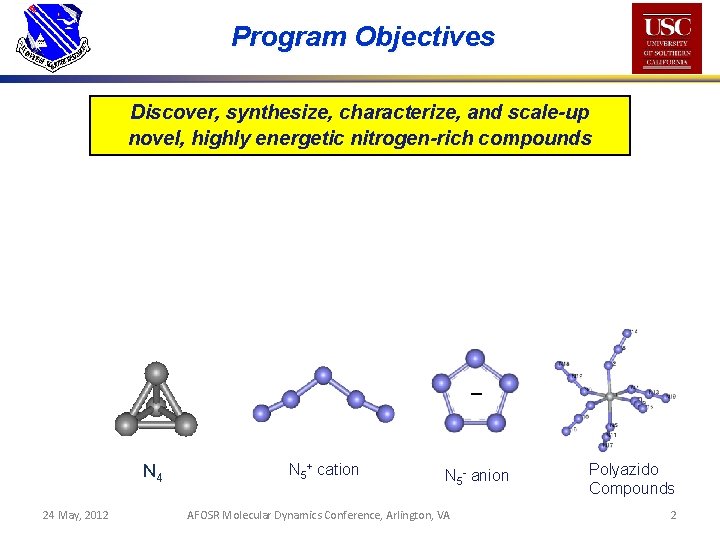
Program Objectives Discover, synthesize, characterize, and scale-up novel, highly energetic nitrogen-rich compounds N 4 24 May, 2012 N 5+ cation N 5 - anion AFOSR Molecular Dynamics Conference, Arlington, VA Polyazido Compounds 2
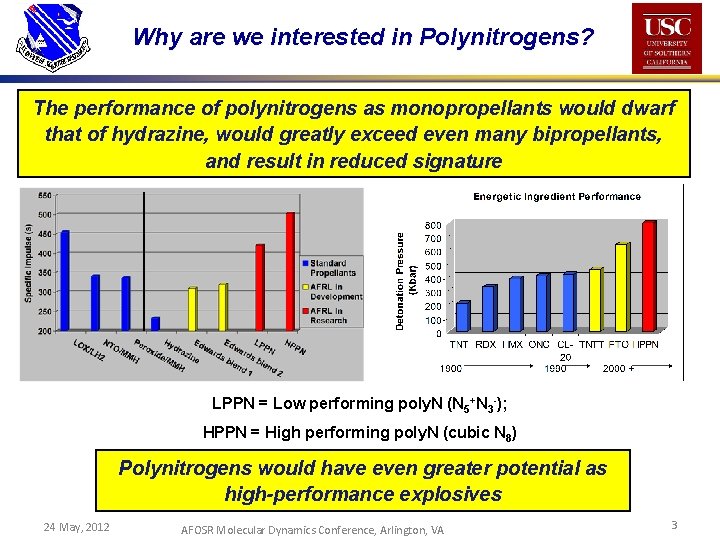
Why are we interested in Polynitrogens? The performance of polynitrogens as monopropellants would dwarf that of hydrazine, would greatly exceed even many bipropellants, and result in reduced signature LPPN = Low performing poly. N (N 5+N 3 -); HPPN = High performing poly. N (cubic N 8) Polynitrogens would have even greater potential as high-performance explosives 24 May, 2012 AFOSR Molecular Dynamics Conference, Arlington, VA 3
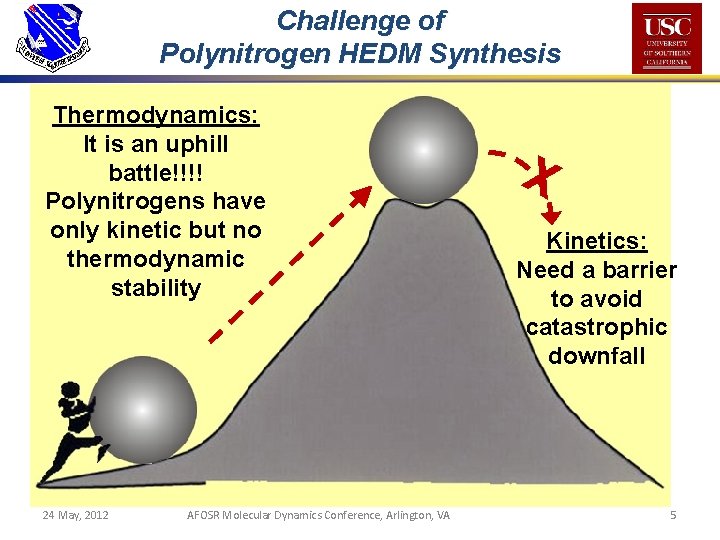
Challenge of Polynitrogen HEDM Synthesis • All the energy must come from endothermicity, and sensitivity typically increases with endothermicity • Basis for high energy content is the large differences in bond energies 24 May, 2012 AFOSR Molecular Dynamics Conference, Arlington, VA 4
Challenge of Polynitrogen HEDM Synthesis Thermodynamics: It is an uphill battle!!!! Polynitrogens have only kinetic but no thermodynamic stability 24 May, 2012 AFOSR Molecular Dynamics Conference, Arlington, VA X Kinetics: Need a barrier to avoid catastrophic downfall 5
Results from our Previous Studies • Synthesized and characterized N 5+ and N 3 NOF+. • Identified the cyclo-N 5 - anion and the N 7 O+ cation. • Demonstrated experimentally and computationally that ionic polynitrogens, such as N 5+N 3 - or N 5+N 5 -, cannot exist because the electron affinity of the cation is much higher than the first ionization potential of the anion and cannot be compensated by the lattice energy of the salt. • This conclusion is supported by the fact that no ionic allotropes are known for any element. • Therefore, the synthesis of a nitrogen allotrope must be focused on a neutral covalent polynitrogen. 24 May, 2012 AFOSR Molecular Dynamics Conference, Arlington, VA 6
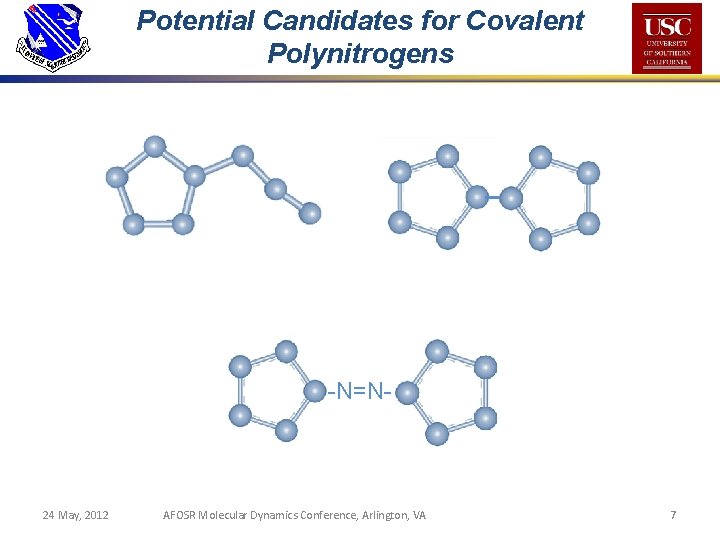
Potential Candidates for Covalent Polynitrogens _ -N=N- 24 May, 2012 AFOSR Molecular Dynamics Conference, Arlington, VA 7
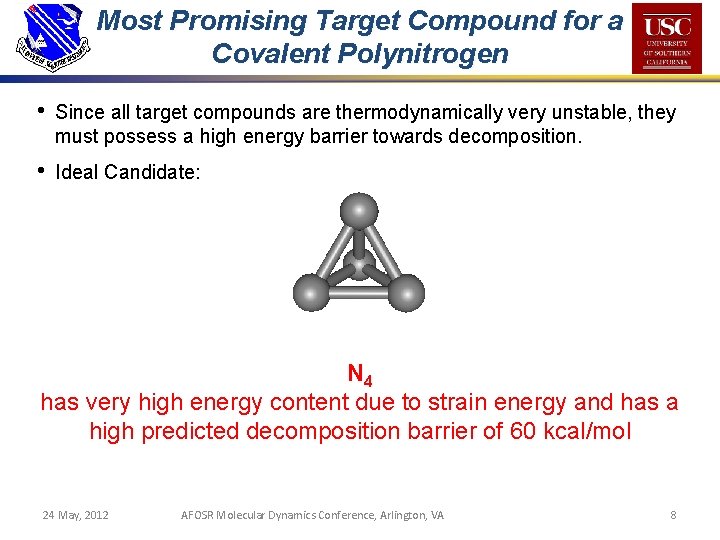
Most Promising Target Compound for a Covalent Polynitrogen • Since all target compounds are thermodynamically very unstable, they must possess a high energy barrier towards decomposition. • Ideal Candidate: N 4 has very high energy content due to strain energy and has a high predicted decomposition barrier of 60 kcal/mol 24 May, 2012 AFOSR Molecular Dynamics Conference, Arlington, VA 8
Previous Work on N 4 (Radziszewski) • Under a previous DARPA Program, Radziszewski and coworkers had studied the low-temperature vibrational spectra of the matrix isolated products generated by a microwave discharge of N 2. • In some of their experiments they observed some weak bands which had frequencies predicted by theoretical calculations for N 4, but the observed 14 N/15 N isotopic shifts substantially deviated from theoretical values. • Because for the identification of a compound isotopic shifts are a more reliable indicator than a perfect match of the frequencies, doubts exist about the true identity of Radziszewski’s product. • We, therefore, started to reinvestigate this area under conditions which might be more conducive for the unambiguous identification of this species. 24 May, 2012 AFOSR Molecular Dynamics Conference, Arlington, VA 9
Our Modifications • • Use of silent glow discharge in place of microwave discharge. • Enrichment of the desired poly-N product by carrying out the glow discharge at -196 ºC which should trap the desired N 4 on the cold walls and allow pumping off the excess N 2 starting material, thus providing a chance for a bulk synthesis of N 4. • Use of Raman spectroscopy for the identification of the bulk material. N 4 has three Raman active vibrations, while only one of them is active in the infrared spectrum. • Use of 14 N/15 N isotopes to obtain accurate isotopic shifts. Use of Ar as a diluent in the discharge to enhance N atom generation. 24 May, 2012 AFOSR Molecular Dynamics Conference, Arlington, VA 10
Progress to Date • Have built hardware, metal and glass vacuum lines, transfer apparatus and low-temperature quartz dewars for the glow discharge experiments. • Have built and checked out a low-temperature Raman cell for recording spectra at -196 ºC. • • • Have built a metal vacuum line for the matrix isolation set up. Construction of the matrix isolation set up is 80 % complete. Have carried out preliminary screening experiments to validate the feasibility of our approach. 24 May, 2012 AFOSR Molecular Dynamics Conference, Arlington, VA 11
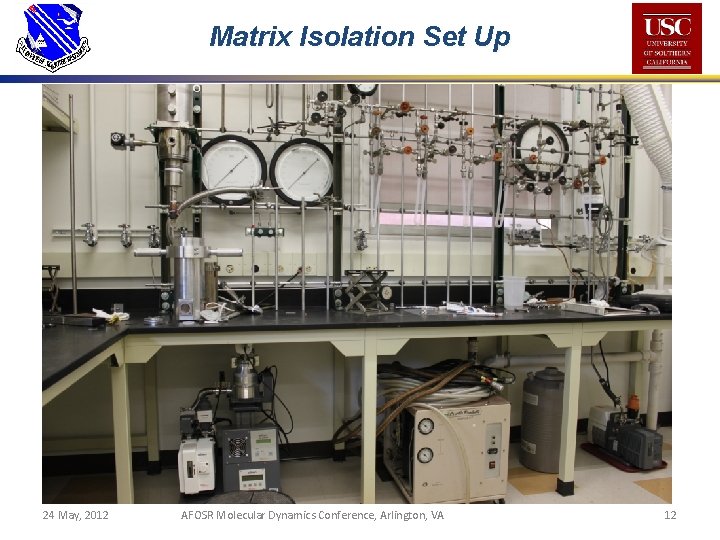
Matrix Isolation Set Up 24 May, 2012 AFOSR Molecular Dynamics Conference, Arlington, VA 12
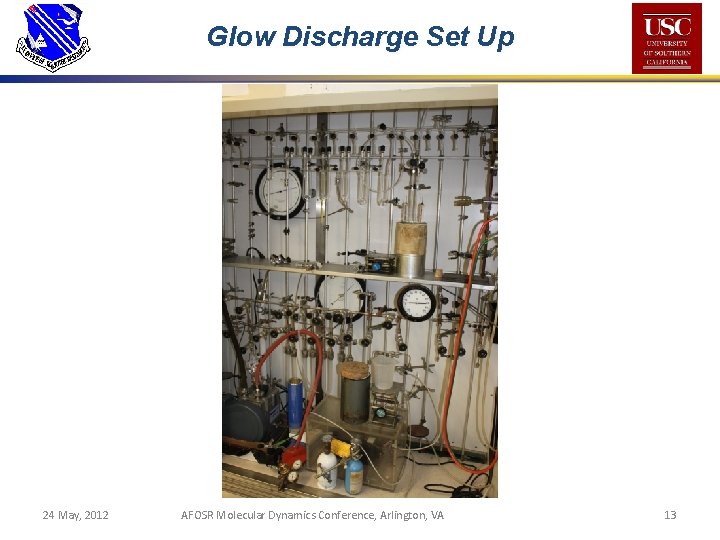
Glow Discharge Set Up 24 May, 2012 AFOSR Molecular Dynamics Conference, Arlington, VA 13
Glow Discharge Apparatus 24 May, 2012 AFOSR Molecular Dynamics Conference, Arlington, VA 14
Validation of Experimental Technique • Have discharged N 2/Ar mixtures at -196 ºC and collected and transferred the non-volatile product at low-temperature to Raman cell. • Raman cell worked well and good quality lowtemperature spectra were obtained. • Product was shown to be solid N 2 O formed by reaction of N 2 with traces of O 2 in the system. 24 May, 2012 AFOSR Molecular Dynamics Conference, Arlington, VA 15
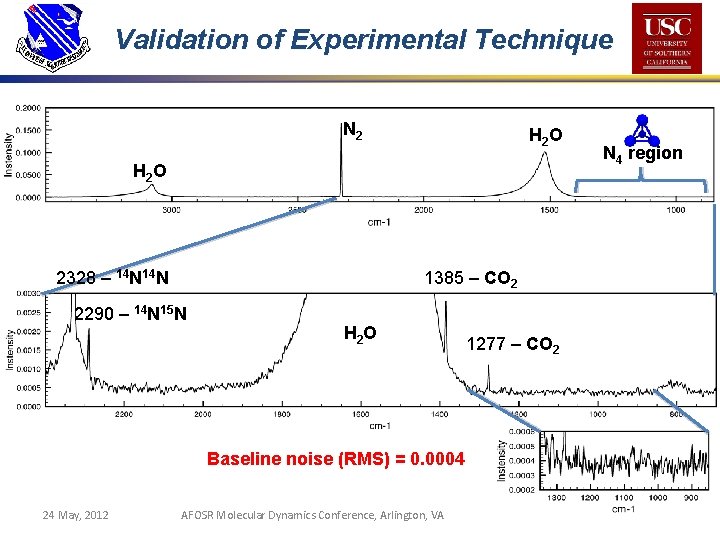
Validation of Experimental Technique N 2 H 2 O 2328 – 14 N N 4 region 1385 – CO 2 2290 – 14 N 15 N H 2 O 1277 – CO 2 Baseline noise (RMS) = 0. 0004 24 May, 2012 AFOSR Molecular Dynamics Conference, Arlington, VA 16
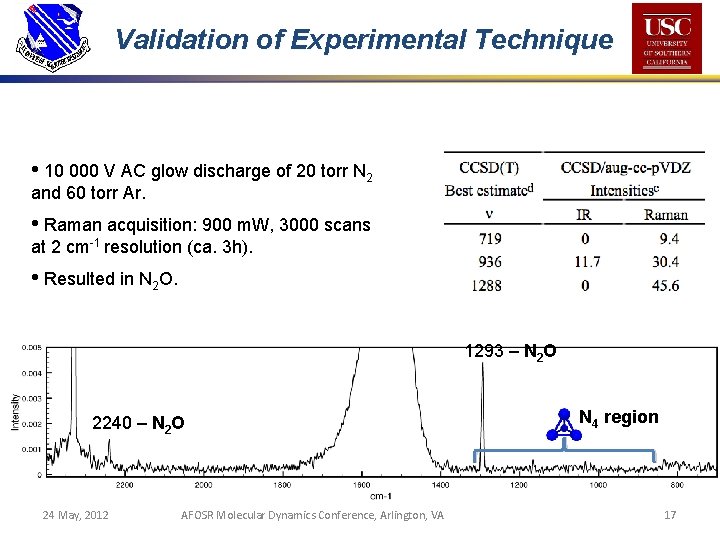
Validation of Experimental Technique • 10 000 V AC glow discharge of 20 torr N 2 and 60 torr Ar. • Raman acquisition: 900 m. W, 3000 scans at 2 cm-1 resolution (ca. 3 h). • Resulted in N 2 O. 1293 – N 2 O 2240 – N 2 O 24 May, 2012 AFOSR Molecular Dynamics Conference, Arlington, VA N 4 region 17
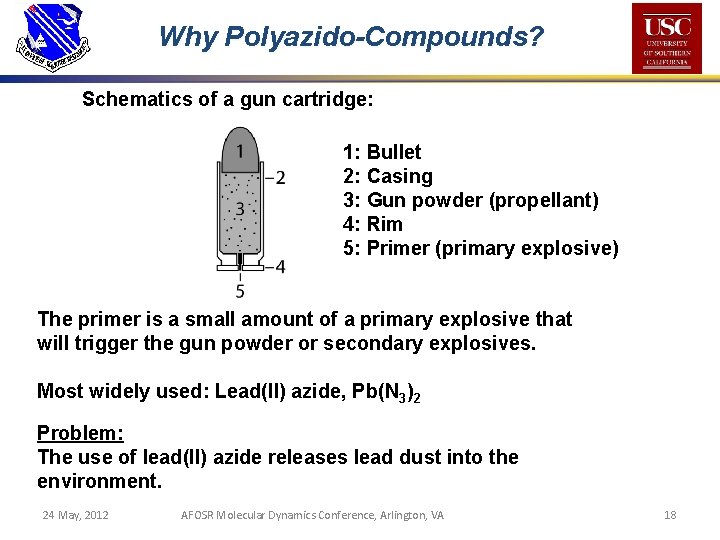
Why Polyazido-Compounds? Schematics of a gun cartridge: 1: Bullet 2: Casing 3: Gun powder (propellant) 4: Rim 5: Primer (primary explosive) The primer is a small amount of a primary explosive that will trigger the gun powder or secondary explosives. Most widely used: Lead(II) azide, Pb(N 3)2 Problem: The use of lead(II) azide releases lead dust into the environment. 24 May, 2012 AFOSR Molecular Dynamics Conference, Arlington, VA 18
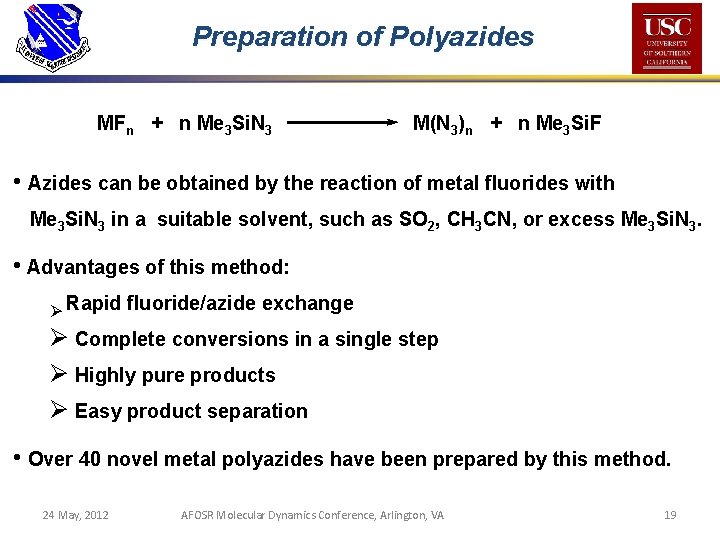
Preparation of Polyazides MFn + n Me 3 Si. N 3 M(N 3)n + n Me 3 Si. F • Azides can be obtained by the reaction of metal fluorides with Me 3 Si. N 3 in a suitable solvent, such as SO 2, CH 3 CN, or excess Me 3 Si. N 3. • Advantages of this method: Ø Rapid fluoride/azide exchange Ø Complete conversions in a single step Ø Highly pure products Ø Easy product separation • Over 40 novel metal polyazides have been prepared by this method. 24 May, 2012 AFOSR Molecular Dynamics Conference, Arlington, VA 19
Examples of Novel Polyazides [Ga(N 3)5]2 - [In(N 3)6]3 - [Tl(N 3)6]3 - R. Haiges, J. Boatz, J. Williams, K. Christe, Angew. Chem. Int. Ed. 2011, 50, 8828 24 May, 2012 AFOSR Molecular Dynamics Conference, Arlington, VA 20
Examples of Novel Polyazides contd. [Re. O 2(N 3)4]- 24 May, 2012 [OMo(N 3)5]2 - AFOSR Molecular Dynamics Conference, Arlington, VA [O 2 U(N 3)4]2 - 21
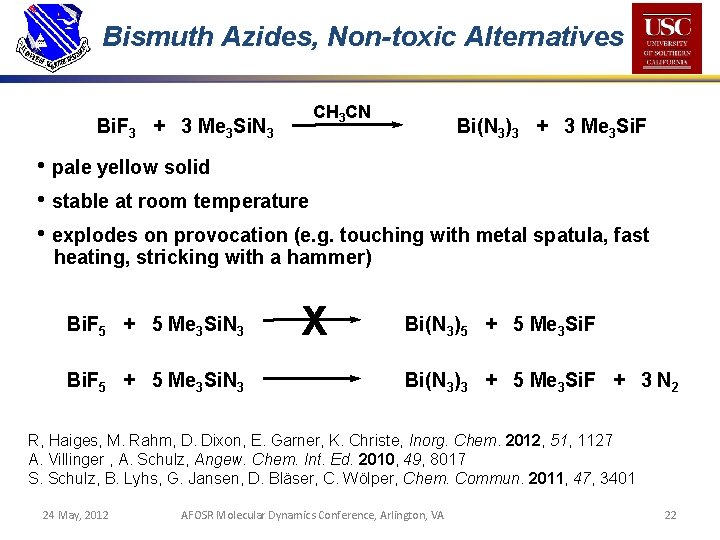
Bismuth Azides, Non-toxic Alternatives Bi. F 3 + 3 Me 3 Si. N 3 CH 3 CN Bi(N 3)3 + 3 Me 3 Si. F • pale yellow solid • stable at room temperature • explodes on provocation (e. g. touching with metal spatula, fast heating, stricking with a hammer) Bi. F 5 + 5 Me 3 Si. N 3 X Bi(N 3)5 + 5 Me 3 Si. F Bi(N 3)3 + 5 Me 3 Si. F + 3 N 2 R, Haiges, M. Rahm, D. Dixon, E. Garner, K. Christe, Inorg. Chem. 2012, 51, 1127 A. Villinger , A. Schulz, Angew. Chem. Int. Ed. 2010, 49, 8017 S. Schulz, B. Lyhs, G. Jansen, D. Bläser, C. Wölper, Chem. Commun. 2011, 47, 3401 24 May, 2012 AFOSR Molecular Dynamics Conference, Arlington, VA 22
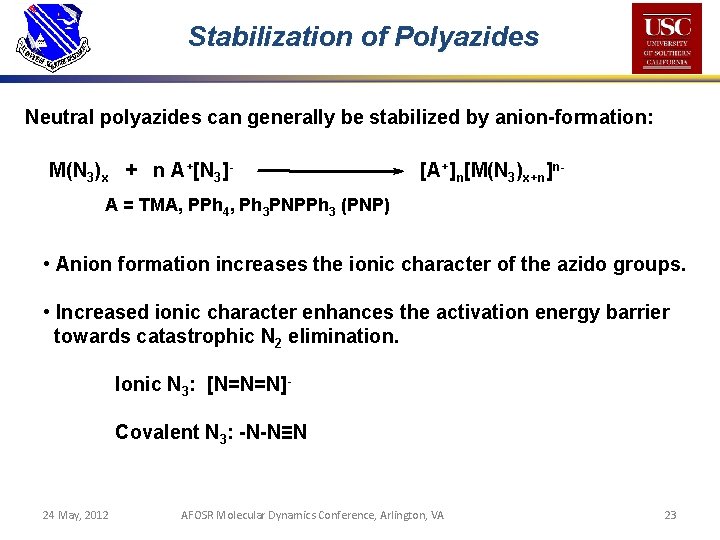
Stabilization of Polyazides Neutral polyazides can generally be stabilized by anion-formation: M(N 3)x + n A+[N 3]- [A+]n[M(N 3)x+n]n- A = TMA, PPh 4, Ph 3 PNPPh 3 (PNP) • Anion formation increases the ionic character of the azido groups. • Increased ionic character enhances the activation energy barrier towards catastrophic N 2 elimination. Ionic N 3: [N=N=N]Covalent N 3: -N-N≡N 24 May, 2012 AFOSR Molecular Dynamics Conference, Arlington, VA 23
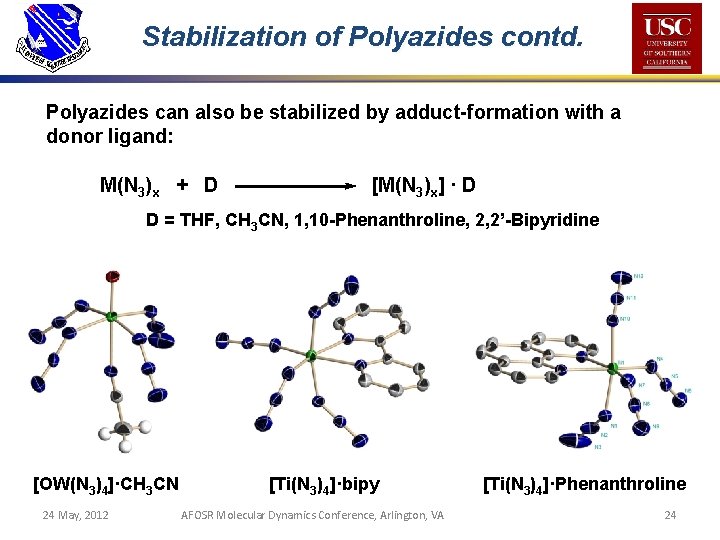
Stabilization of Polyazides contd. Polyazides can also be stabilized by adduct-formation with a donor ligand: M(N 3)x + D [M(N 3)x] · D D = THF, CH 3 CN, 1, 10 -Phenanthroline, 2, 2’-Bipyridine [OW(N 3)4]·CH 3 CN 24 May, 2012 [Ti(N 3)4]·bipy AFOSR Molecular Dynamics Conference, Arlington, VA [Ti(N 3)4]·Phenanthroline 24
[A][Bi(N 3)4]Bi(N 3)3 + PPh 4+[N 3]- CH 3 CN [PPh 4][Bi(N 3)4] Chains of planar Bi 2 N 2 units rotated by 69°. 24 May, 2012 AFOSR Molecular Dynamics Conference, Arlington, VA 25
[A][Bi(N 3)4]- contd. • lone pair is sterically active • CN 5 (7 with bridges) • pseudo-trigonal bipyramid • Bi-Naxial 2. 276 Å • Bi-Nequat 2. 382 Å • axial N 1 -Bi-N 10 compressed to 159. 4° 24 May, 2012 AFOSR Molecular Dynamics Conference, Arlington, VA 26
[A]2[Bi(N 3)5] Bi(N 3)3 + 2 A + N 3 - CH 3 CN [A]2[Bi(N 3)5] A = PPh 4, PNP+: Ph 3 P=N=PPh 3]+ • monomeric anion • lone pair is sterically active • CN 6 • pseudo-octahedral geometry • Bi-Naxial 2. 195 Å • Bi-Nequat 2. 382 Å • axial N-Bi-N compressed to 168° 24 May, 2012 AFOSR Molecular Dynamics Conference, Arlington, VA 27
[PPh 4]3[Bi(N 3)6] Bi(N 3)3 + 3 PNP+[N 3 ]- Bi(N 3)3 + 3 PPh 4+[N 3]- CH 3 CN [PNP]2[Bi(N 3)5] + PNP+[N 3]- CH 3 CN [PPh 4]3[Bi(N 3)6] • monomeric anion • lone pair is sterically active • CN 7 • monocapped octahedron • similar to IF 6 • three shorter and three longer Bi-N bonds 24 May, 2012 AFOSR Molecular Dynamics Conference, Arlington, VA 28
[PPh 4]2[bipy·Bi(N 3)5] [PPh 4]2[Bi(N 3)5] + bipy [PPh 4]2[bipy·Bi(N 3)5] bipy: 2, 2’-bipyridine • monomeric anion • lone pair sterically inactive • CN 7 • pseudo-monocapped trigonal prism (2: 4: 1) 24 May, 2012 AFOSR Molecular Dynamics Conference, Arlington, VA 29
(bipy)2·Bi(N 3)3 + 2 bipy (bipy)2·Bi(N 3)3 bipy: 2, 2’-bipyridine • dimer • planar Bi 2 N 2 unit • Bi-Nbridge 2. 510 Å • Bi-Nterminal 2. 345 / 2. 438 Å • lone pair is sterically inactive • CN 8 24 May, 2012 AFOSR Molecular Dynamics Conference, Arlington, VA 30
[(bipy)2·Bi(N 3)3]2 Two pseudo-square antiprisms with a common edge. 24 May, 2012 AFOSR Molecular Dynamics Conference, Arlington, VA 31
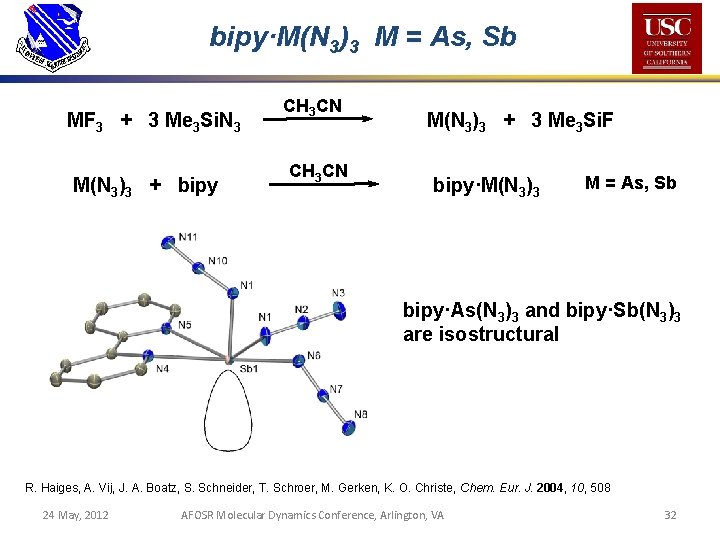
bipy·M(N 3)3 M = As, Sb MF 3 + 3 Me 3 Si. N 3 M(N 3)3 + bipy CH 3 CN M(N 3)3 + 3 Me 3 Si. F bipy·M(N 3)3 M = As, Sb bipy·As(N 3)3 and bipy·Sb(N 3)3 are isostructural R. Haiges, A. Vij, J. A. Boatz, S. Schneider, T. Schroer, M. Gerken, K. O. Christe, Chem. Eur. J. 2004, 10, 508 24 May, 2012 AFOSR Molecular Dynamics Conference, Arlington, VA 32
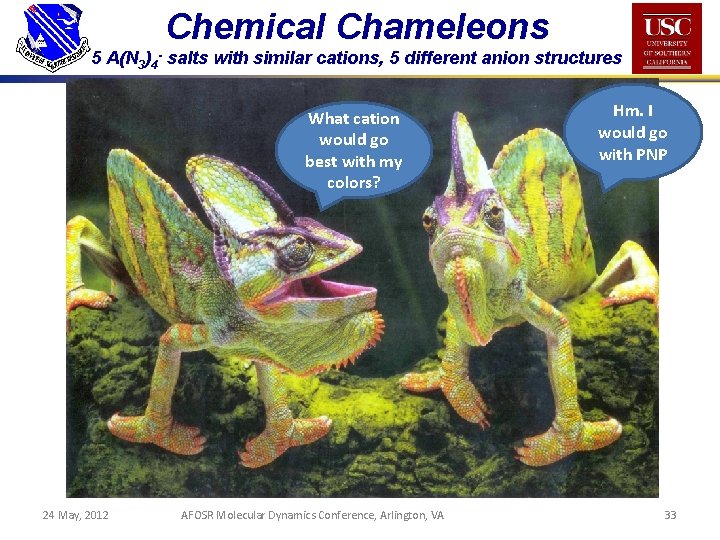
Chemical Chameleons 5 A(N 3)4 - salts with similar cations, 5 different anion structures What cation would go best with my colors? 24 May, 2012 AFOSR Molecular Dynamics Conference, Arlington, VA Hm. I would go with PNP 33
A[As(N 3)4] M (N 3)3 + AN 3 PPh 4[As(N 3)4] 24 May, 2012 CH 3 CN M[As(N 3)4] PNP[As(N 3)4] AFOSR Molecular Dynamics Conference, Arlington, VA A = TMA, PPh 4, PNP M = As, Sb TMA[As(N 3)4]: (ionic? ) liquid at ambient temperature 34
TMA[Sb(N 3)4] (1) 57 2. 9 2. 264(1 ) Anion chain structure through m 1, 1 and m 1, 3 bridges. 2. 111(1) ) 1 3. (1) 2. 261 (1 76 Bond lengths given in [Å] 24 May, 2012 AFOSR Molecular Dynamics Conference, Arlington, VA 35
PPh 4[Sb(N 3)4] 2. 071(4) 4) 2. 254( 3 2. 24 4) 8( 43 3. (2) 7. 28 4(4) Anion chain structure through two m 1, 3 bridges. Bond lengths given in [Å] 24 May, 2012 AFOSR Molecular Dynamics Conference, Arlington, VA 36
PNP[Sb(N 3)4] 3. 024 (2) 2. 280(2) Anion dimer structure through a single m 1, 3 bridge. 2. 096(2) 2) 2. 240( Bond lengths given in [Å] 24 May, 2012 AFOSR Molecular Dynamics Conference, Arlington, VA 37
Summary • A new program was started aimed at the bulk synthesis and characterization of N 4, a highly energetic and first example of a meta-stable nitrogen allotrope. • Low-temperature glow discharge, coupled with Raman and infrared spectroscopy, is used to identify the material. • Setting up and checking out the equipment for carrying out this task is proceeding well. • Excellent progress was made in the area of polyazide chemistry. • A new family of bismuth polyazides has been prepared and characterized. • An amazing and highly unusual observation was made during a systematic structural study of M(N 3)4 - (M = As, Sb) anions. • For five salts with almost identical cations, five different anion structures were found (“Chemical Chameleons”). 24 May, 2012 AFOSR Molecular Dynamics Conference, Arlington, VA 38
Thank you for your Attention 24 May, 2012 AFOSR Molecular Dynamics Conference, Arlington, VA 39