
Polymorphism part 2 November 28 2007 2004 Pearson
Polymorphism (part 2) November 28, 2007 © 2004 Pearson Addison-Wesley. All rights reserved Com. S 207: Programming I (in Java) Iowa State University, FALL 2007 Instructor: Alexander Stoytchev
Quick Review of Last Lecture © 2004 Pearson Addison-Wesley. All rights reserved
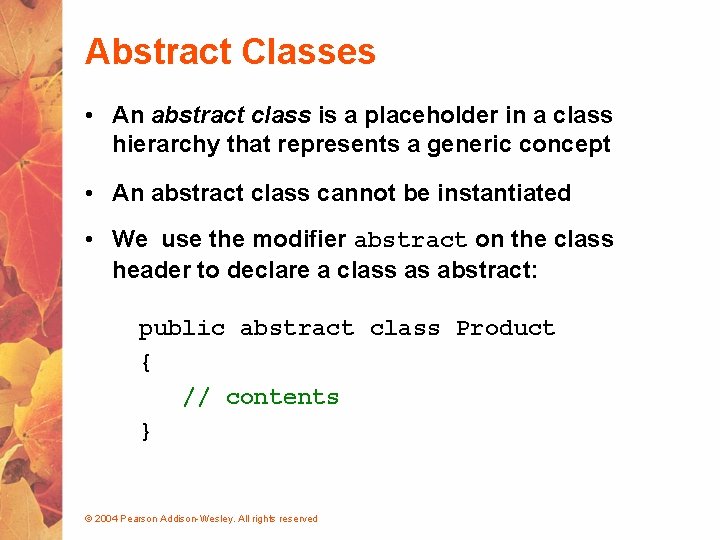
Abstract Classes • An abstract class is a placeholder in a class hierarchy that represents a generic concept • An abstract class cannot be instantiated • We use the modifier abstract on the class header to declare a class as abstract: public abstract class Product { // contents } © 2004 Pearson Addison-Wesley. All rights reserved
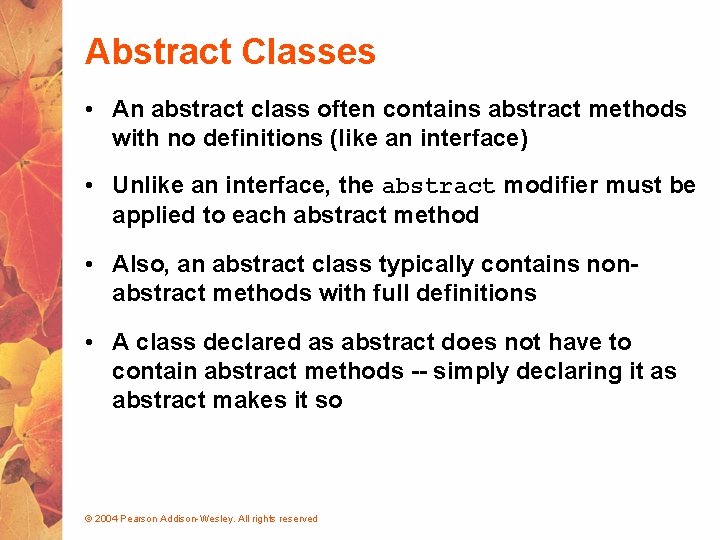
Abstract Classes • An abstract class often contains abstract methods with no definitions (like an interface) • Unlike an interface, the abstract modifier must be applied to each abstract method • Also, an abstract class typically contains nonabstract methods with full definitions • A class declared as abstract does not have to contain abstract methods -- simply declaring it as abstract makes it so © 2004 Pearson Addison-Wesley. All rights reserved
Abstract Classes • The child of an abstract class must override the abstract methods of the parent, or it too will be considered abstract • An abstract method cannot be defined as final or static • The use of abstract classes is an important element of software design – it allows us to establish common elements in a hierarchy that are too generic to instantiate © 2004 Pearson Addison-Wesley. All rights reserved
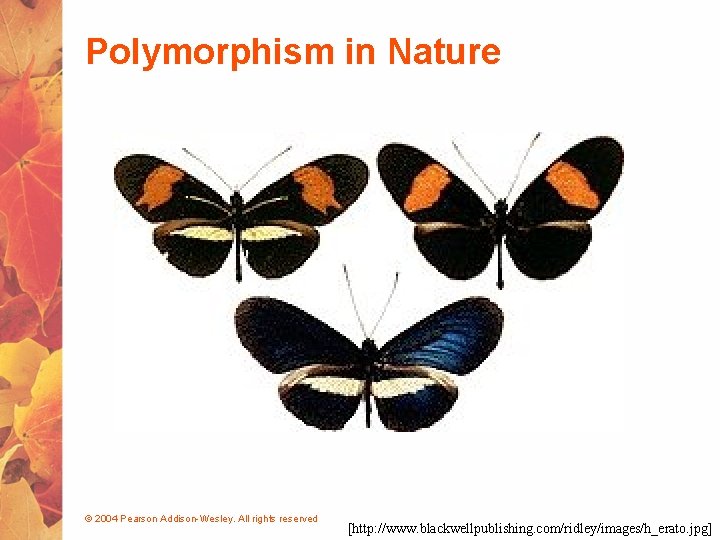
Polymorphism in Nature © 2004 Pearson Addison-Wesley. All rights reserved [http: //www. blackwellpublishing. com/ridley/images/h_erato. jpg]
Polymorphism • The term polymorphism literally means "having many forms" • A polymorphic reference is a variable that can refer to different types of objects at different points in time • The method invoked through a polymorphic reference can change from one invocation to the next • All object references in Java are potentially polymorphic © 2004 Pearson Addison-Wesley. All rights reserved
Polymorphism via Inheritance © 2004 Pearson Addison-Wesley. All rights reserved
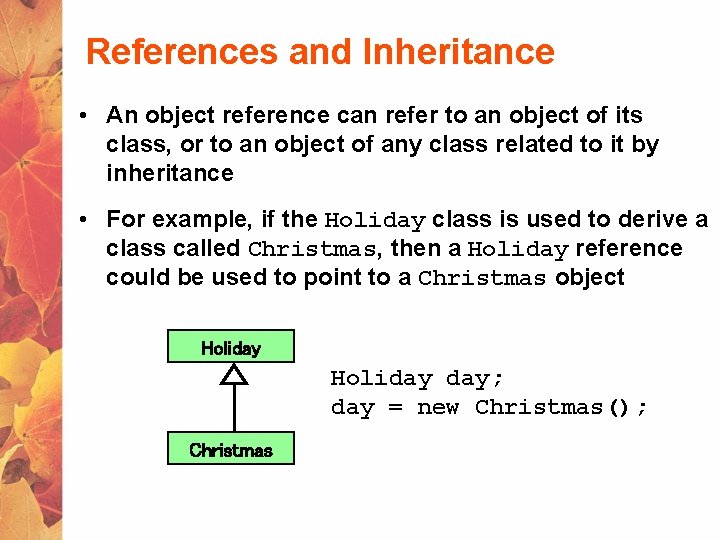
References and Inheritance • An object reference can refer to an object of its class, or to an object of any class related to it by inheritance • For example, if the Holiday class is used to derive a class called Christmas, then a Holiday reference could be used to point to a Christmas object Holiday day; day = new Christmas(); Christmas
Binding • Consider the following method invocation: obj. do. It(); • At some point, this invocation is bound to the definition of the method that it invokes • If this binding occurred at compile time, then that line of code would call the same method every time • However, Java defers method binding until run time -- this is called dynamic binding or late binding • Late binding provides flexibility in program design © 2004 Pearson Addison-Wesley. All rights reserved
References and Inheritance • Assigning a child object to a parent reference is considered to be a widening conversion, and can be performed by simple assignment • Assigning an parent object to a child reference can be done also, but it is considered a narrowing conversion and must be done with a cast • The widening conversion is the most useful
Example: Animals class hierarchy • Animal. java • Cow. java • Duck. java • Dog. java • Farm. java © 2004 Pearson Addison-Wesley. All rights reserved
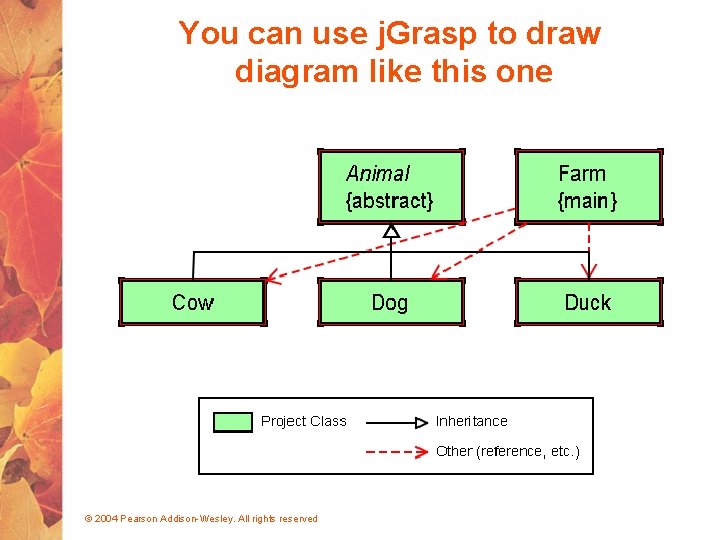
You can use j. Grasp to draw diagram like this one © 2004 Pearson Addison-Wesley. All rights reserved
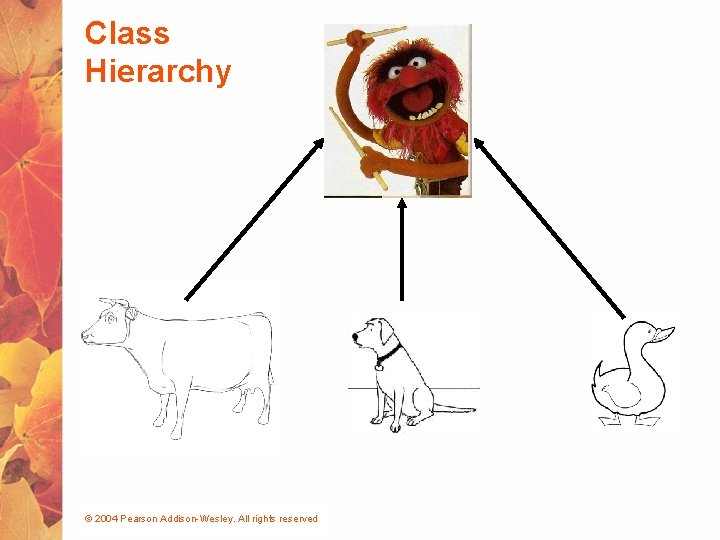
Class Hierarchy © 2004 Pearson Addison-Wesley. All rights reserved

public abstract class Animal { abstract void make. Sound(); } public class Cow extends Animal { public void make. Sound() { System. out. println("Moo-Moo"); } } public class Dog extends Animal { public void make. Sound() { System. out. println(“Wuf-Wuf"); } } public class Duck extends Animal { public void make. Sound() { System. out. println(“Quack-Quack"); } } © 2004 Pearson Addison-Wesley. All rights reserved
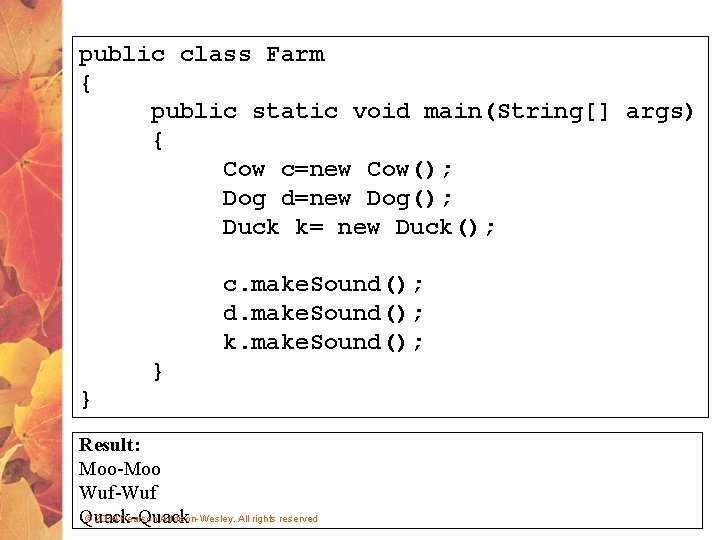
public class Farm { public static void main(String[] args) { Cow c=new Cow(); Dog d=new Dog(); Duck k= new Duck(); c. make. Sound(); d. make. Sound(); k. make. Sound(); } } Result: Moo-Moo Wuf-Wuf © 2004 Pearson Addison-Wesley. All rights reserved Quack-Quack
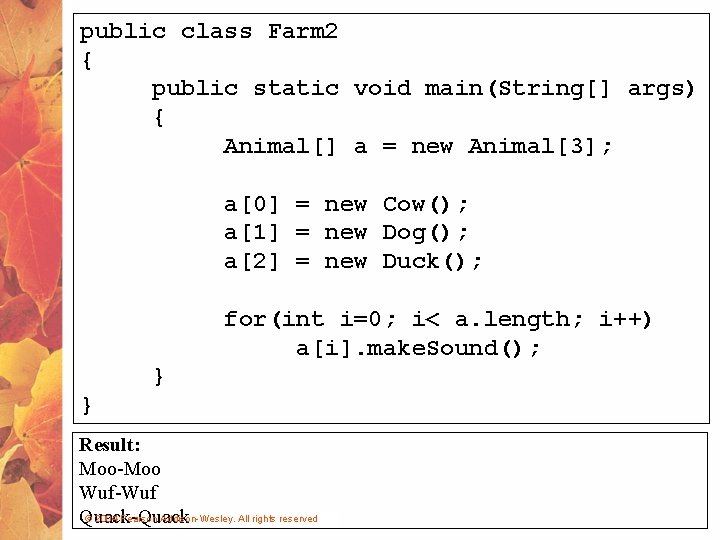
public class Farm 2 { public static void main(String[] args) { Animal[] a = new Animal[3]; a[0] = new Cow(); a[1] = new Dog(); a[2] = new Duck(); for(int i=0; i< a. length; i++) a[i]. make. Sound(); } } Result: Moo-Moo Wuf-Wuf © 2004 Pearson Addison-Wesley. All rights reserved Quack-Quack
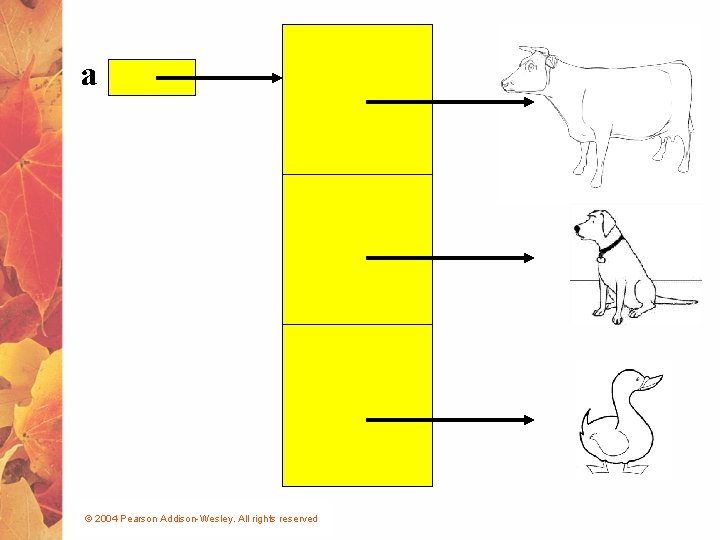
a © 2004 Pearson Addison-Wesley. All rights reserved
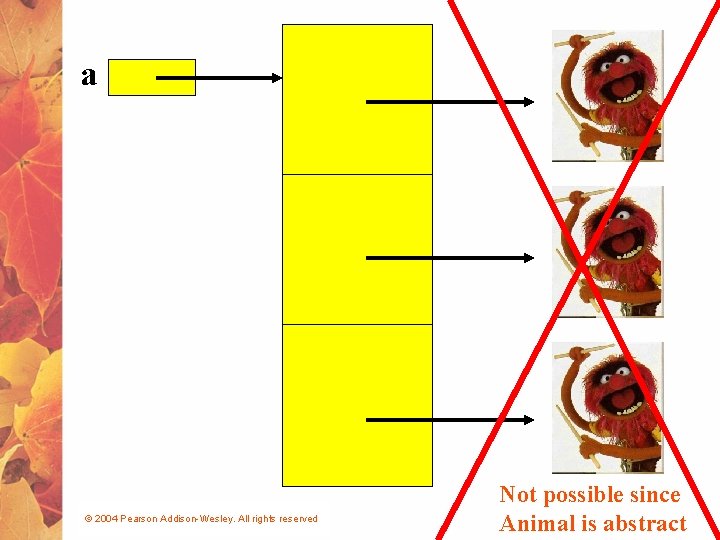
a © 2004 Pearson Addison-Wesley. All rights reserved Not possible since Animal is abstract
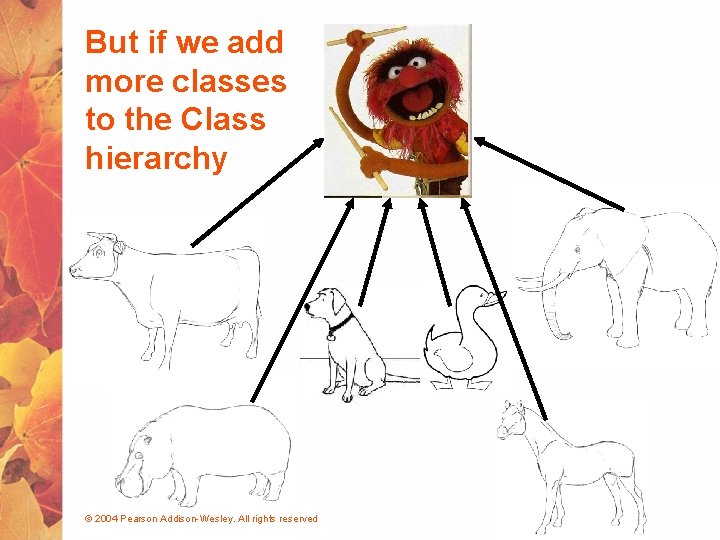
But if we add more classes to the Class hierarchy © 2004 Pearson Addison-Wesley. All rights reserved

We can do this… a © 2004 Pearson Addison-Wesley. All rights reserved
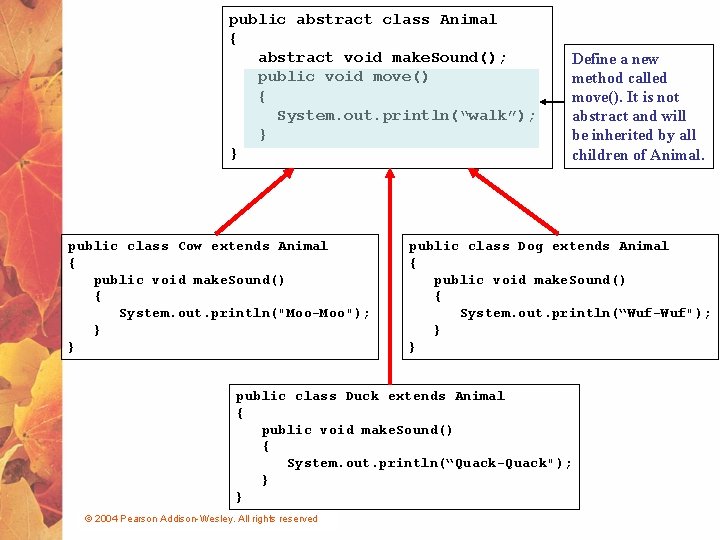
public abstract class Animal { abstract void make. Sound(); public void move() { System. out. println(“walk”); } } public class Cow extends Animal { public void make. Sound() { System. out. println("Moo-Moo"); } } Define a new method called move(). It is not abstract and will be inherited by all children of Animal. public class Dog extends Animal { public void make. Sound() { System. out. println(“Wuf-Wuf"); } } public class Duck extends Animal { public void make. Sound() { System. out. println(“Quack-Quack"); } } © 2004 Pearson Addison-Wesley. All rights reserved
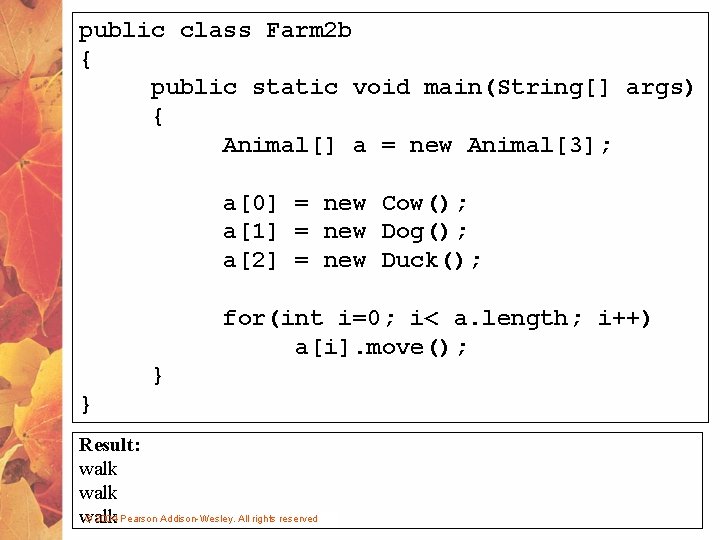
public class Farm 2 b { public static void main(String[] args) { Animal[] a = new Animal[3]; a[0] = new Cow(); a[1] = new Dog(); a[2] = new Duck(); for(int i=0; i< a. length; i++) a[i]. move(); } } Result: walk © 2004 Pearson Addison-Wesley. All rights reserved walk
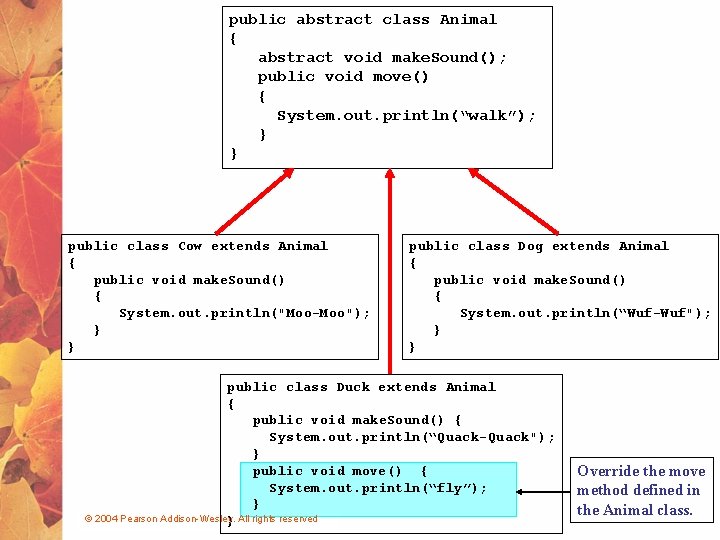
public abstract class Animal { abstract void make. Sound(); public void move() { System. out. println(“walk”); } } public class Cow extends Animal { public void make. Sound() { System. out. println("Moo-Moo"); } } public class Dog extends Animal { public void make. Sound() { System. out. println(“Wuf-Wuf"); } } public class Duck extends Animal { public void make. Sound() { System. out. println(“Quack-Quack"); } public void move() { System. out. println(“fly”); } © 2004 Pearson Addison-Wesley. All rights reserved } Override the move method defined in the Animal class.
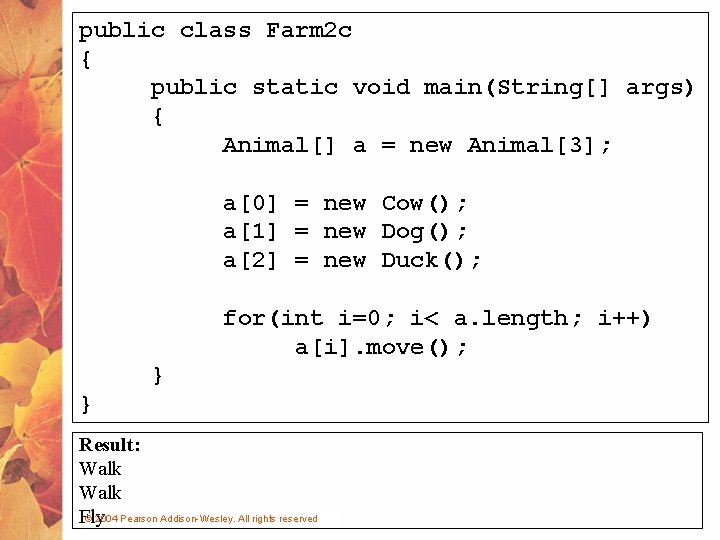
public class Farm 2 c { public static void main(String[] args) { Animal[] a = new Animal[3]; a[0] = new Cow(); a[1] = new Dog(); a[2] = new Duck(); for(int i=0; i< a. length; i++) a[i]. move(); } } Result: Walk © 2004 Pearson Addison-Wesley. All rights reserved Fly
Chapter 9 Section 9. 1 & 9. 2
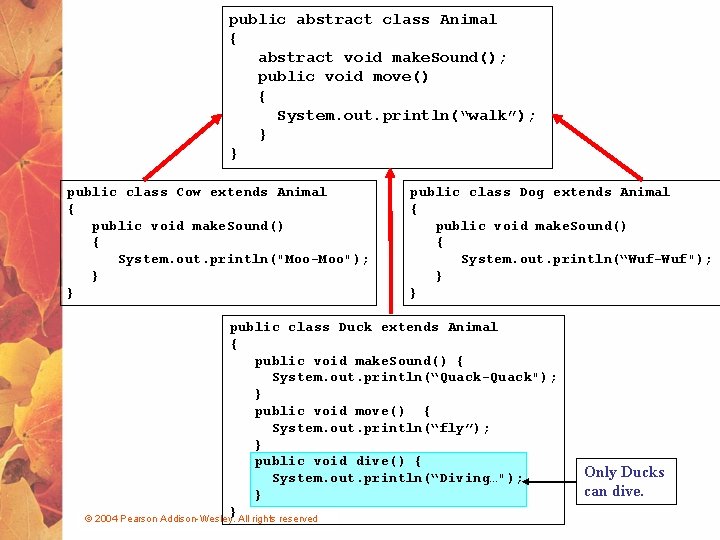
public abstract class Animal { abstract void make. Sound(); public void move() { System. out. println(“walk”); } } public class Cow extends Animal { public void make. Sound() { System. out. println("Moo-Moo"); } } public class Dog extends Animal { public void make. Sound() { System. out. println(“Wuf-Wuf"); } } public class Duck extends Animal { public void make. Sound() { System. out. println(“Quack-Quack"); } public void move() { System. out. println(“fly”); } public void dive() { System. out. println(“Diving…"); } } © 2004 Pearson Addison-Wesley. All rights reserved Only Ducks can dive.
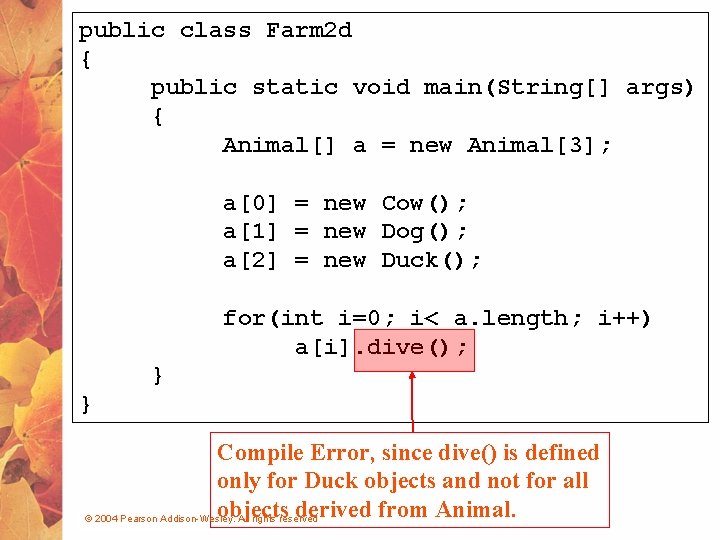
public class Farm 2 d { public static void main(String[] args) { Animal[] a = new Animal[3]; a[0] = new Cow(); a[1] = new Dog(); a[2] = new Duck(); for(int i=0; i< a. length; i++) a[i]. dive(); } } Compile Error, since dive() is defined only for Duck objects and not for all objects derived from Animal. © 2004 Pearson Addison-Wesley. All rights reserved
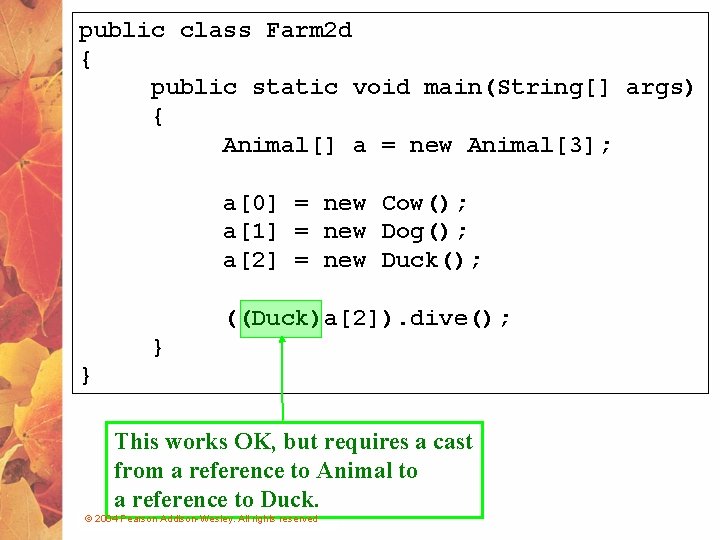
public class Farm 2 d { public static void main(String[] args) { Animal[] a = new Animal[3]; a[0] = new Cow(); a[1] = new Dog(); a[2] = new Duck(); ((Duck)a[2]). dive(); } } This works OK, but requires a cast from a reference to Animal to a reference to Duck. © 2004 Pearson Addison-Wesley. All rights reserved
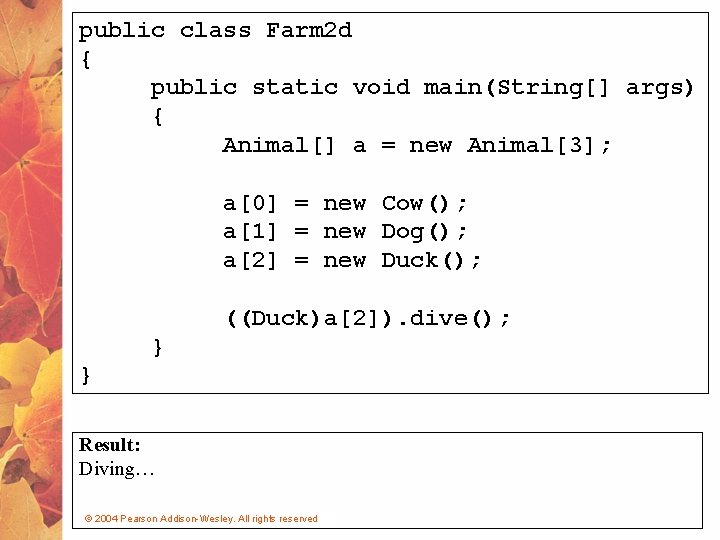
public class Farm 2 d { public static void main(String[] args) { Animal[] a = new Animal[3]; a[0] = new Cow(); a[1] = new Dog(); a[2] = new Duck(); ((Duck)a[2]). dive(); } } Result: Diving… © 2004 Pearson Addison-Wesley. All rights reserved

Polymorphism via Inheritance • Now let's look at an example that pays a set of diverse employees using a polymorphic method • • See Firm. java (page 486) See Staff. java (page 487) See Staff. Member. java (page 489) See Volunteer. java (page 491) See Employee. java (page 492) See Executive. java (page 493) See Hourly. java (page 494) © 2004 Pearson Addison-Wesley. All rights reserved
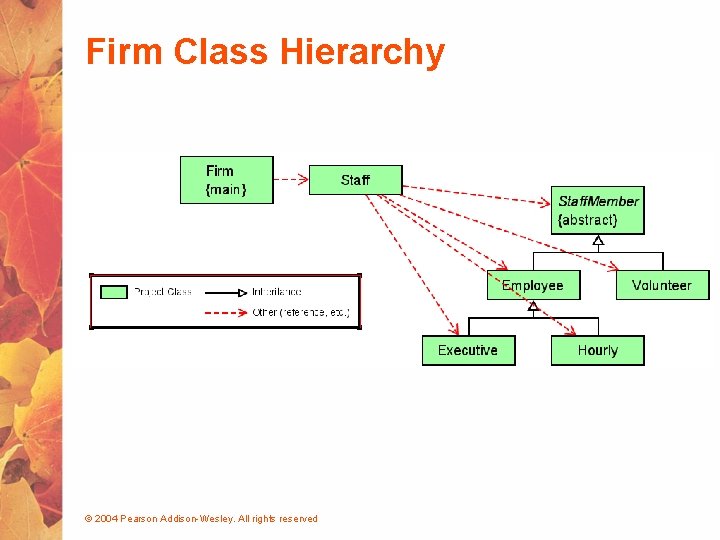
Firm Class Hierarchy © 2004 Pearson Addison-Wesley. All rights reserved
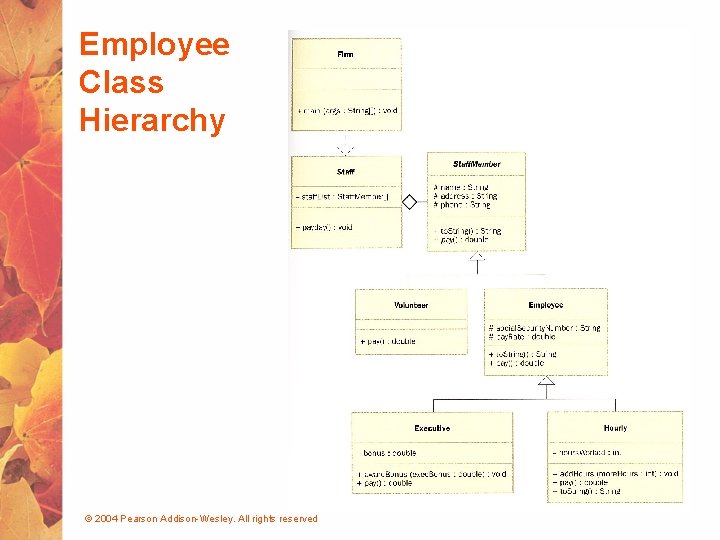
Employee Class Hierarchy © 2004 Pearson Addison-Wesley. All rights reserved
Chapter 9 Section 9. 3
Interface Hierarchies • Inheritance can be applied to interfaces as well as classes • That is, one interface can be derived from another interface • The child interface inherits all abstract methods of the parent • A class implementing the child interface must define all methods from both the ancestor and child interfaces • Note that class hierarchies and interface hierarchies are distinct (they do not overlap) © 2004 Pearson Addison-Wesley. All rights reserved
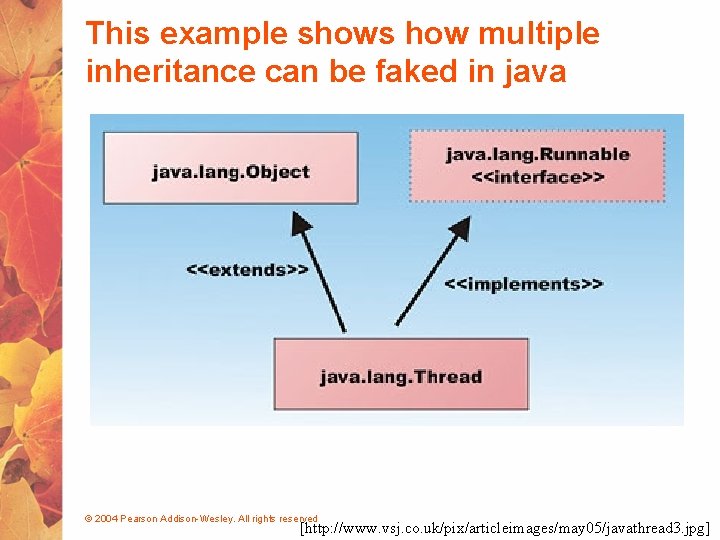
This example shows how multiple inheritance can be faked in java © 2004 Pearson Addison-Wesley. All rights reserved [http: //www. vsj. co. uk/pix/articleimages/may 05/javathread 3. jpg]
Polymorphism via Interfaces • An interface name can be used as the type of an object reference variable Speaker current; • The current reference can be used to point to any object of any class that implements the Speaker interface • The version of speak that the following line invokes depends on the type of object that current is referencing current. speak(); © 2004 Pearson Addison-Wesley. All rights reserved
Polymorphism via Interfaces • Suppose two classes, Philosopher and Dog, both implement the Speaker interface, providing distinct versions of the speak method • In the following code, the first call to speak invokes one version and the second invokes another: Speaker guest = new Philospher(); guest. speak(); guest = new Dog(); guest. speak(); © 2004 Pearson Addison-Wesley. All rights reserved
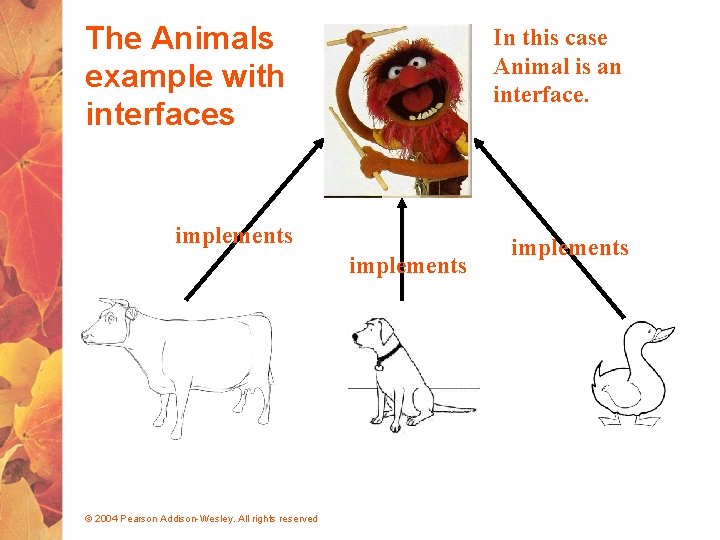
The Animals example with interfaces In this case Animal is an interface. implements © 2004 Pearson Addison-Wesley. All rights reserved implements
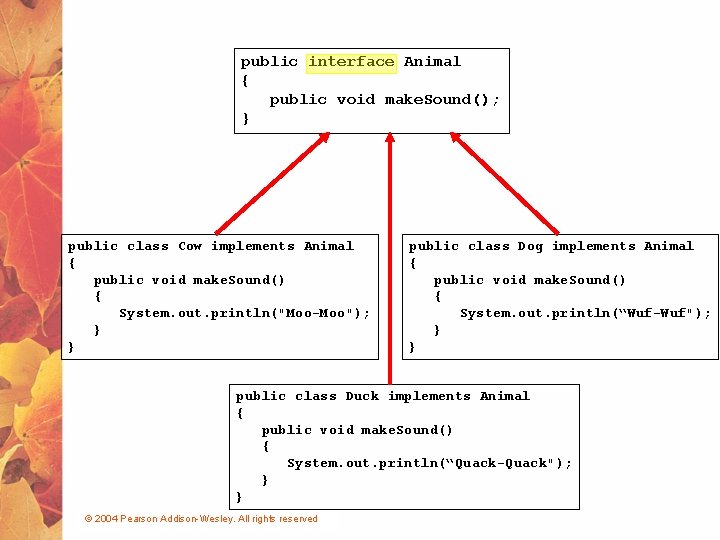
public interface Animal { public void make. Sound(); } public class Cow implements Animal { public void make. Sound() { System. out. println("Moo-Moo"); } } public class Dog implements Animal { public void make. Sound() { System. out. println(“Wuf-Wuf"); } } public class Duck implements Animal { public void make. Sound() { System. out. println(“Quack-Quack"); } } © 2004 Pearson Addison-Wesley. All rights reserved
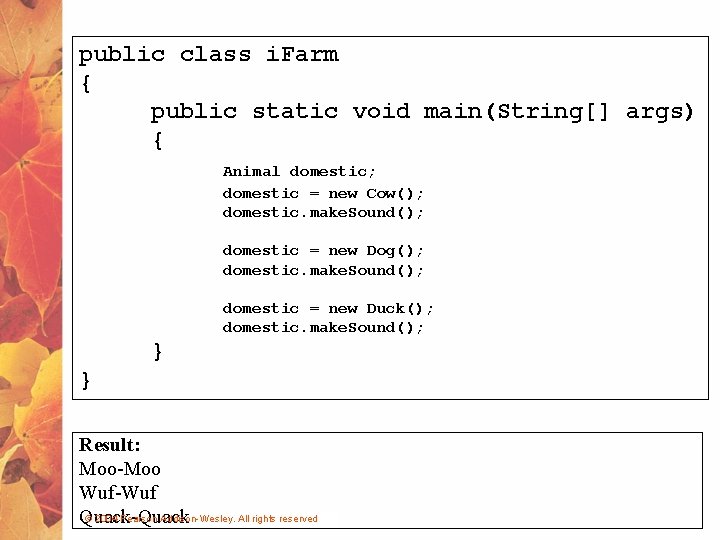
public class i. Farm { public static void main(String[] args) { Animal domestic; domestic = new Cow(); domestic. make. Sound(); domestic = new Dog(); domestic. make. Sound(); domestic = new Duck(); domestic. make. Sound(); } } Result: Moo-Moo Wuf-Wuf © 2004 Pearson Addison-Wesley. All rights reserved Quack-Quack
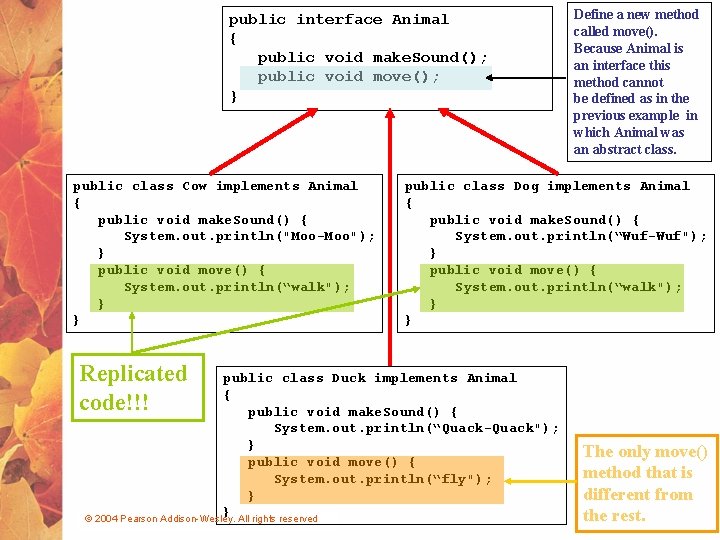
public interface Animal { public void make. Sound(); public void move(); } public class Cow implements Animal { public void make. Sound() { System. out. println("Moo-Moo"); } public void move() { System. out. println(“walk"); } } Define a new method called move(). Because Animal is an interface this method cannot be defined as in the previous example in which Animal was an abstract class. public class Dog implements Animal { public void make. Sound() { System. out. println(“Wuf-Wuf"); } public void move() { System. out. println(“walk"); } } Replicated code!!! public class Duck implements Animal { public void make. Sound() { System. out. println(“Quack-Quack"); } public void move() { System. out. println(“fly"); } } © 2004 Pearson Addison-Wesley. All rights reserved The only move() method that is different from the rest.
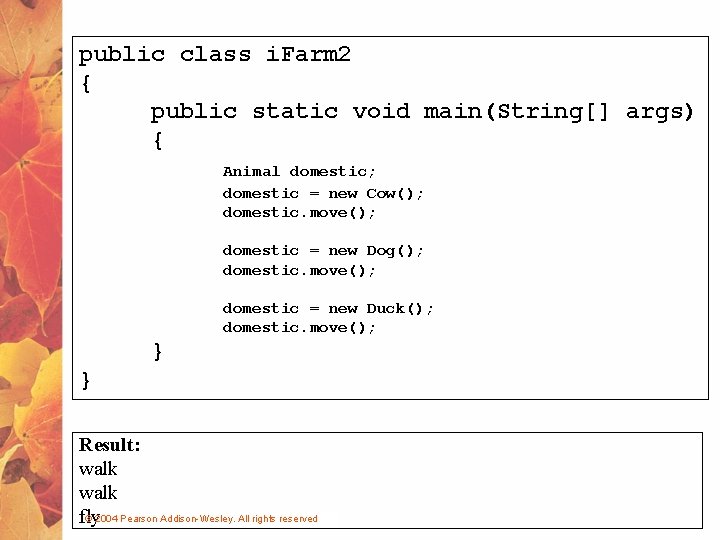
public class i. Farm 2 { public static void main(String[] args) { Animal domestic; domestic = new Cow(); domestic. move(); domestic = new Dog(); domestic. move(); domestic = new Duck(); domestic. move(); } } Result: walk © 2004 Pearson Addison-Wesley. All rights reserved fly
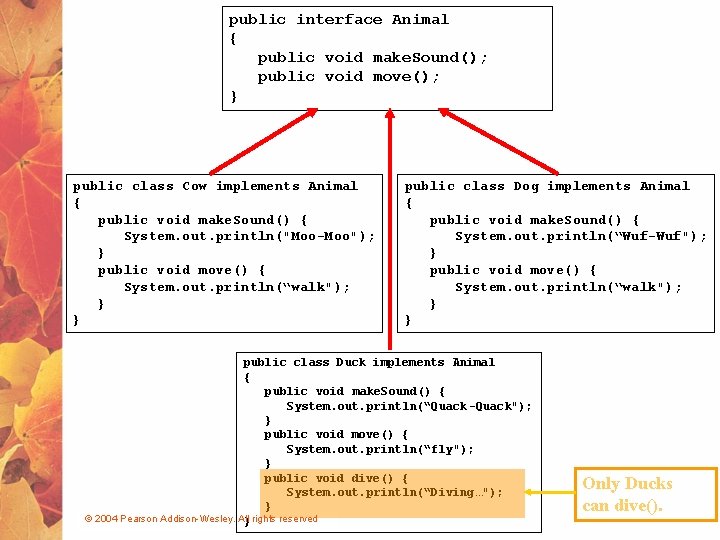
public interface Animal { public void make. Sound(); public void move(); } public class Cow implements Animal { public void make. Sound() { System. out. println("Moo-Moo"); } public void move() { System. out. println(“walk"); } } public class Dog implements Animal { public void make. Sound() { System. out. println(“Wuf-Wuf"); } public void move() { System. out. println(“walk"); } } public class Duck implements Animal { public void make. Sound() { System. out. println(“Quack -Quack"); } public void move() { System. out. println(“fly"); } public void dive() { System. out. println(“Diving …"); } © 2004 Pearson Addison-Wesley. All } rights reserved Only Ducks can dive().
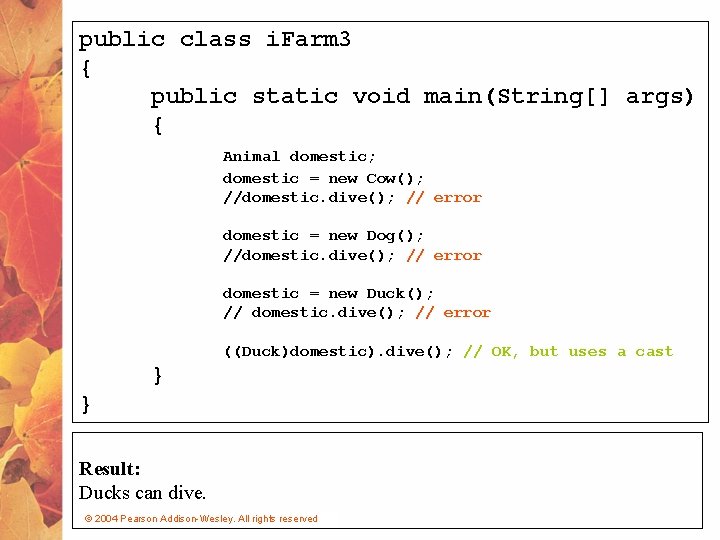
public class i. Farm 3 { public static void main(String[] args) { Animal domestic; domestic = new Cow(); //domestic. dive(); // error domestic = new Dog(); //domestic. dive(); // error domestic = new Duck(); // domestic. dive(); // error ((Duck)domestic). dive(); // OK, but uses a cast } } Result: Ducks can dive. © 2004 Pearson Addison-Wesley. All rights reserved
THE END © 2004 Pearson Addison-Wesley. All rights reserved
- Slides: 46