
Polymorphism Chapter Eight Modern Programming Languages 1 What
- Slides: 41
Polymorphism Chapter Eight Modern Programming Languages 1
What is Polymorphism? Varying function behavior based on parameter types • Objects are just parameters (“this”) • Manifest in several ways! • Chapter Eight Modern Programming Languages 2
Outline Overloading Parameter coercion Parametric polymorphism Subtype polymorphism Definitions and classifications Chapter Eight Modern Programming Languages 3
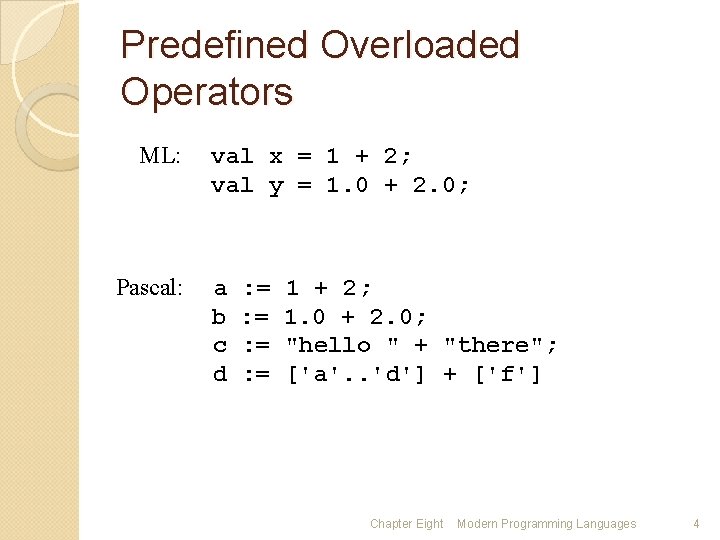
Predefined Overloaded Operators ML: Pascal: val x = 1 + 2; val y = 1. 0 + 2. 0; a b c d : = : = 1 + 2; 1. 0 + 2. 0; "hello " + "there"; ['a'. . 'd'] + ['f'] Chapter Eight Modern Programming Languages 4
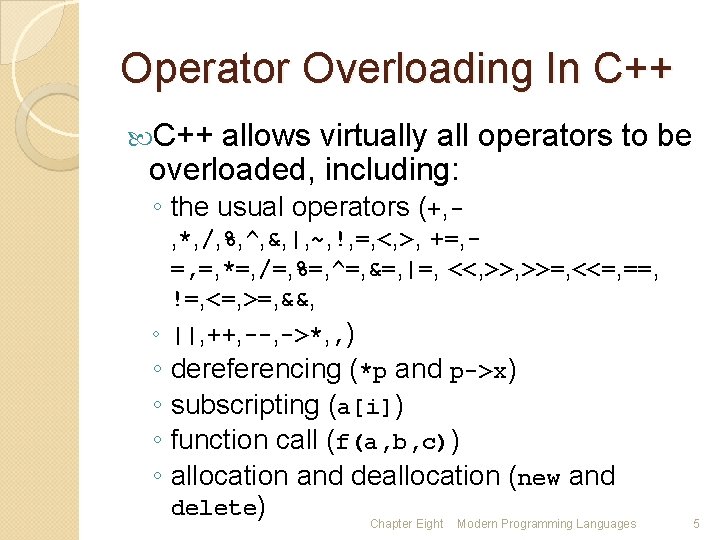
Operator Overloading In C++ allows virtually all operators to be overloaded, including: ◦ the usual operators (+, , *, /, %, ^, &, |, ~, !, =, <, >, +=, =, =, *=, /=, %=, ^=, &=, |=, <<, >>=, <<=, ==, !=, <=, >=, &&, ◦ ||, ++, --, ->*, , ) ◦ dereferencing (*p and p->x) ◦ subscripting (a[i]) ◦ function call (f(a, b, c)) ◦ allocation and deallocation (new and delete) Chapter Eight Modern Programming Languages 5
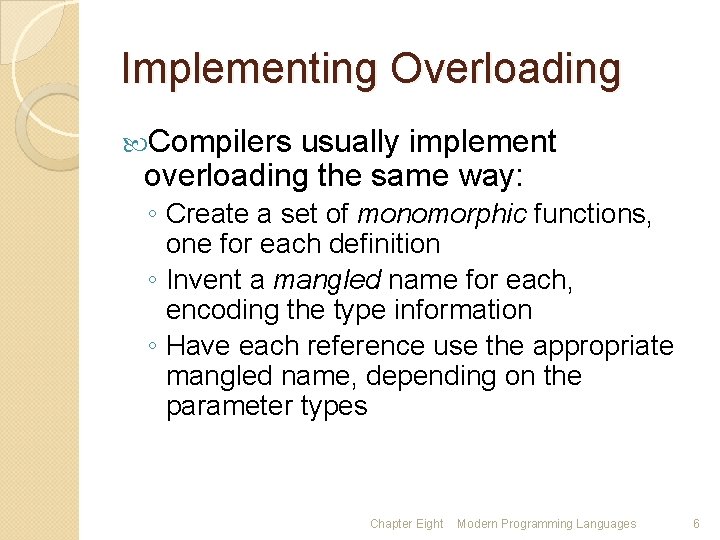
Implementing Overloading Compilers usually implement overloading the same way: ◦ Create a set of monomorphic functions, one for each definition ◦ Invent a mangled name for each, encoding the type information ◦ Have each reference use the appropriate mangled name, depending on the parameter types Chapter Eight Modern Programming Languages 6
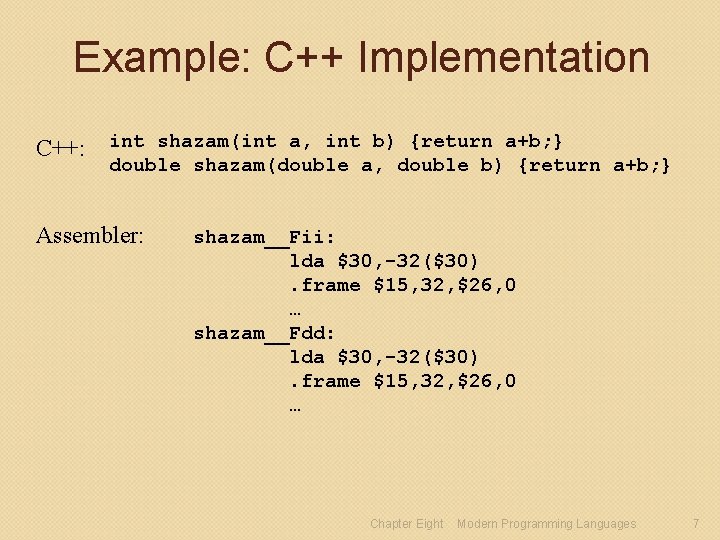
Example: C++ Implementation C++: int shazam(int a, int b) {return a+b; } double shazam(double a, double b) {return a+b; } Assembler: shazam__Fii: lda $30, -32($30). frame $15, 32, $26, 0 … shazam__Fdd: lda $30, -32($30). frame $15, 32, $26, 0 … Chapter Eight Modern Programming Languages 7
When is Overloading Resolved? Chapter Eight Modern Programming Languages 8
Outline Overloading Parameter coercion Parametric polymorphism Subtype polymorphism Definitions and classifications Chapter Eight Modern Programming Languages 9
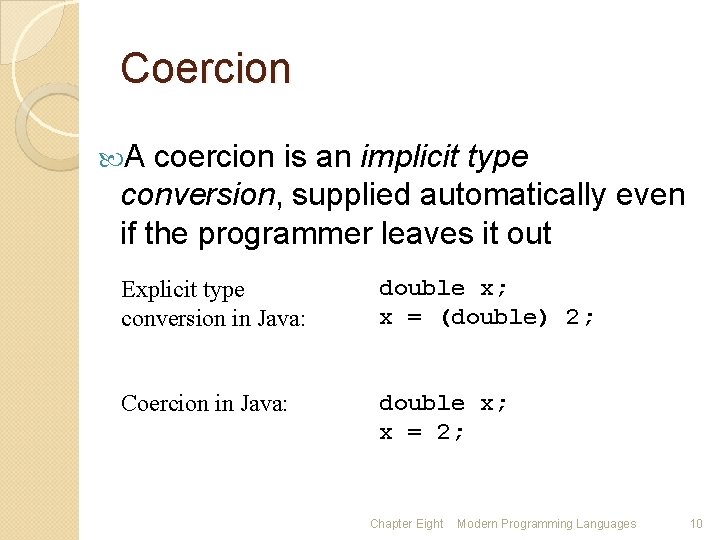
Coercion A coercion is an implicit type conversion, supplied automatically even if the programmer leaves it out Explicit type conversion in Java: double x; x = (double) 2; Coercion in Java: double x; x = 2; Chapter Eight Modern Programming Languages 10
Parameter Coercion Languages support different coercions in different contexts: assignments, other binary operations, unary operations, parameters… When a language supports coercion of parameters on a function call (or of operands when an operator is applied), the resulting function (or operator) is polymorphic Chapter Eight Modern Programming Languages 11
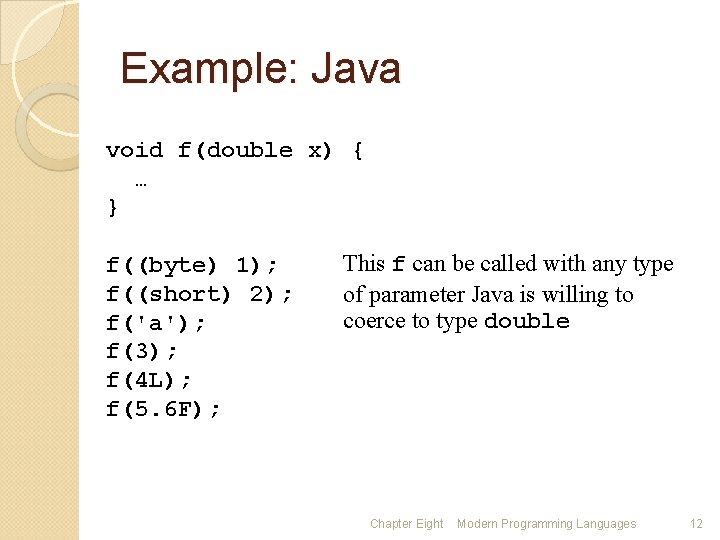
Example: Java void f(double x) { … } f((byte) 1); f((short) 2); f('a'); f(3); f(4 L); f(5. 6 F); This f can be called with any type of parameter Java is willing to coerce to type double Chapter Eight Modern Programming Languages 12
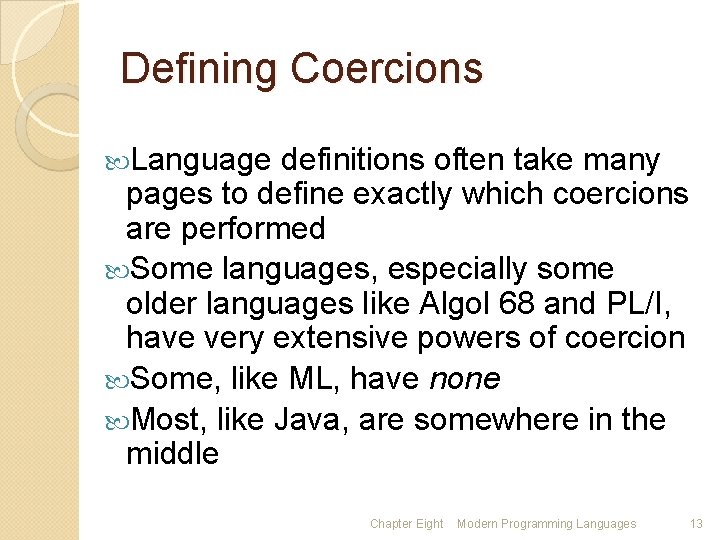
Defining Coercions Language definitions often take many pages to define exactly which coercions are performed Some languages, especially some older languages like Algol 68 and PL/I, have very extensive powers of coercion Some, like ML, have none Most, like Java, are somewhere in the middle Chapter Eight Modern Programming Languages 13
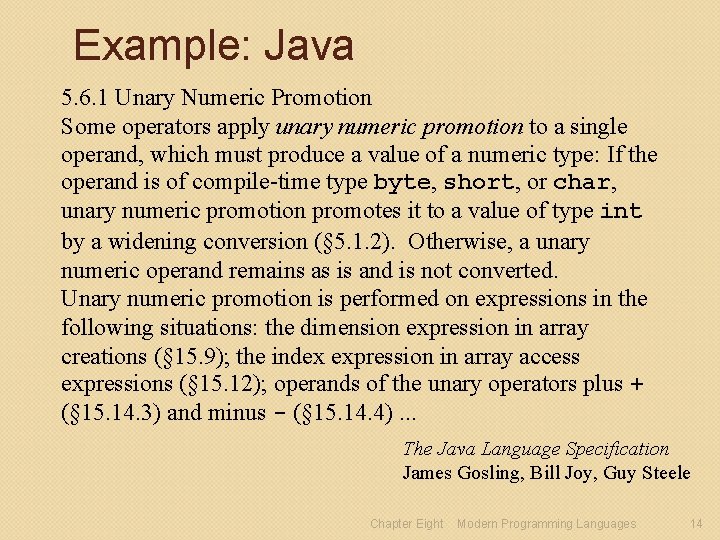
Example: Java 5. 6. 1 Unary Numeric Promotion Some operators apply unary numeric promotion to a single operand, which must produce a value of a numeric type: If the operand is of compile-time type byte, short, or char, unary numeric promotion promotes it to a value of type int by a widening conversion (§ 5. 1. 2). Otherwise, a unary numeric operand remains as is and is not converted. Unary numeric promotion is performed on expressions in the following situations: the dimension expression in array creations (§ 15. 9); the index expression in array access expressions (§ 15. 12); operands of the unary operators plus + (§ 15. 14. 3) and minus - (§ 15. 14. 4). . . The Java Language Specification James Gosling, Bill Joy, Guy Steele Chapter Eight Modern Programming Languages 14
Coercion and Overloading: Tricky Interactions There are potentially tricky interactions between overloading and coercion ◦ Overloading uses the types to choose the definition ◦ Coercion uses the definition to choose a type conversion Chapter Eight Modern Programming Languages 15
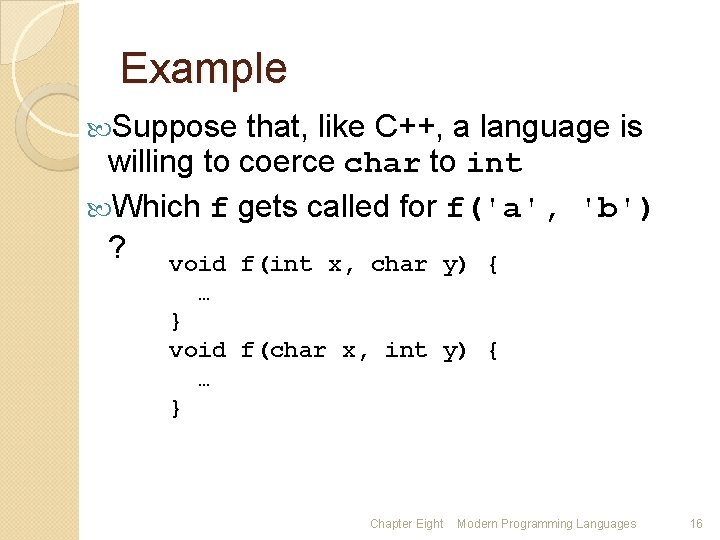
Example Suppose that, like C++, a language is willing to coerce char to int Which f gets called for f('a', 'b') ? void f(int x, char y) { … } void f(char x, int y) { … } Chapter Eight Modern Programming Languages 16
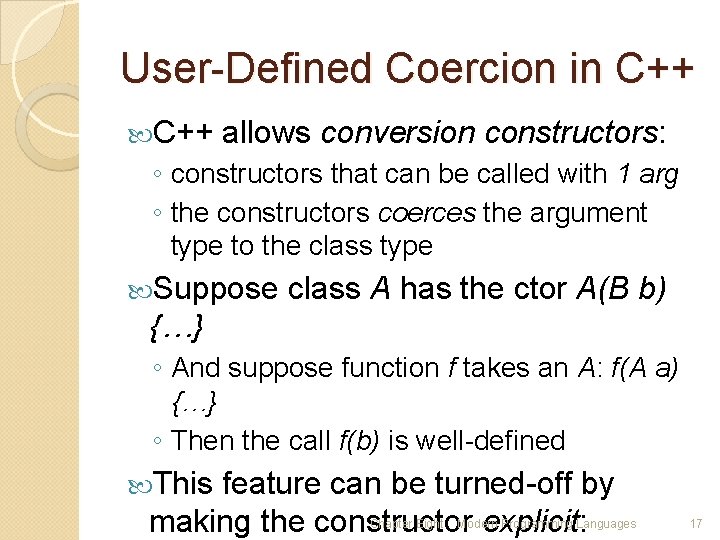
User-Defined Coercion in C++ allows conversion constructors: ◦ constructors that can be called with 1 arg ◦ the constructors coerces the argument type to the class type Suppose class A has the ctor A(B b) {…} ◦ And suppose function f takes an A: f(A a) {…} ◦ Then the call f(b) is well-defined This feature can be turned-off by making the constructor explicit: Chapter Eight Modern Programming Languages 17
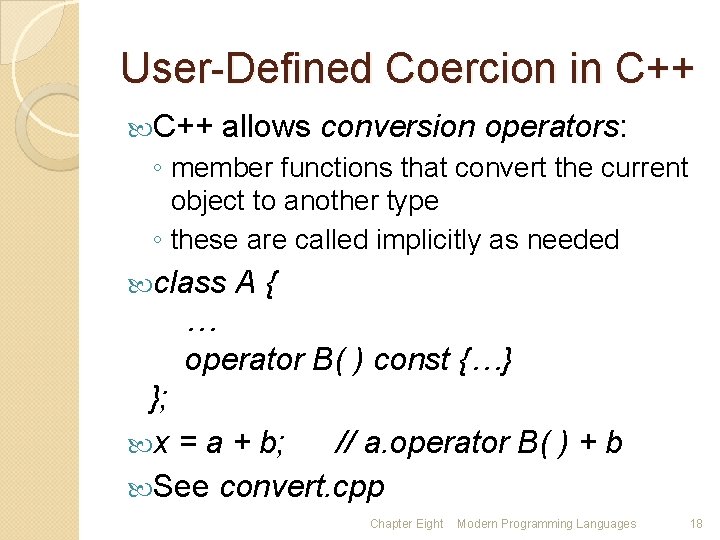
User-Defined Coercion in C++ allows conversion operators: ◦ member functions that convert the current object to another type ◦ these are called implicitly as needed class A{ … operator B( ) const {…} }; x = a + b; // a. operator B( ) + b See convert. cpp Chapter Eight Modern Programming Languages 18
When is Coercion Resolved? Chapter Eight Modern Programming Languages 19
Outline Overloading Parameter coercion Parametric polymorphism Subtype polymorphism Definitions and classifications Chapter Eight Modern Programming Languages 20
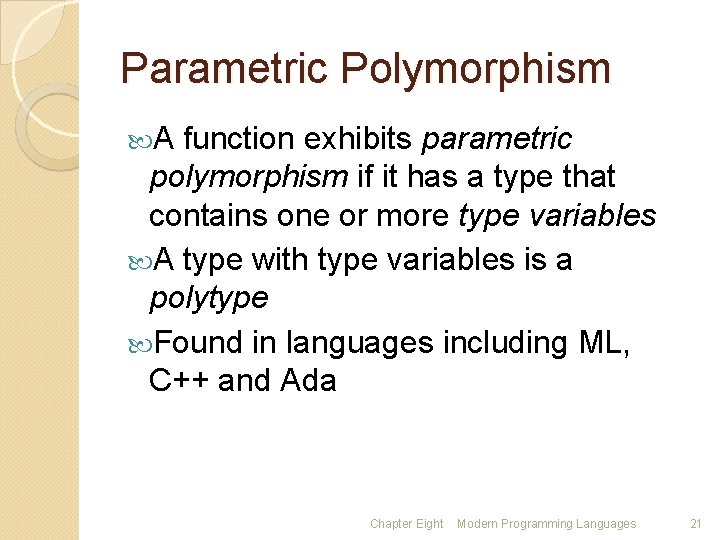
Parametric Polymorphism A function exhibits parametric polymorphism if it has a type that contains one or more type variables A type with type variables is a polytype Found in languages including ML, C++ and Ada Chapter Eight Modern Programming Languages 21
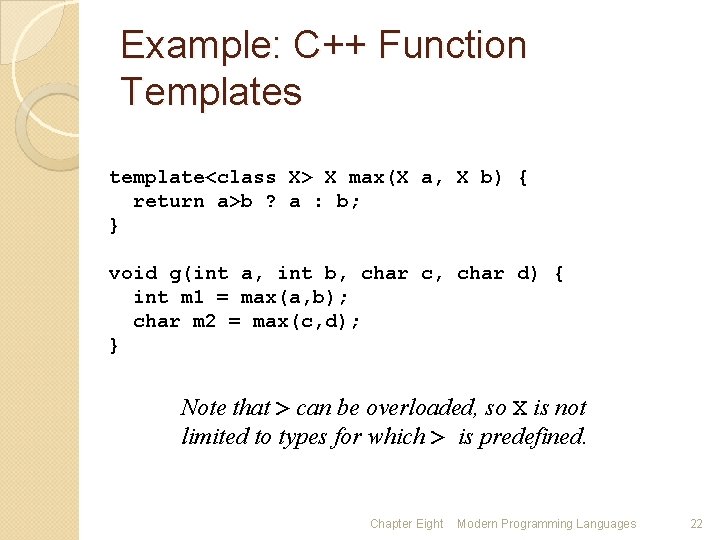
Example: C++ Function Templates template<class X> X max(X a, X b) { return a>b ? a : b; } void g(int a, int b, char c, char d) { int m 1 = max(a, b); char m 2 = max(c, d); } Note that > can be overloaded, so X is not limited to types for which > is predefined. Chapter Eight Modern Programming Languages 22
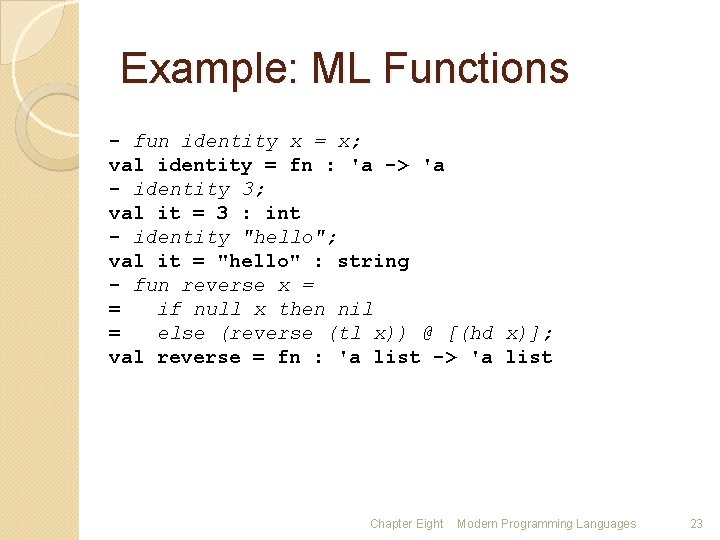
Example: ML Functions - fun identity x = x; val identity = fn : 'a -> 'a - identity 3; val it = 3 : int - identity "hello"; val it = "hello" : string - fun reverse x = = if null x then nil = else (reverse (tl x)) @ [(hd x)]; val reverse = fn : 'a list -> 'a list Chapter Eight Modern Programming Languages 23
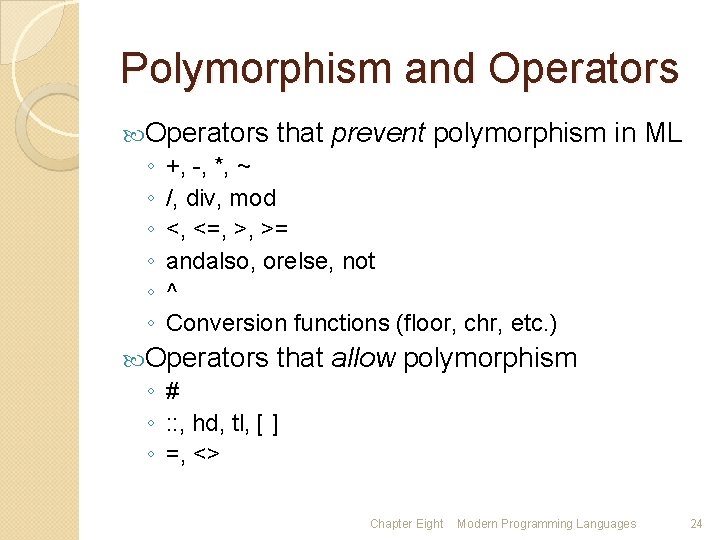
Polymorphism and Operators that prevent polymorphism ◦ +, -, *, ~ ◦ /, div, mod ◦ <, <=, >, >= ◦ andalso, orelse, not ◦ ^ ◦ Conversion functions (floor, chr, etc. ) Operators that ◦ # ◦ : : , hd, tl, [ ] ◦ =, <> in ML allow polymorphism Chapter Eight Modern Programming Languages 24
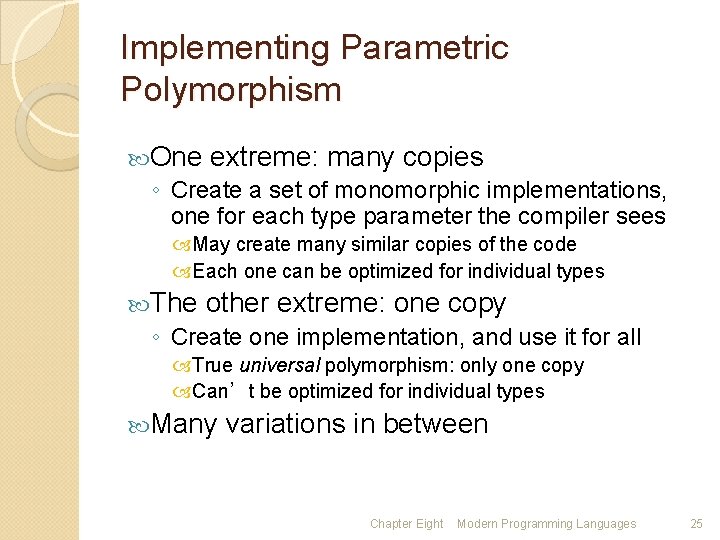
Implementing Parametric Polymorphism One extreme: many copies ◦ Create a set of monomorphic implementations, one for each type parameter the compiler sees May create many similar copies of the code Each one can be optimized for individual types The other extreme: one copy ◦ Create one implementation, and use it for all True universal polymorphism: only one copy Can’t be optimized for individual types Many variations in between Chapter Eight Modern Programming Languages 25
When are Type Parameters Resolved? Chapter Eight Modern Programming Languages 26
Outline Overloading Parameter coercion Parametric polymorphism Subtype polymorphism Definitions and classifications Chapter Eight Modern Programming Languages 27
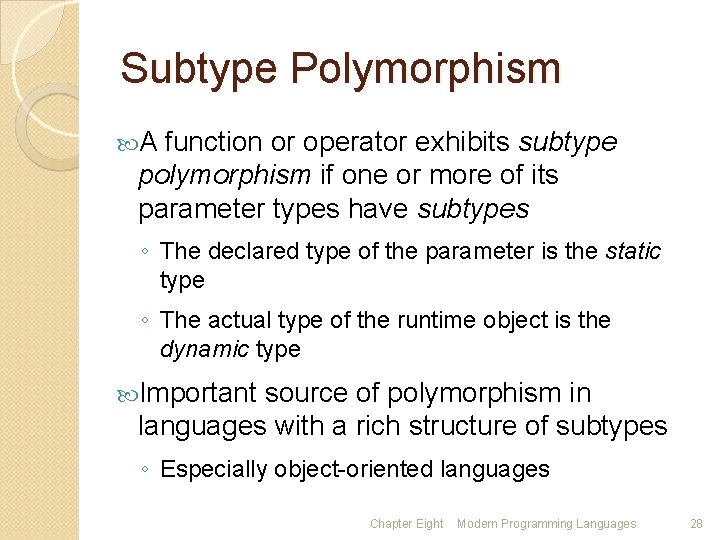
Subtype Polymorphism A function or operator exhibits subtype polymorphism if one or more of its parameter types have subtypes ◦ The declared type of the parameter is the static type ◦ The actual type of the runtime object is the dynamic type Important source of polymorphism in languages with a rich structure of subtypes ◦ Especially object-oriented languages Chapter Eight Modern Programming Languages 28
Exposing Dynamic Types Rarely done! See rtti. cpp Chapter Eight Modern Programming Languages 29
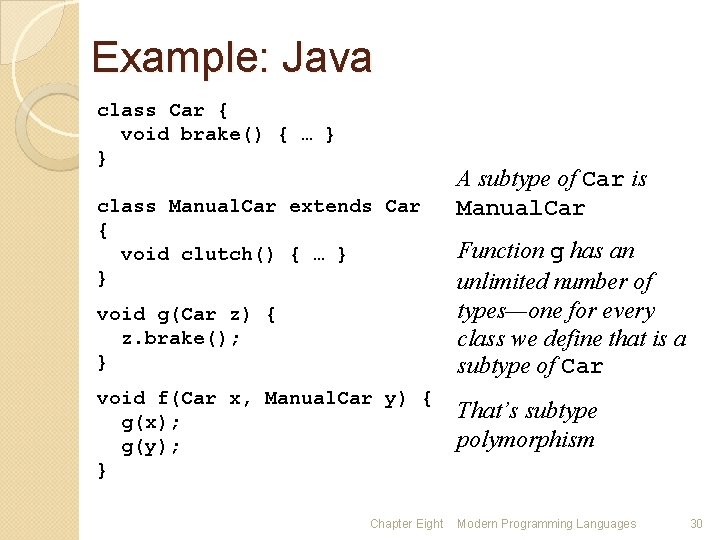
Example: Java class Car { void brake() { … } } class Manual. Car extends Car { void clutch() { … } } void g(Car z) { z. brake(); } void f(Car x, Manual. Car y) { g(x); g(y); } Chapter Eight A subtype of Car is Manual. Car Function g has an unlimited number of types—one for every class we define that is a subtype of Car That’s subtype polymorphism Modern Programming Languages 30
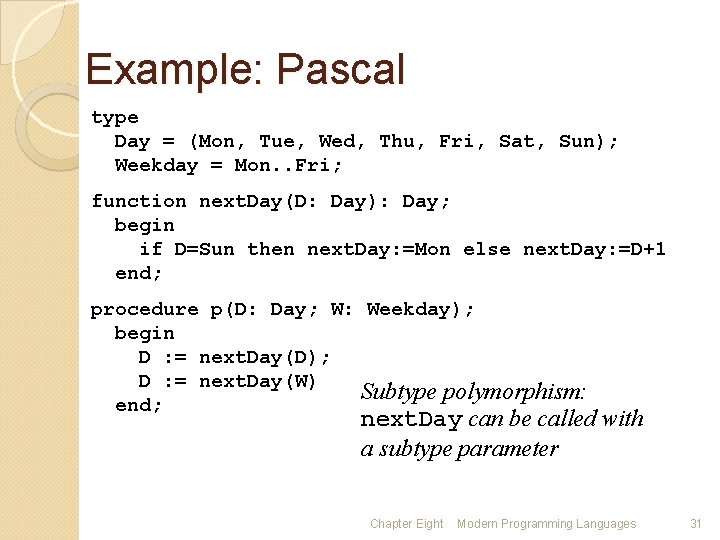
Example: Pascal type Day = (Mon, Tue, Wed, Thu, Fri, Sat, Sun); Weekday = Mon. . Fri; function next. Day(D: Day): Day; begin if D=Sun then next. Day: =Mon else next. Day: =D+1 end; procedure p(D: Day; W: Weekday); begin D : = next. Day(D); D : = next. Day(W) Subtype polymorphism: end; next. Day can be called with a subtype parameter Chapter Eight Modern Programming Languages 31
When are Subtypes Resolved? Chapter Eight Modern Programming Languages 32
Outline Overloading Parameter coercion Parametric polymorphism Subtype polymorphism Definitions and classifications Chapter Eight Modern Programming Languages 33
Polymorphism We have seen four kinds of polymorphic functions There are many other uses of polymorphic: ◦ Polymorphic variables, classes, packages, languages ◦ Another name for runtime method dispatch: when x. f may call different methods depending on the runtime class of the object x Here are definitions that cover our four… Chapter Eight Modern Programming Languages 34
Definitions For Our Four A function or operator is polymorphic if it has at least two possible types ◦ It exhibits ad hoc polymorphism if it has at least two but only finitely many possible types The number of applicable types is known in advance ◦ It exhibits universal polymorphism if it has infinitely many possible types (extensible) New types may be easily added without changing any original code Chapter Eight Modern Programming Languages No type-specific code appears in original 35
Overloading Ad hoc polymorphism Each different type requires an explicit definition in code Chapter Eight Modern Programming Languages 36
Parameter Coercion Ad hoc polymorphism The different types that can be coerced to a given parameter type is determined explicitly in code and by language definitions, as applicable Chapter Eight Modern Programming Languages 37
Parametric Polymorphism Universal polymorphism As long as the universe over which type variables are instantiated is locally unbounded A type unforeseen by the function’s developer can be employed ◦ Extended by the user Chapter Eight Modern Programming Languages 38
Subtype Polymorphism Universal As long as there is no limit to the number of different subtypes that can be declared for a given type True for all class-based objectoriented languages, like Java, C++, C#, etc. Chapter Eight Modern Programming Languages 39
Runtime vs. Compile-time Polymorphism Everything except subtype polymorphism is resolved at compile time ◦ the correctly typed functions are chosen by the compiler Subtype polymorphism uses late binding ◦ requires runtime overhead to resolve Chapter Eight Modern Programming Languages 40
Static vs. Dynamic Languages Polymorphism is visible only in statically typed languages ◦ the compiler ensures that everything is type-safe Dynamically typed languages are by nature polymorphic (“duck typing”) ◦ see page 128 in text ◦ (first paragraph in 8. 6) Chapter Eight Modern Programming Languages 41