
POLYMORPHIC PHASES IN LOCUSTS INTRODUCTION POLYMORPHISM The occurrence
- Slides: 27
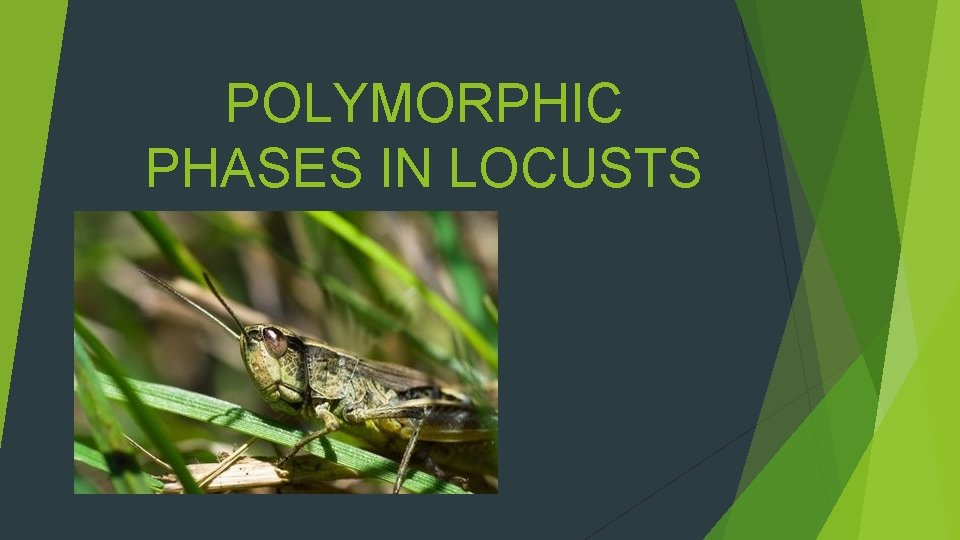
POLYMORPHIC PHASES IN LOCUSTS
INTRODUCTION POLYMORPHISM The occurrence of different forms, stages or types in individual organism or in organism of the same species, independent of sexual variation is known as POLYMORPHISM. It is very common among social insects (ants, honey bees and termites). Phase polymorphism is found in the family Acrididae, Phasmatidae and Tettigonidae. q Types of Polymorphism _ Simple polymorphism _ Phase polymorphism _ Caste or Social polymorphism _ Geographical polymorphism
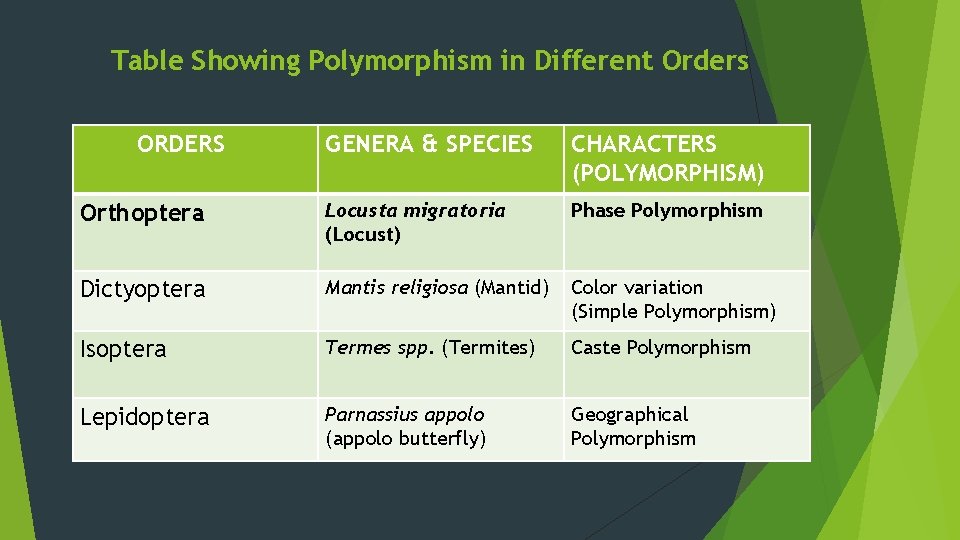
Table Showing Polymorphism in Different Orders ORDERS GENERA & SPECIES CHARACTERS (POLYMORPHISM) Orthoptera Locusta migratoria (Locust) Phase Polymorphism Dictyoptera Mantis religiosa (Mantid) Color variation (Simple Polymorphism) Isoptera Termes spp. (Termites) Caste Polymorphism Lepidoptera Parnassius appolo (appolo butterfly) Geographical Polymorphism
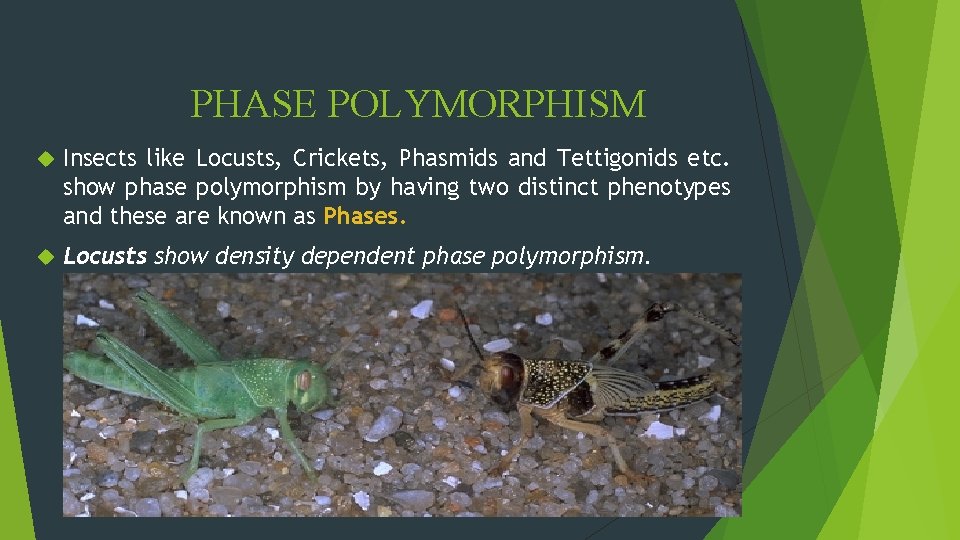
PHASE POLYMORPHISM Insects like Locusts, Crickets, Phasmids and Tettigonids etc. show phase polymorphism by having two distinct phenotypes and these are known as Phases. Locusts show density dependent phase polymorphism.
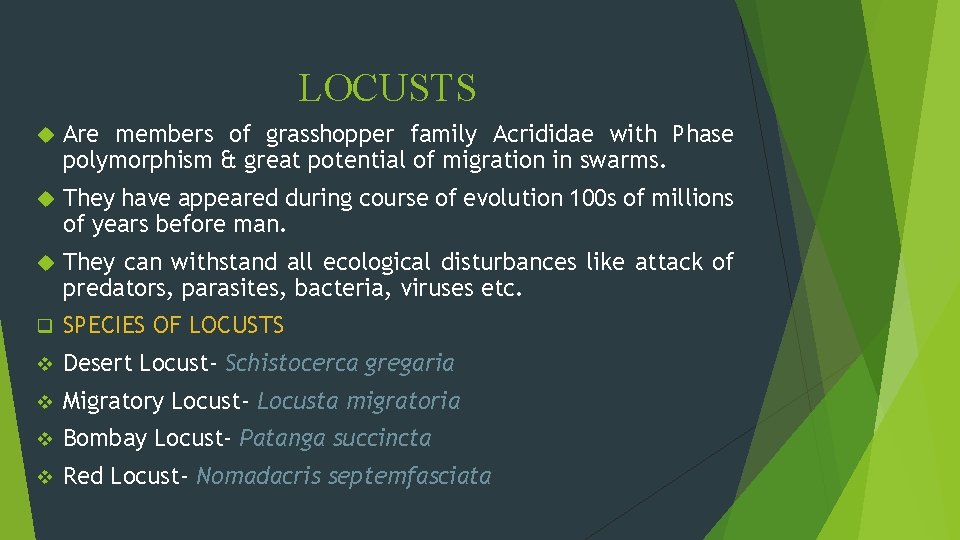
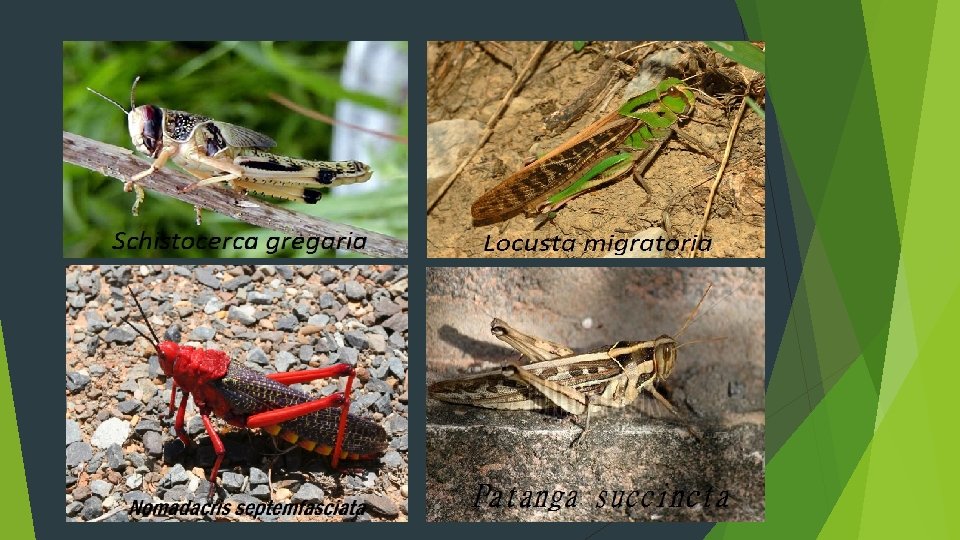
LOCUSTS Are members of grasshopper family Acrididae with Phase polymorphism & great potential of migration in swarms. They have appeared during course of evolution 100 s of millions of years before man. They can withstand all ecological disturbances like attack of predators, parasites, bacteria, viruses etc. q SPECIES OF LOCUSTS v Desert Locust- Schistocerca gregaria v Migratory Locust- Locusta migratoria v Bombay Locust- Patanga succincta v Red Locust- Nomadacris septemfasciata
§ PHASE THEORY Given by Uvarov (1921) According to theory, True locusts belong to Family Acrididae are polymorphic species. Morphologically and Biologically different forms are Phases. Three possible phases in a Locust population are Solitarious phase Gregarious phase Transient phase
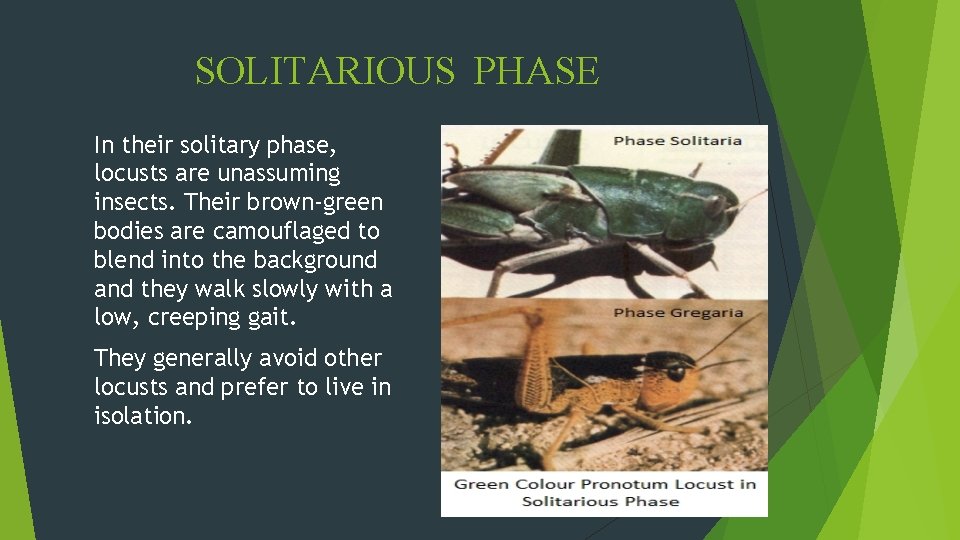
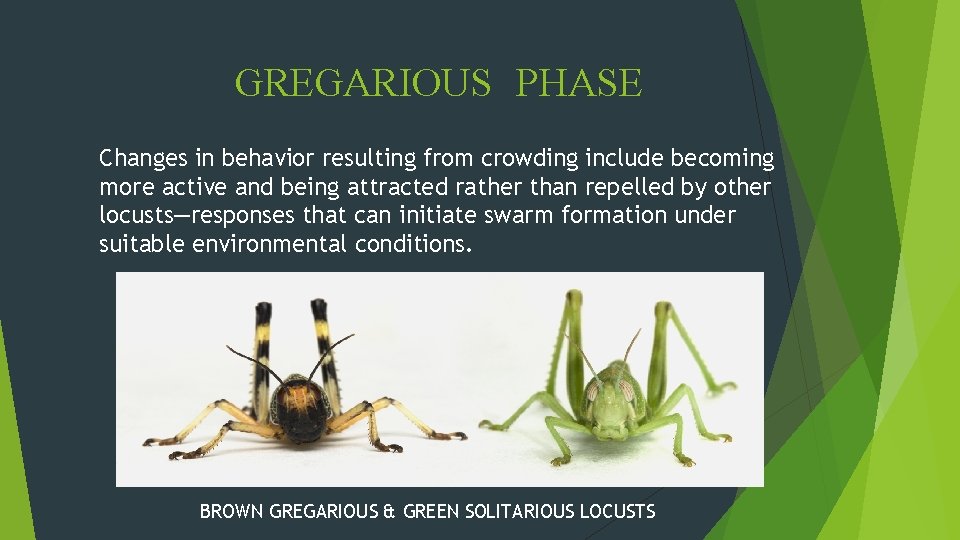
SOLITARIOUS PHASE In their solitary phase, locusts are unassuming insects. Their brown-green bodies are camouflaged to blend into the background and they walk slowly with a low, creeping gait. They generally avoid other locusts and prefer to live in isolation.
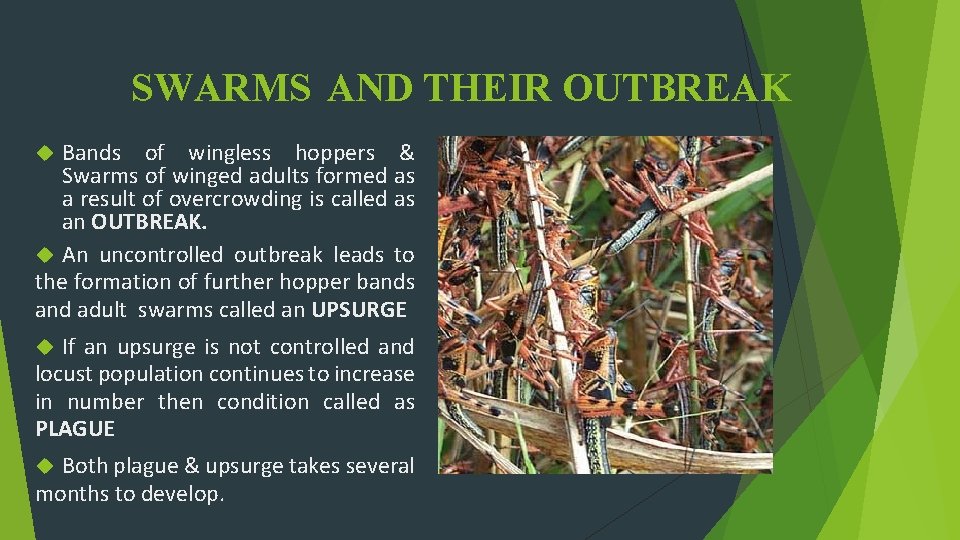
GREGARIOUS PHASE Changes in behavior resulting from crowding include becoming more active and being attracted rather than repelled by other locusts—responses that can initiate swarm formation under suitable environmental conditions. BROWN GREGARIOUS & GREEN SOLITARIOUS LOCUSTS
TRANSIENT PHASE Phase transition includes rapid behavioral change (occurring in a matter of hours), whereas color, shape, and reproductive physiology alter more gradually. Transient phase divide into: - v Phase Congregans or Transient Congregans v Phase Dissocians or Transient Dissocians
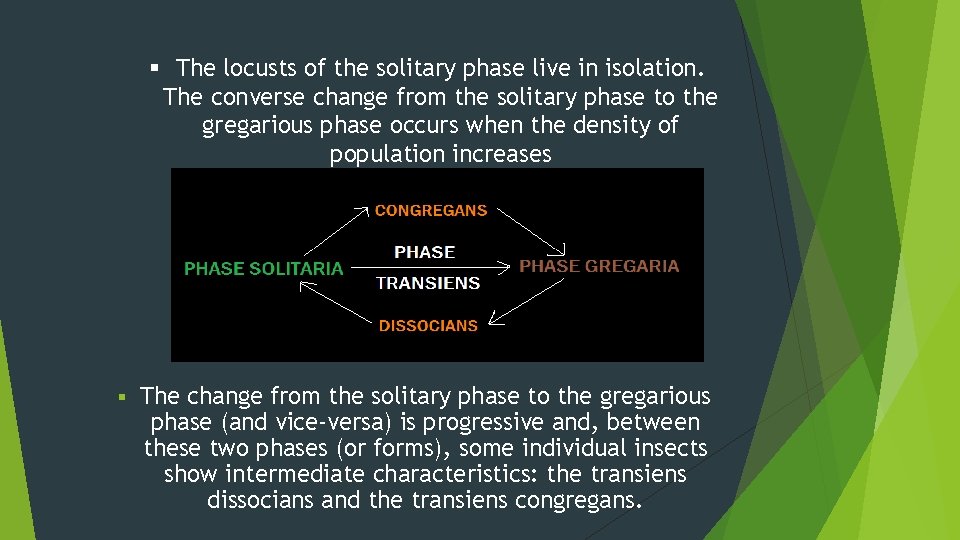
§ The locusts of the solitary phase live in isolation. The converse change from the solitary phase to the gregarious phase occurs when the density of population increases § The change from the solitary phase to the gregarious phase (and vice-versa) is progressive and, between these two phases (or forms), some individual insects show intermediate characteristics: the transiens dissocians and the transiens congregans.
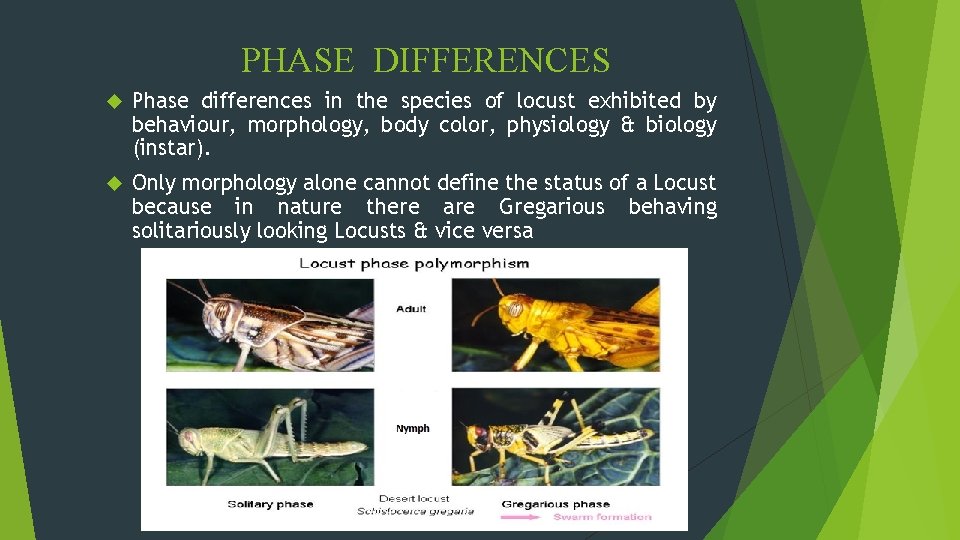
PHASE DIFFERENCES Phase differences in the species of locust exhibited by behaviour, morphology, body color, physiology & biology (instar). Only morphology alone cannot define the status of a Locust because in nature there are Gregarious behaving solitariously looking Locusts & vice versa
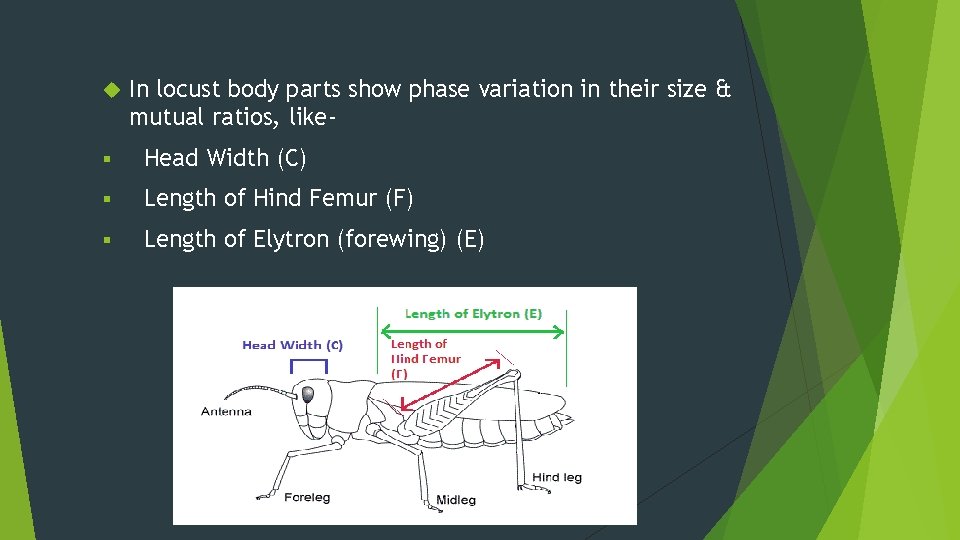
In locust body parts show phase variation in their size & mutual ratios, like- § Head Width (C) § Length of Hind Femur (F) § Length of Elytron (forewing) (E)
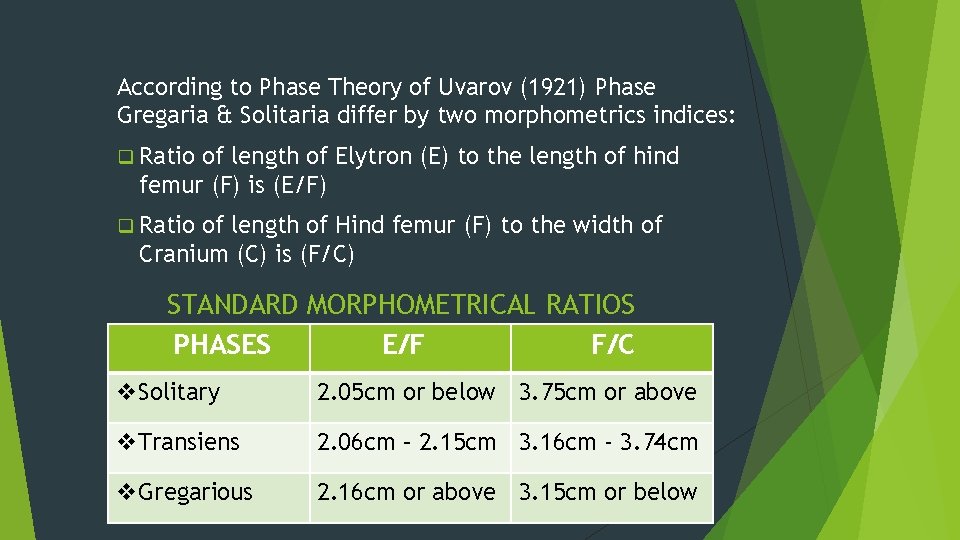
According to Phase Theory of Uvarov (1921) Phase Gregaria & Solitaria differ by two morphometrics indices: q Ratio of length of Elytron (E) to the length of hind femur (F) is (E/F) q Ratio of length of Hind femur (F) to the width of Cranium (C) is (F/C) STANDARD MORPHOMETRICAL RATIOS PHASES E/F F/C v. Solitary 2. 05 cm or below 3. 75 cm or above v. Transiens 2. 06 cm – 2. 15 cm 3. 16 cm - 3. 74 cm v. Gregarious 2. 16 cm or above 3. 15 cm or below
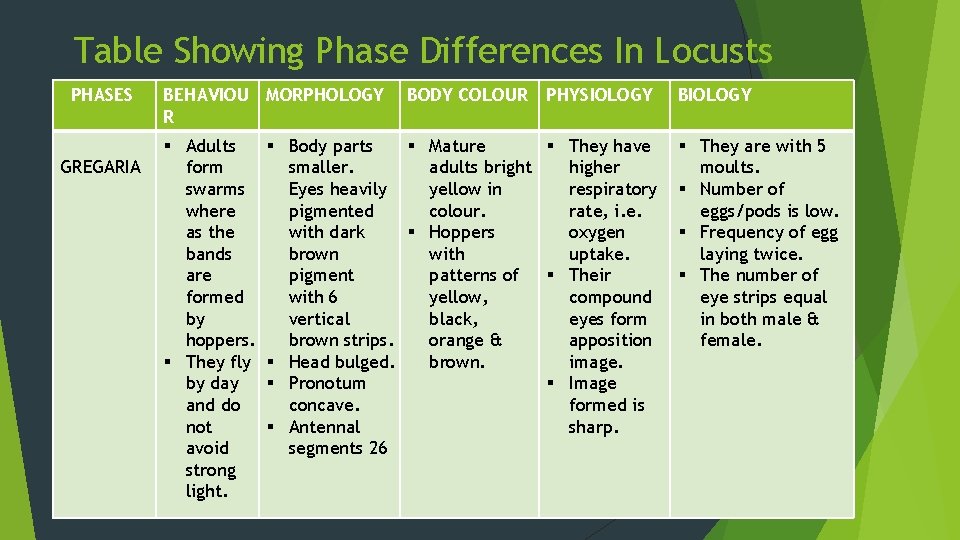
Table Showing Phase Differences In Locusts PHASES GREGARIA BEHAVIOU MORPHOLOGY R § Adults form swarms where as the bands are formed by hoppers. § They fly by day and do not avoid strong light. BODY COLOUR PHYSIOLOGY § Body parts § Mature § They have smaller. adults bright higher Eyes heavily yellow in respiratory pigmented colour. rate, i. e. with dark § Hoppers oxygen brown with uptake. pigment patterns of § Their with 6 yellow, compound vertical black, eyes form brown strips. orange & apposition § Head bulged. brown. image. § Pronotum § Image concave. formed is § Antennal sharp. segments 26 BIOLOGY § They are with 5 moults. § Number of eggs/pods is low. § Frequency of egg laying twice. § The number of eye strips equal in both male & female.
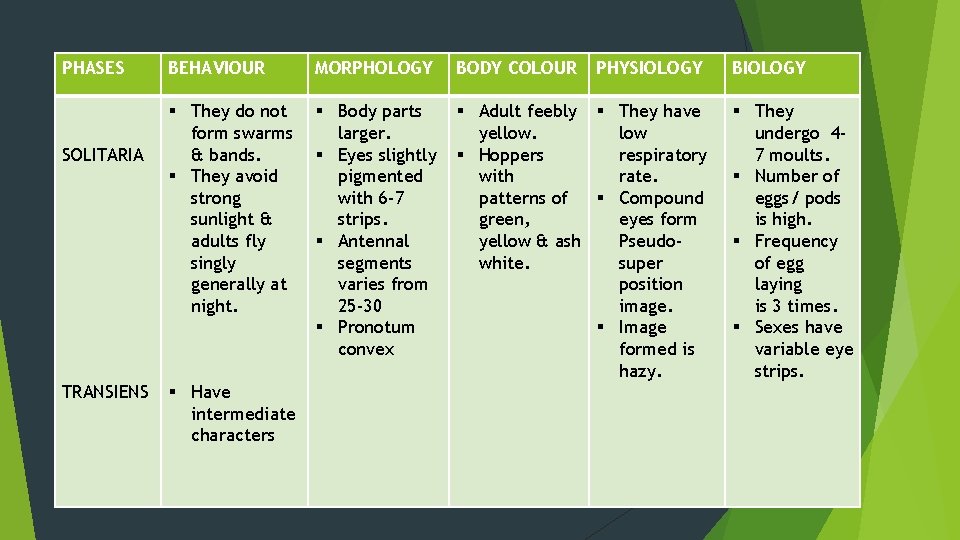
PHASES SOLITARIA TRANSIENS BEHAVIOUR MORPHOLOGY BODY COLOUR § They do not form swarms & bands. § They avoid strong sunlight & adults fly singly generally at night. § Body parts larger. § Eyes slightly pigmented with 6 -7 strips. § Antennal segments varies from 25 -30 § Pronotum convex § Adult feebly § They have yellow. low § Hoppers respiratory with rate. patterns of § Compound green, eyes form yellow & ash Pseudowhite. super position image. § Image formed is hazy. § Have intermediate characters PHYSIOLOGY BIOLOGY § They undergo 47 moults. § Number of eggs/ pods is high. § Frequency of egg laying is 3 times. § Sexes have variable eye strips.
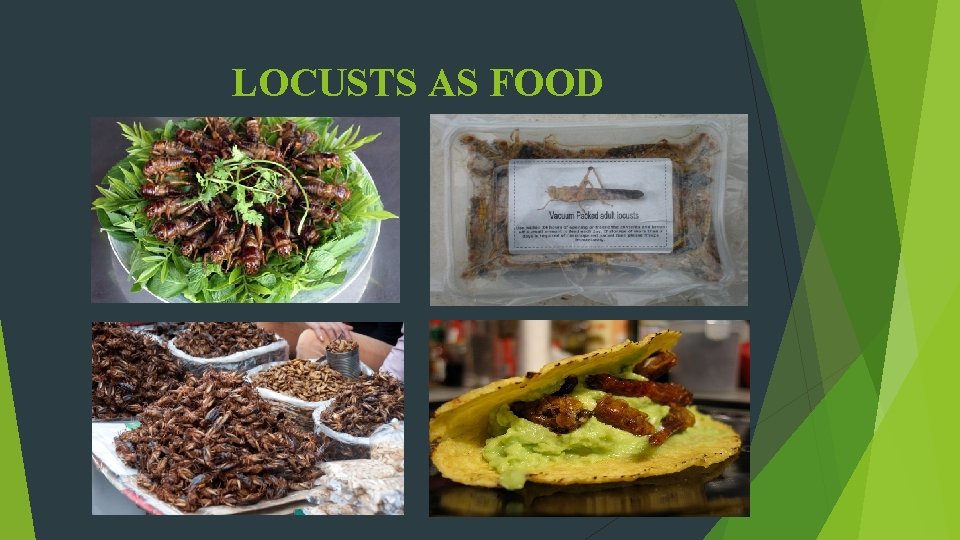
LOCUSTS AS FOOD
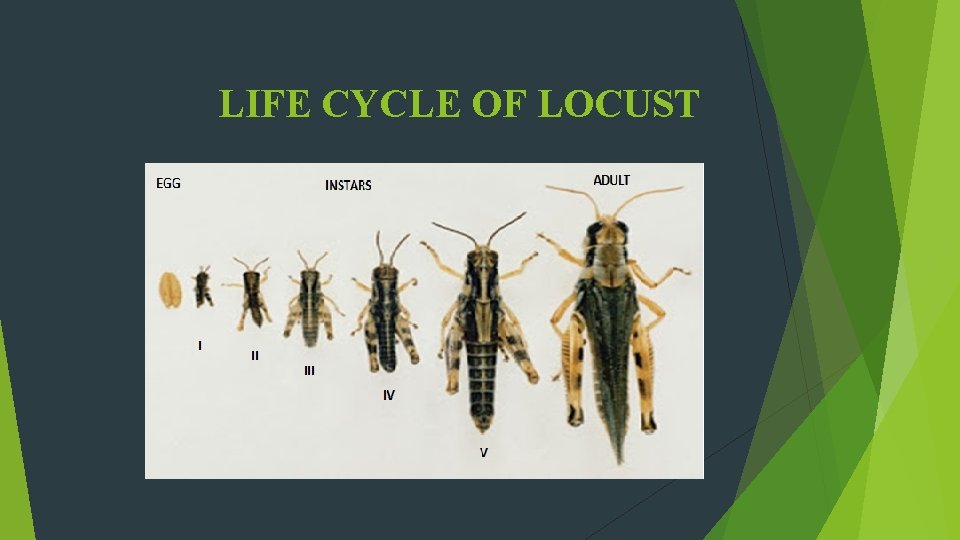
LIFE CYCLE OF LOCUST
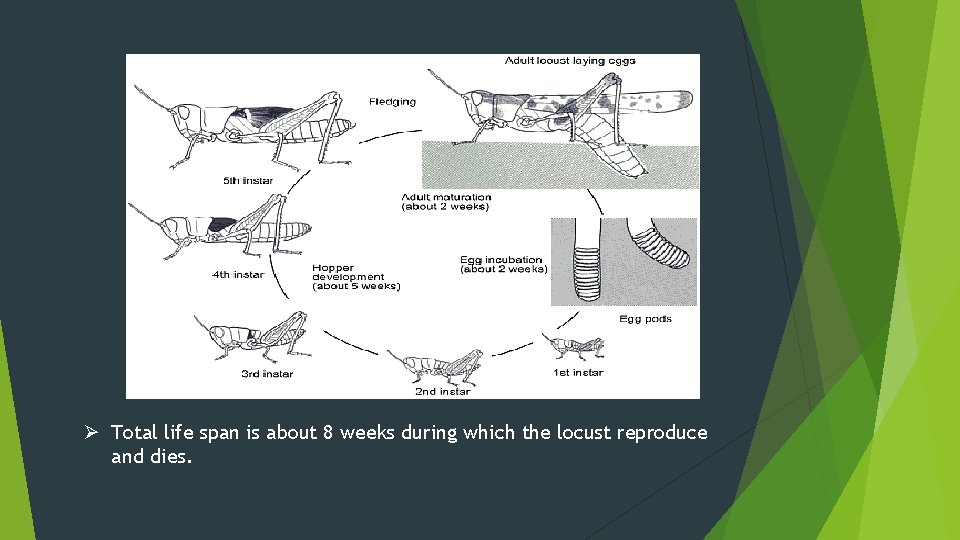
Ø Total life span is about 8 weeks during which the locust reproduce and dies.
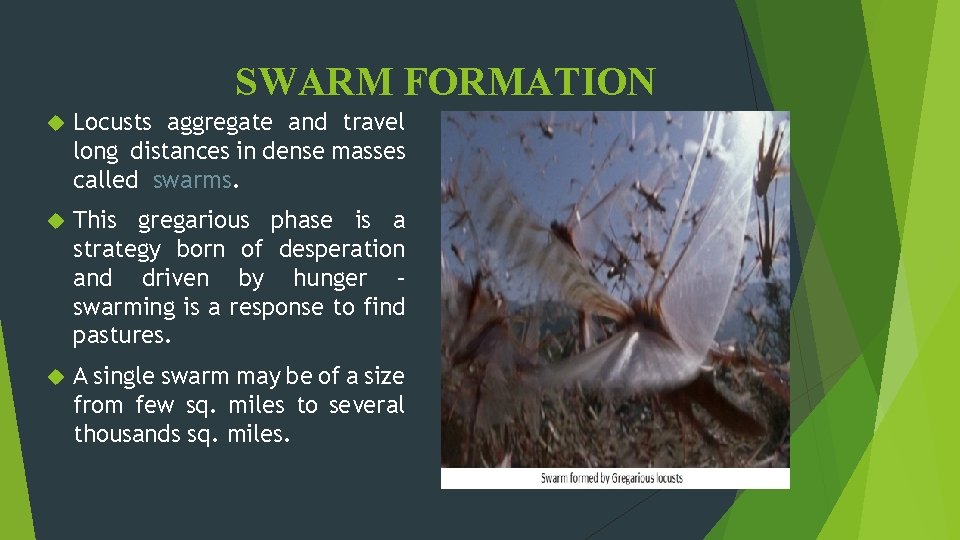
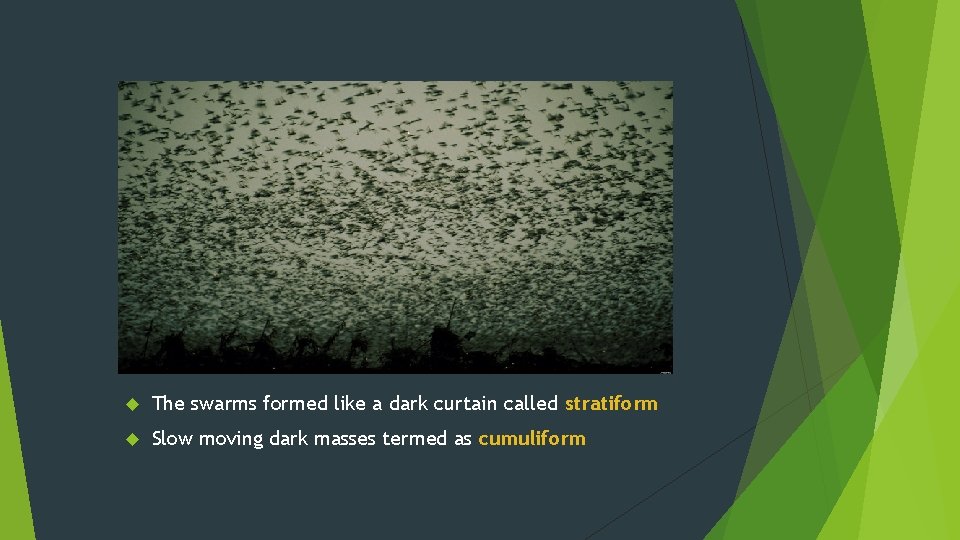
SWARM FORMATION Locusts aggregate and travel long distances in dense masses called swarms. This gregarious phase is a strategy born of desperation and driven by hunger – swarming is a response to find pastures. A single swarm may be of a size from few sq. miles to several thousands sq. miles.
The swarms formed like a dark curtain called stratiform Slow moving dark masses termed as cumuliform
SWARMS AND THEIR OUTBREAK Bands of wingless hoppers & Swarms of winged adults formed as a result of overcrowding is called as an OUTBREAK. An uncontrolled outbreak leads to the formation of further hopper bands and adult swarms called an UPSURGE If an upsurge is not controlled and locust population continues to increase in number then condition called as PLAGUE Both plague & upsurge takes several months to develop.
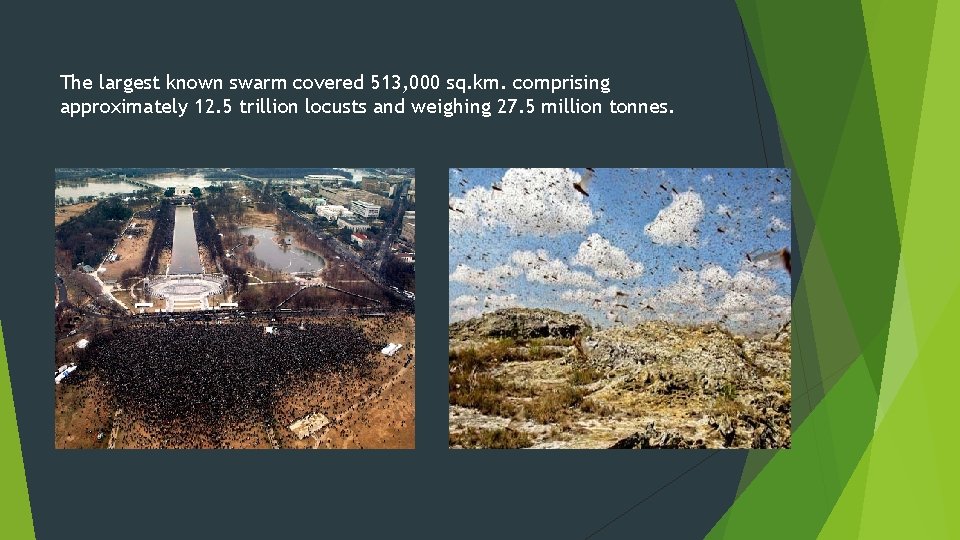
The largest known swarm covered 513, 000 sq. km. comprising approximately 12. 5 trillion locusts and weighing 27. 5 million tonnes.
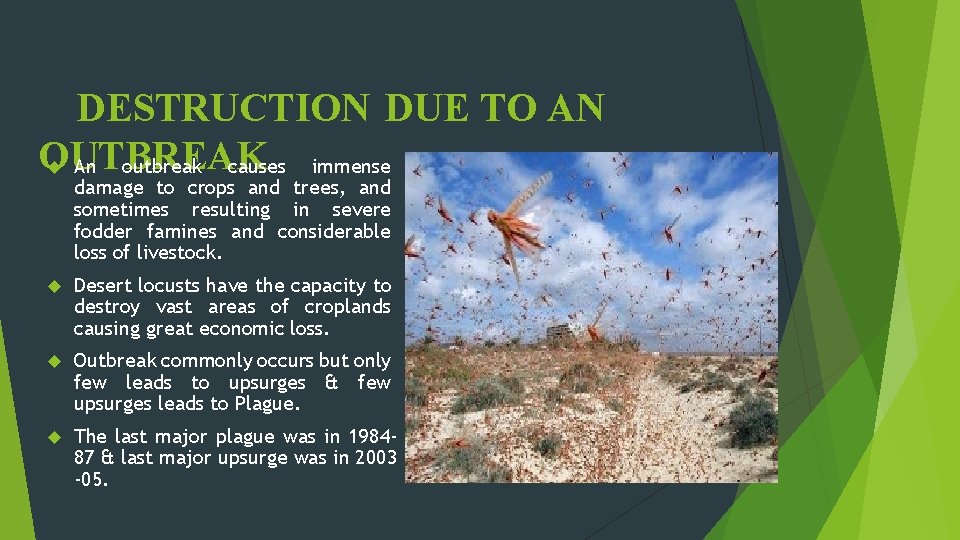
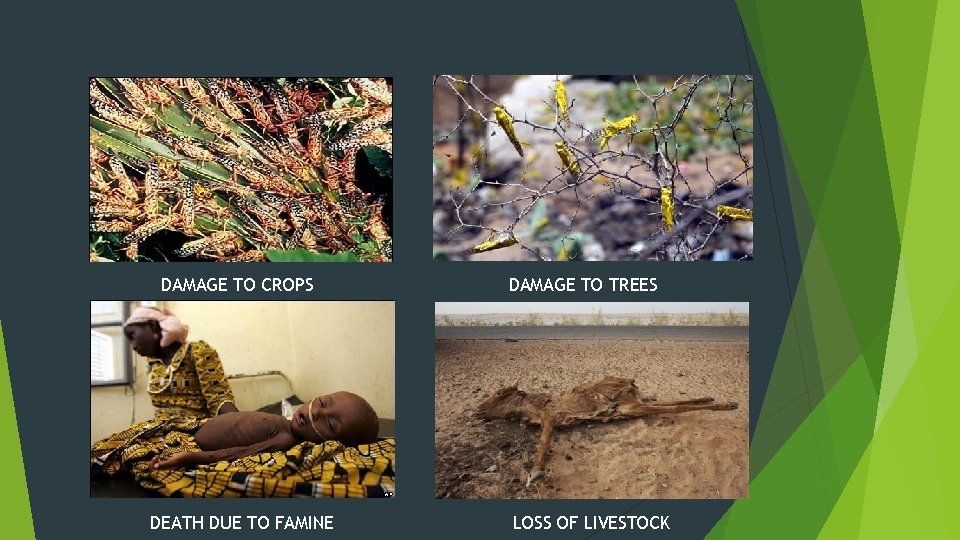
DESTRUCTION DUE TO AN OUTBREAK An outbreak causes immense damage to crops and trees, and sometimes resulting in severe fodder famines and considerable loss of livestock. Desert locusts have the capacity to destroy vast areas of croplands causing great economic loss. Outbreak commonly occurs but only few leads to upsurges & few upsurges leads to Plague. The last major plague was in 198487 & last major upsurge was in 2003 -05.
DAMAGE TO CROPS DEATH DUE TO FAMINE DAMAGE TO TREES LOSS OF LIVESTOCK
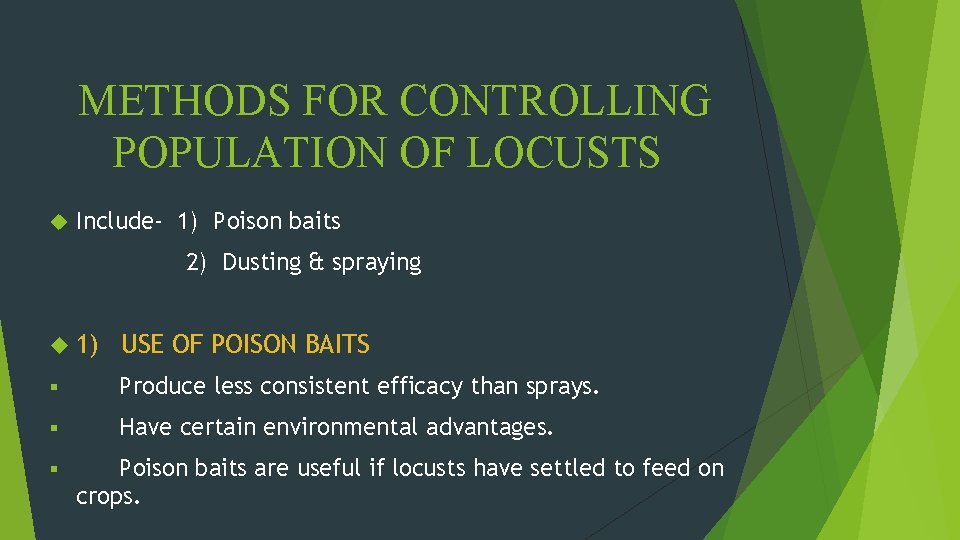
METHODS FOR CONTROLLING POPULATION OF LOCUSTS Include- 1) Poison baits 2) Dusting & spraying 1) USE OF POISON BAITS § Produce less consistent efficacy than sprays. § Have certain environmental advantages. § Poison baits are useful if locusts have settled to feed on crops.
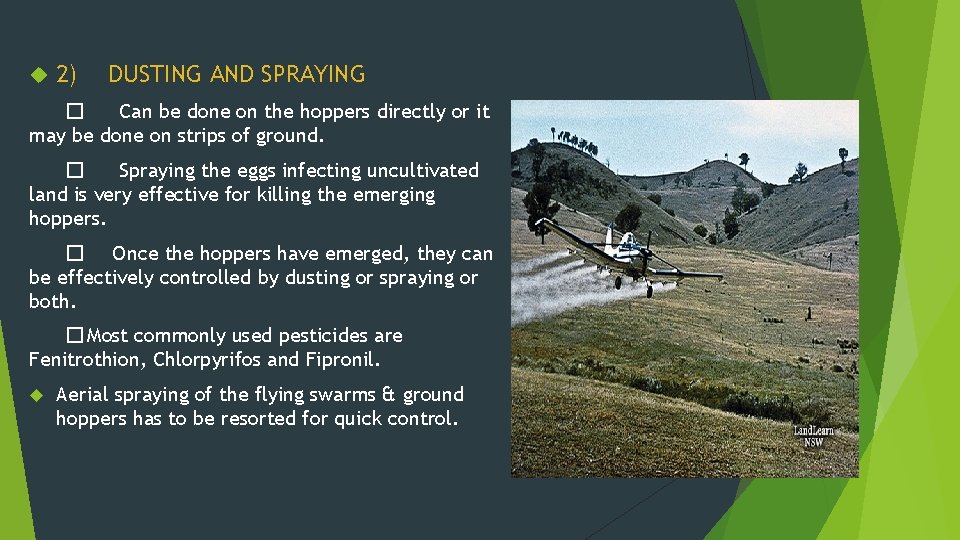
2) DUSTING AND SPRAYING � Can be done on the hoppers directly or it may be done on strips of ground. � Spraying the eggs infecting uncultivated land is very effective for killing the emerging hoppers. � Once the hoppers have emerged, they can be effectively controlled by dusting or spraying or both. � Most commonly used pesticides are Fenitrothion, Chlorpyrifos and Fipronil. Aerial spraying of the flying swarms & ground hoppers has to be resorted for quick control.