
POLYMERS Qasim Habib Lecturer Polymer Process Engineering Department
POLYMERS Qasim Habib Lecturer Polymer & Process Engineering Department UET, Lahore 1/22/2022 Polymer & Process Engineering Department, UET, Lahore 1
Polymer Ø Polymer is derived from two from Greek words “poly” (many) and “meros” (part) Ø Polymers are long chain giant organic molecules, assembled from repetitive bonding of many smaller molecules called monomers. 1/22/2022 Polymer & Process Engineering Department, UET, Lahore 2
Structure Ø The structure of a polymer is related to the physical arrangement of Ø Ø 1/22/2022 monomers along the backbone of the chain. Structure has a strong influence on the other properties of a polymer. Polymer scientists have developed terminology to precisely describe both the nature of the monomers as well as their relative arrangement If repeating units along the chain are chemically and sterically regular, then the polymer is said to possess structural regularity. This is known as configuration. Change in the overall shape and size of the polymer chain may occur due to rotation about primary valence bonds. This is known as conformation. A polymer molecule may assume a large or limited number of conformations depending on: a) Whether the polymer is amorphous or crystalline. b) Whether the polymer is in a solution state, molten state, or solid state. Polymer & Process Engineering Department, UET, Lahore 3
Classification Of Structure: The polymer structure can be divided into 3 main classes. a) Primary structure : The chemical structure (atomic composition) of the monomer. b) Secondary structure: The structure of single polymer chain. c) Tertiary structure: Total structure of polymer chains. 1/22/2022 Polymer & Process Engineering Department, UET, Lahore 4
a)-Primary structure � Primary structure refers to the atomic composition and chemical structure of the monomer. It is the building block of the polymer chain. � The chemical and electrical properties of a polymer are directly related to the chemistry of the constituent monomers. � The properties by a monomers are determined on the basis of the following factors: a) b) c) d) 1/22/2022 The nature of bonds in monomers. The chemical composition of monomers. The type of monomers that are capable of forming polymers. (functionality of monomers) The mode of linking of monomers. Polymer & Process Engineering Department, UET, Lahore 5
b)-Secondary structure �Secondary structure is the size and shape of an isolated single molecule. The size of the polymer is best discussed in terms of molecular weight. �The shape of the polymer molecule will be influenced naturally by the nature of the repeating unit and the manner in which these units are linked together. 1/22/2022 Polymer & Process Engineering Department, UET, Lahore 6
c)-Tertiary structure �A given polymeric solid material consist of a large number of polymer molecules. �Depending on the molecular structure, the process of molecular aggregation occurs essentially by leading to either a crystalline or amorphous material. 1/22/2022 Polymer & Process Engineering Department, UET, Lahore 7
Classes of microstructure There are two main classifications for the microstructures of polymers. Ø Chemical structure: a) Organic & Inorganic polymers. b) Homochain & Heterochain polymers. c) Homopolymers & Copolymers. Ø Geometrical structure: a) Linear , Branched, Network & Cross linked polymers. b) Random, Alternating, Block & Graft polymers. c) Stereo Regular polymers. 1/22/2022 Polymer & Process Engineering Department, UET, Lahore 8

Chemical Structure: a)-Organic & Inorganic polymers; � Organic polymers: where the backbone is made essentially of Carbon-Carbon (C-C) links. e. g. Polyethylene , Polypropylene 1/22/2022 Polymer & Process Engineering Department, UET, Lahore 9
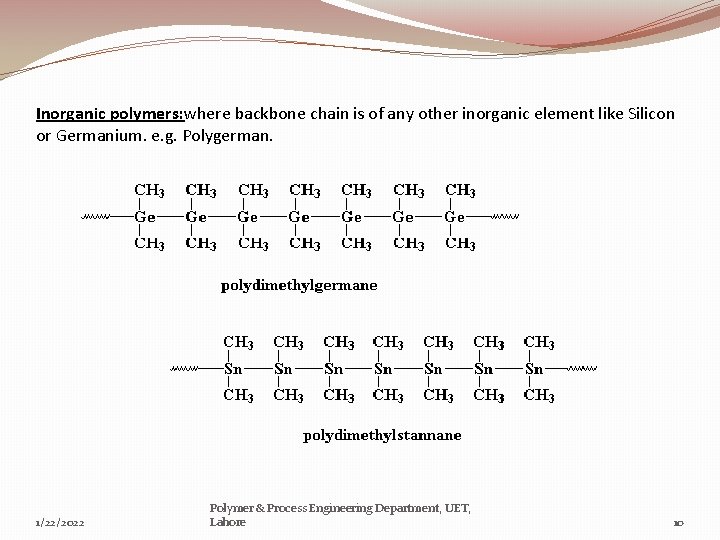
Inorganic polymers: where backbone chain is of any other inorganic element like Silicon or Germanium. e. g. Polygerman. 1/22/2022 Polymer & Process Engineering Department, UET, Lahore 10
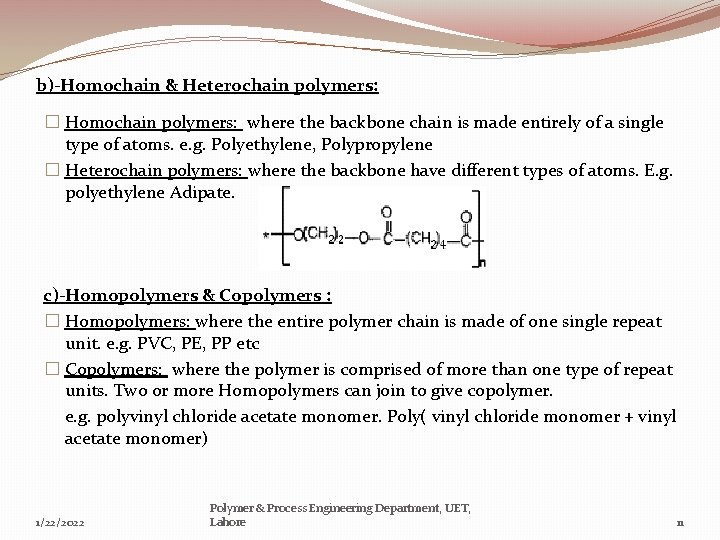
b)-Homochain & Heterochain polymers: � Homochain polymers: where the backbone chain is made entirely of a single type of atoms. e. g. Polyethylene, Polypropylene � Heterochain polymers: where the backbone have different types of atoms. E. g. polyethylene Adipate. c)-Homopolymers & Copolymers : � Homopolymers: where the entire polymer chain is made of one single repeat unit. e. g. PVC, PE, PP etc � Copolymers: where the polymer is comprised of more than one type of repeat units. Two or more Homopolymers can join to give copolymer. e. g. polyvinyl chloride acetate monomer. Poly( vinyl chloride monomer + vinyl acetate monomer) 1/22/2022 Polymer & Process Engineering Department, UET, Lahore 11
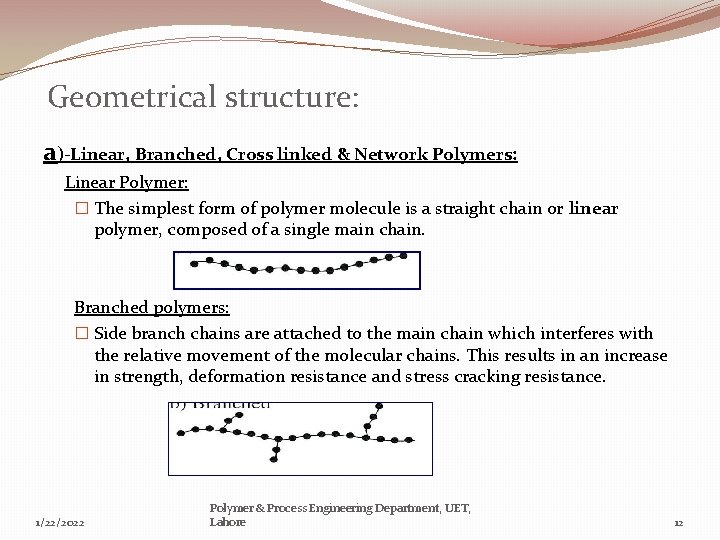
Geometrical structure: a)-Linear, Branched, Cross linked & Network Polymers: Linear Polymer: � The simplest form of polymer molecule is a straight chain or linear polymer, composed of a single main chain. Branched polymers: � Side branch chains are attached to the main chain which interferes with the relative movement of the molecular chains. This results in an increase in strength, deformation resistance and stress cracking resistance. 1/22/2022 Polymer & Process Engineering Department, UET, Lahore 12
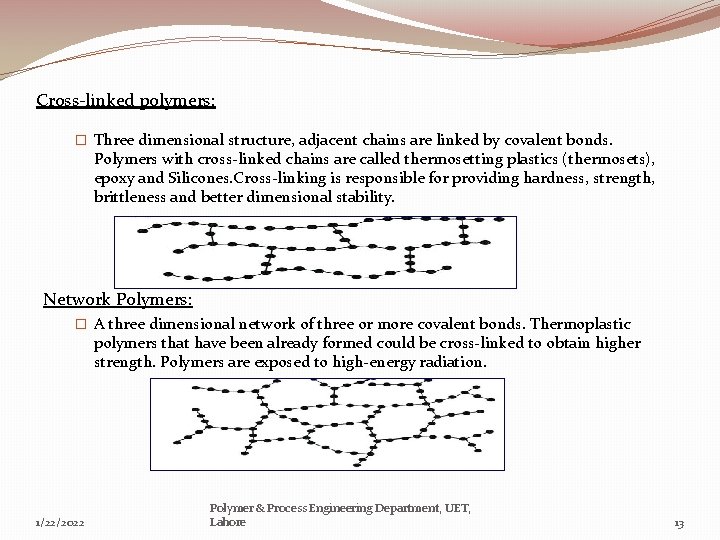
Cross-linked polymers: � Three dimensional structure, adjacent chains are linked by covalent bonds. Polymers with cross-linked chains are called thermosetting plastics (thermosets), epoxy and Silicones. Cross-linking is responsible for providing hardness, strength, brittleness and better dimensional stability. Network Polymers: � A three dimensional network of three or more covalent bonds. Thermoplastic polymers that have been already formed could be cross-linked to obtain higher strength. Polymers are exposed to high-energy radiation. 1/22/2022 Polymer & Process Engineering Department, UET, Lahore 13
b)-Random, Alternating, Block & Graft Polymers: Random copolymers: two monomers randomly distributed in chain. � AABAAABBABAABBA � poly(acrylonitrile-ran-butadiene) Alternating copolymers: two monomers incorporated sequentially � ABABABAB � poly(styrene-alt-maleic anhydride) Block copolymers: linear arrangement of blocks of high mol weight � AAAAAABBBBBBBBAAAA � polystyrene-block-polybutadiene-block-polystyrene or poly(styrene-bbutadiene-b-styrene) Graft copolymers: differing backbone and side-chain monomers � poly(isobutylene-graft-butadiene) 1/22/2022 Polymer & Process Engineering Department, UET, Lahore 14
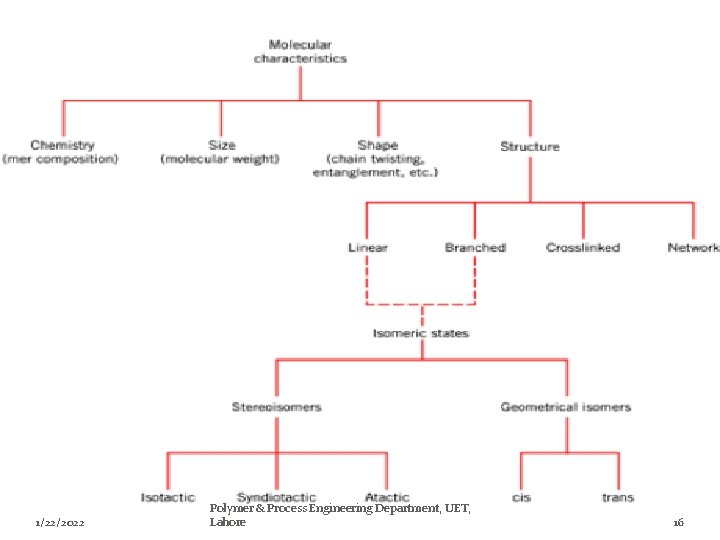
c)-Stereo Regular polymers � In stereo regular polymers, each monomer segment is in a regular configuration, giving structural regularity to the polymer � There are two types of isomerism i. ii. 1/22/2022 Optical or stereo Isomerism Geometric Isomerism Polymer & Process Engineering Department, UET, Lahore 15
1/22/2022 Polymer & Process Engineering Department, UET, Lahore 16
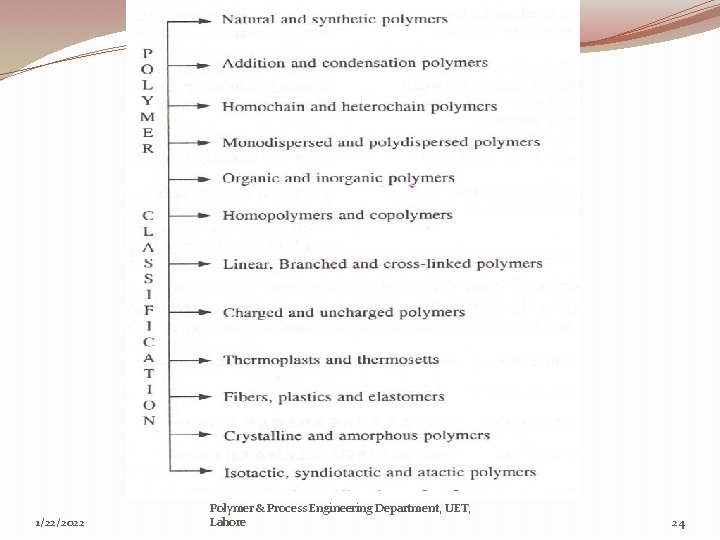
Classification of Polymers � The classification is based on several considerations. By Occurrence: Ø a) b) Ø By Chemical Composition: a) b) c) d) a) b) c) Linear Branched Network By Processing Properties: a) b) Ø Random Alternating Block Graft Nature and type of chain: Ø Ø Natural Polymers Synthetic Polymers Thermosetting Thermoplastics By Physical Properties or End use: 1/22/2022 Polymer & Process Engineering Department, UET, Lahore 17
By Occurrence: a)-Natural Polymers: Ø The common natural polymers include polysaccharides (starch, cellulose, gums etc), proteins (gelatin, albumin, enzymes, insulin), polyisoprenes (natural rubber, gutta percha) and nucleic acids (RNA and DNA). Ø Natural polymers are sometimes also called ‘Biopolymers' or‘ Biological macromolecules'. b)-Synthetic polymers: Ø They include polyethylene, olypropylene, poly methylmethacrylate, polystyrene, polyester, epoxy resins, Nylon. 1/22/2022 Polymer & Process Engineering Department, UET, Lahore 18
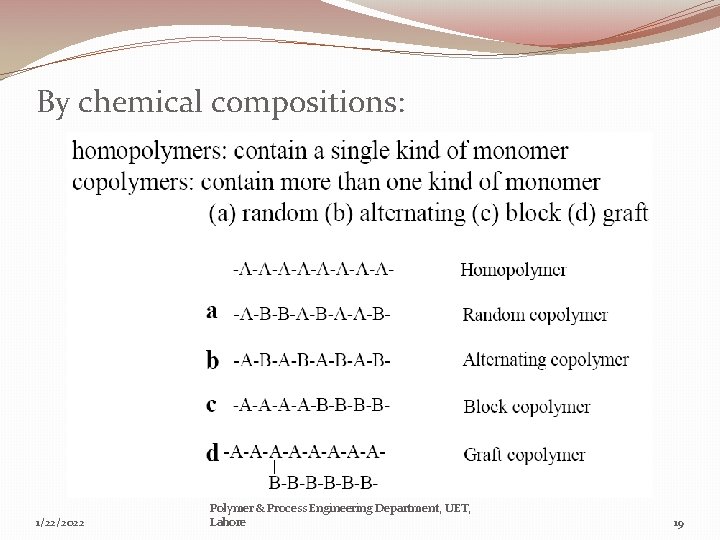
By chemical compositions: 1/22/2022 Polymer & Process Engineering Department, UET, Lahore 19
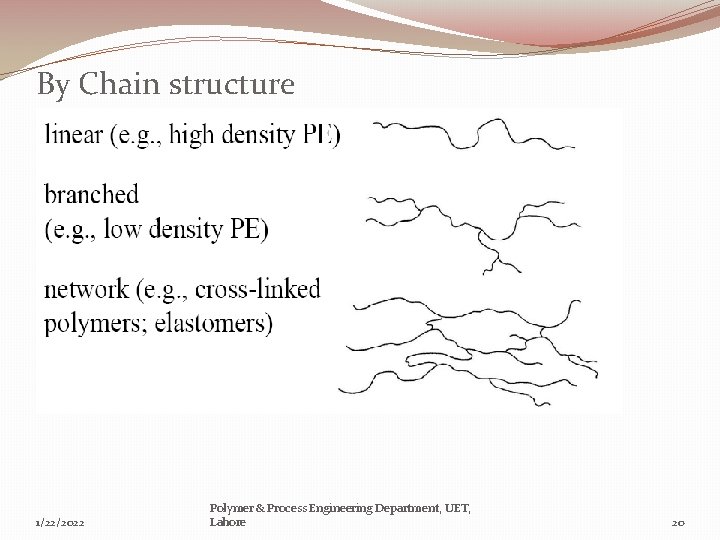
By Chain structure 1/22/2022 Polymer & Process Engineering Department, UET, Lahore 20
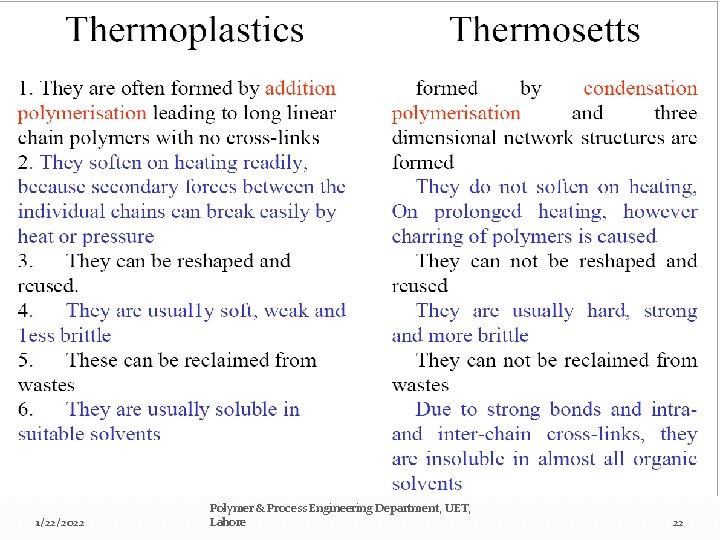
By processing properties a)-Thermosetting polymers: insoluble and only swell. Cross-linked polymers cannot be made to flow or melt irreversibly (network polymer). b)-Thermoplastic polymers: not crosslinked, soluble, will melt and flow. Most linear polymers take on new shapes by the application of heat and pressure (linear or branched polymer). 1/22/2022 Polymer & Process Engineering Department, UET, Lahore 21
1/22/2022 Polymer & Process Engineering Department, UET, Lahore 22
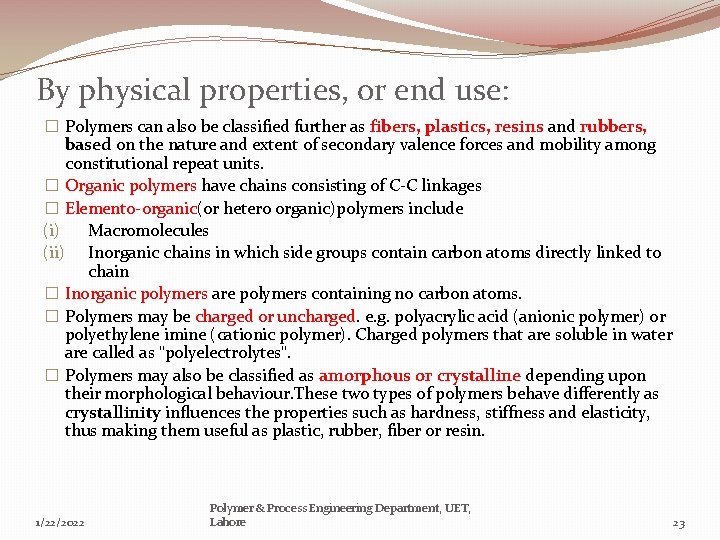
By physical properties, or end use: � Polymers can also be classified further as fibers, plastics, resins and rubbers, based on the nature and extent of secondary valence forces and mobility among constitutional repeat units. � Organic polymers have chains consisting of C-C linkages � Elemento-organic(or hetero organic)polymers include (i) Macromolecules (ii) Inorganic chains in which side groups contain carbon atoms directly linked to chain � Inorganic polymers are polymers containing no carbon atoms. � Polymers may be charged or uncharged. e. g. polyacrylic acid (anionic polymer) or polyethylene imine (cationic polymer). Charged polymers that are soluble in water are called as "polyelectrolytes". � Polymers may also be classified as amorphous or crystalline depending upon their morphological behaviour. These two types of polymers behave differently as crystallinity influences the properties such as hardness, stiffness and elasticity, thus making them useful as plastic, rubber, fiber or resin. 1/22/2022 Polymer & Process Engineering Department, UET, Lahore 23
1/22/2022 Polymer & Process Engineering Department, UET, Lahore 24
Monodispersed & Polydispersed Polymers � Monodispersed Polymers: A polymers whose constituents have consistent and uniform mass & mass distribution are known as monodispersed. Anionic polymerization yields the mono dispersed polymers. � Polydispersed Polymers: The polymers which have broad range of size and inconsistent mass distribution, are termed as Polydispersed polymers. 1/22/2022 Polymer & Process Engineering Department, UET, Lahore 25
Nomenclature: � A standard nomenclature system based on chemical structure as is used for small inorganic and organic compounds is most desired. 1. Some polymers are named by adding the name of the monomer onto the prefix ‘‘poly’’ without a space or hyphen. Thus the polymers from ethylene and acetaldehyde are named polyethylene and polyacetaldehyde, respectively. 2. When the monomer has a substituted parent name or a multi worded name or an abnormally long name, parentheses are placed around its name following the prefix ‘‘poly. ’’ e. g. The polymers from 3 -methyl-1 pentene=poly(3 -methyl-1 -pentene), vinyl chloride= poly(vinyl chloride), propylene oxide= poly(propylene oxide). 1/22/2022 Polymer & Process Engineering Department, UET, Lahore 26
Types of Nomenclature: a. Source name : to be based on names of corresponding monomer Polyethylene, Poly(vinyl chloride), Poly(ethylene oxide) b. IUPAC name : to be based on systematic name Poly(1 -chloroethylene), Poly(1 -butene-1, 4 -diyl), c. Functional group name : According to name of functional group in the polymer backbone Polyamide, Polyester d. Trade name : The commercial names by manufacturer Teflon, Nylon e. Abbreviation name : PVC, PET 1/22/2022 Polymer & Process Engineering Department, UET, Lahore 27
- Slides: 27