
Polymers 352021 Department of Polymer Process Engineering UET
- Slides: 29
Polymers 3/5/2021 Department of Polymer & Process Engineering, UET, Lahore 1
Polymerization � In polymer chemistry, polymerization is a process of reacting monomer molecules together in a chemical reaction to form three-dimensional networks or polymer chains. � In more straightforward polymerization, alkenes, which are relatively stable due to σ bonding between carbon atoms form polymers through relatively simple radical reactions. � In contrast, more complex reactions such as those that involve substitution at the carbonyl group require more complex synthesis. 3/5/2021 Department of Polymer & Process Engineering, UET, Lahore 2
Types Of Polymer Synthesis �There are two major classes of polymer formation mechanisms a) Addition Polymerization b) Step-Growth ( Condensation) Polymerization va)-Addition Polymerization: Ø The polymer grows by sequential addition of monomers to a reactive site � Chain growth is linear � Maximum molecular weight is obtained early in the reaction 3/5/2021 Department of Polymer & Process Engineering, UET, Lahore 3
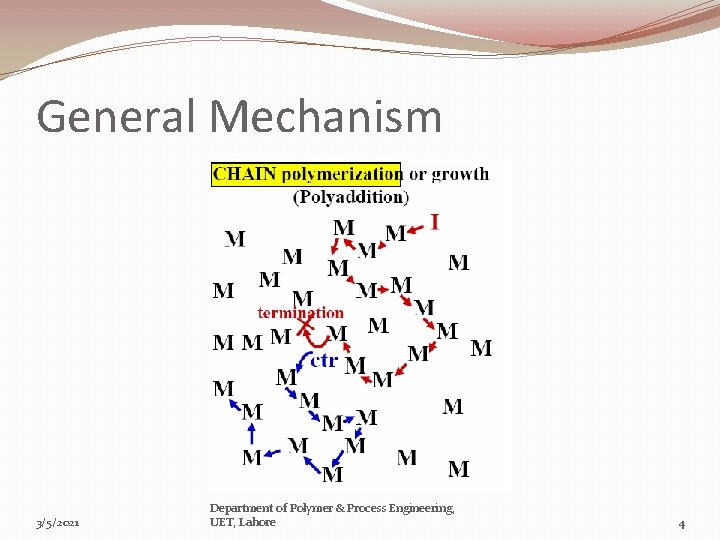
General Mechanism 3/5/2021 Department of Polymer & Process Engineering, UET, Lahore 4
a)-Addition Polymerization: �It isn't difficult to form addition polymers from monomers containing C=C double bonds; many of these compounds polymerize spontaneously unless polymerization is actively inhibited. �There are 3 mechanisms through which the addition polymerization can proceed I. Free-Radical Polymerization Reactions II. Anionic Polymerization III. Cationic Polymerization 3/5/2021 Department of Polymer & Process Engineering, UET, Lahore 5
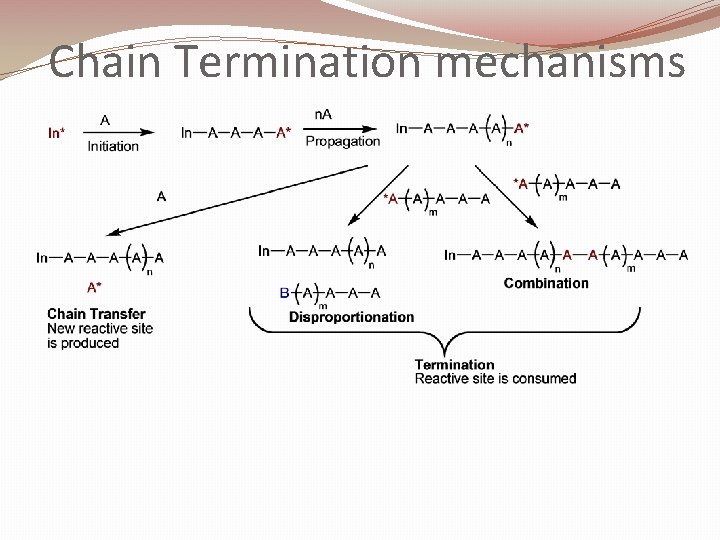
I-Free-Radical Polymerization: � The simplest way to catalyze the polymerization reaction that leads to an addition polymer is to add a source of a free radical to the monomer. � The term free radical is used to describe a family of very reactive, short -lived components of a reaction that contain one or more unpaired electrons. � The presence of a free radical, addition polymers form by a chainreaction mechanism. � There are 3 main steps involved Ø Chain-initiation Ø Chain-propagation Ø Chain- termination 3/5/2021 Department of Polymer & Process Engineering, UET, Lahore 6
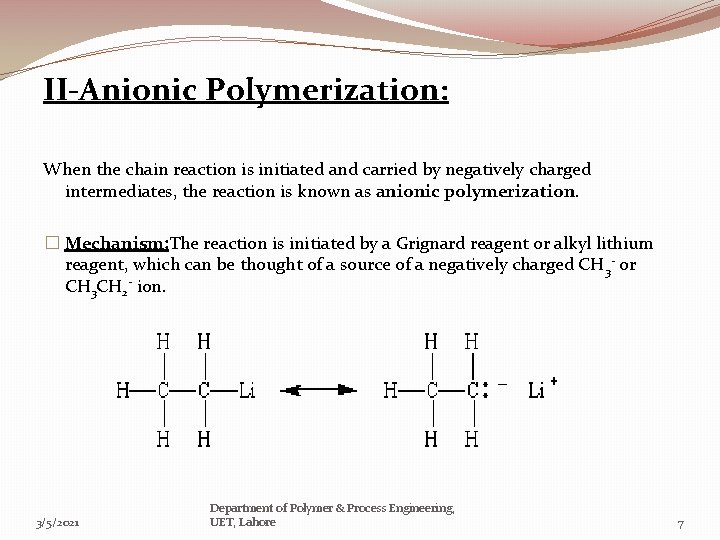
II-Anionic Polymerization: When the chain reaction is initiated and carried by negatively charged intermediates, the reaction is known as anionic polymerization. � Mechanism: The reaction is initiated by a Grignard reagent or alkyl lithium reagent, which can be thought of a source of a negatively charged CH 3 - or CH 3 CH 2 - ion. 3/5/2021 Department of Polymer & Process Engineering, UET, Lahore 7
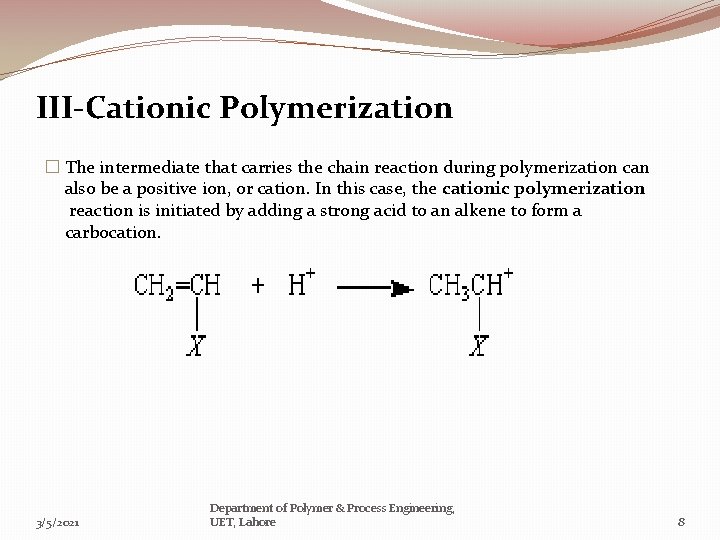
III-Cationic Polymerization � The intermediate that carries the chain reaction during polymerization can also be a positive ion, or cation. In this case, the cationic polymerization reaction is initiated by adding a strong acid to an alkene to form a carbocation. 3/5/2021 Department of Polymer & Process Engineering, UET, Lahore 8
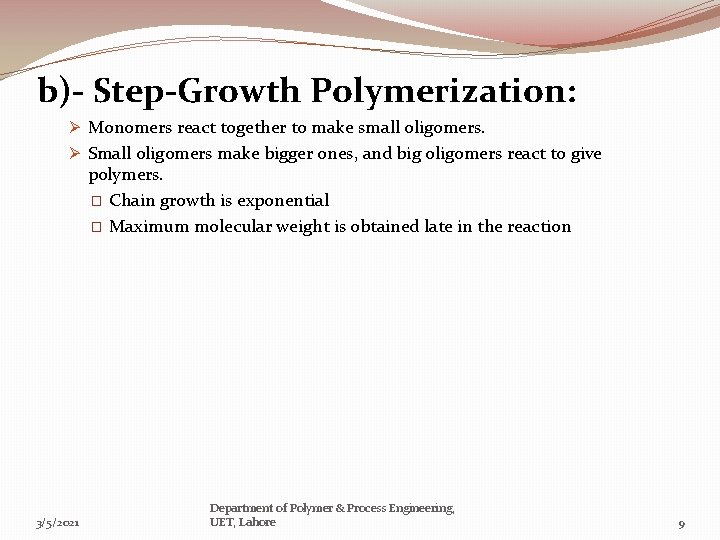
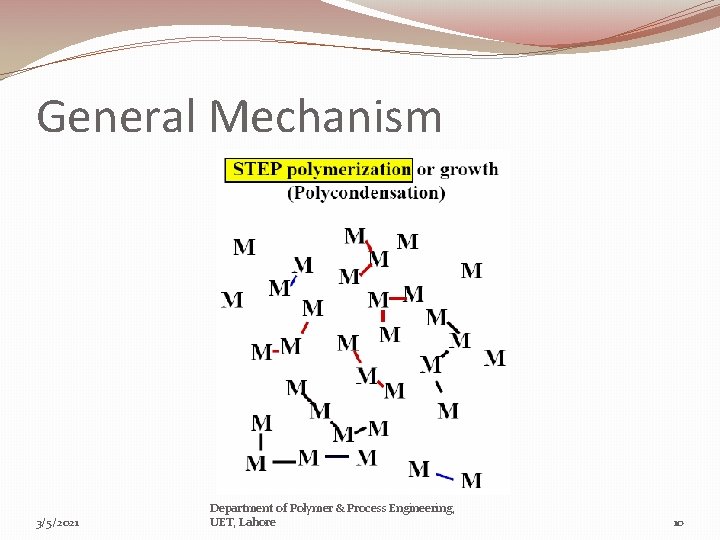
b)- Step-Growth Polymerization: Ø Monomers react together to make small oligomers. Ø Small oligomers make bigger ones, and big oligomers react to give polymers. � Chain growth is exponential � Maximum molecular weight is obtained late in the reaction 3/5/2021 Department of Polymer & Process Engineering, UET, Lahore 9
General Mechanism 3/5/2021 Department of Polymer & Process Engineering, UET, Lahore 10
Chain Termination mechanisms
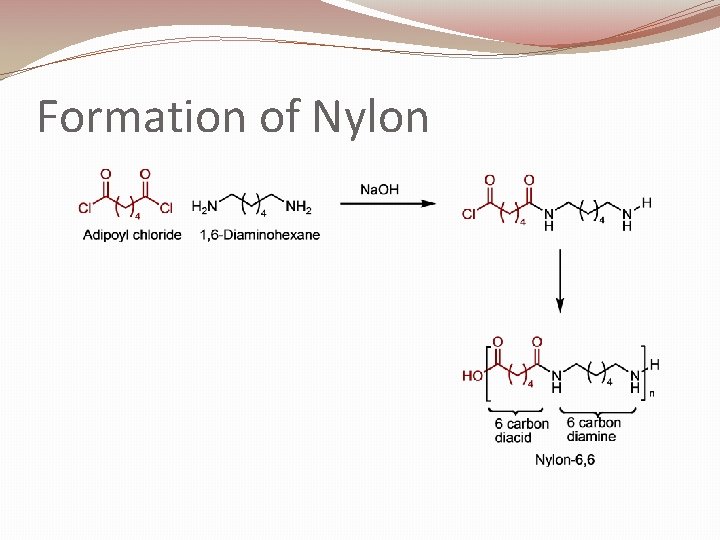
Formation of Nylon
Polymerization Methods A number of different techniques are applied to carry on the polymerization process, important of them are: Bulk polymerization 2. Suspension polymerization 3. Solution polymerization 4. Emulsion polymerization 1. 3/5/2021 Department of Polymer & Process Engineering, UET, Lahore 13
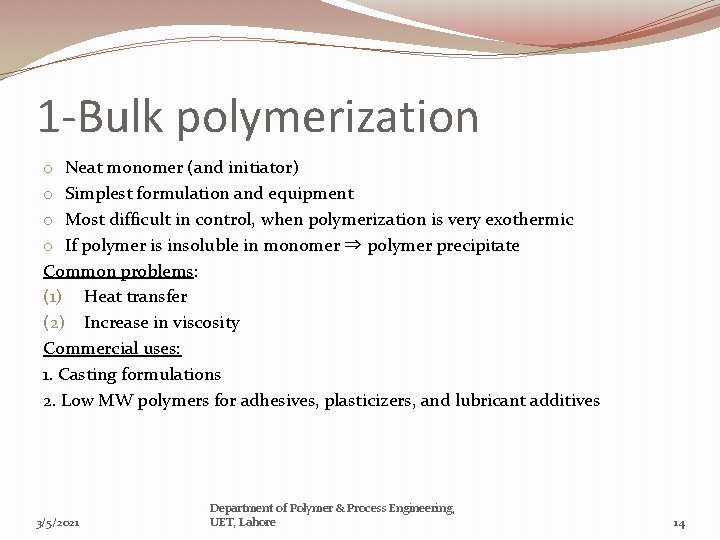
1 -Bulk polymerization o Neat monomer (and initiator) o Simplest formulation and equipment o Most difficult in control, when polymerization is very exothermic o If polymer is insoluble in monomer ⇒ polymer precipitate Common problems: (1) Heat transfer (2) Increase in viscosity Commercial uses: 1. Casting formulations 2. Low MW polymers for adhesives, plasticizers, and lubricant additives 3/5/2021 Department of Polymer & Process Engineering, UET, Lahore 14
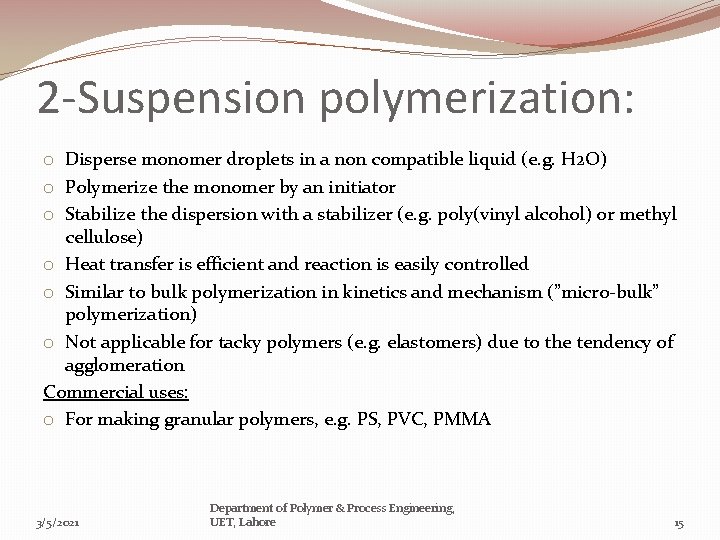
2 -Suspension polymerization: o Disperse monomer droplets in a non compatible liquid (e. g. H 2 O) o Polymerize the monomer by an initiator o Stabilize the dispersion with a stabilizer (e. g. poly(vinyl alcohol) or methyl cellulose) o Heat transfer is efficient and reaction is easily controlled o Similar to bulk polymerization in kinetics and mechanism (”micro-bulk” polymerization) o Not applicable for tacky polymers (e. g. elastomers) due to the tendency of agglomeration Commercial uses: o For making granular polymers, e. g. PS, PVC, PMMA 3/5/2021 Department of Polymer & Process Engineering, UET, Lahore 15
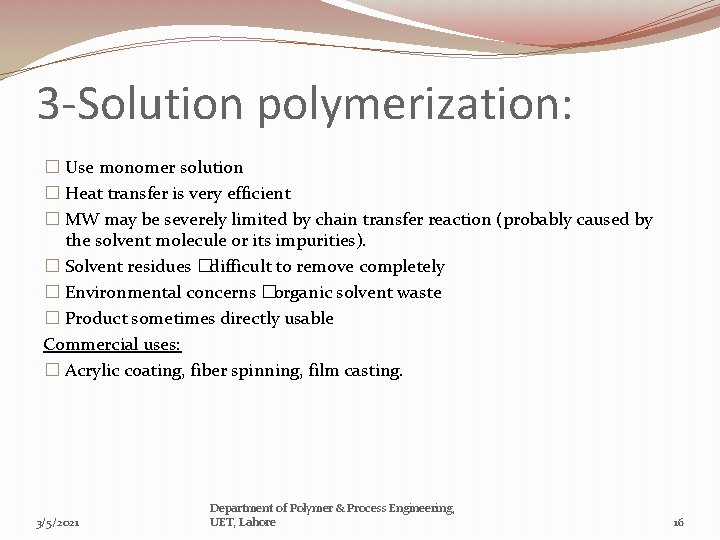
3 -Solution polymerization: � Use monomer solution � Heat transfer is very efficient � MW may be severely limited by chain transfer reaction (probably caused by the solvent molecule or its impurities). � Solvent residues � difficult to remove completely � Environmental concerns � organic solvent waste � Product sometimes directly usable Commercial uses: � Acrylic coating, fiber spinning, film casting. 3/5/2021 Department of Polymer & Process Engineering, UET, Lahore 16
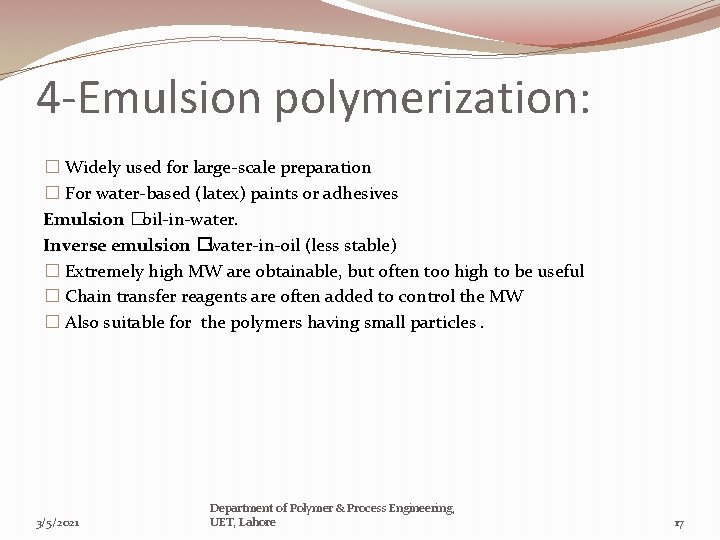
4 -Emulsion polymerization: � Widely used for large-scale preparation � For water-based (latex) paints or adhesives Emulsion � oil-in-water. Inverse emulsion �water-in-oil (less stable) � Extremely high MW are obtainable, but often too high to be useful � Chain transfer reagents are often added to control the MW � Also suitable for the polymers having small particles. 3/5/2021 Department of Polymer & Process Engineering, UET, Lahore 17
POLYMER COMPOUNDING 3/5/2021 Department of Polymer & Process Engineering, UET, Lahore 18
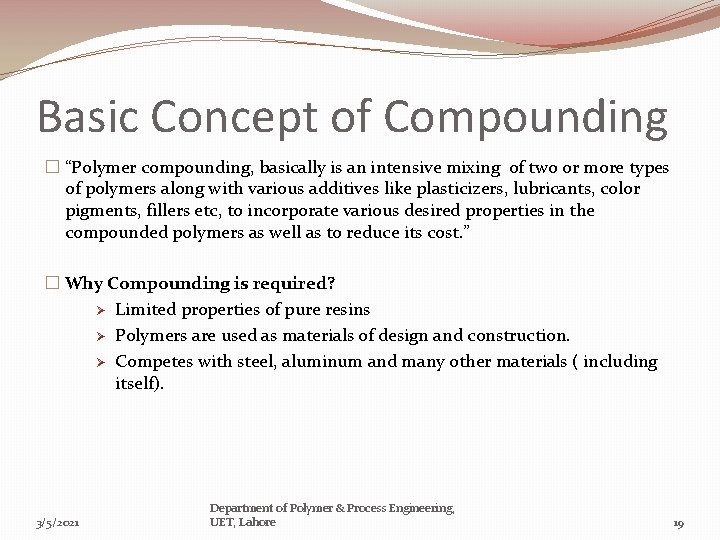
Basic Concept of Compounding � “Polymer compounding, basically is an intensive mixing of two or more types of polymers along with various additives like plasticizers, lubricants, color pigments, fillers etc, to incorporate various desired properties in the compounded polymers as well as to reduce its cost. ” � Why Compounding is required? Ø Limited properties of pure resins Ø Polymers are used as materials of design and construction. Ø Competes with steel, aluminum and many other materials ( including itself). 3/5/2021 Department of Polymer & Process Engineering, UET, Lahore 19
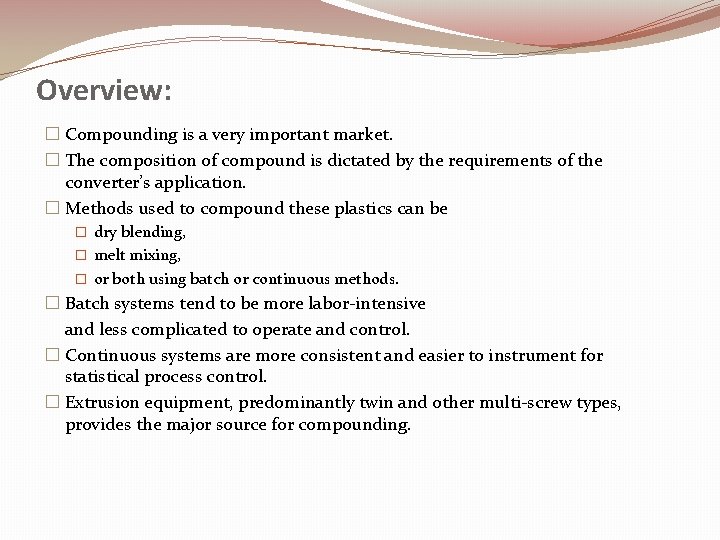
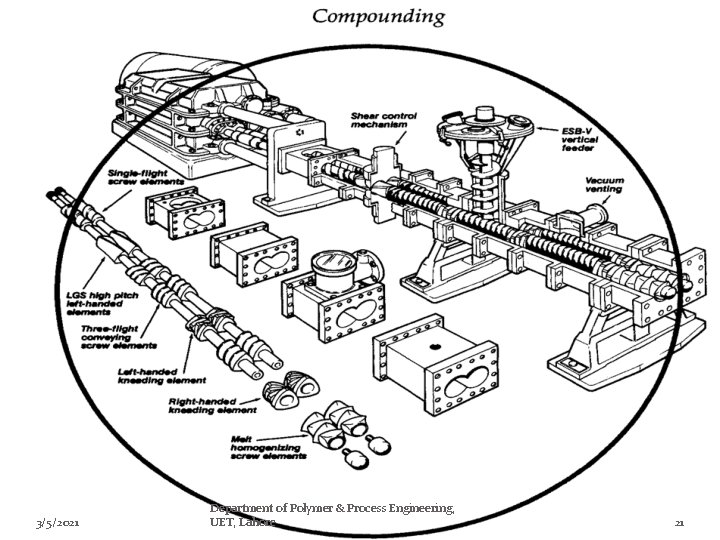
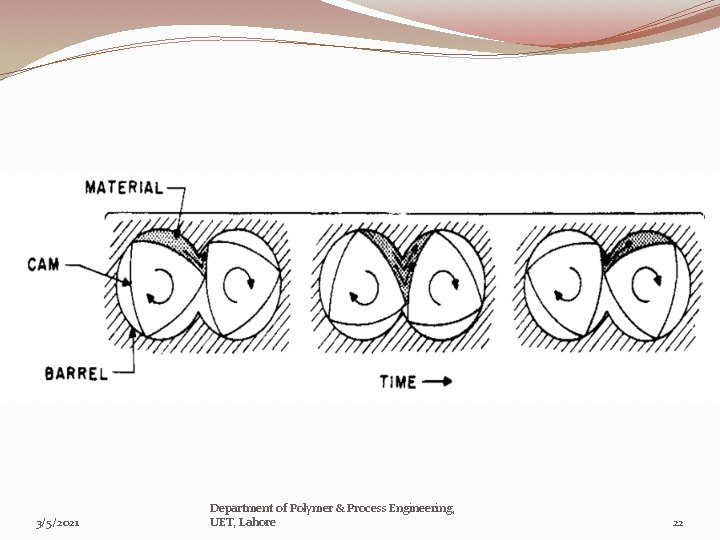
Overview: � Compounding is a very important market. � The composition of compound is dictated by the requirements of the converter’s application. � Methods used to compound these plastics can be � dry blending, � melt mixing, � or both using batch or continuous methods. � Batch systems tend to be more labor-intensive and less complicated to operate and control. � Continuous systems are more consistent and easier to instrument for statistical process control. � Extrusion equipment, predominantly twin and other multi-screw types, provides the major source for compounding.
3/5/2021 Department of Polymer & Process Engineering, UET, Lahore 21
3/5/2021 Department of Polymer & Process Engineering, UET, Lahore 22
Plastic Materials � In compounding, a plastic is modified physically and/or chemically by additives that change its properties. � Wide range of grades of plastics are available. � Better the mixing/compounding, the better the materials performances. � The plastic being used is usually in the form of powder just as it comes from the plastic manufacturer. � Why Compounding is interesting and complicated? � Color requirements are important. Concentrate or master batch compounds are used.
Blend Mixing of two compatible Plastics having different properties in order to produce an intermediate compound. Two factors are considered during mixing; � � Plastics are ultimately miscible Plastics are ultimately immiscible 1. 2. � � � Other factors including: a) b) c) d) e) f) 3/5/2021 Minor Component (Dispersed) Major Component (Matrix) Order of Mixing Thermal Properties Rheological Properties Nature of Feed streams ( Solids or melt) Average stress level Heating History of Extruders Department of Polymer & Process Engineering, UET, Lahore 24
Important features of Blending: � Medium-intensity mixers usually consist of low-intensity mixers fitted with attachments called intensifiers. The intensifiers are normally a high-speed mixing head added to the low-intensity mixer. � The high-intensity mixer is a high-speed unit with specialized blade designs. � Mixing times are typically measured in minutes, High-intensity mixers are used most often in the areas of pigment dispersion and premixing of the compound. � Single and Twin screw extruders are used in continuous compounding. Re-active Compounding: � Extruder is not only used as melt processor but also as a chemical reactor. � The most common reactants are plastic or pre-plastic melts and gaseous, liquid, or molten low molecular weight compounds.
Pellets �The primary form of materials to be processed are compounds in pellet form. Advantages: �Simpler feeding system �Dust-free handling �Greater extrusion capacity �Lower shipping costs as a result of higher feed-bulk density
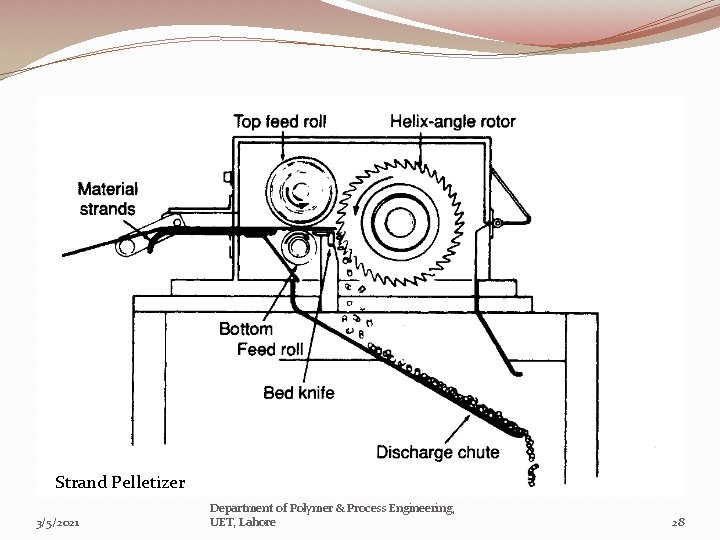
Disadvantages: � The plastics additional heating cycle � The additional cost Pellets are produced by using Pelletizer Two methods are used to produce pellets 1. 2. Strand Palletizing (3. 2 mm dia. ) Underwater Palletizing
Strand Pelletizer 3/5/2021 Department of Polymer & Process Engineering, UET, Lahore 28
Process Optimization �Contamination problems with changing the material in a single extrusion line. �Control �Die �Troubleshooting Ø Flecks formation Ø Non-uniform distribution of stabilizers Ø Bubble formation due to decomposition of additives Ø Using wrong additives