
Polymerase Chain Reaction PCR A Brief History of
Polymerase Chain Reaction PCR
A Brief History of Forensic Analysis �Forensic sciences describe the boundary between science and law �Science can as easily convict someone of a crime as free someone wrongly convicted �Fingerprint evidence has been in use for about 100 years �Blood group typing was introduced next � 1980’s saw the 1 st use of DNA based forensic testing with restriction fragment length polymorphisms �Modern genetic profiling makes it posssible to distinguish any two people on the planet (except identical twins) living or dead
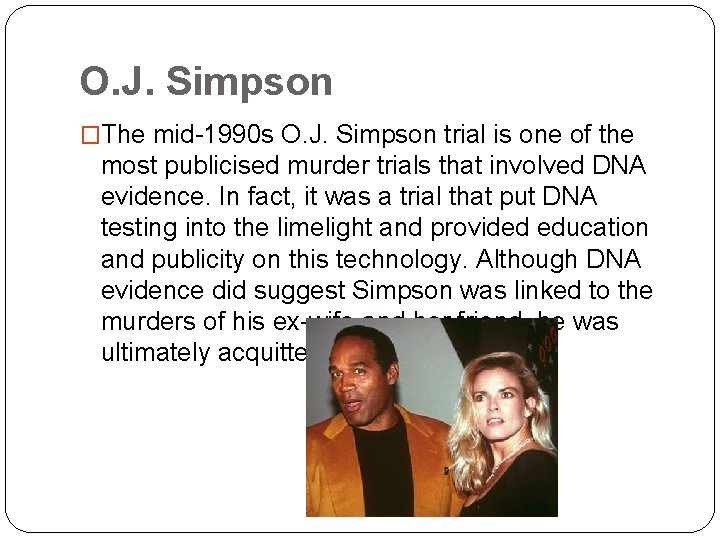
O. J. Simpson �The mid-1990 s O. J. Simpson trial is one of the most publicised murder trials that involved DNA evidence. In fact, it was a trial that put DNA testing into the limelight and provided education and publicity on this technology. Although DNA evidence did suggest Simpson was linked to the murders of his ex-wife and her friend, he was ultimately acquitted.
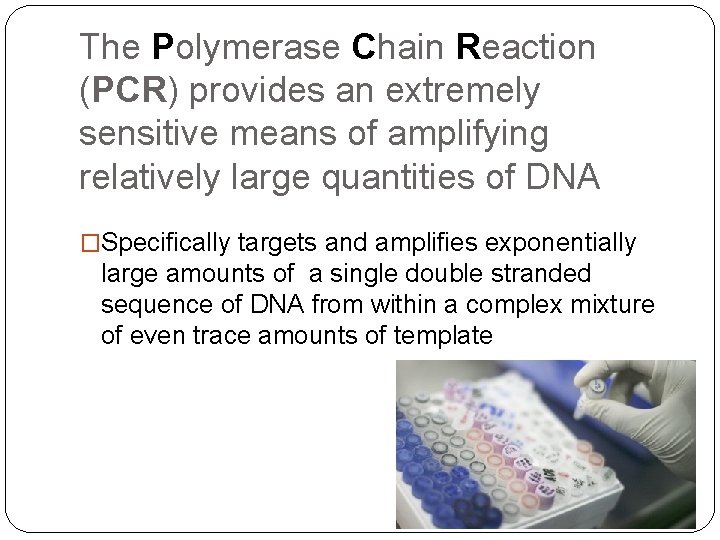
The Polymerase Chain Reaction (PCR) provides an extremely sensitive means of amplifying relatively large quantities of DNA �Specifically targets and amplifies exponentially large amounts of a single double stranded sequence of DNA from within a complex mixture of even trace amounts of template
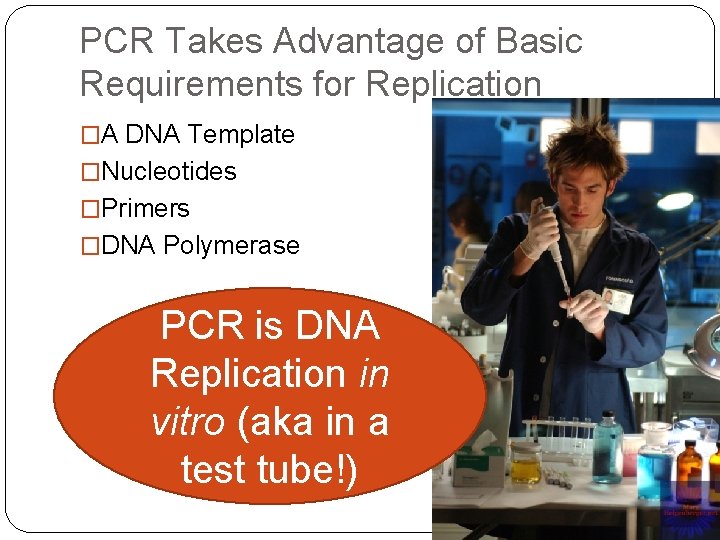
PCR Takes Advantage of Basic Requirements for Replication �A DNA Template �Nucleotides �Primers �DNA Polymerase PCR is DNA Replication in vitro (aka in a test tube!)
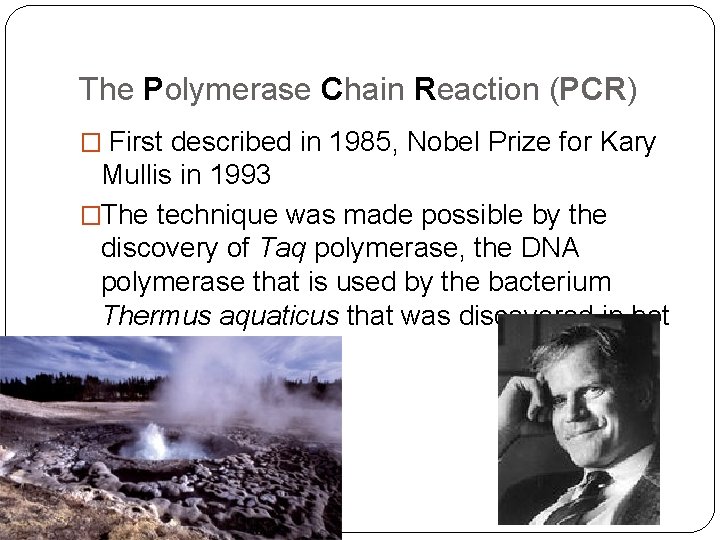
The Polymerase Chain Reaction (PCR) � First described in 1985, Nobel Prize for Kary Mullis in 1993 �The technique was made possible by the discovery of Taq polymerase, the DNA polymerase that is used by the bacterium Thermus aquaticus that was discovered in hot springs
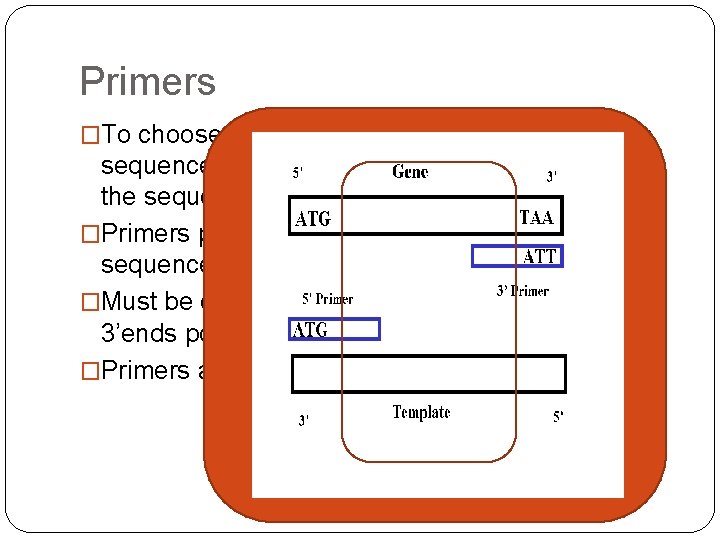
Primers �To choose a primer, you must not only know the sequence of the DNA you want to amplify, but the sequences flanking that DNA as well �Primers provide specificity, so that only your sequence of interest is amplified �Must be complementary to opposite strands with 3’ends pointing towards each other �Primers are used in excess
The primary materials, or reagents, used in PCR are: �DNA nucleotides: the building blocks for the new DNA �Template DNA: the DNA sequence that you want to amplify �Primers: single-stranded DNAs between 20 and 50 nucleotides long (oligonucleotides) that are complementary to a short region on either side of the template DNA �DNA polymerase: a heat stable enzyme that drives, or catalyzes, the synthesis of new DNA
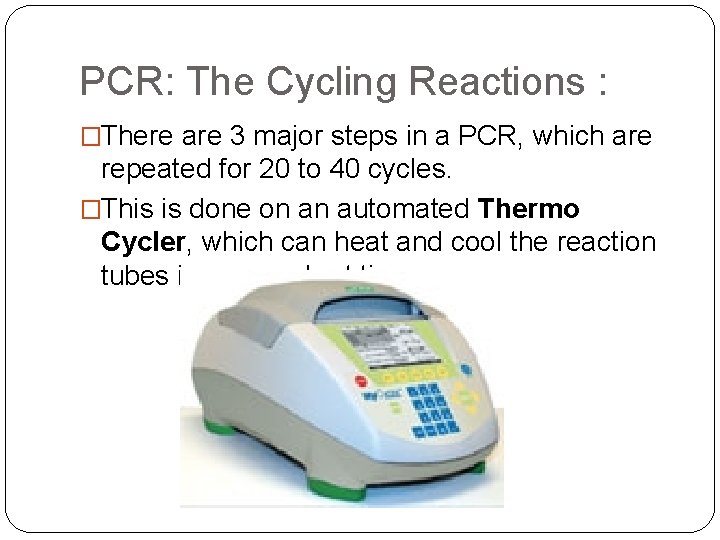
PCR: The Cycling Reactions : �There are 3 major steps in a PCR, which are repeated for 20 to 40 cycles. �This is done on an automated Thermo Cycler, which can heat and cool the reaction tubes in a very short time.
3 Steps in PCR � Denaturation at around 94°C : �During the denaturation, the double strand melts open to single stranded DNA, all enzymatic reactions stop (for example the extension from a previous cycle). � Annealing at around 54°C : �Hydrogen bonds are constantly formed and broken between the single stranded primer and the single stranded template. If the primers exactly fit the template, the hydrogen bonds are so strong that the primer stays attached � Extension at around 72°C : �The bases (complementary to the template) are coupled to the primer on the 3' side (the polymerase adds d. NTP's from 5' to 3', reading the template from 3' to 5' side, bases are added complementary to the template)
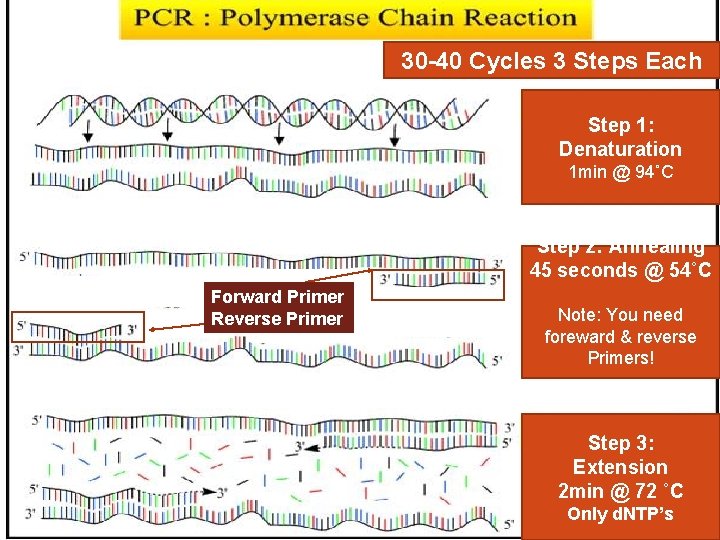
30 -40 Cycles 3 Steps Each Step 1: Denaturation 1 min @ 94˚C Step 2: Annealing 45 seconds @ 54˚C Forward Primer Reverse Primer Note: You need foreward & reverse Primers! Step 3: Extension 2 min @ 72 ˚C Only d. NTP’s
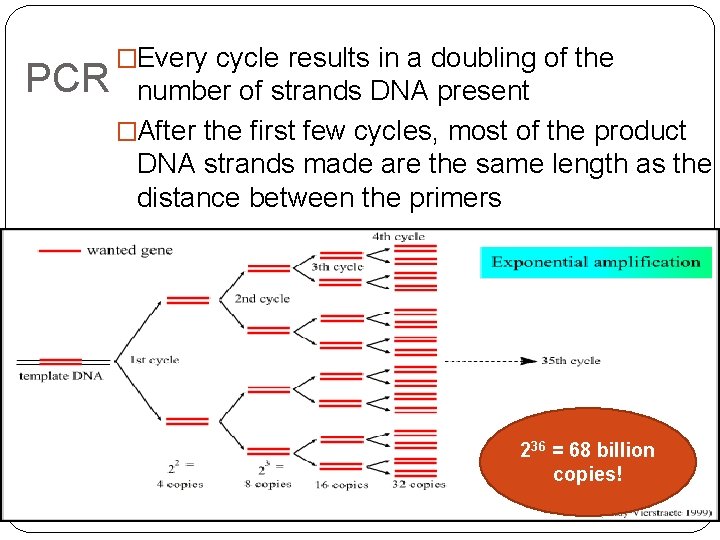
PCR �Every cycle results in a doubling of the number of strands DNA present �After the first few cycles, most of the product DNA strands made are the same length as the distance between the primers 236 = 68 billion copies!
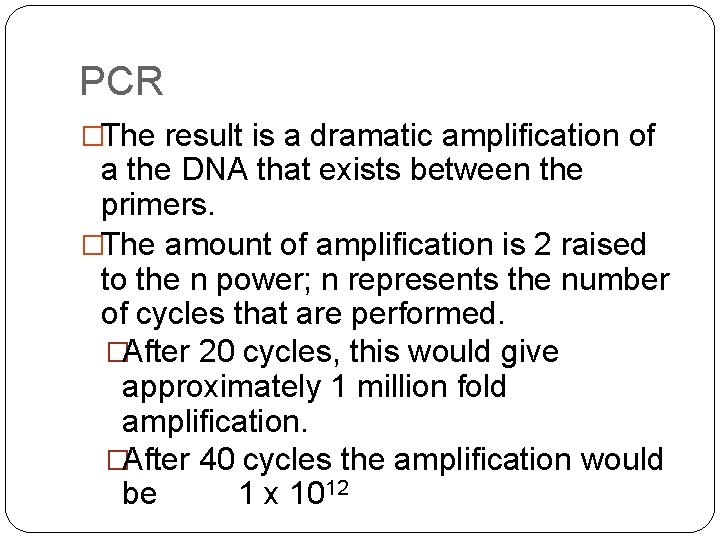
PCR �The result is a dramatic amplification of a the DNA that exists between the primers. �The amount of amplification is 2 raised to the n power; n represents the number of cycles that are performed. �After 20 cycles, this would give approximately 1 million fold amplification. �After 40 cycles the amplification would be 1 x 10¹²
Why This is so Useful �You only need a very small amount of template for PCR �In theory, 1 molecule of DNA is enough to produce over 50 billion copies after PCR �You don’t need to isolate the sequence of interest ahead of time �The DNA sample does not have to be highly purified �You want to avoid nuclease contamination as that will degrade the DNA �You also want to avoid cross contamination from other samples
In the News NOW �The Frail Pharaoh By Ker Than| - National Geographic| Scitech … Article comments Updated February 17, 2010 DNA Tests Reveal Mysteries of Boy-King. . . a strapping sun god. Instead, a new DNA study says, King Tut was a frail pharaoh. . . incestuous origins. The report is the first DNA study ever conducted with ancient Egyptian … Story|02/17/2010 �Southern California Police Try to Identify Human Head Found in Desert … haired woman, wrapped in plastic grocery bags with the store labels "Fiesta Foods" and "Walgreens. " Barstow police say DNA samples and X-rays have been sent to the state and investigators also are asking for the public's help. The head was … Story|02/17/2010
�Milwaukee Man Reportedly Told Cellmate He Killed Women … learned prison officials planned to take DNA samples from inmates, prosecutors said. . . Department officials should have collected a DNA sample at that time. Agency records. . . through thousands of cases and tested the DNA of more than 100 people. Prosecutor Mark … Story|02/19/2010 �DNA Evidence Helps Solve 1982 Murder and Rape … DNA Evidence Helps Solve 1982 Murder and Rape Thursday, February 11, 2010 CLEVELAND An Ohio prosecutor says DNA evidence has helped solve the June 1982 shooting death of one woman and the rape …
� Judge Declares Mistrial for N. Y. Jeweler Accused of Killing Wife … confessions were concocted to get authorities off his back until he could make a case to a judge. The prosecution had no forensic evidence. Faith's body was never found and no trace of her or her DNA was detected around the Lippes' suburban home. Story|02/19/2010 � Police Debate Use of Family DNA to ID Suspects … Police Debate Use of Family DNA to ID Suspects Tuesday, February 09. . . least two states are increasingly using a DNA crime-solving technique that some legal. . . been in trouble with the law and is in a DNA database because of it, you, too … Story|02/09/2010 � DNA Evidence Helps Solve 1982 Murder and Rape … DNA Evidence Helps Solve 1982 Murder and Rape Thursday, February 11, 2010 CLEVELAND An Ohio
PCR & Contamination �The most important consideration in PCR is contamination �Even the smallest contamination with DNA could affect amplification �For example, if a technician in a crime lab set up a test reaction (with blood from the crime scene) after setting up a positive control reaction (with blood from the suspect) cross contamination between the samples could result in an erroneous incrimination, even if the technician changed pipette tips between samples. A few blood cells could volitilize in the pipette, stick to the plastic of the pipette, and then get ejected into the test sample �Modern labs take account of this fact and devote tremendous effort to avoiding cross-contamination
5 Main Areas of Biotechnology Tremendously Impacted by Development of PCR �Gene mapping �Cloning �DNA Sequencing �Gene Detection �DNA Profiling
DNA Profiling �DNA Profiling: the use of molecular genetic methods to determine the exact genotype of a DNA sample to distinguish one human being from another �Used in �Crime scene investigations �Missing person cases �Mass disasters to identify victims �Human rights violations �Paternity testing
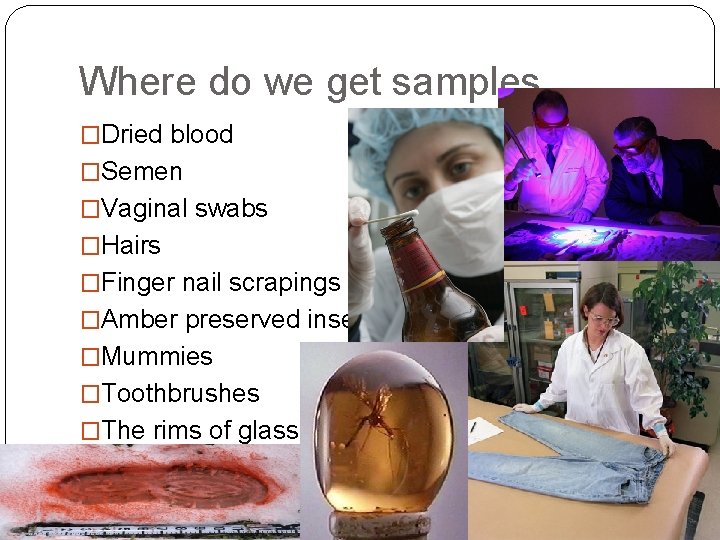
Where do we get samples �Dried blood �Semen �Vaginal swabs �Hairs �Finger nail scrapings �Amber preserved insects �Mummies �Toothbrushes �The rims of glasses
How Can DNA Evidence Solve Crimes �If the DNA profile obtained from evidence at a crime scene matches the DNA profile of a subject, the individual may be included as a potentially guilty person �If the two DNA profiles do not match, the individual is excluded from the suspect pool
What Kinds of Human DNA Sequences are used in Investigations �There about 3 billion bases in the human genome �More than 99. 5% of these bases are identical between individuals �The. 5% that does vary between individuals is called Polymorphic DNA �Literally translates “many forms” �These sequences are the ones used in forensic testing �DNA sequences used forensic typing are derived from regions of chromosomes that do not control any known traits and have no known function
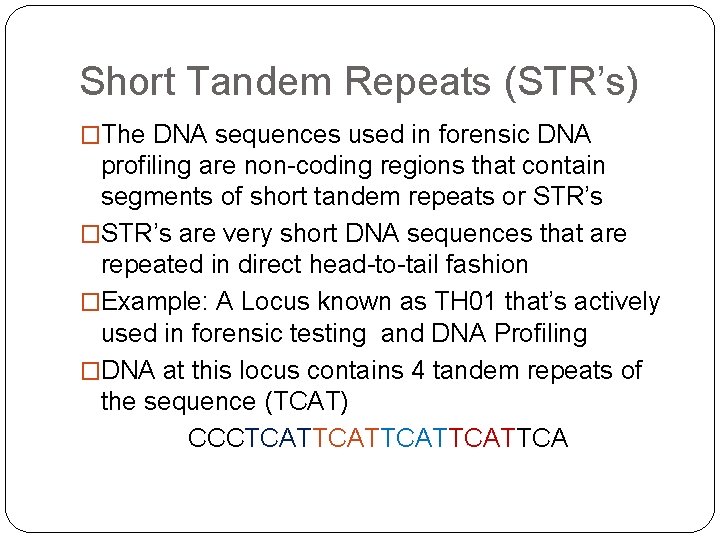
Short Tandem Repeats (STR’s) �The DNA sequences used in forensic DNA profiling are non-coding regions that contain segments of short tandem repeats or STR’s �STR’s are very short DNA sequences that are repeated in direct head-to-tail fashion �Example: A Locus known as TH 01 that’s actively used in forensic testing and DNA Profiling �DNA at this locus contains 4 tandem repeats of the sequence (TCAT) CCCTCATTCATTCA
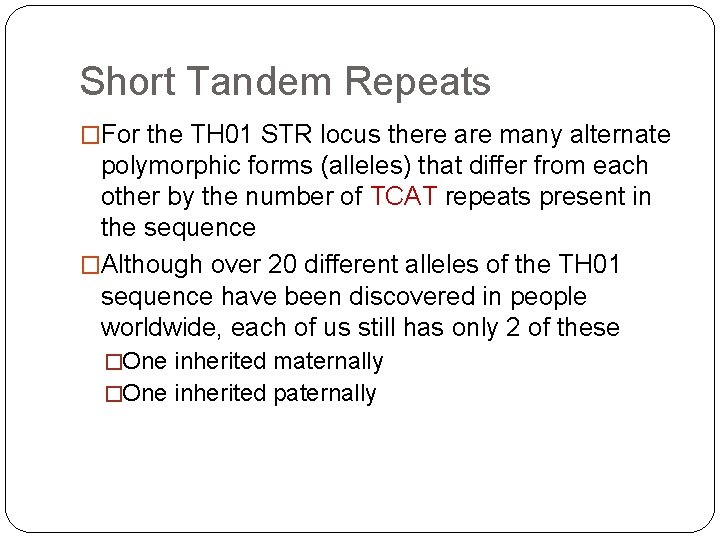
Short Tandem Repeats �For the TH 01 STR locus there are many alternate polymorphic forms (alleles) that differ from each other by the number of TCAT repeats present in the sequence �Although over 20 different alleles of the TH 01 sequence have been discovered in people worldwide, each of us still has only 2 of these �One inherited maternally �One inherited paternally
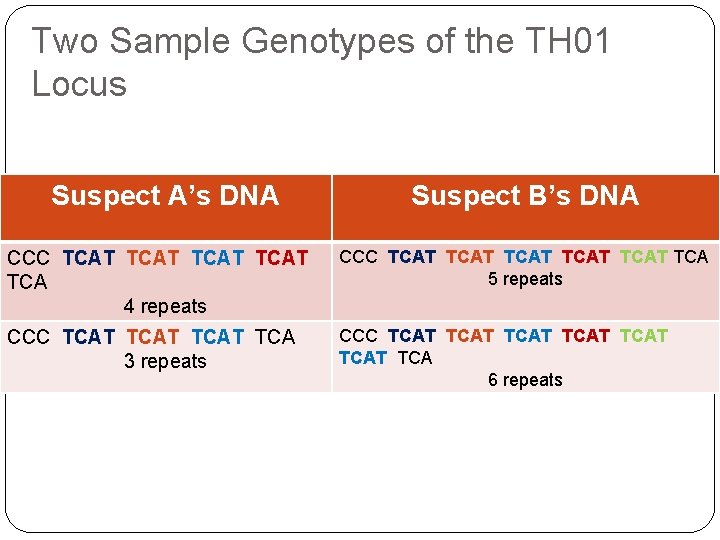
Two Sample Genotypes of the TH 01 Locus Suspect A’s DNA Suspect B’s DNA CCC TCAT TCA 4 repeats CCC TCAT TCAT TCA 5 repeats CCC TCAT TCA 3 repeats CCC TCAT TCAT TCA 6 repeats
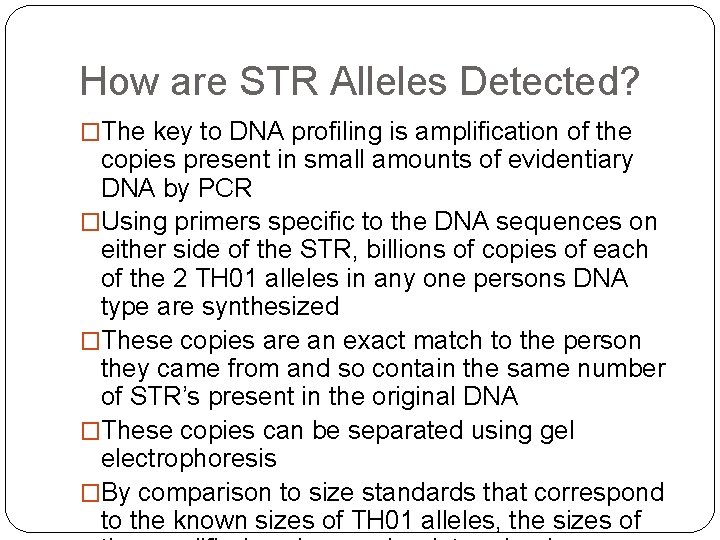
How are STR Alleles Detected? �The key to DNA profiling is amplification of the copies present in small amounts of evidentiary DNA by PCR �Using primers specific to the DNA sequences on either side of the STR, billions of copies of each of the 2 TH 01 alleles in any one persons DNA type are synthesized �These copies are an exact match to the person they came from and so contain the same number of STR’s present in the original DNA �These copies can be separated using gel electrophoresis �By comparison to size standards that correspond to the known sizes of TH 01 alleles, the sizes of
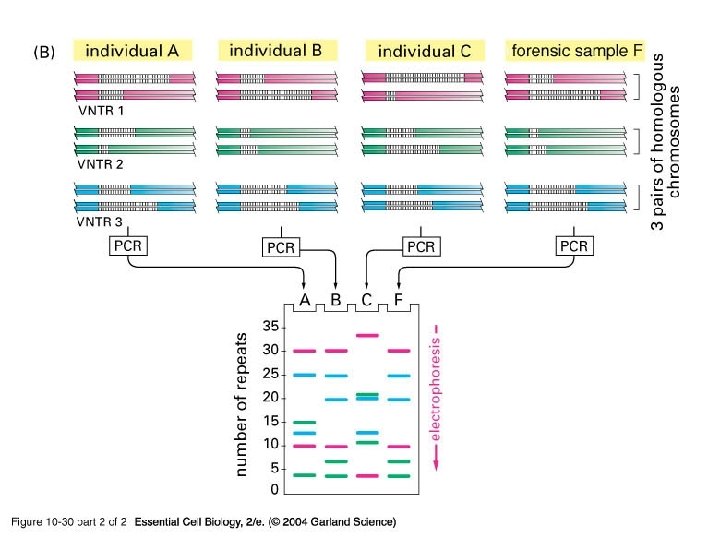
Power of Discrimination �In real crime scene applications DNA profiling is performed at a number of different loci to improve the power of discrimination �The ability of the typing to discriminate between different individuals �The larger the number of loci typed, the more powerful the ability to discriminate and the better the accuracy �Can identify 1 person out of a billion
Allele Frequencies & the Power of Discrimination �In addition to DNA samples taken from crime scenes, forensic specialists will isolate DNA from suspects, victims, and others present to genotype as controls �Using PCR based analysis, the samples will then be examined at 13 different loci using genotyping software to interpret the results from the amplification products
- Slides: 30