
Polymer Technology Structureproperty relations for polyamide 6 E
- Slides: 1
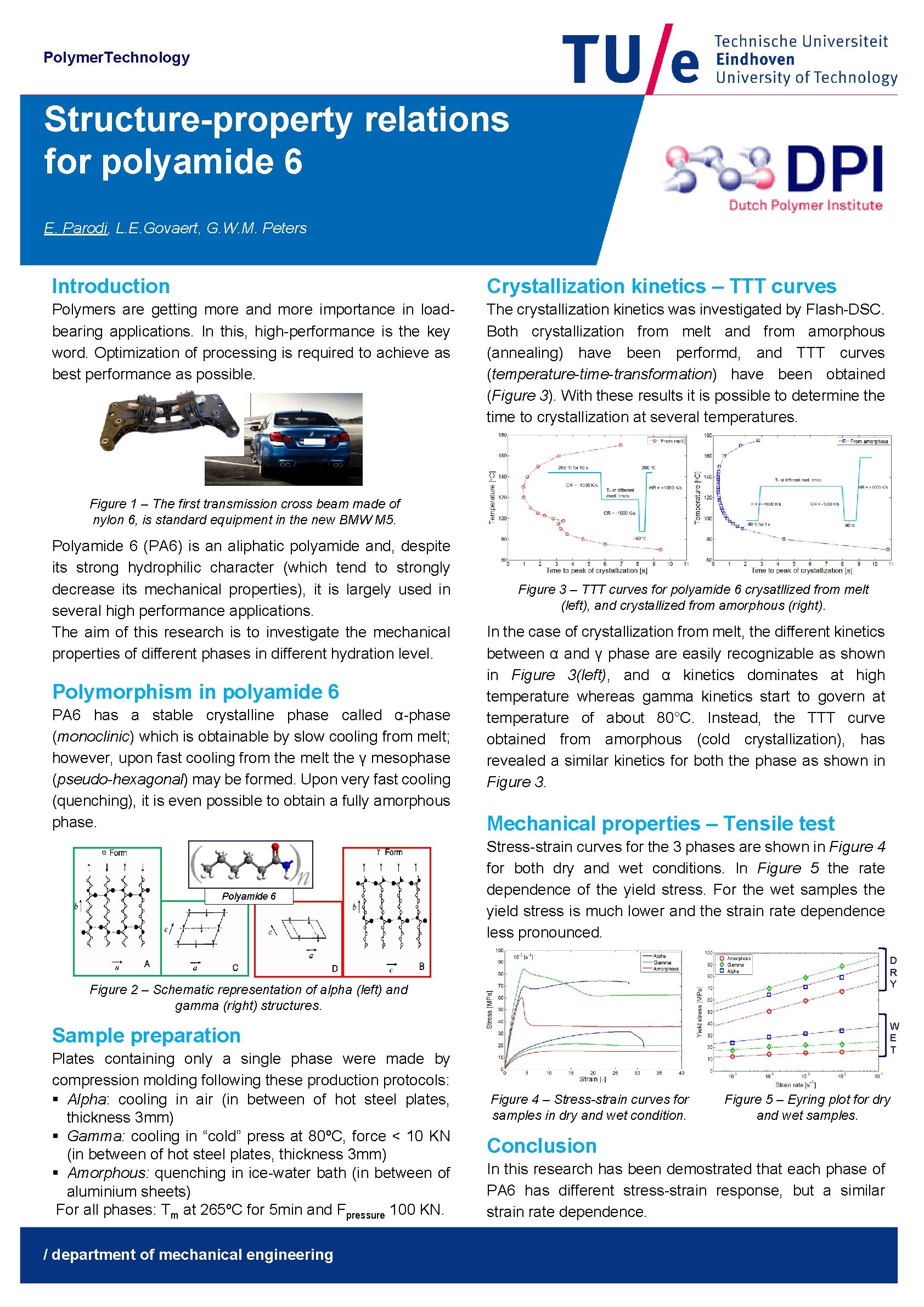
Polymer. Technology Structure-property relations for polyamide 6 E. Parodi, L. E. Govaert, G. W. M. Peters Introduction Crystallization kinetics – TTT curves Polymers are getting more and more importance in loadbearing applications. In this, high-performance is the key word. Optimization of processing is required to achieve as best performance as possible. The crystallization kinetics was investigated by Flash-DSC. Both crystallization from melt and from amorphous (annealing) have been performd, and TTT curves (temperature-time-transformation) have been obtained (Figure 3). With these results it is possible to determine the time to crystallization at several temperatures. Figure 1 – The first transmission cross beam made of nylon 6, is standard equipment in the new BMW M 5. Polyamide 6 (PA 6) is an aliphatic polyamide and, despite its strong hydrophilic character (which tend to strongly decrease its mechanical properties), it is largely used in several high performance applications. The aim of this research is to investigate the mechanical properties of different phases in different hydration level. Polymorphism in polyamide 6 PA 6 has a stable crystalline phase called α-phase (monoclinic) which is obtainable by slow cooling from melt; however, upon fast cooling from the melt the γ mesophase (pseudo-hexagonal) may be formed. Upon very fast cooling (quenching), it is even possible to obtain a fully amorphous phase. Polyamide 6 Figure 3 – TTT curves for polyamide 6 crysatllized from melt (left), and crystallized from amorphous (right). In the case of crystallization from melt, the different kinetics between α and γ phase are easily recognizable as shown in Figure 3(left), and α kinetics dominates at high temperature whereas gamma kinetics start to govern at temperature of about 80°C. Instead, the TTT curve obtained from amorphous (cold crystallization), has revealed a similar kinetics for both the phase as shown in Figure 3. Mechanical properties – Tensile test Stress-strain curves for the 3 phases are shown in Figure 4 for both dry and wet conditions. In Figure 5 the rate dependence of the yield stress. For the wet samples the yield stress is much lower and the strain rate dependence less pronounced. D R Y Figure 2 – Schematic representation of alpha (left) and gamma (right) structures. W E T Sample preparation Plates containing only a single phase were made by compression molding following these production protocols: § Alpha: cooling in air (in between of hot steel plates, thickness 3 mm) § Gamma: cooling in “cold” press at 80ºC, force < 10 KN (in between of hot steel plates, thickness 3 mm) § Amorphous: quenching in ice-water bath (in between of aluminium sheets) For all phases: Tm at 265ºC for 5 min and Fpressure 100 KN. / department of mechanical engineering Figure 4 – Stress-strain curves for samples in dry and wet condition. Figure 5 – Eyring plot for dry and wet samples. Conclusion In this research has been demostrated that each phase of PA 6 has different stress-strain response, but a similar strain rate dependence.