
Polymer Technology Chapter 6 Chemical Bonding and Polymer
Polymer Technology Chapter 6 Chemical Bonding and Polymer Structure
Chemical Bonding • The size of a plastic material can be discussed in terms of molecular weight of the plastic material. • The shape of a plastic molecule may be influenced by the nature of the repeating unit and the manner in which the repeating units are linked together. • It is therefore convenient to consider the shape of the plastic material in two contexts: -Configuration — Arrangement of the polymer chain, fixed by primary valence bonds; It can be altered only through the breaking or reforming of chemical bonds along the polymer chain. -Conformation — Arrangement of the polymer chain, established by rotation about primary valence bonds of the polymer chain.

Chemical Bonding • The molecule of the plastic may be linear, branched, or cross-linked depending on the functionality of the monomers utilized during the synthesis. • If the repeating units of the polymer along the chain are chemically and sterically regular, then the macromolecule is said to possess structural regularity. • To consider structural regularity, we need to define two terms, which are recurrence regularity and stereoregularity. • Crucial mechanical properties, such as tensile strength and compressive strength, elongation at break, tensile modulus, impact strength depend on molecular weight in a definite way. • In addition, other properties, like softening point, solution viscosity, melt viscosity and solubility, depend on molecular weight in a similar way as the mechanical properties do.
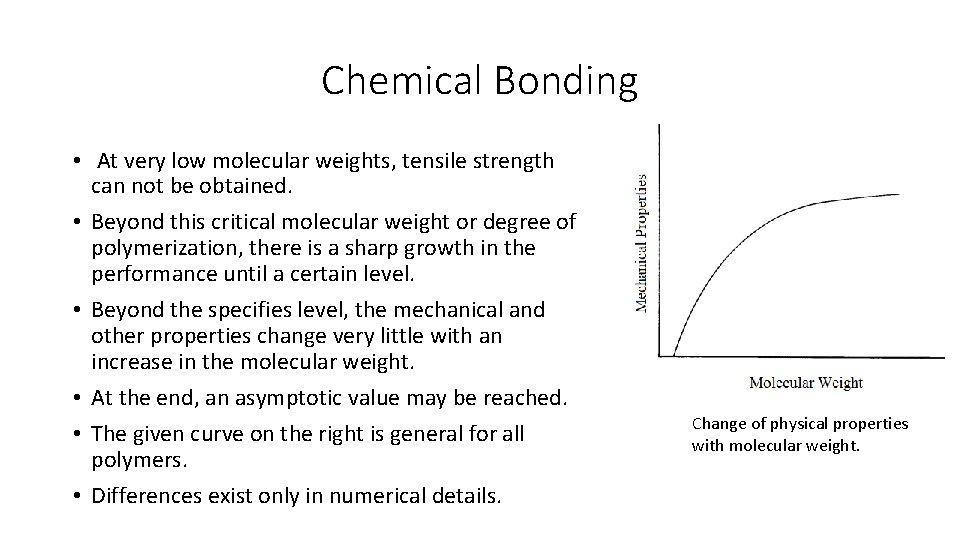
Chemical Bonding • At very low molecular weights, tensile strength can not be obtained. • Beyond this critical molecular weight or degree of polymerization, there is a sharp growth in the performance until a certain level. • Beyond the specifies level, the mechanical and other properties change very little with an increase in the molecular weight. • At the end, an asymptotic value may be reached. • The given curve on the right is general for all polymers. • Differences exist only in numerical details. Change of physical properties with molecular weight.
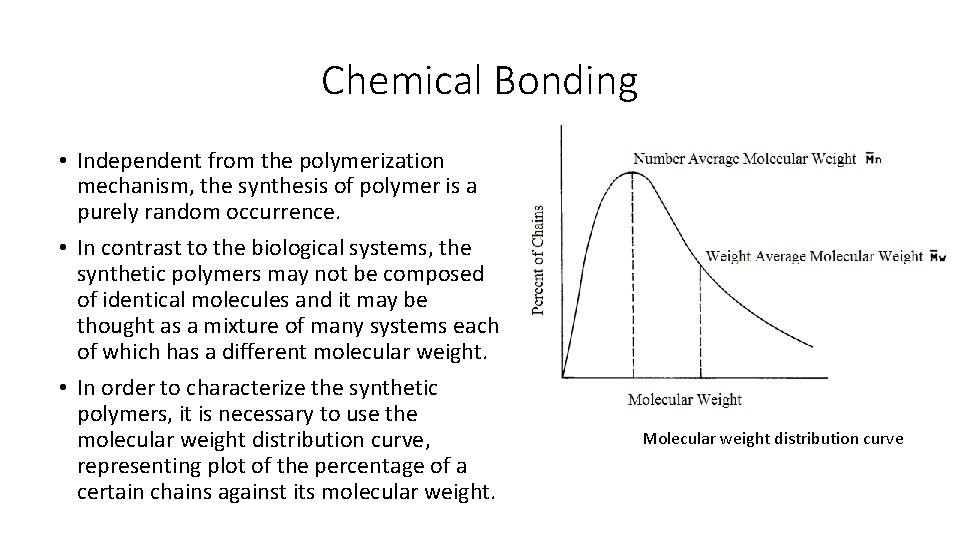
Chemical Bonding • Independent from the polymerization mechanism, the synthesis of polymer is a purely random occurrence. • In contrast to the biological systems, the synthetic polymers may not be composed of identical molecules and it may be thought as a mixture of many systems each of which has a different molecular weight. • In order to characterize the synthetic polymers, it is necessary to use the molecular weight distribution curve, representing plot of the percentage of a certain chains against its molecular weight. Molecular weight distribution curve
Chemical Bonding • The molecular weight of the macromolecules can be calculated by a number of physical methods and chemical methods. • These metods contain (1) end group analysis, (2) measurement of colligative properties, (3) light scattering, (4) ultracentrifugation, (5) dilute solution viscosity, and (6) gel permeation chromatography (GPC). • The specified colligative properties can be determined by the following measurements on dilute polymer solutions: -Vapor pressure lowering -Boiling point elevation -Freezing point depression -Osmotic pressure
Chemical Bonding • The number-average weight, Mn, can be obtained from end-group analysis of the polymers, colligative property measurements of the macromolecules, and gel permeation chromotography of the plastic materials. • The weight-average molecular weight, Mw, can be obtained from light scattering of the polymers, ultracentrifugation and gel permeation chromatography of the macromolecules. • z-average molecular weight, Mz, can be obtained from gel permeation chromotography of the macromolecules. • Viscosity-average molecular weight, Mv, can be obtained from measurements of the solution viscosity of the macromolecules.
Chemical Bonding • A polymeric material in the solid form is an aggregate of a large number of polymer molecules. • Depending on the molecular structure of the polymer, the process of molecular aggregation takes place essentially by either of two possible arrangements of molecules, which leads to either a crystalline material or amorphous material. • Independent from the type of molecular arrangement within the macromolecule, the forces responsible for the molecular aggregation are the intermolecular secondary bonding forces. • The bonding energies owing to the secondary bonding forces range from 0. 5 kcal/mol to 10 kcal/mol. • The bonding energies owing to the primary bonding forces range from 50 kcal/mol to 100 kcal/mol.
Chemical Bonding • When the polymer molecules are large enough, the attractive forces due to the secondary intermolecular bonding forces between the polymer chains may build up to such a level that they become greater than the primary valence forces responsible for intramolecular bonds. • The magnitude of the secondary bonding forces between the polymer chains with the high physical entanglement of the polymer chains dictates many polymer properties. • The tertiary polymer structure is related with the nature of the intermolecular secondary bonding forces and with structural order of the resulting polymer. • The secondary bonds are composed of dipole bonds, induction bonds, van der Waals bonds, and hydrogen bonds.
Chemical Bonding • The magnitude of the secondary bond energies decreases from hydrogen bonds to van der Waals bonds. • If a plastic material is cooled from the molten state, molecules within the macromolecule are attracted to each other forming a solid mass. • Two arrangements are essentially possible when the polymer is solidifed: • In the first arrangement, the polymer molecules vitrify and the polymer chains randomly coiled and entangled. • The resulting solid of the macromolecule is amorphous and glassy. • In the second arrangement, the individual polymer chains are folded and packed in a regular manner characterized by three-dimensional long-range order. • The resulting polymer in solid form is said to be crystalline.
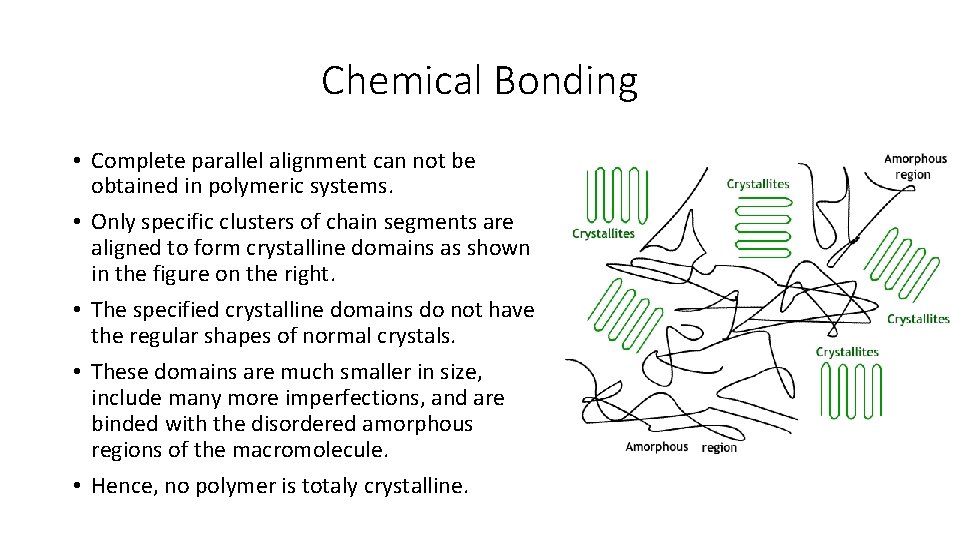
Chemical Bonding • Complete parallel alignment can not be obtained in polymeric systems. • Only specific clusters of chain segments are aligned to form crystalline domains as shown in the figure on the right. • The specified crystalline domains do not have the regular shapes of normal crystals. • These domains are much smaller in size, include many more imperfections, and are binded with the disordered amorphous regions of the macromolecule. • Hence, no polymer is totaly crystalline.
References • Robert O. Ebewele, «POLYMER SCIENCE AND TECHNOLOGY» , CRC Press, 2000. • Fried, Joel R. , «Polymer science and technology» , Prentice Hall, Third edition.
- Slides: 12