
Polymer Technology Chapter 2 Introduction to Polymer Science
- Slides: 12
Polymer Technology Chapter 2 Introduction to Polymer Science Cont’d & CLASSIFICATION OF POLYMERS
BASIC DEFINITIONS • The molecular weights Mw and Mn give us the information on the size of molecules. • In addition, this ratio of Mw to Mn is a measure of polydispersity (PDI), and it is often called as the heterogeneity index. • In an ideal polymer like protein, all the polymer molecules are of the same size, which means that ratio of Mw to Mn is equal to 1. • This case can not be observed with synthetic polymers. • The numerical value of Mw is always greater than the numerical value of Mn. • Hence, following an increase in the ratio of Mw to Mn, the molecular weight distribution turns into more broader form. • The polydispersity of commercial polymers varies widely.
BASIC DEFINITIONS • As an example, polystyrene with a Mn of over 100000 have a polydispersity index value varying between 2 and 5. • At the same time, commercial polyethylene synthesized in the presence of a stereospecific catalyst may have a polydispersity index value of 30. • On the contrary, the polydispersity index of some commercial vinyl polymers synthesized using the living polymerization technique can be as low as 1. 06. • Polymers synthesized with nearly monodisperse molecular-weight distributions are useful as molecular-weight standards for the determination of molecular weights and molecular- weight distributions of commercial polymers.
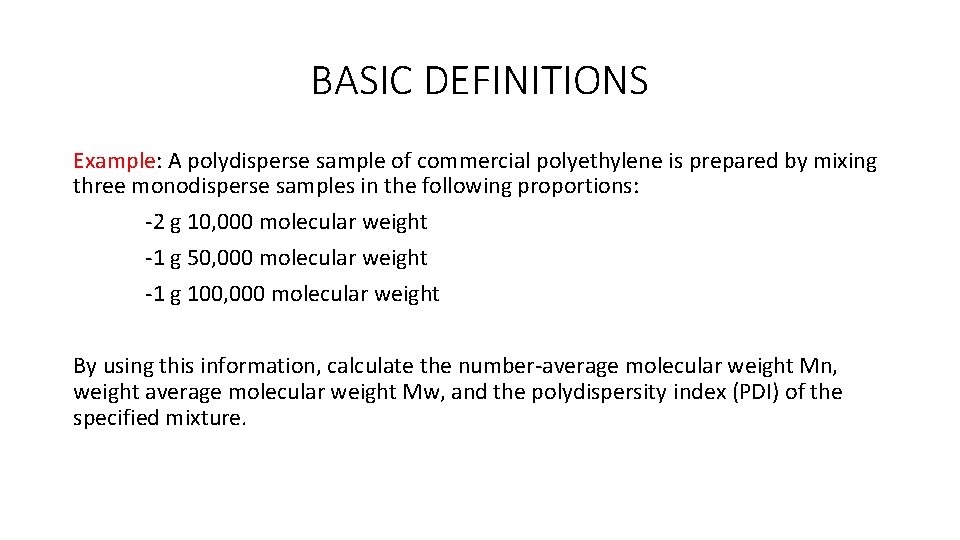
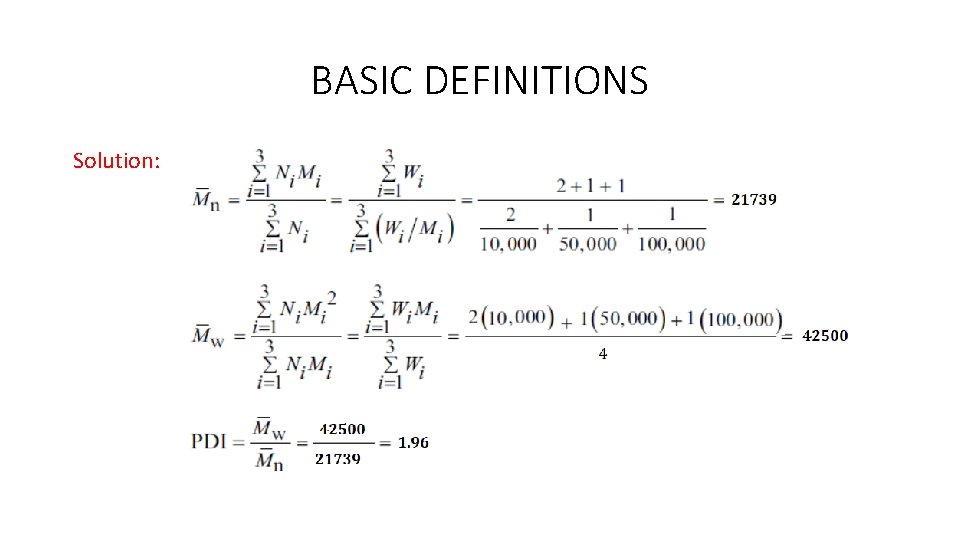
BASIC DEFINITIONS Example: A polydisperse sample of commercial polyethylene is prepared by mixing three monodisperse samples in the following proportions: -2 g 10, 000 molecular weight -1 g 50, 000 molecular weight -1 g 100, 000 molecular weight By using this information, calculate the number-average molecular weight Mn, weight average molecular weight Mw, and the polydispersity index (PDI) of the specified mixture.
BASIC DEFINITIONS Solution:
CLASSIFICATION OF POLYMERS • Macromolecules or polymers may either be naturally occurring or purely synthetic. • All the conversion processes occurring in our body such as generation of energy from our food intake are due to the presence of enzymes, which are polymers of biological origin. • The structure of the polymers with biological origin are normally a bit complex and can not be understood until very recently. • In contrast to the polymers with biological origin, the starch, cellulose, and natural rubber are examples of polymers of plant origin. • The specified polymers with plant origin have relatively simpler structures than those of enzymes or proteins. • There a large number of synthetic polymers including the following types: fibers, elastomers, plastics, adhesives, etc.
CLASSIFICATION OF POLYMERS 1. Linear, Branched or Cross-linked • A macromolecule or polymer chain can be formed when a very large number of repeating units of monomers come together to be linked up by covalent bonds under appropriate conditions. • The functionality is important in terms of the polymerization capability of a specified monomer. • As a definition, the functionality of a molecule is simply its interlinking capacity, or the number of sites it has available for bonding with other molecules under the specific polymerization conditions. • Any molecule can be classified as monofunctional, bifunctional, or polyfunctional depending on whether it has one, two, or more than two functional sites available for linking with other molecules.
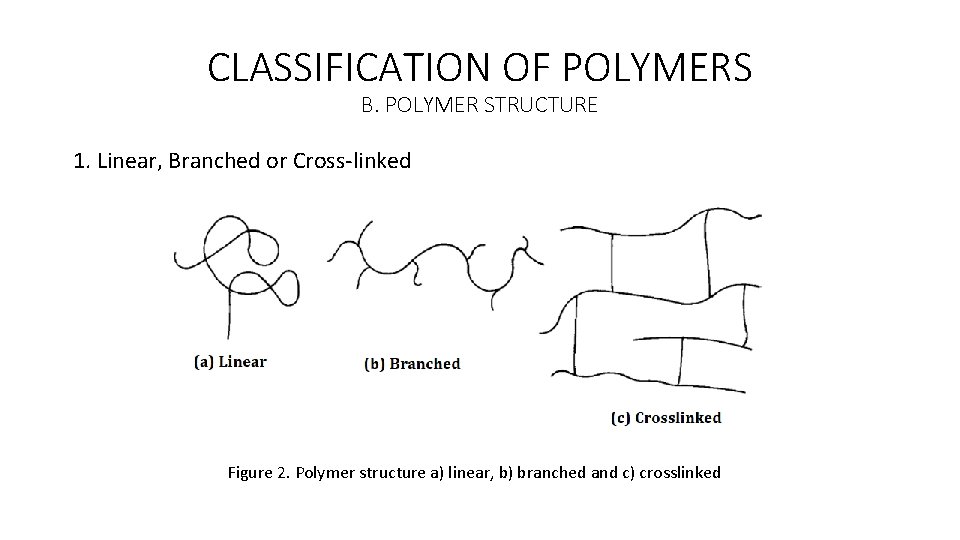
CLASSIFICATION OF POLYMERS B. POLYMER STRUCTURE 1. Linear, Branched or Cross-linked Figure 2. Polymer structure a) linear, b) branched and c) crosslinked
CLASSIFICATION OF POLYMERS • The structural units resulting from the reaction of monomers may in principle be linked together in any conceivable pattern. • Bifunctional structural units can enter into two and only two linkages with other structural units, which means that the sequence of linkages between bifunctional units is necessarily linear. • Hence, the resulting polymer is said to be linear. • On the other hand, the reaction between polyfunctional molecules results in structural units that may be linked so as to form nonlinear structures. • In some cases the side growth of each polymer chain may be terminated before the chain has a chance to link up with another chain. • Hence, the resulting polymer molecules are said to be branched.
CLASSIFICATION OF POLYMERS B. POLYMER STRUCTURE • Most of the times, the linear and the branched polymers are soluble in some solvent at normal temperatures. • However, the presence of certain polar pendant groups can considerably reduce room temperature solubility. • On the other hand, the crosslinked polymers are chemically tied together. • Hence, the crosslinked polymers do not dissolve, but can only be swelled by liquids. • The presence of crosslinking between the polymer chains confers stability on the macromolecules. • Highly crosslinked macromolecules are generally rigid and high-melting. • There are lots of commercial crosslinked polymers in use.
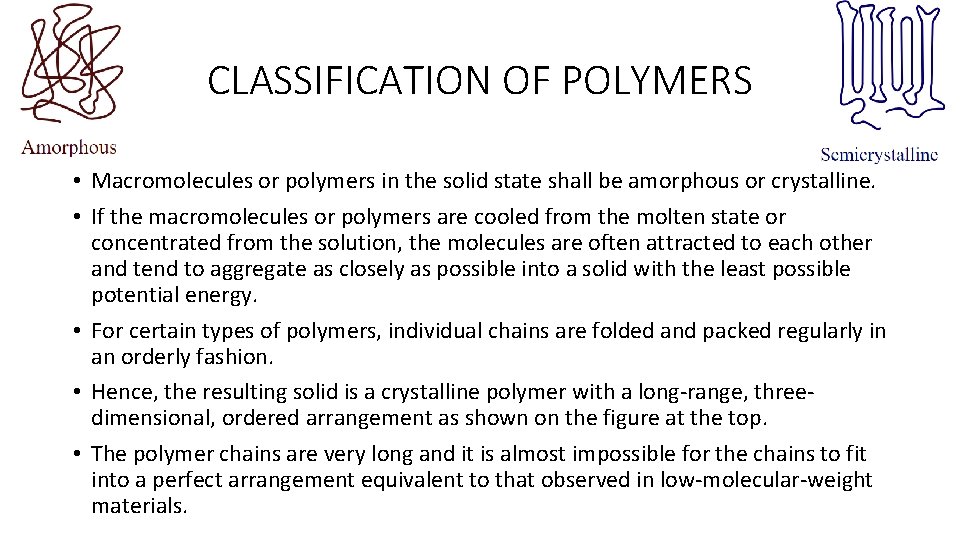
CLASSIFICATION OF POLYMERS • Macromolecules or polymers in the solid state shall be amorphous or crystalline. • If the macromolecules or polymers are cooled from the molten state or concentrated from the solution, the molecules are often attracted to each other and tend to aggregate as closely as possible into a solid with the least possible potential energy. • For certain types of polymers, individual chains are folded and packed regularly in an orderly fashion. • Hence, the resulting solid is a crystalline polymer with a long-range, threedimensional, ordered arrangement as shown on the figure at the top. • The polymer chains are very long and it is almost impossible for the chains to fit into a perfect arrangement equivalent to that observed in low-molecular-weight materials.
References • Robert O. Ebewele, «POLYMER SCIENCE AND TECHNOLOGY» , CRC Press, 2000. • Fried, Joel R. , «Polymer science and technology» , Prentice Hall, Third edition.