
Polymer Processing CHAPTER I INTRODUCTION Introduction What is


- Slides: 11
Polymer Processing
CHAPTER I INTRODUCTION
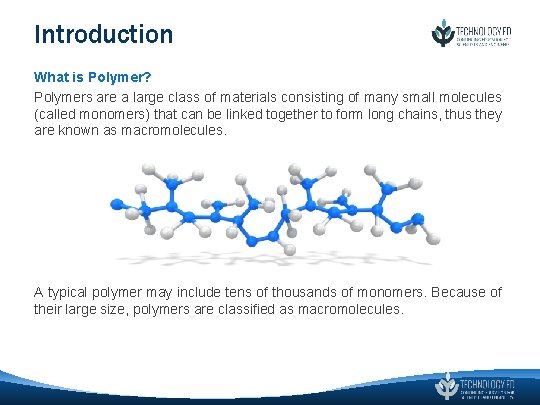
Introduction What is Polymer? Polymers are a large class of materials consisting of many small molecules (called monomers) that can be linked together to form long chains, thus they are known as macromolecules. A typical polymer may include tens of thousands of monomers. Because of their large size, polymers are classified as macromolecules.
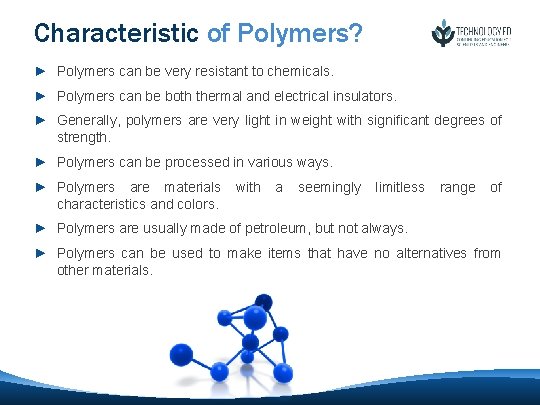
Characteristic of Polymers? ► Polymers can be very resistant to chemicals. ► Polymers can be both thermal and electrical insulators. ► Generally, polymers are very light in weight with significant degrees of strength. ► Polymers can be processed in various ways. ► Polymers are materials with a seemingly limitless range of characteristics and colors. ► Polymers are usually made of petroleum, but not always. ► Polymers can be used to make items that have no alternatives from other materials.
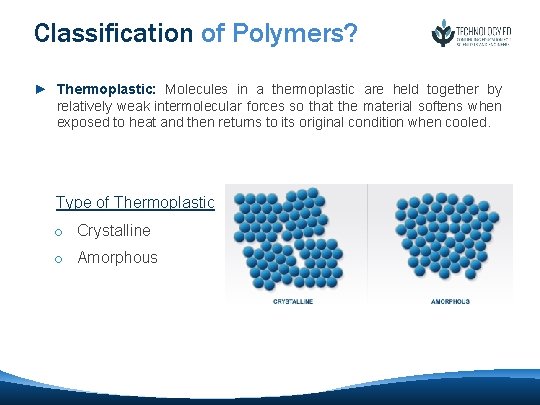
Classification of Polymers? ► Thermoplastic: Molecules in a thermoplastic are held together by relatively weak intermolecular forces so that the material softens when exposed to heat and then returns to its original condition when cooled. Type of Thermoplastic o Crystalline o Amorphous
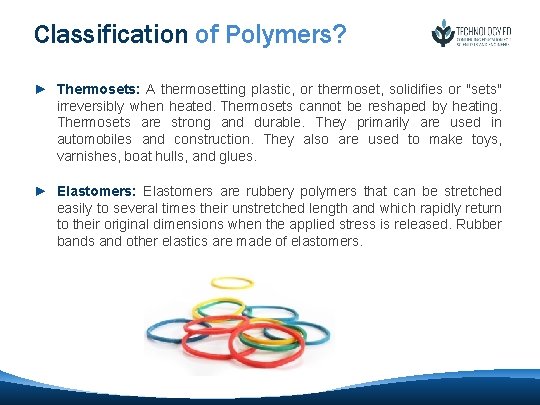
Classification of Polymers? ► Thermosets: A thermosetting plastic, or thermoset, solidifies or "sets" irreversibly when heated. Thermosets cannot be reshaped by heating. Thermosets are strong and durable. They primarily are used in automobiles and construction. They also are used to make toys, varnishes, boat hulls, and glues. ► Elastomers: Elastomers are rubbery polymers that can be stretched easily to several times their unstretched length and which rapidly return to their original dimensions when the applied stress is released. Rubber bands and other elastics are made of elastomers.
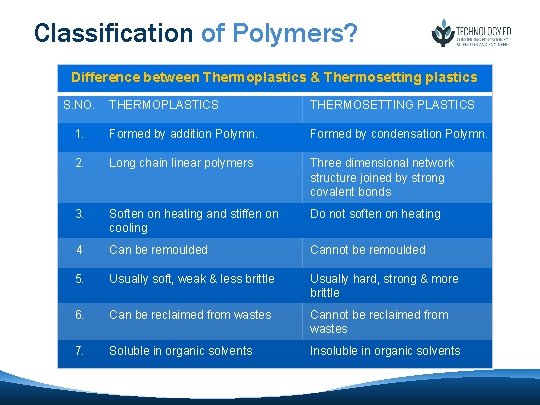
Classification of Polymers? Difference between Thermoplastics & Thermosetting plastics S. NO. THERMOPLASTICS THERMOSETTING PLASTICS 1. Formed by addition Polymn. Formed by condensation Polymn. 2. Long chain linear polymers Three dimensional network structure joined by strong covalent bonds 3. Soften on heating and stiffen on cooling Do not soften on heating 4 Can be remoulded Cannot be remoulded 5. Usually soft, weak & less brittle Usually hard, strong & more brittle 6. Can be reclaimed from wastes Cannot be reclaimed from wastes 7. Soluble in organic solvents Insoluble in organic solvents
Processing Polymers? Basic Description of Some of the tools associated with the processing of polymers. ► Dies - A die is a specialized tool used in manufacturing industries to cut or shape material mostly using a press. Like molds, dies are generally customized to the item they are used to create. ► Extruder - An extruder is a machine used in the processing of polymers. It is used to form metal or plastic with a desired cross section by forcing through a die. ► Screw - The screw is the heart of the extruder. The screw melts the polymer, prepares the homogeneous melt and pumps the melt through the die.
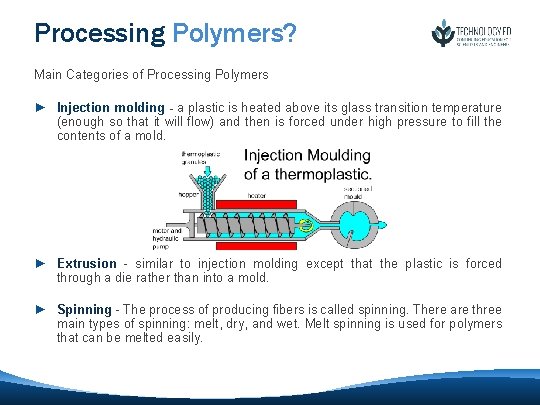
Processing Polymers? Main Categories of Processing Polymers ► Injection molding - a plastic is heated above its glass transition temperature (enough so that it will flow) and then is forced under high pressure to fill the contents of a mold. ► Extrusion - similar to injection molding except that the plastic is forced through a die rather than into a mold. ► Spinning - The process of producing fibers is called spinning. There are three main types of spinning: melt, dry, and wet. Melt spinning is used for polymers that can be melted easily.
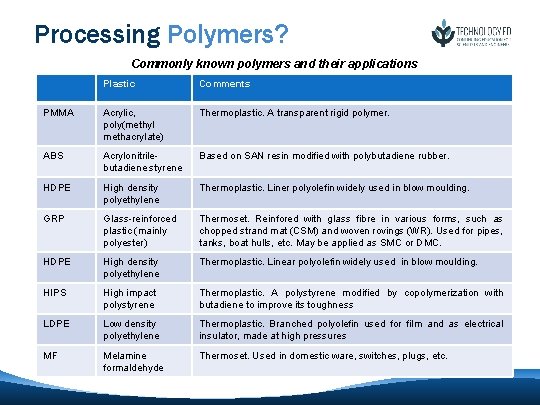
Processing Polymers? Commonly known polymers and their applications Plastic Comments PMMA Acrylic, poly(methyl methacrylate) Thermoplastic. A transparent rigid polymer. ABS Acrylonitrilebutadiene styrene Based on SAN resin modified with polybutadiene rubber. HDPE High density polyethylene Thermoplastic. Liner polyolefin widely used in blow moulding. GRP Glass-reinforced plastic (mainly polyester) Thermoset. Reinfored with glass fibre in various forms, such as chopped strand mat (CSM) and woven rovings (WR). Used for pipes, tanks, boat hulls, etc. May be applied as SMC or DMC. HDPE High density polyethylene Thermoplastic. Linear polyolefin widely used in blow moulding. HIPS High impact polystyrene Thermoplastic. A polystyrene modified by copolymerization with butadiene to improve its toughness LDPE Low density polyethylene Thermoplastic. Branched polyolefin used for film and as electrical insulator, made at high pressures MF Melamine formaldehyde Thermoset. Used in domestic ware, switches, plugs, etc.
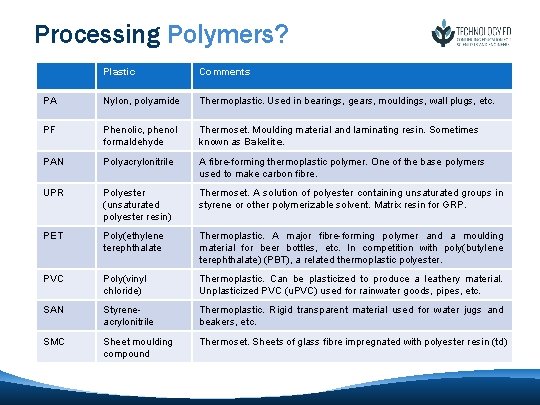
Processing Polymers? Plastic Comments PA Nylon, polyamide Thermoplastic. Used in bearings, gears, mouldings, wall plugs, etc. PF Phenolic, phenol formaldehyde Thermoset. Moulding material and laminating resin. Sometimes known as Bakelite. PAN Polyacrylonitrile A fibre-forming thermoplastic polymer. One of the base polymers used to make carbon fibre. UPR Polyester (unsaturated polyester resin) Thermoset. A solution of polyester containing unsaturated groups in styrene or other polymerizable solvent. Matrix resin for GRP. PET Poly(ethylene terephthalate Thermoplastic. A major fibre-forming polymer and a moulding material for beer bottles, etc. In competition with poly(butylene terephthalate) (PBT), a related thermoplastic polyester. PVC Poly(vinyl chloride) Thermoplastic. Can be plasticized to produce a leathery material. Unplasticized PVC (u. PVC) used for rainwater goods, pipes, etc. SAN Styreneacrylonitrile Thermoplastic. Rigid transparent material used for water jugs and beakers, etc. SMC Sheet moulding compound Thermoset. Sheets of glass fibre impregnated with polyester resin (td)