
Polymer Characterization I NMR FTIR DSC and XRay

- Slides: 24
Polymer Characterization (I): NMR, FTIR, DSC and X-Ray Analyses Polymer Characterization (I) NMR, DSC and X-Ray Analyses Adviser:Professor Feng-Chih Chang (張豐志 教授) Reporter: Chih-Chia Cheng (鄭智嘉 博士班學生) 1 Chang’s group, Polymer Research Centerof , Institute Applied Chemistry Institute Appliedof. Chemistry at NCTU
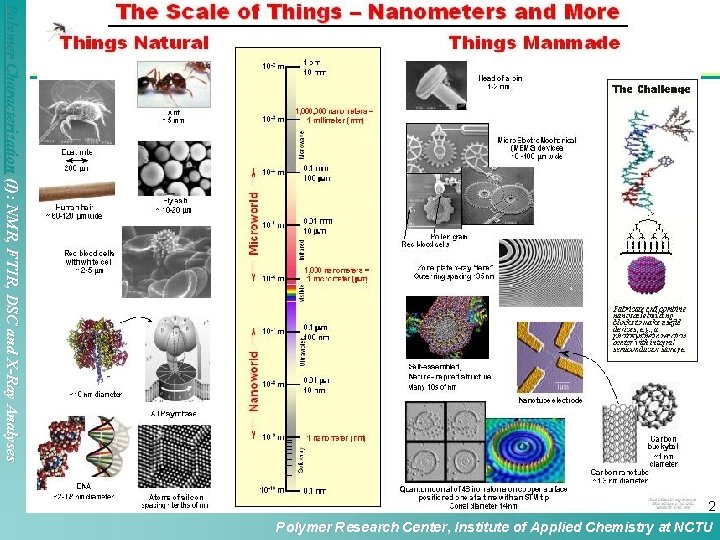
Polymer Characterization (I): NMR, FTIR, DSC and X-Ray Analyses Outline 2 Polymer Research Center, Institute of Applied Chemistry at NCTU
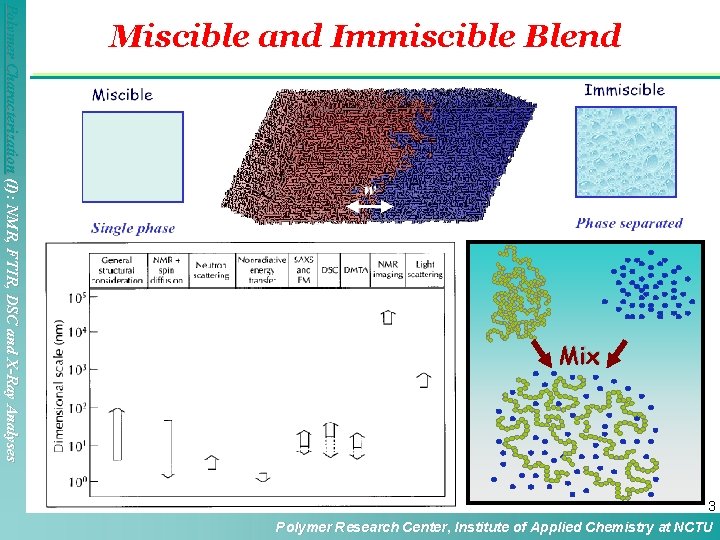
Polymer Characterization (I): NMR, FTIR, DSC and X-Ray Analyses Miscible and Immiscible Blend Mix 3 Polymer Research Center, Institute of Applied Chemistry at NCTU
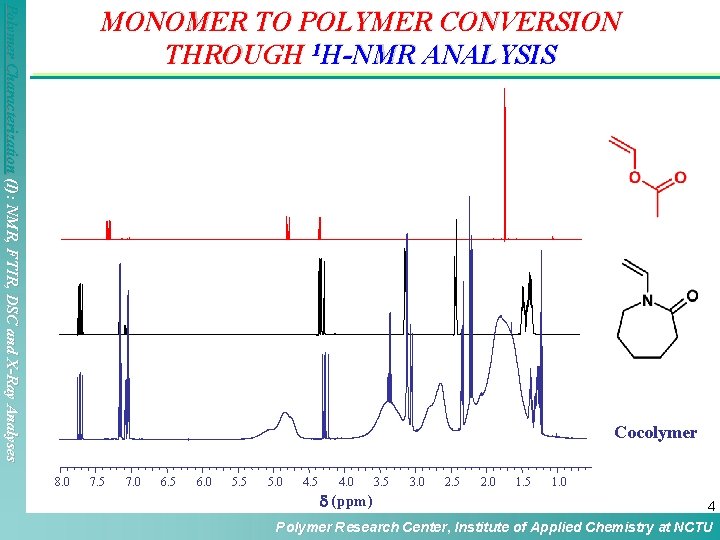
Polymer Characterization (I): NMR, FTIR, DSC and X-Ray Analyses MONOMER TO POLYMER CONVERSION THROUGH 1 H-NMR ANALYSIS Cocolymer 8. 0 7. 5 7. 0 6. 5 6. 0 5. 5 5. 0 4. 5 4. 0 (ppm) 3. 5 3. 0 2. 5 2. 0 1. 5 1. 0 4 Polymer Research Center, Institute of Applied Chemistry at NCTU
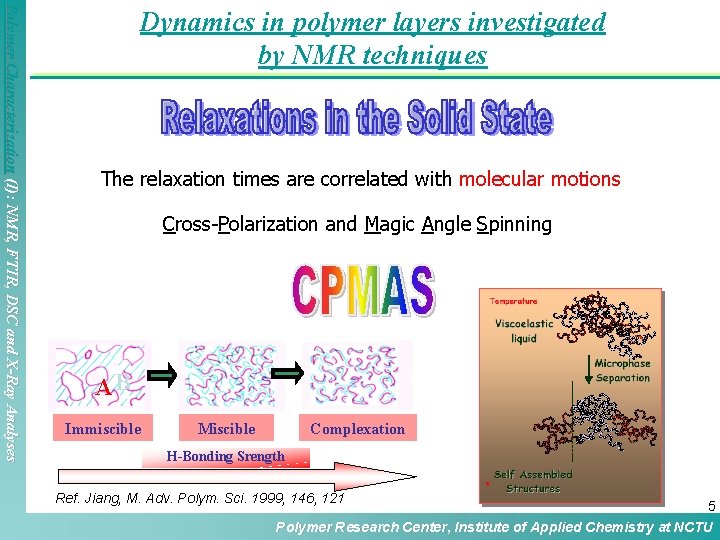
Polymer Characterization (I): NMR, FTIR, DSC and X-Ray Analyses Dynamics in polymer layers investigated by NMR techniques The relaxation times are correlated with molecular motions Cross-Polarization and Magic Angle Spinning AB Immiscible Miscible Complexation H-Bonding Srength Ref. Jiang, M. Adv. Polym. Sci. 1999, 146, 121 5 Polymer Research Center, Institute of Applied Chemistry at NCTU
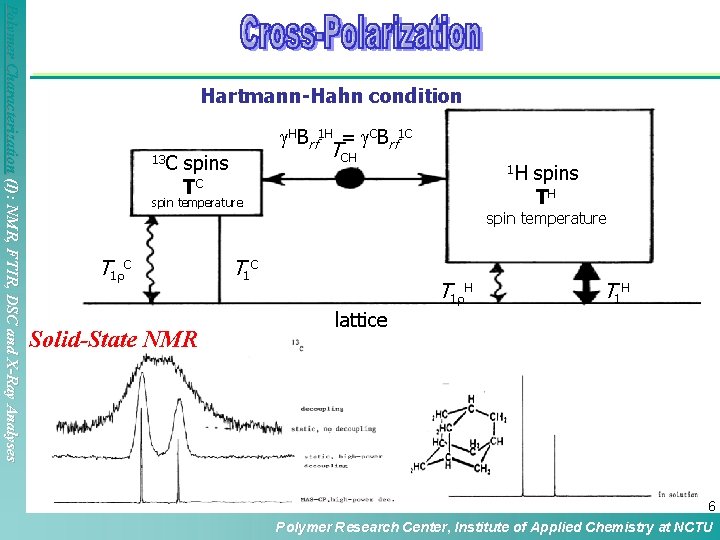
Polymer Characterization (I): NMR, FTIR, DSC and X-Ray Analyses Hartmann-Hahn condition 13 C HBrf 1 H = CBrf 1 C TCH spins TC 1 H spin temperature T 1 C Solid-State NMR spins TH spin temperature T 1 C T 1 H lattice 6 Polymer Research Center, Institute of Applied Chemistry at NCTU
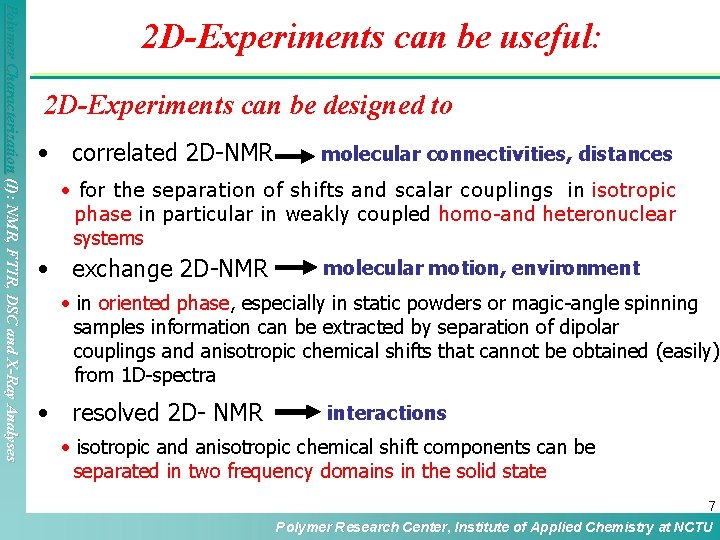
Polymer Characterization (I): NMR, FTIR, DSC and X-Ray Analyses 2 D-Experiments can be useful: 2 D-Experiments can be designed to • correlated 2 D-NMR molecular connectivities, distances • for the separation of shifts and scalar couplings in isotropic phase in particular in weakly coupled homo-and heteronuclear systems molecular motion, environment • exchange 2 D-NMR • in oriented phase, especially in static powders or magic-angle spinning samples information can be extracted by separation of dipolar couplings and anisotropic chemical shifts that cannot be obtained (easily) from 1 D-spectra • resolved 2 D- NMR interactions • isotropic and anisotropic chemical shift components can be separated in two frequency domains in the solid state 7 Polymer Research Center, Institute of Applied Chemistry at NCTU
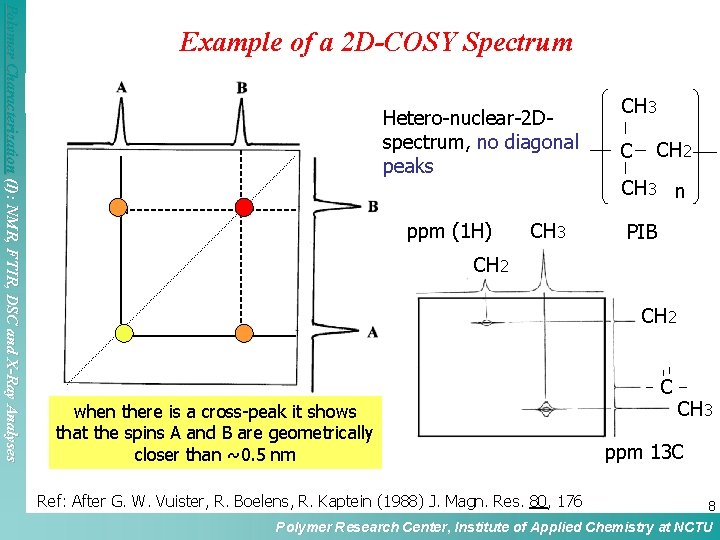
Polymer Characterization (I): NMR, FTIR, DSC and X-Ray Analyses Example of a 2 D-COSY Spectrum Hetero-nuclear-2 Dspectrum, no diagonal peaks ppm (1 H) CH 3 C CH 2 CH 3 n PIB CH 2 C when there is a cross-peak it shows that the spins A and B are geometrically closer than ~0. 5 nm Ref: After G. W. Vuister, R. Boelens, R. Kaptein (1988) J. Magn. Res. 80, 176 CH 3 ppm 13 C 8 Polymer Research Center, Institute of Applied Chemistry at NCTU
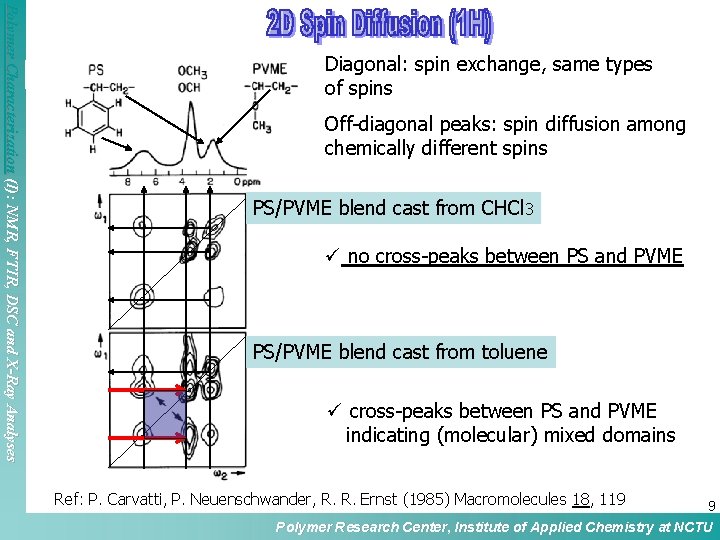
Polymer Characterization (I): NMR, FTIR, DSC and X-Ray Analyses Diagonal: spin exchange, same types of spins Off-diagonal peaks: spin diffusion among chemically different spins PS/PVME blend cast from CHCl 3 ü no cross-peaks between PS and PVME PS/PVME blend cast from toluene ü cross-peaks between PS and PVME indicating (molecular) mixed domains Ref: P. Carvatti, P. Neuenschwander, R. R. Ernst (1985) Macromolecules 18, 119 9 Polymer Research Center, Institute of Applied Chemistry at NCTU
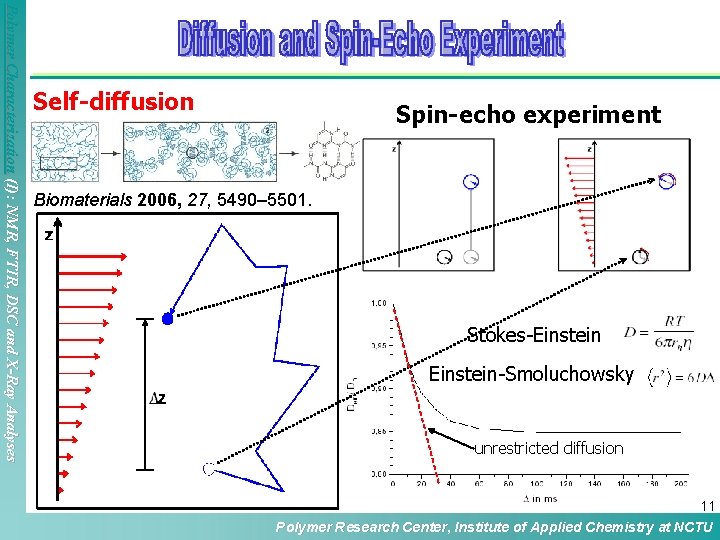
Polymer Characterization (I): NMR, FTIR, DSC and X-Ray Analyses Self-diffusion Spin-echo experiment Biomaterials 2006, 27, 5490– 5501. Stokes-Einstein-Smoluchowsky unrestricted diffusion 11 Polymer Research Center, Institute of Applied Chemistry at NCTU
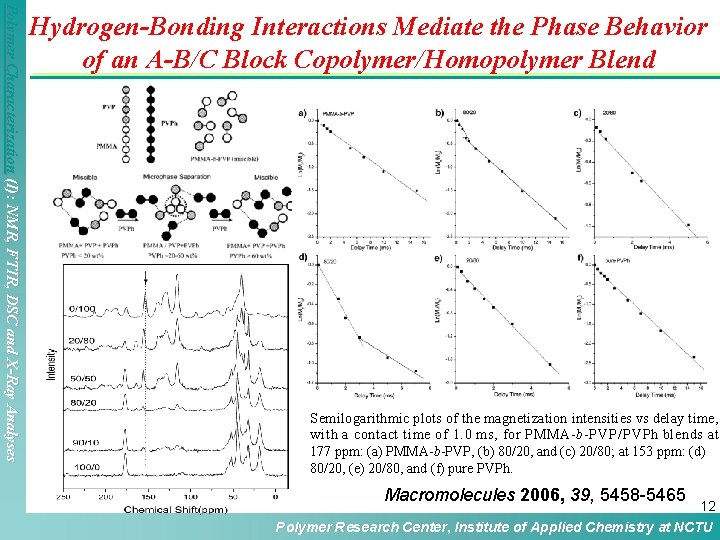
Polymer Characterization (I): NMR, FTIR, DSC and X-Ray Analyses Hydrogen-Bonding Interactions Mediate the Phase Behavior of an A-B/C Block Copolymer/Homopolymer Blend Semilogarithmic plots of the magnetization intensities vs delay time, with a contact time of 1. 0 ms, for PMMA-b-PVP/PVPh blends at 177 ppm: (a) PMMA-b-PVP, (b) 80/20, and (c) 20/80; at 153 ppm: (d) 80/20, (e) 20/80, and (f) pure PVPh. Macromolecules 2006, 39, 5458 -5465 12 Polymer Research Center, Institute of Applied Chemistry at NCTU
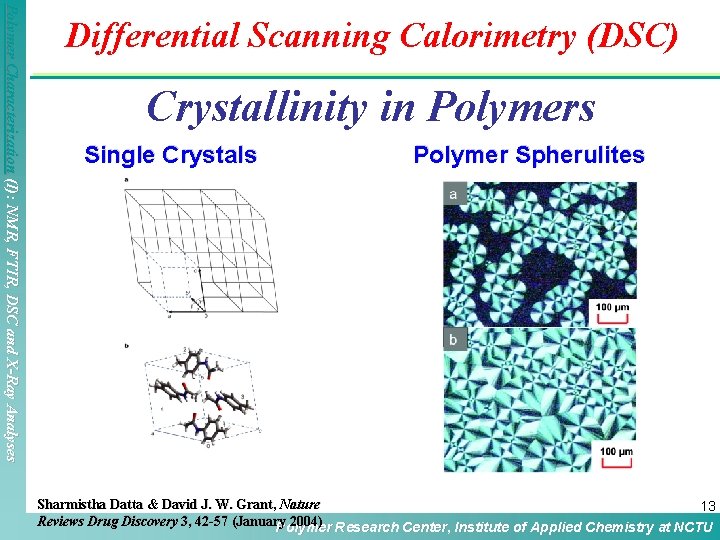
Polymer Characterization (I): NMR, FTIR, DSC and X-Ray Analyses Differential Scanning Calorimetry (DSC) Crystallinity in Polymers Single Crystals Polymer Spherulites Sharmistha Datta & David J. W. Grant, Nature 13 Reviews Drug Discovery 3, 42 -57 (January 2004) Research Center, Institute of Applied Chemistry at NCTU Polymer
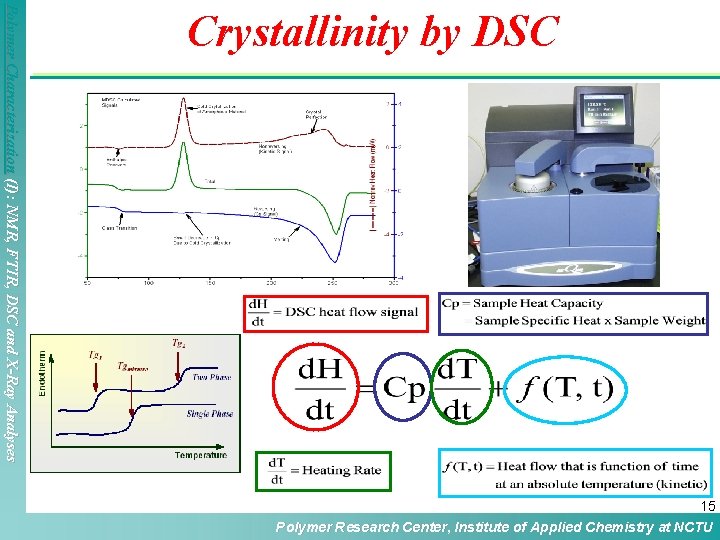
Polymer Characterization (I): NMR, FTIR, DSC and X-Ray Analyses Crystallinity by DSC 15 Polymer Research Center, Institute of Applied Chemistry at NCTU
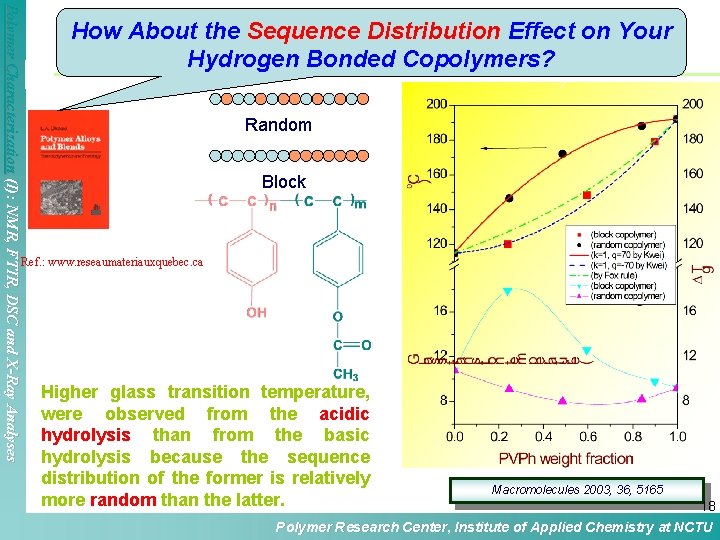
Polymer Characterization (I): NMR, FTIR, DSC and X-Ray Analyses How About the Sequence Distribution Effect on Your Hydrogen Bonded Copolymers? Random Block Ref. : www. reseaumateriauxquebec. ca Higher glass transition temperature, were observed from the acidic hydrolysis than from the basic hydrolysis because the sequence distribution of the former is relatively more random than the latter. Macromolecules 2003, 36, 5165 18 Polymer Research Center, Institute of Applied Chemistry at NCTU
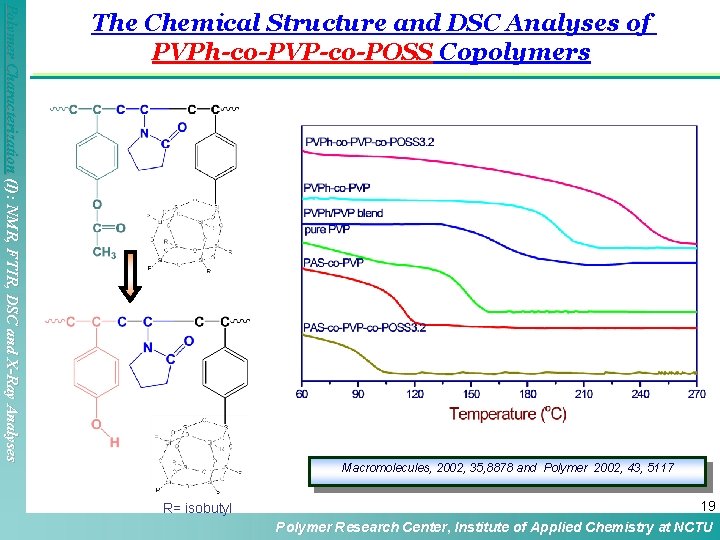
Polymer Characterization (I): NMR, FTIR, DSC and X-Ray Analyses The Chemical Structure and DSC Analyses of PVPh-co-PVP-co-POSS Copolymers Macromolecules, 2002, 35, 8878 and Polymer 2002, 43, 5117 R= isobutyl 19 Polymer Research Center, Institute of Applied Chemistry at NCTU
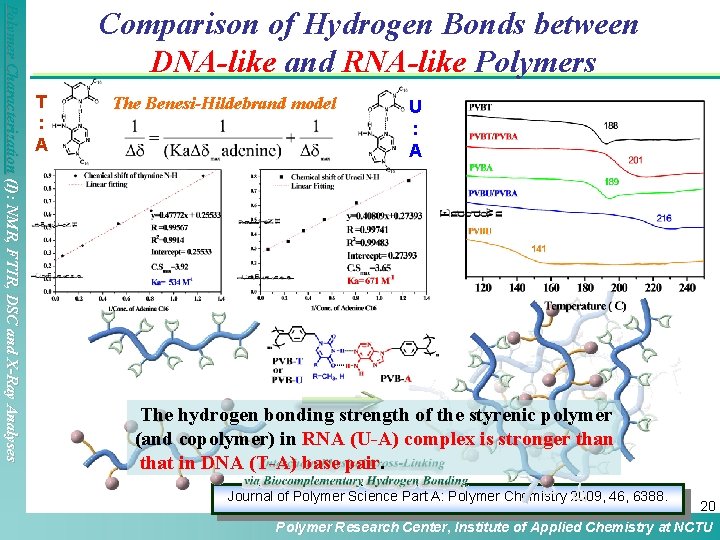
Polymer Characterization (I): NMR, FTIR, DSC and X-Ray Analyses Comparison of Hydrogen Bonds between DNA-like and RNA-like Polymers T : A The Benesi-Hildebrand model U : A The hydrogen bonding strength of the styrenic polymer (and copolymer) in RNA (U-A) complex is stronger than that in DNA (T-A) base pair. Journal of Polymer Science Part A: Polymer Chemistry 2009, 46, 6388. 20 Polymer Research Center, Institute of Applied Chemistry at NCTU
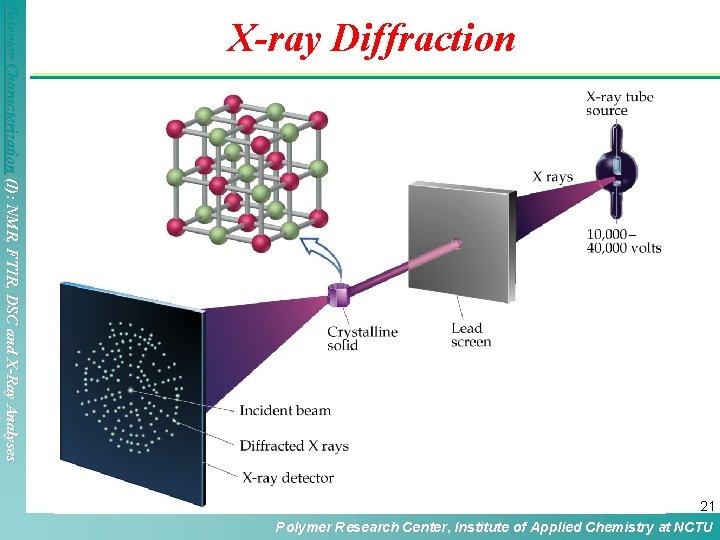
Polymer Characterization (I): NMR, FTIR, DSC and X-Ray Analyses X-ray Diffraction 21 Polymer Research Center, Institute of Applied Chemistry at NCTU
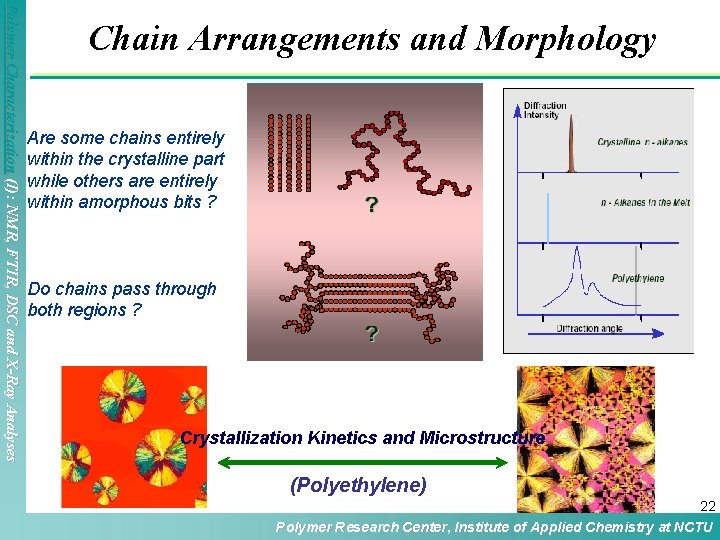
Polymer Characterization (I): NMR, FTIR, DSC and X-Ray Analyses Chain Arrangements and Morphology Are some chains entirely within the crystalline part while others are entirely within amorphous bits ? Do chains pass through both regions ? Crystallization Kinetics and Microstructure (Polyethylene) 22 Polymer Research Center, Institute of Applied Chemistry at NCTU
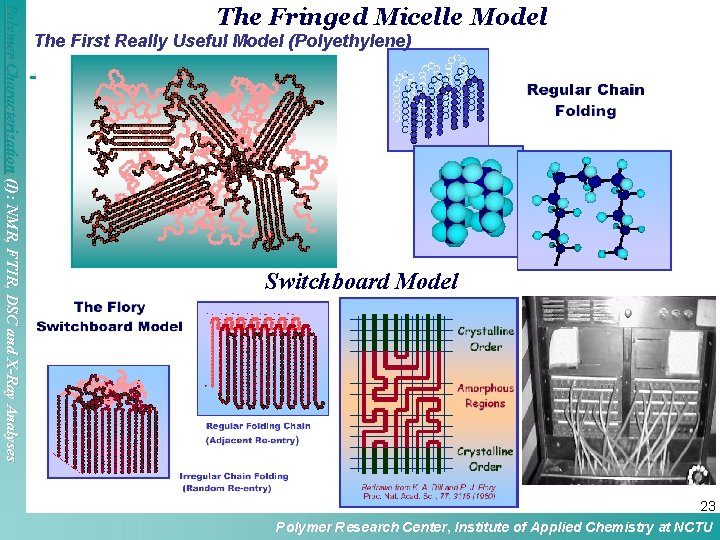
Polymer Characterization (I): NMR, FTIR, DSC and X-Ray Analyses The Fringed Micelle Model The First Really Useful Model (Polyethylene) Switchboard Model 23 Polymer Research Center, Institute of Applied Chemistry at NCTU
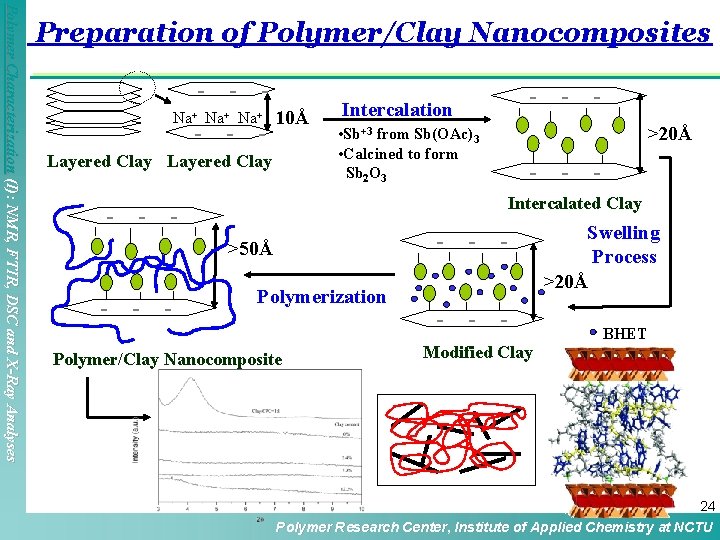
Polymer Characterization (I): NMR, FTIR, DSC and X-Ray Analyses Preparation of Polymer/Clay Nanocomposites Na+ - 10Å Layered Clay - - - - Intercalated Clay - - - >20Å • Sb+3 from Sb(OAc)3 • Calcined to form Sb 2 O 3 >50Å - - Intercalation Polymerization Polymer/Clay Nanocomposite - - - Swelling Process >20Å BHET Modified Clay 24 Polymer Research Center, Institute of Applied Chemistry at NCTU
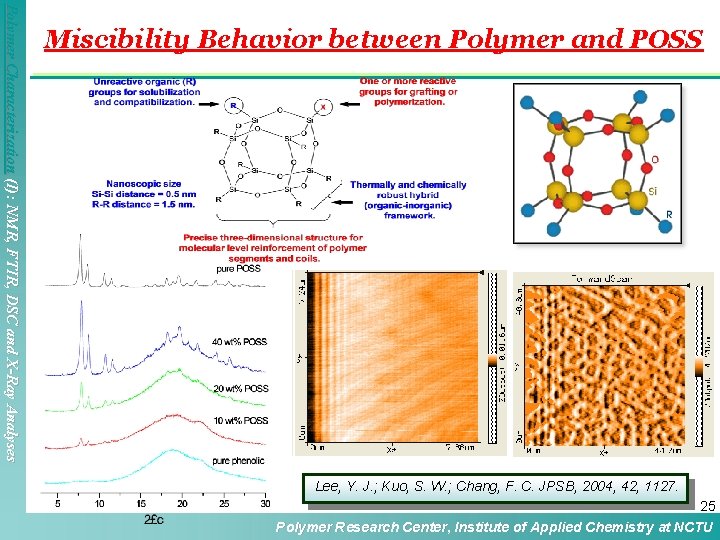
Polymer Characterization (I): NMR, FTIR, DSC and X-Ray Analyses Miscibility Behavior between Polymer and POSS Lee, Y. J. ; Kuo, S. W. ; Chang, F. C. JPSB, 2004, 42, 1127. 25 Polymer Research Center, Institute of Applied Chemistry at NCTU
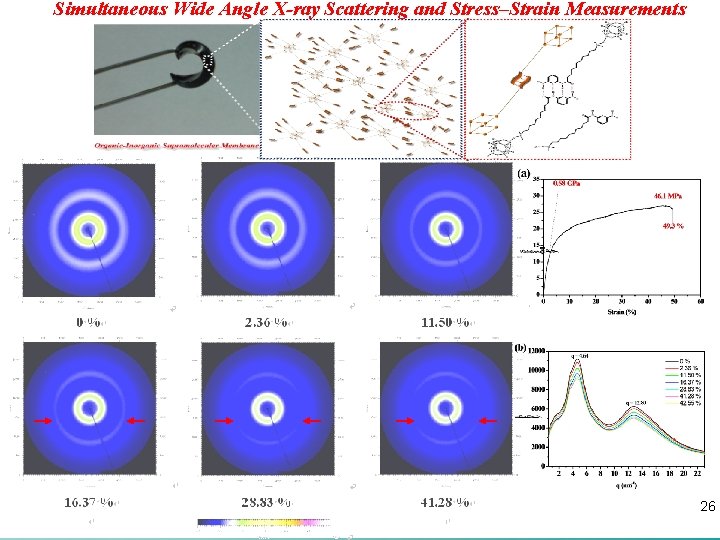
Polymer Characterization (I): NMR, FTIR, DSC and X-Ray Analyses Simultaneous Wide Angle X-ray Scattering and Stress–Strain Measurements 26 Polymer Research Center, Institute of Applied Chemistry at NCTU
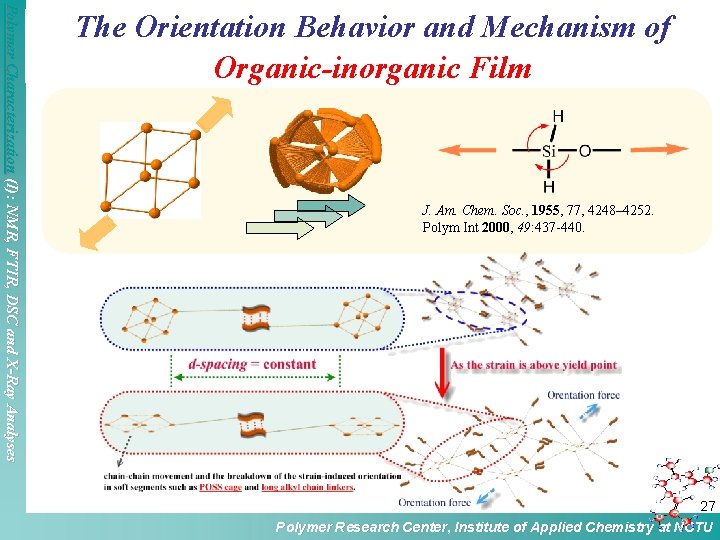
Polymer Characterization (I): NMR, FTIR, DSC and X-Ray Analyses The Orientation Behavior and Mechanism of Organic-inorganic Film J. Am. Chem. Soc. , 1955, 77, 4248– 4252. Polym Int 2000, 49: 437 -440. 27 Polymer Research Center, Institute of Applied Chemistry at NCTU
Polymer Characterization (I): NMR, FTIR, DSC and X-Ray Analyses Thanks for your attention ! I shall be interested in receiving your comments. The end 2009. 11. 16 Special Topic on Supramolecular Engineering 28 Institute of Applied Chemistry at NCTU Polymer Research Center, Institute of Applied Chemistry at NCTU