
POLYHYDRA MNIOS AMNIOTIC FLUID 1 2 3 4







- Slides: 32
POLYHYDRA MNIOS
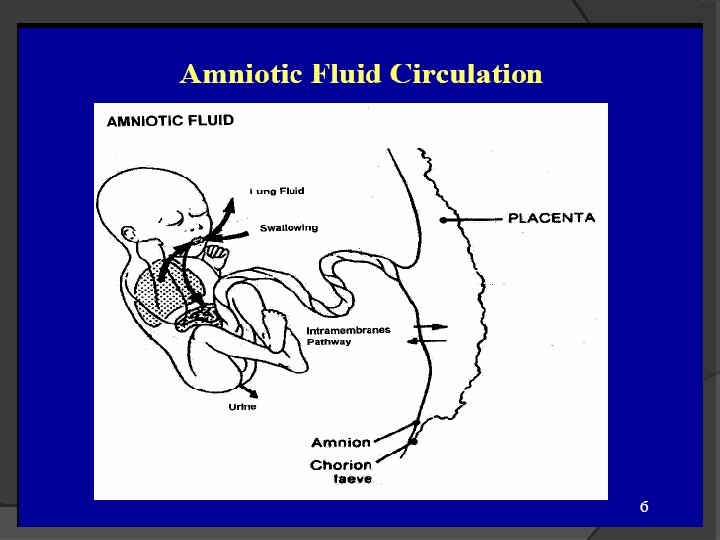
AMNIOTIC FLUID 1. 2. 3. 4. ORIGIN- Precise origin is still unsolved Probably of maternal and fetal origin Speculative theories; TRANSUDATE FROM MATERNAL SERUM across fetal membrane or maternal circulation in placenta TRANSUDATE ACROSS THE UMBILICAL CORD or from fetal circulation in placenta or secretion from the amniotic epithelium TRANSUDATE OF FETAL PLASMA through fetal skin before keratinised at 20 th week CONTRIBUTION FROM FETUS
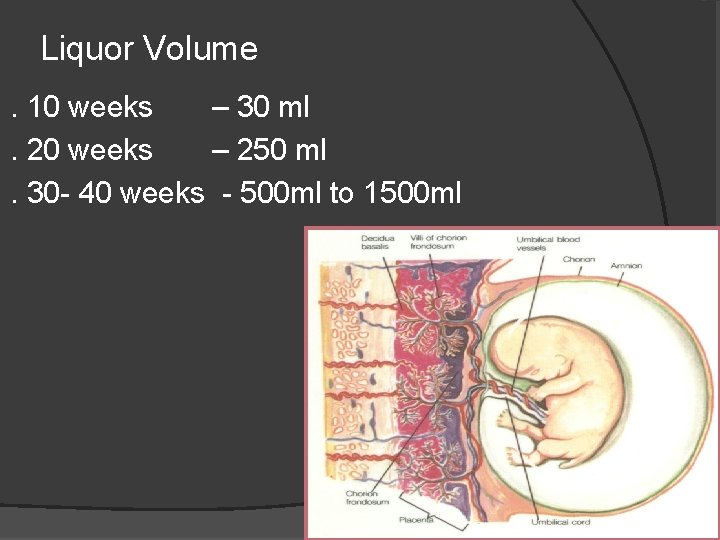
Liquor Volume. 10 weeks – 30 ml. 20 weeks – 250 ml. 30 - 40 weeks - 500 ml to 1500 ml
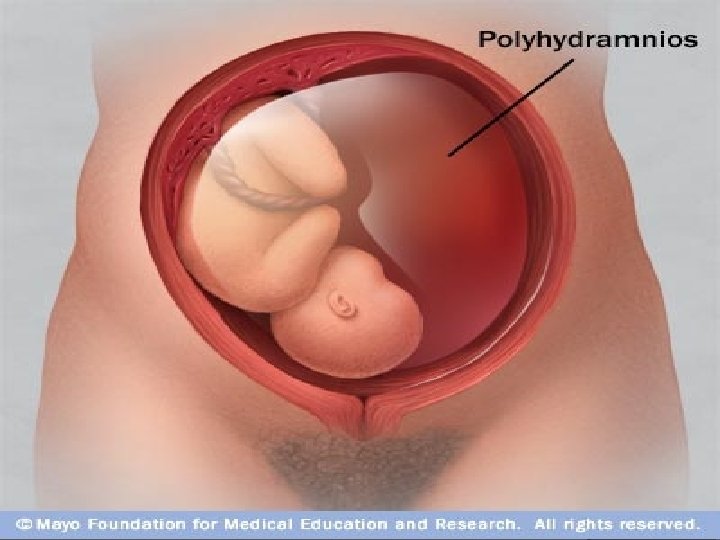
DEFINITION ANATOMICALLY Polyhydramnios is defined as a state where liquor amnii exceeds 2000 ml q DIAGNOSTICALLY when A. F. I. is more than 24 -25 cm or a single pocket of amniotic fluid is greater than 8 cm by ultrasonography. q CLINICALLY the excessive accumulation of liquor amnii causing discomfort to the patient and or when an imaging help is needed to substantiate the clinical diagnosis of the lie and presentation of the fetus. q -D C Dutta
INCIDENCE ü 1% to 2 % of the cases ü More common in multiparae than primi ü Minor degrees are fairly common ü Clinical symptoms probably occurs in 1000 pregnancies
CAUSES Maternal (15%) Rh iso-immunization GDM Placental (less than 1%) Placental chorioangioma Circumvallate placental syndrome Fetal (18% -20%) Multiple pregnancies Fetal anomalies Idiopathic (65%)
CAUSES I. q ü ü ü q q ü ü FETAL ANOMALIES (20%): ANECEPHALY (50%) Transudation from exposed meninges Absence of fetal swallowing reflex Suppression of fetal ADH leading >urination OPEN SPINA BIFIDA OESOPHAGEAL OR DUODENAL ATRESIA(15%) FACIAL CLEFTS AND NECK MASSES HYDROPS FETALIS Cardiothoracic anomalies Fetal cirrhosis
CAUSES……Contd II. Placenta ü Chorioangioma- tumor growing from single villus with increased hyperplasia of blood vessels
CAUSES……. Contd III. MULTIPLE PREGNANCY (10%) - Uniovular twins- second sac - Twin to twin transfusion syndrome.
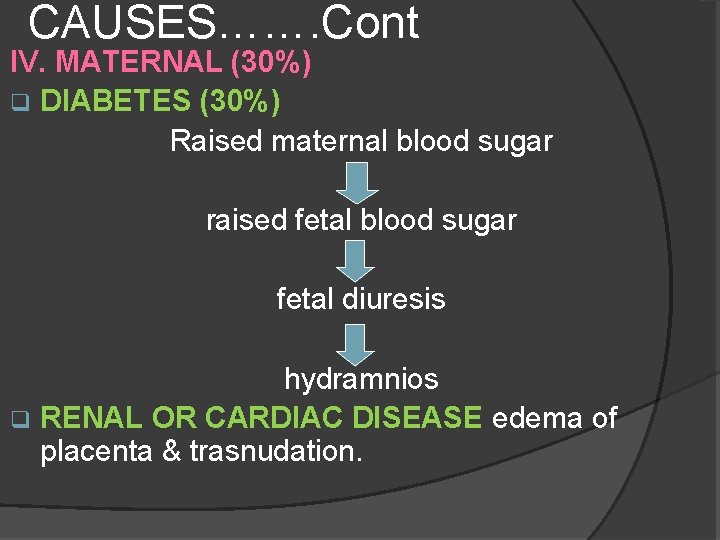
CAUSES……. Cont IV. MATERNAL (30%) q DIABETES (30%) Raised maternal blood sugar raised fetal blood sugar fetal diuresis hydramnios q RENAL OR CARDIAC DISEASE edema of placenta & trasnudation.
CLINICAL TYPES Depending on the rapidity of onset hydramnios can be A. ACUTE ü Sudden onset ü Appear in few days ü Appear acutely on pre-existing chronic type B. CHRONIC ü Onset insidious ü Taking few weeks
CHRONIC POLYHYDRAMNIOS
CLINICAL FEATURES SYMPTOMS ü RESPIRATORY Dysponea PALPATION ü Oedema of legs ü Varicosities in the legs or vulva ü Haemorrhoids
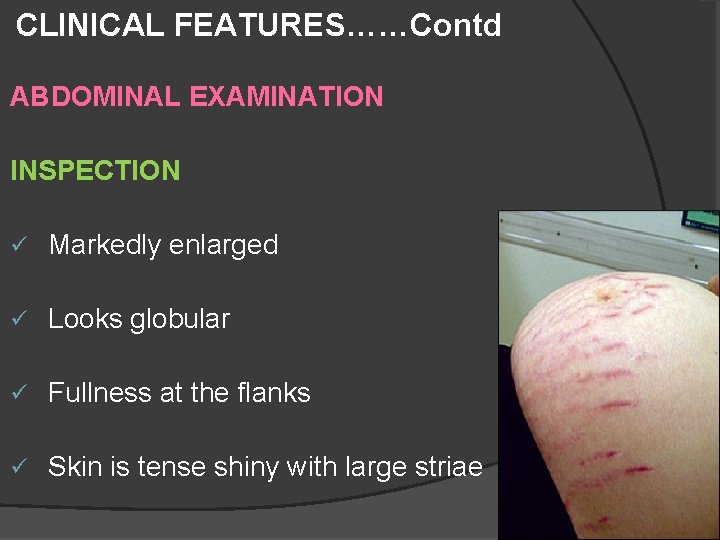
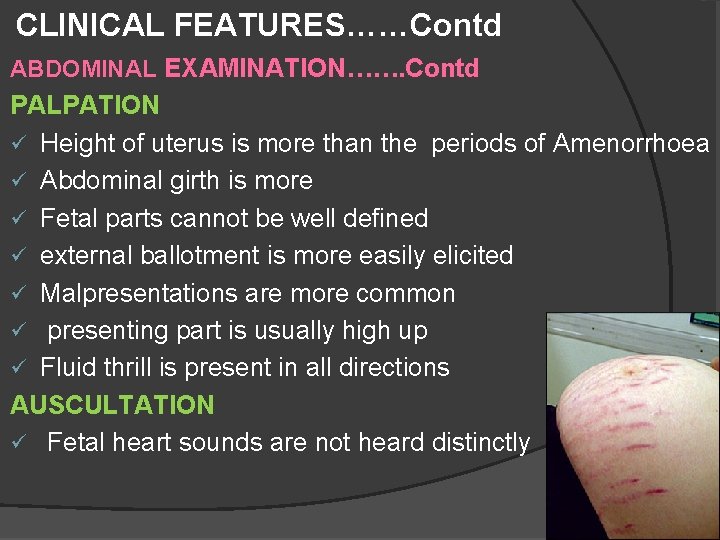
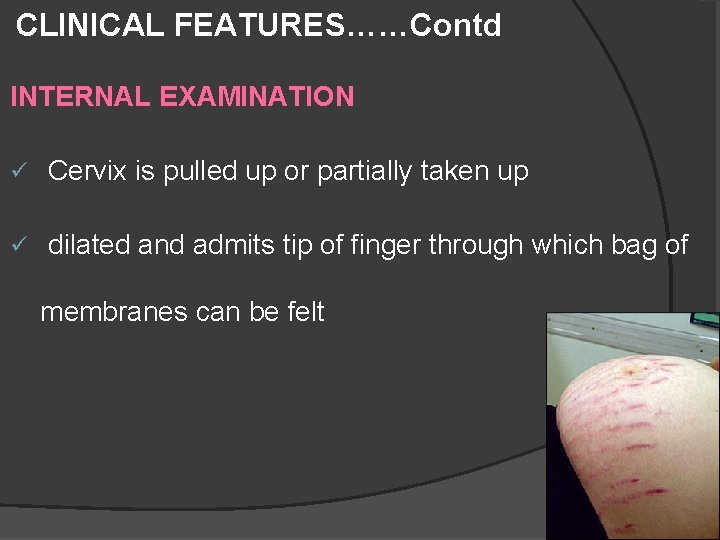
CLINICAL FEATURES……Contd ABDOMINAL EXAMINATION INSPECTION ü Markedly enlarged ü Looks globular ü Fullness at the flanks ü Skin is tense shiny with large striae
CLINICAL FEATURES……Contd ABDOMINAL EXAMINATION……. Contd PALPATION ü Height of uterus is more than the periods of Amenorrhoea ü Abdominal girth is more ü Fetal parts cannot be well defined ü external ballotment is more easily elicited ü Malpresentations are more common ü presenting part is usually high up ü Fluid thrill is present in all directions AUSCULTATION ü Fetal heart sounds are not heard distinctly
CLINICAL FEATURES……Contd INTERNAL EXAMINATION ü Cervix is pulled up or partially taken up ü dilated and admits tip of finger through which bag of membranes can be felt
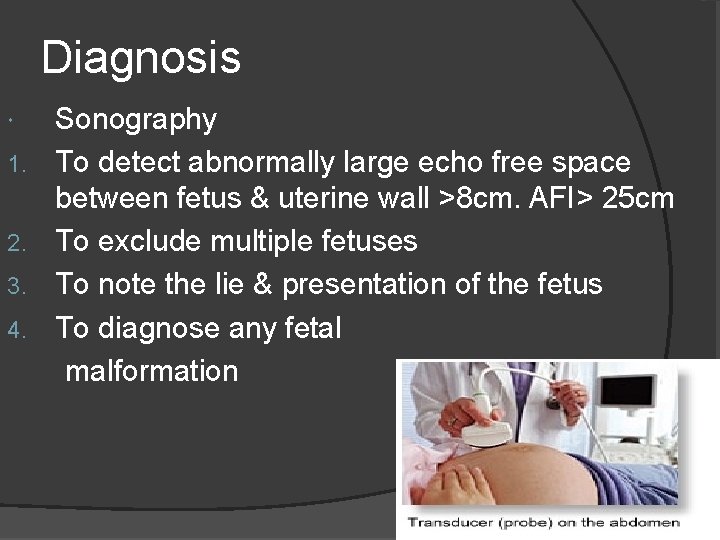
Diagnosis 1. 2. 3. 4. Sonography To detect abnormally large echo free space between fetus & uterine wall >8 cm. AFI> 25 cm To exclude multiple fetuses To note the lie & presentation of the fetus To diagnose any fetal malformation
Cont… Radiolography- not common Blood- 1. ABO & Rh grouping 2. Post prandial sugar & GTT Amniotic fluid- Estimation of alpha feto protein, neural tube defect Differential diagnosis: 1. Twins 2. Pregnancy with huge ovarian cyst 3. Maternal ascites
COMPLICATIONS: Maternal- During pregnancy; 1. pre-eclampsia(25%) 2. Malpresentation 3. Premature rupture of membranes 4. Preterm labour 5. Accidental haemorrhage During labour; 1. Early rupture of membrane 2. Cord prolapse 3. Uterine inertia A.
Cont… 4. Increased operative delivery 5. Retained placenta 6. PPH 7. Shock During puerperium; 1. Subinvolution 2. Increased puerperial morbidity FETAL: Increased perinatal mortality(50%) Death mostly due to prematurity(20%)
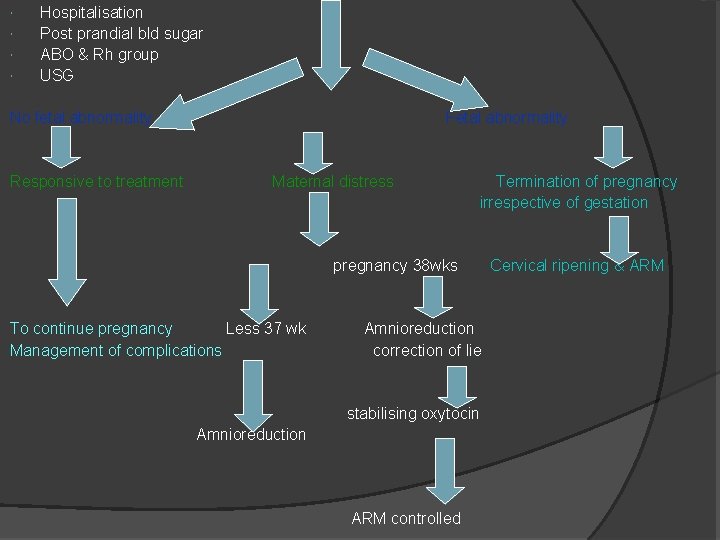
MANAGEMENT o Principles To relieve the symptoms o To find out the causes o To avoid and to deal with the comlication o
General mangement Supportive theraphy ü Bed rest with back rest ü Analgesics when ever required in presence of GDM or PIH ü Diuretics ü Indomethacin orally 25 mg every 6 hourly (to decrease amniotic fluid) q Investigations to rule out complications q Actual management- response to treatment - period of gestation -presence of fetal malformation - associated complications q
Hospitalisation Post prandial bld sugar ABO & Rh group USG No fetal abnormality Responsive to treatment Fetal abnormality Maternal distress Termination of pregnancy irrespective of gestation pregnancy 38 wks To continue pregnancy Less 37 wk Management of complications Amnioreduction correction of lie stabilising oxytocin Amnioreduction ARM controlled Cervical ripening & ARM
Acute Polyhydramnios
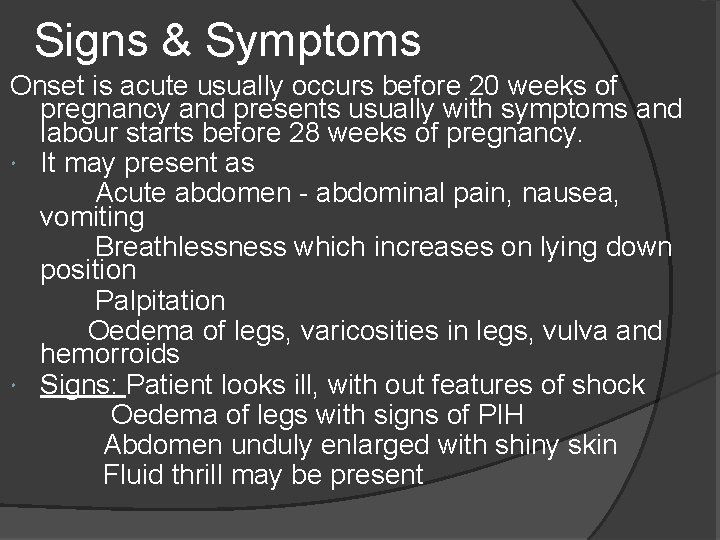
Signs & Symptoms Onset is acute usually occurs before 20 weeks of pregnancy and presents usually with symptoms and labour starts before 28 weeks of pregnancy. It may present as Acute abdomen - abdominal pain, nausea, vomiting Breathlessness which increases on lying down position Palpitation Oedema of legs, varicosities in legs, vulva and hemorroids Signs: Patient looks ill, with out features of shock Oedema of legs with signs of PIH Abdomen unduly enlarged with shiny skin Fluid thrill may be present
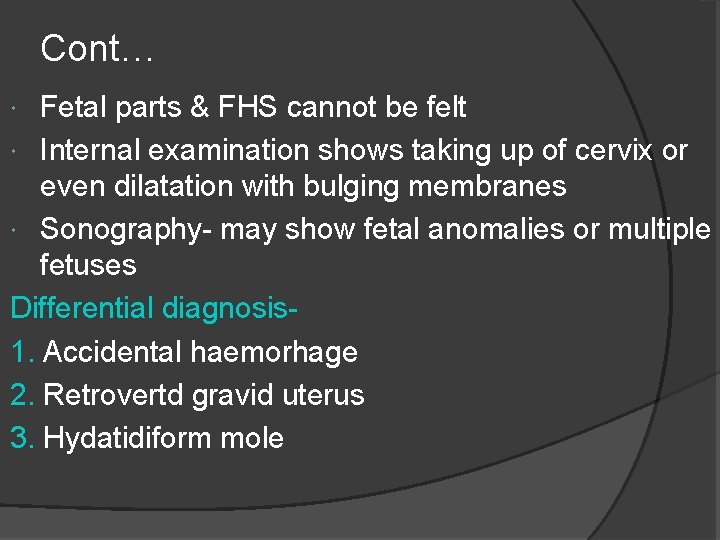
Cont… Fetal parts & FHS cannot be felt Internal examination shows taking up of cervix or even dilatation with bulging membranes Sonography- may show fetal anomalies or multiple fetuses Differential diagnosis 1. Accidental haemorhage 2. Retrovertd gravid uterus 3. Hydatidiform mole
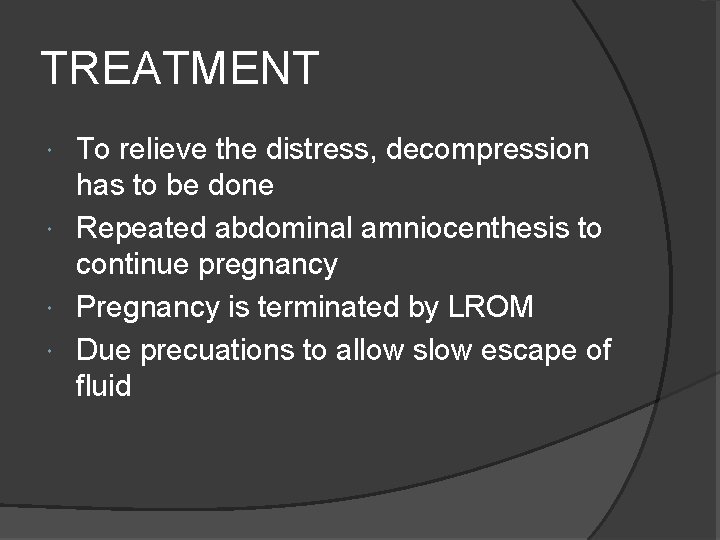
TREATMENT To relieve the distress, decompression has to be done Repeated abdominal amniocenthesis to continue pregnancy Pregnancy is terminated by LROM Due precuations to allow slow escape of fluid
PROGNOSIS Major fetal congenital malformation occurs in 20% v Incidence of prematurity twice more than normal rate v Prolapse of the cord may occur when membrane rupture so increase the operative v Placental abruption due rapid decompression of uterus when membranes rupture result in increased mortality & morbidity v Pregnancy complicated with GDM consequent risk for fetus v