
Polygraph MR Enhancing the Reliability and Dependability of
Polygraph. MR: Enhancing the Reliability and Dependability of CNNs Salar Latifi, Babak Zamirai, Scott Mahlke University of Michigan
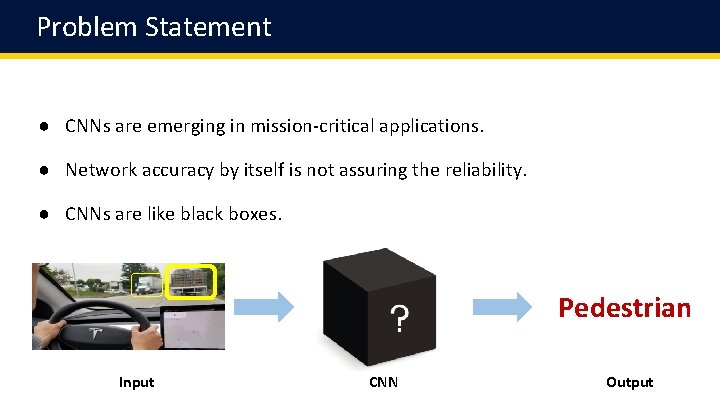
Problem Statement ● CNNs are emerging in mission-critical applications. ● Network accuracy by itself is not assuring the reliability. ● CNNs are like black boxes. Pedestrian Truck Input CNN Output
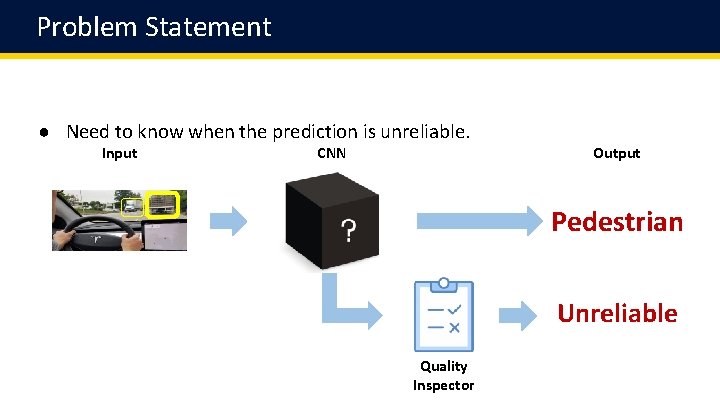
Problem Statement ● Need to know when the prediction is unreliable. Input CNN Output Pedestrian Truck Unreliable Reliable Quality Inspector
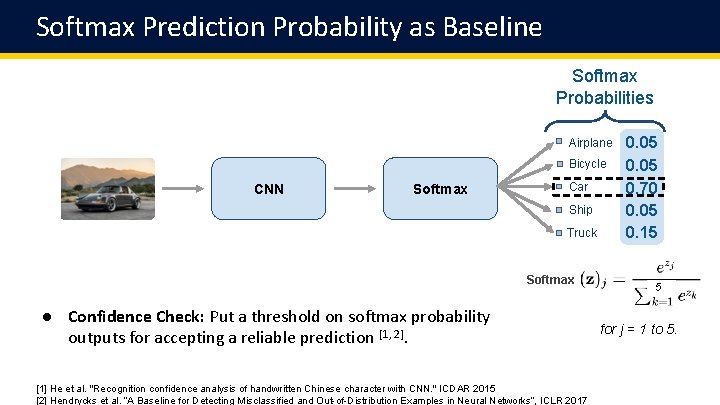
Softmax Prediction Probability as Baseline Softmax Probabilities Airplane Bicycle CNN Softmax Car Ship Truck Softmax ● Confidence Check: Put a threshold on softmax probability outputs for accepting a reliable prediction [1, 2]. [1] He et al. "Recognition confidence analysis of handwritten Chinese character with CNN. " ICDAR 2015 [2] Hendrycks et al. “A Baseline for Detecting Misclassified and Out-of-Distribution Examples in Neural Networks”, ICLR 2017 0. 05 0. 70 0. 05 0. 15 5 for j = 1 to 5.
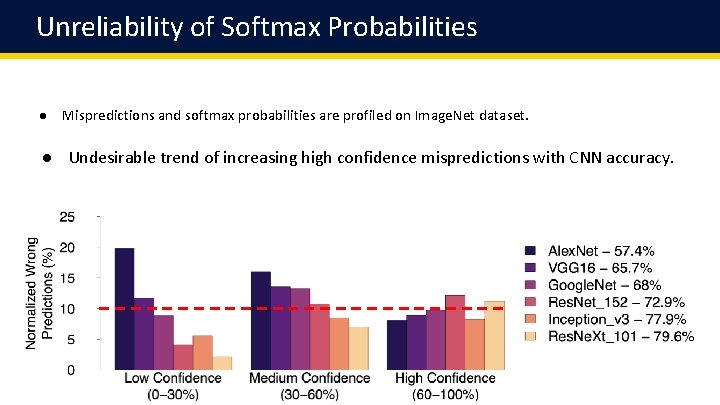
Unreliability of Softmax Probabilities ● Mispredictions and softmax probabilities are profiled on Image. Net dataset. ● Undesirable trend of increasing high confidence mispredictions with CNN accuracy.
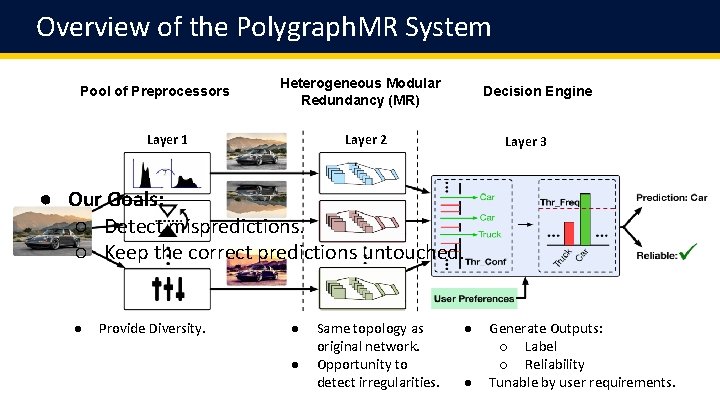
Overview of the Polygraph. MR System Pool of Preprocessors Heterogeneous Modular Redundancy (MR) Layer 1 Decision Engine Layer 2 Layer 3 ● Our Goals: ○ Detect mispredictions. ○ Keep the correct predictions untouched. ● Provide Diversity. ● ● Same topology as original network. Opportunity to detect irregularities. ● ● Generate Outputs: ○ Label ○ Reliability Tunable by user requirements.
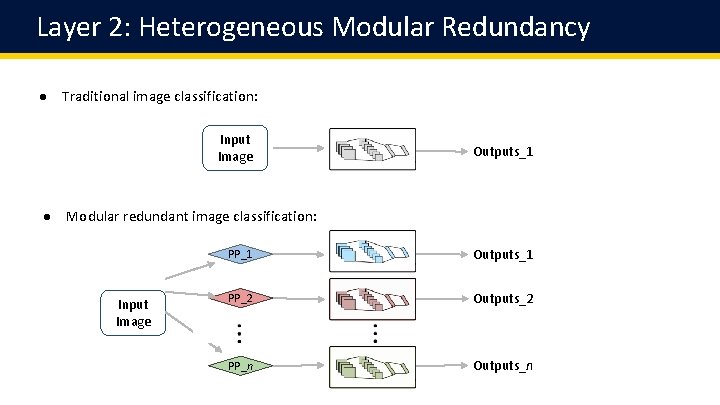
Layer 2: Heterogeneous Modular Redundancy ● Traditional image classification: Input Image Outputs_1 ● Modular redundant image classification: Input Image PP_1 Outputs_1 PP_2 Outputs_2 PP_n Outputs_n
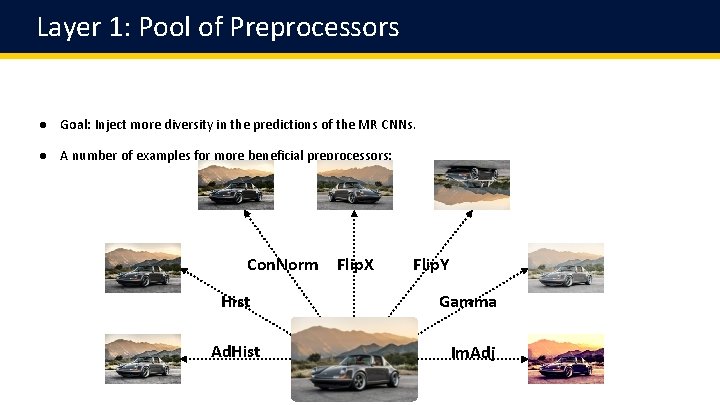
Layer 1: Pool of Preprocessors ● Goal: Inject more diversity in the predictions of the MR CNNs. ● A number of examples for more beneficial preprocessors: Con. Norm Flip. X Flip. Y Hist Gamma Ad. Hist Im. Adj
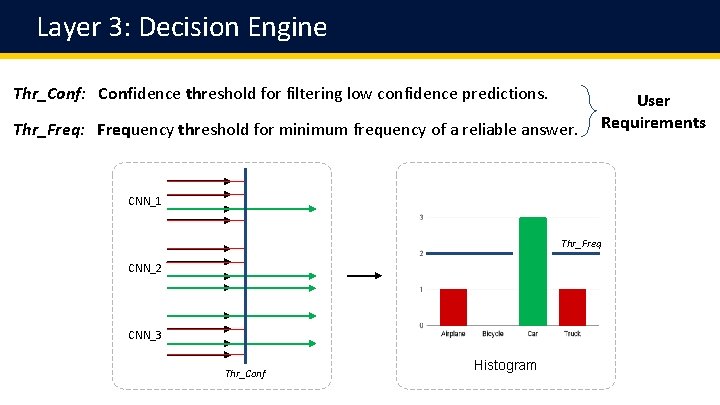
Layer 3: Decision Engine Thr_Conf: Confidence threshold for filtering low confidence predictions. Thr_Freq: Frequency threshold for minimum frequency of a reliable answer. User Requirements CNN_1 Thr_Freq CNN_2 CNN_3 Thr_Conf Histogram
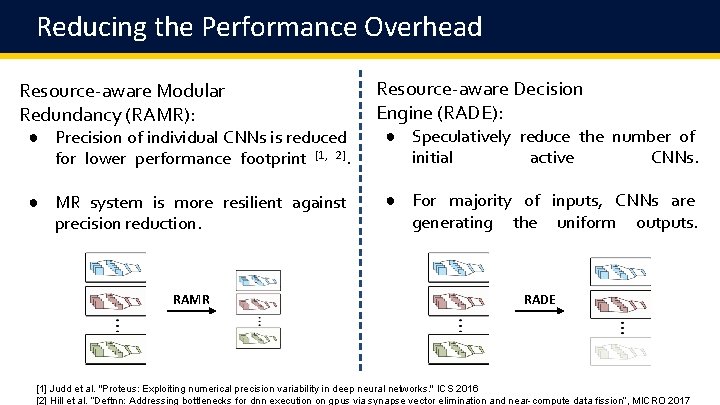
Reducing the Performance Overhead Resource-aware Modular Redundancy (RAMR): Resource-aware Decision Engine (RADE): ● Precision of individual CNNs is reduced for lower performance footprint [1, 2]. ● Speculatively reduce the number of initial active CNNs. ● MR system is more resilient against precision reduction. ● For majority of inputs, CNNs are generating the uniform outputs. RAMR RADE [1] Judd et al. "Proteus: Exploiting numerical precision variability in deep neural networks. " ICS 2016 [2] Hill et al. “Deftnn: Addressing bottlenecks for dnn execution on gpus via synapse vector elimination and near-compute data fission”, MICRO 2017
Evaluation Setup ● Benchmarks: ○ 6 benchmarks across three different image classification datasets: ■ MNIST ■ CIFAR-10 ■ Image. Net ● Evaluation Metrics: ○ # of undetected mispredictions at 100% of baseline accuracy ● Frameworks: ○ Image Preprocessing: Open. CV, MATLAB ○ CNN Training and Inference: Caffe
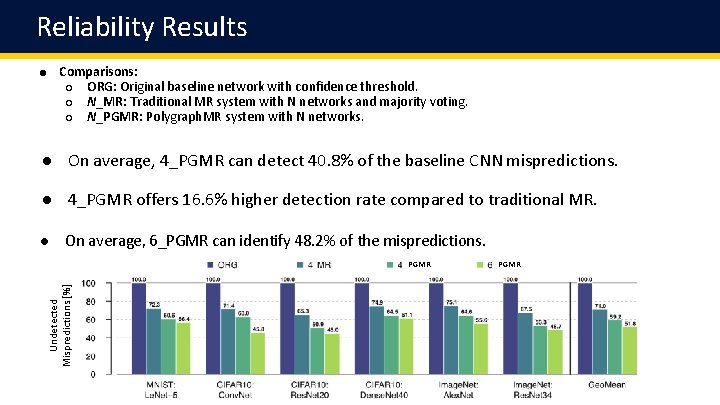
Reliability Results ● Comparisons: ○ ORG: Original baseline network with confidence threshold. ○ N_MR: Traditional MR system with N networks and majority voting. ○ N_PGMR: Polygraph. MR system with N networks. ● On average, 4_PGMR can detect 40. 8% of the baseline CNN mispredictions. ● 4_PGMR offers 16. 6% higher detection rate compared to traditional MR. ● On average, 6_PGMR can identify 48. 2% of the mispredictions. Undetected Mispredictions [%] PGMR
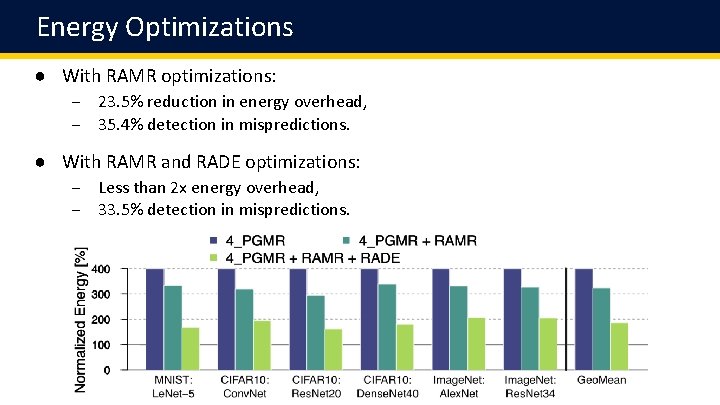
Energy Optimizations ● With RAMR optimizations: − − 23. 5% reduction in energy overhead, 35. 4% detection in mispredictions. ● With RAMR and RADE optimizations: − − Less than 2 x energy overhead, 33. 5% detection in mispredictions.
Conclusion ● Softmax probabilities are failing to assure reliability for mission-critical applications. ● Modular redundancy and behavior diversity provided by preprocessing can help to detect mispredictions. ● On average, Polygraph. MR can detect mispredictions by up to 48. 2% while keeping correct predictions untouched. ● With RAMR and RADE optimizations, Polygraph. MR can still detect 33. 5% of the mispredictions with less than 2 x performance overhead.

Q&A Email: salar@umich. edu
- Slides: 15