
Polygons Polygon closed figure whose sides are all
- Slides: 19
Polygons • Polygon- closed figure whose sides are all segments • Concave polygon- a polygon for which there is a line containing a side of the polygon that also contains a point in the interior of the polygon. • Convex polygon- a polygon for which there is no line that contains both sides of the polygon and a point on the interior of the polygon • Regular polygon- a convex polygon in which all the sides are congruent and all the angles are congruent
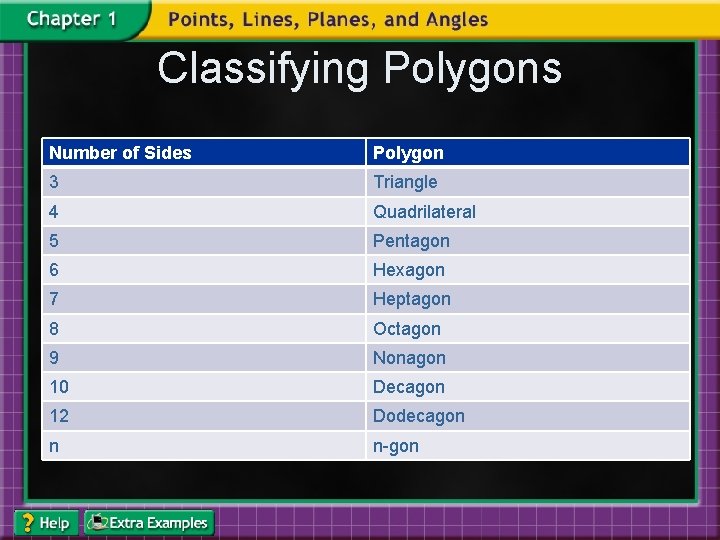
Classifying Polygons Number of Sides Polygon 3 Triangle 4 Quadrilateral 5 Pentagon 6 Hexagon 7 Heptagon 8 Octagon 9 Nonagon 10 Decagon 12 Dodecagon n n-gon
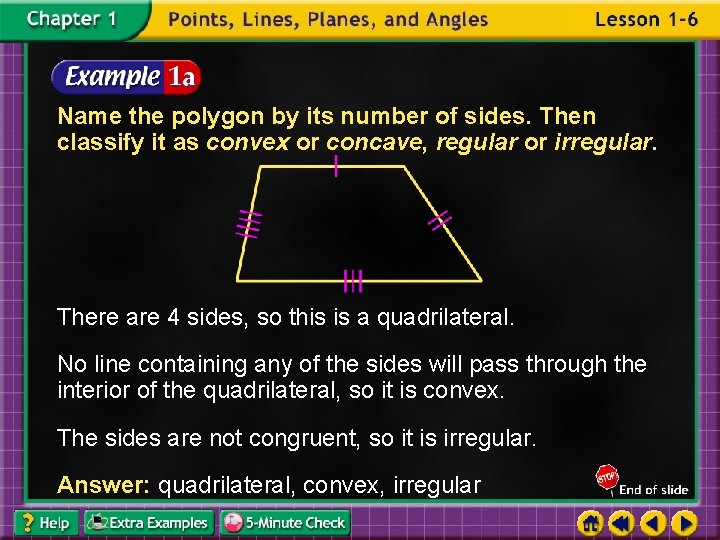
Name the polygon by its number of sides. Then classify it as convex or concave, regular or irregular. There are 4 sides, so this is a quadrilateral. No line containing any of the sides will pass through the interior of the quadrilateral, so it is convex. The sides are not congruent, so it is irregular. Answer: quadrilateral, convex, irregular
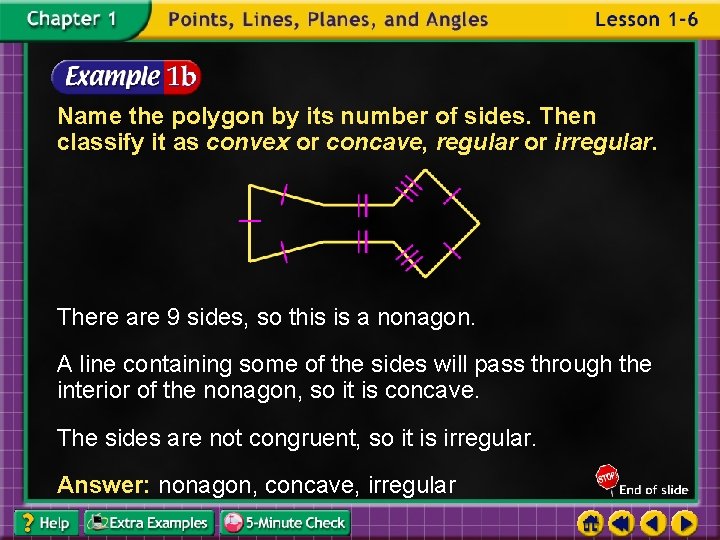
Name the polygon by its number of sides. Then classify it as convex or concave, regular or irregular. There are 9 sides, so this is a nonagon. A line containing some of the sides will pass through the interior of the nonagon, so it is concave. The sides are not congruent, so it is irregular. Answer: nonagon, concave, irregular
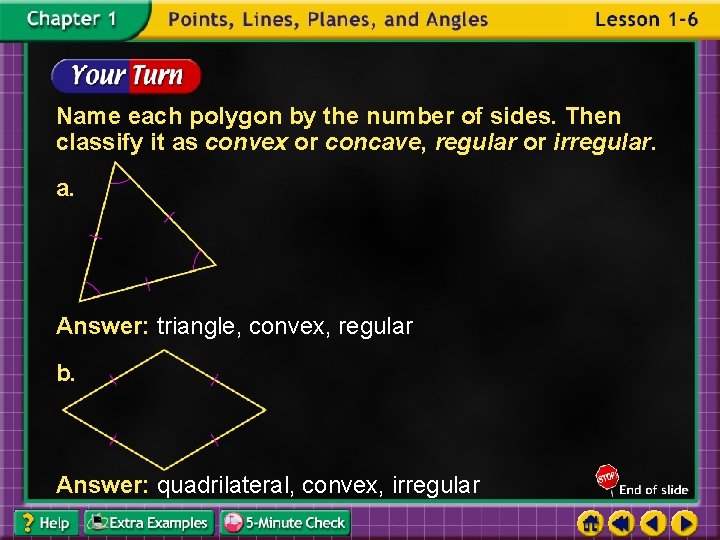
Name each polygon by the number of sides. Then classify it as convex or concave, regular or irregular. a. Answer: triangle, convex, regular b. Answer: quadrilateral, convex, irregular
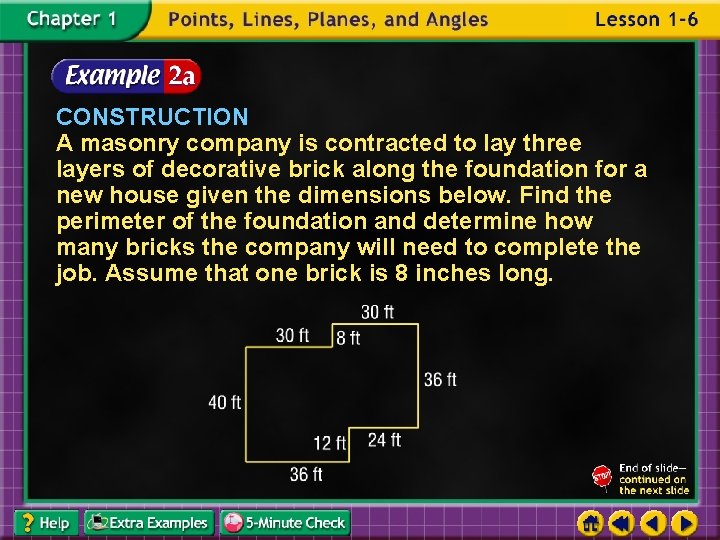
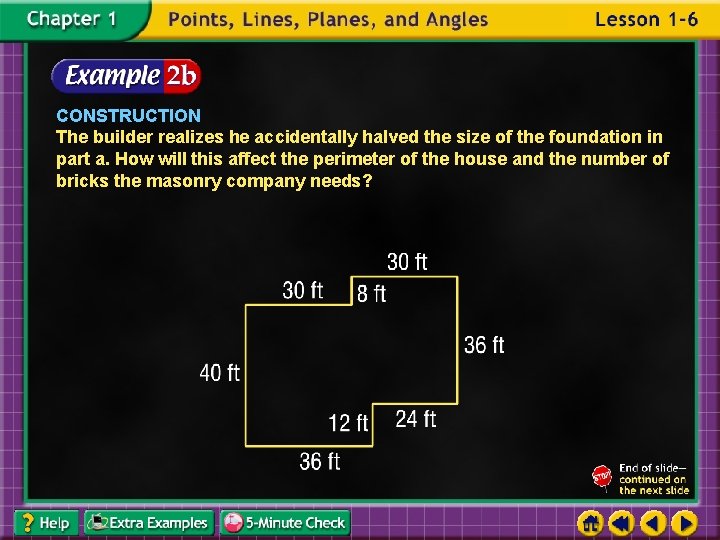
CONSTRUCTION A masonry company is contracted to lay three layers of decorative brick along the foundation for a new house given the dimensions below. Find the perimeter of the foundation and determine how many bricks the company will need to complete the job. Assume that one brick is 8 inches long.
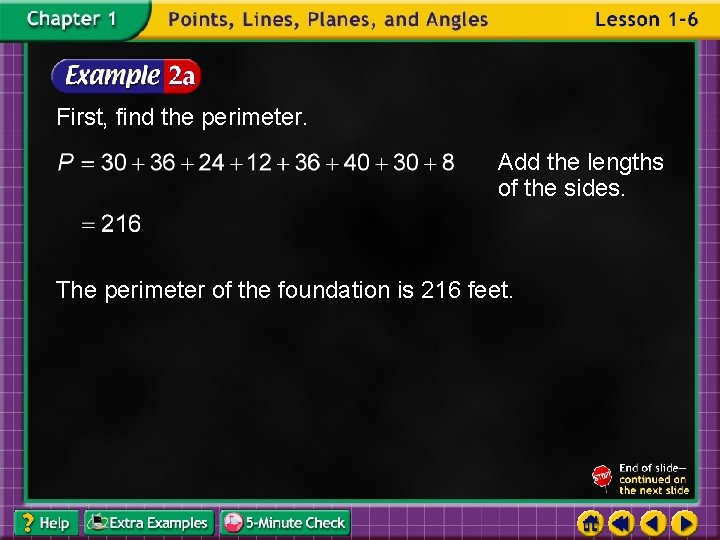
First, find the perimeter. Add the lengths of the sides. The perimeter of the foundation is 216 feet.
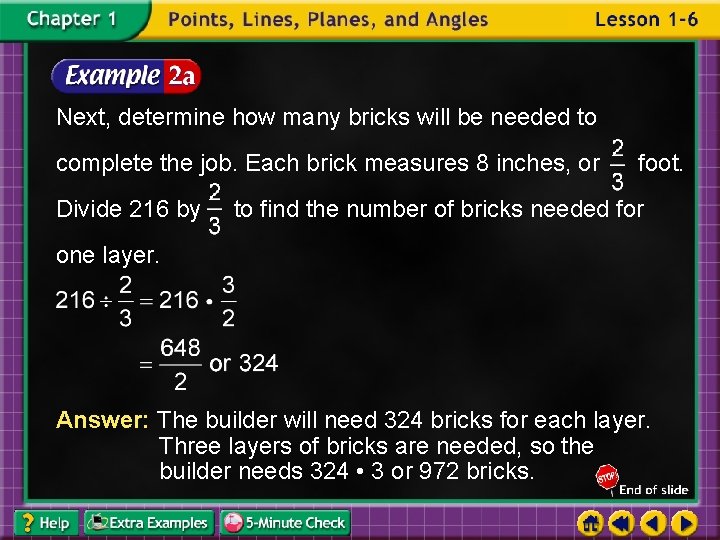
Next, determine how many bricks will be needed to complete the job. Each brick measures 8 inches, or Divide 216 by foot. to find the number of bricks needed for one layer. Answer: The builder will need 324 bricks for each layer. Three layers of bricks are needed, so the builder needs 324 • 3 or 972 bricks.
CONSTRUCTION The builder realizes he accidentally halved the size of the foundation in part a. How will this affect the perimeter of the house and the number of bricks the masonry company needs?
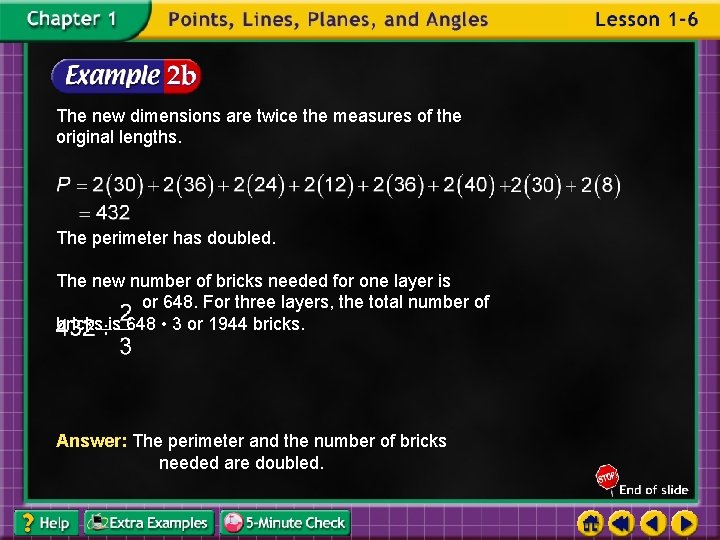
The new dimensions are twice the measures of the original lengths. The perimeter has doubled. The new number of bricks needed for one layer is or 648. For three layers, the total number of bricks is 648 • 3 or 1944 bricks. Answer: The perimeter and the number of bricks needed are doubled.
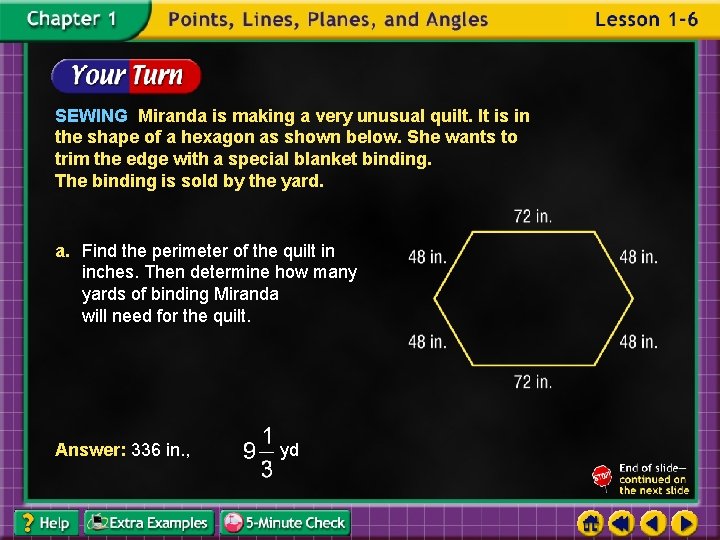
SEWING Miranda is making a very unusual quilt. It is in the shape of a hexagon as shown below. She wants to trim the edge with a special blanket binding. The binding is sold by the yard. a. Find the perimeter of the quilt in inches. Then determine how many yards of binding Miranda will need for the quilt. Answer: 336 in. , yd
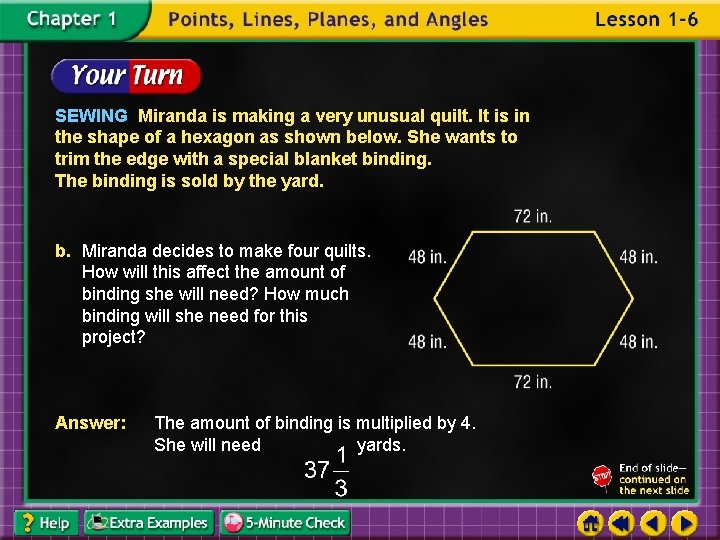
SEWING Miranda is making a very unusual quilt. It is in the shape of a hexagon as shown below. She wants to trim the edge with a special blanket binding. The binding is sold by the yard. b. Miranda decides to make four quilts. How will this affect the amount of binding she will need? How much binding will she need for this project? Answer: The amount of binding is multiplied by 4. She will need yards.
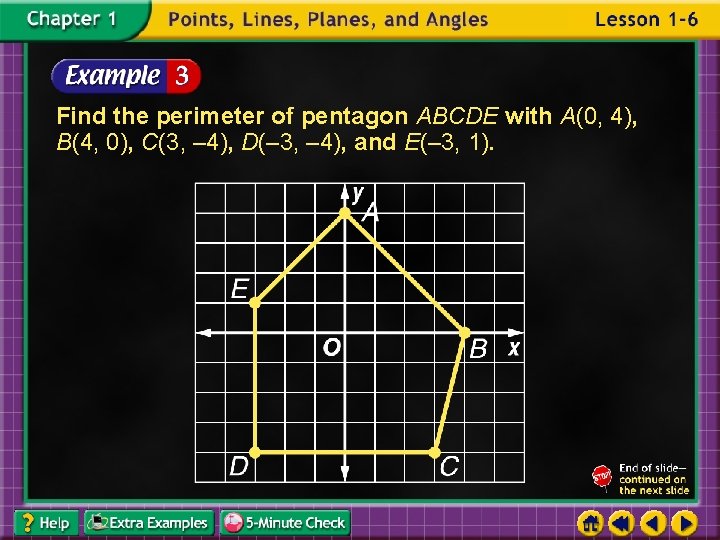
Find the perimeter of pentagon ABCDE with A(0, 4), B(4, 0), C(3, – 4), D(– 3, – 4), and E(– 3, 1).
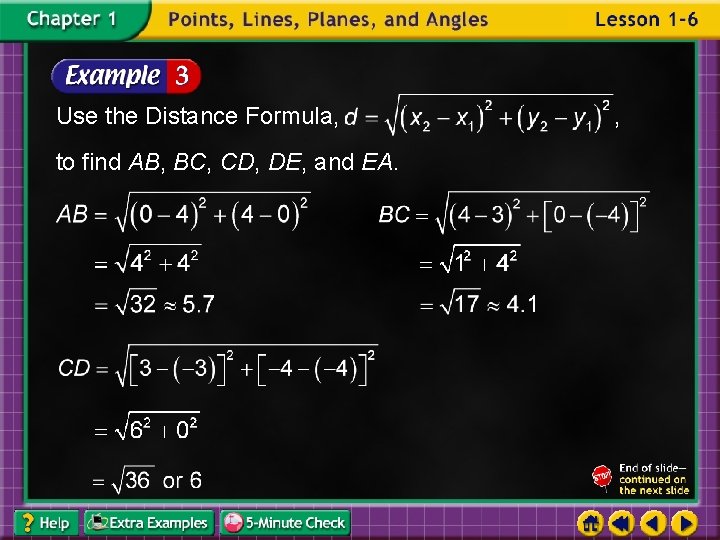
Use the Distance Formula, to find AB, BC, CD, DE, and EA. ,
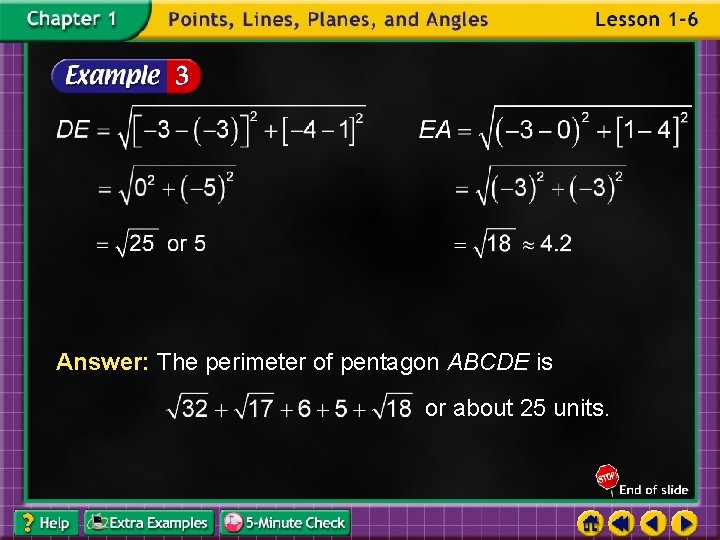
Answer: The perimeter of pentagon ABCDE is or about 25 units.
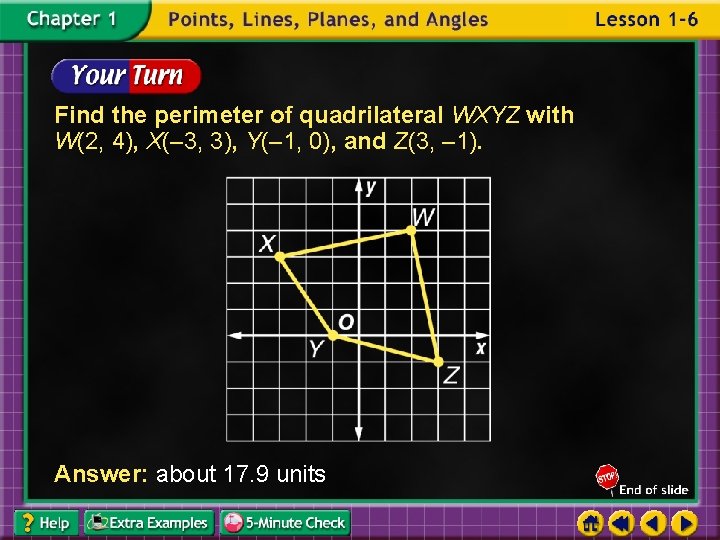
Find the perimeter of quadrilateral WXYZ with W(2, 4), X(– 3, 3), Y(– 1, 0), and Z(3, – 1). Answer: about 17. 9 units
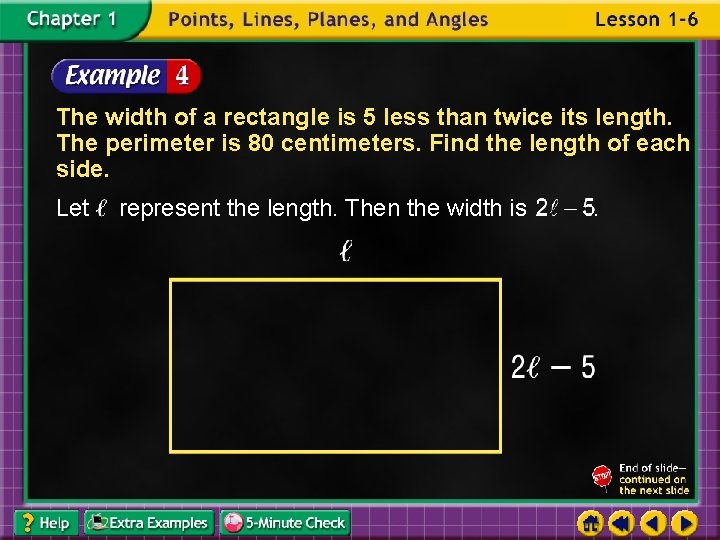
The width of a rectangle is 5 less than twice its length. The perimeter is 80 centimeters. Find the length of each side. Let represent the length. Then the width is .
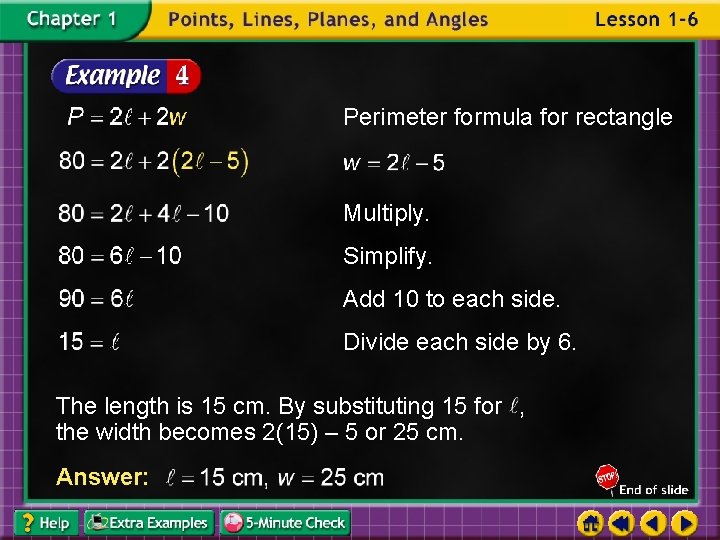
Perimeter formula for rectangle Multiply. Simplify. Add 10 to each side. Divide each side by 6. The length is 15 cm. By substituting 15 for , the width becomes 2(15) – 5 or 25 cm. Answer:
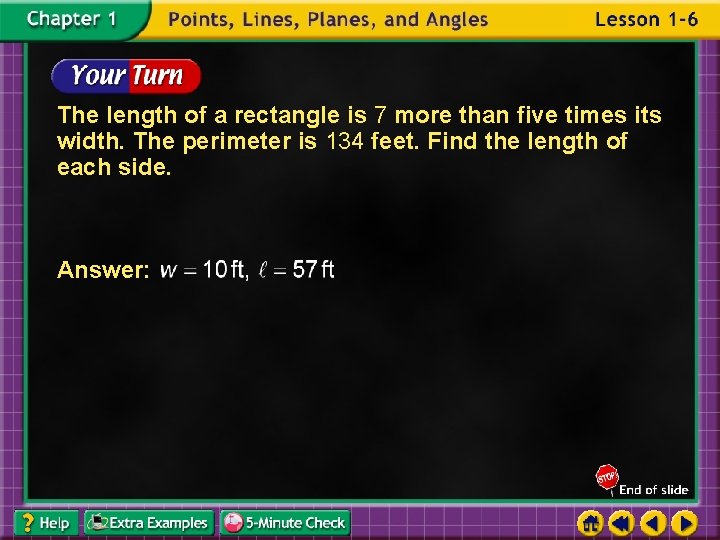
The length of a rectangle is 7 more than five times its width. The perimeter is 134 feet. Find the length of each side. Answer: