
POLYGONS DEFINITION OF A POLYGON A polygon is
- Slides: 8
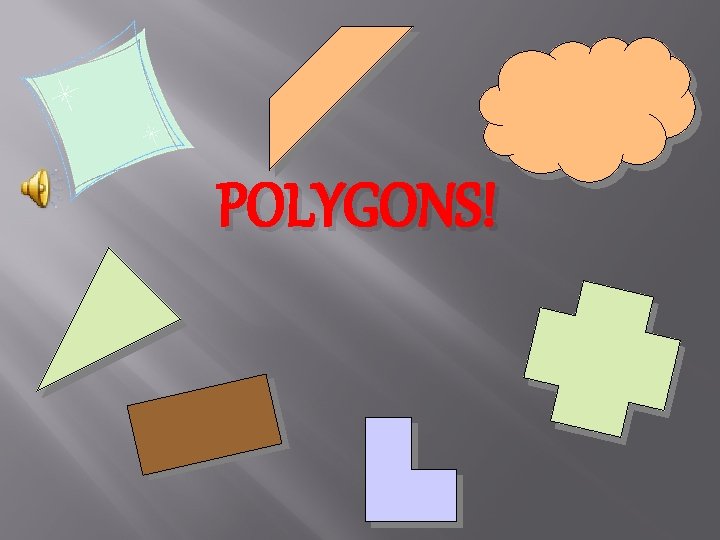
POLYGONS!
DEFINITION OF A POLYGON A polygon is a plane figure with at least three straight sides and angles, and typically five or more
HISTORY OF POLYGONS Polygons have been known since ancient times. The regular polygons were known to the ancient Greeks, and the pentagram which is a non-convex regular polygon~Star Polygon. A Star Polygon is a non-convex polygon which looks in some way, like a star. Only the regular ones have been studied in any depth. Star polygons in general appear not to have been formally defined. It appears on the vase of Aristophonus, Caere, dated to the 7 th century B. C. Whereas, Non-convex polygons in general were not systematically studied until the 14 th century by Thomas Bredwardine. In 1952, Shephard generalised the idea of polygons to the complex plane, where each real dimension is accompanied by an imaginary one, to create complex polygons.
POLYGONS IN NATURE � � � Numerous regular polygons may be seen in nature. In the world of geology, crystals have flat faces, or facets, which are polygons. The most famous hexagons in nature are found in the animal kingdom. The wax honeycomb made by bees is an array of hexagons used to store honey and pollen, and as a secure place for the larvae to grow. Moving off the earth into space, early mathematicians doing calculations using Newton's law of gravitation discovered that if two bodies (such as the sun and the earth) are orbiting one another, there exist certain points in space, called Lagrangian points, where a smaller body (such as an asteroid or a space station) will remain in a stable orbit. The sun-earth system has five Lagrangian points. ~Lagrangian points forms an equilateral triangle. Another fascinating example of regular polygons occurs when the cooling of lava forms areas of tightly packed hexagonal columns of basalt, which may be seen at the Giant's Causeway in Ireland, or at the Devil's Postpile in California.
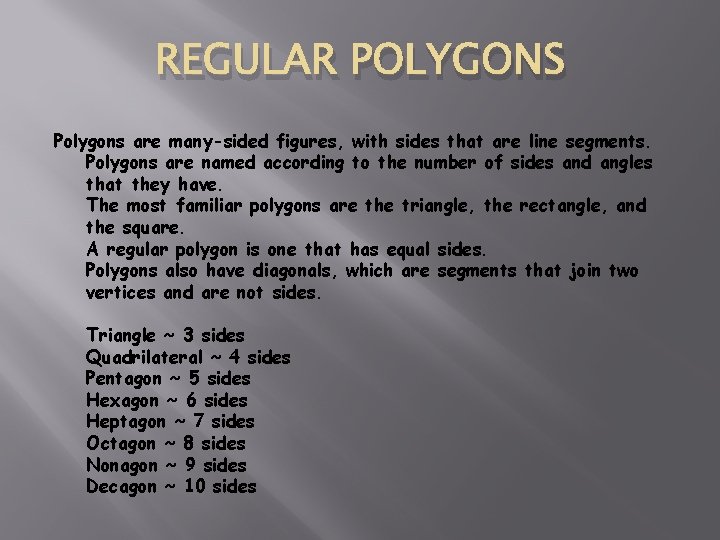
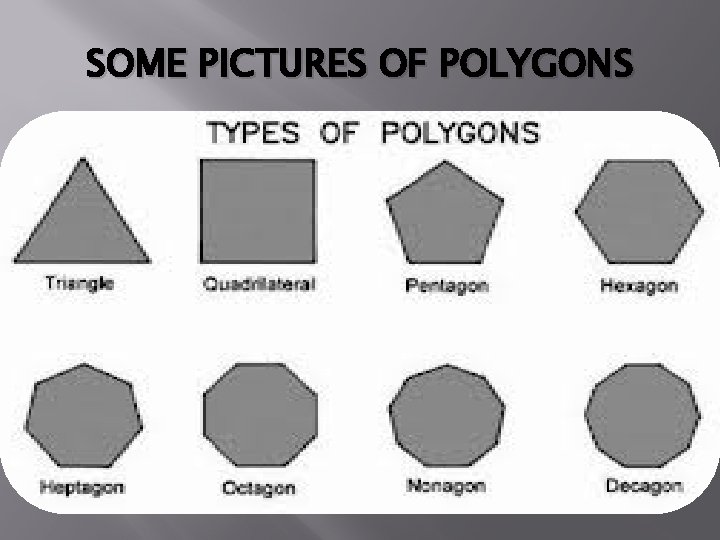
REGULAR POLYGONS Polygons are many-sided figures, with sides that are line segments. Polygons are named according to the number of sides and angles that they have. The most familiar polygons are the triangle, the rectangle, and the square. A regular polygon is one that has equal sides. Polygons also have diagonals, which are segments that join two vertices and are not sides. Triangle ~ 3 sides Quadrilateral ~ 4 sides Pentagon ~ 5 sides Hexagon ~ 6 sides Heptagon ~ 7 sides Octagon ~ 8 sides Nonagon ~ 9 sides Decagon ~ 10 sides
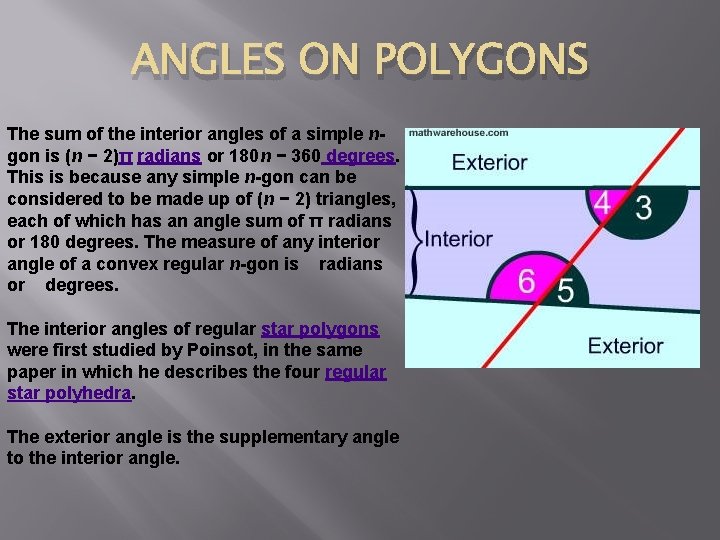
ANGLES ON POLYGONS The sum of the interior angles of a simple ngon is (n − 2)π radians or 180 n − 360 degrees. This is because any simple n-gon can be considered to be made up of (n − 2) triangles, each of which has an angle sum of π radians or 180 degrees. The measure of any interior angle of a convex regular n-gon is radians or degrees. The interior angles of regular star polygons were first studied by Poinsot, in the same paper in which he describes the four regular star polyhedra. The exterior angle is the supplementary angle to the interior angle.
SOME PICTURES OF POLYGONS
POLYGON RIDDLE! � LETS SEE IF YOU CAN TACKLE THIS! I am a polygon. I have one pair of parallel sides. I have 2 acute angles and 2 obtuse angles. Sometimes I have 2 right angles and 1 acute and 1 obtuse angle. I have 4 sides. What am I? (Click to know) TRAPEZOID!