
Polyether Polyether polymers are the most diverse of

- Slides: 45
Polyether ÷Polyether polymers are the most diverse of the non vinyl polymer in the structural variety that have achieved commercial prominence. They includes polyacetals and PPO. ÷The polyacetal is synthesised by chainreaction polymerisation. Sometime this ether is also prepared by ring-opening polymerisation. ÷ PPO (Polyphenylene oxide) is prepared by step-reaction polymerisation. CORPORATE TRAINING AND PLANNING
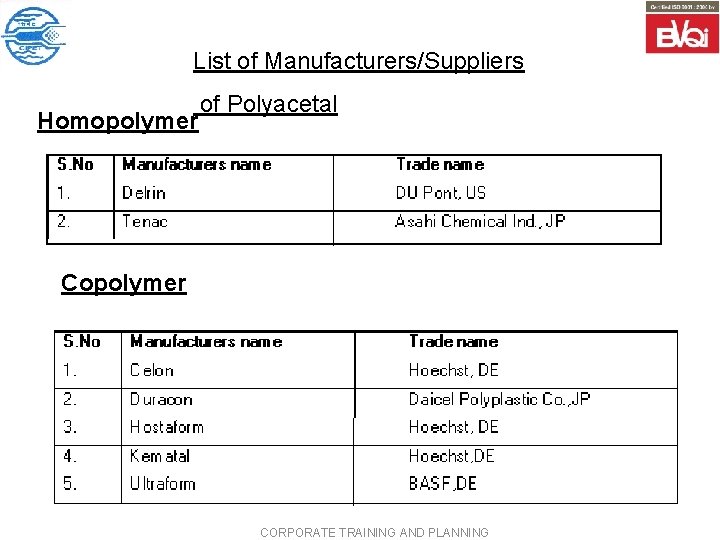
Polyacetal (POM) ÷ The material was produced by the polymerisation of formaldehyde, which was isolated by first Butlerv in 1859 in polymeric form. It was not commercially available until 1952. ÷ The first commercially available acetal resin was marketed by Du Pont in 1952 under the trade name of Derlin. ÷ The Du Pont monopoly was usually shortlived as Celcon, as acetal copolymer produced by the Celanese Corporation in 1960. It was commercialized in 1962. In the same year it was also available as Hoste form from Farb Werke Hoechst Co. Germany. CORPORATE TRAINING AND PLANNING
Polyacetal (POM) ÷In 1963, it was also available from Danippon celluloid Co. , of Osaka, Japan and Imperial Chemical industries (ICI), Britan when Celanese joined them. In the early 1970’s ultra form Gm. BH (A Joint venture of BASF and Degussa) introduced copolymer under the name of ultra form. ÷In the early 1970’s Japanese Co. , Ashai chemicals introduced the homopolymer under the name Tenal. ÷By the late 1990’s the main manufacturers where the American based Du Pont, the Japanese based Poly. Plastics and the European based Ticone. Among atleast 8 plants in Asia those of Mitsubishi Gas and Ashai were significant as was also that of BASF. CORPORATE TRAINING AND PLANNING
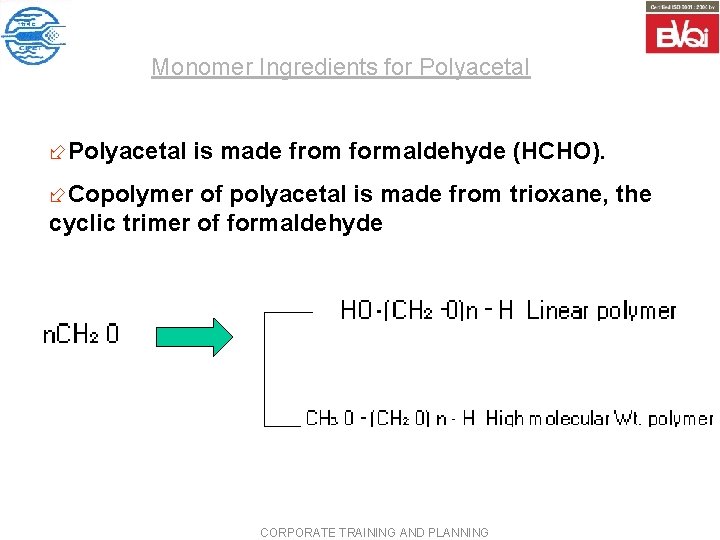
Monomer Ingredients for Polyacetal ÷Polyacetal is made from formaldehyde (HCHO). ÷Copolymer of polyacetal is made from trioxane, the cyclic trimer of formaldehyde CORPORATE TRAINING AND PLANNING
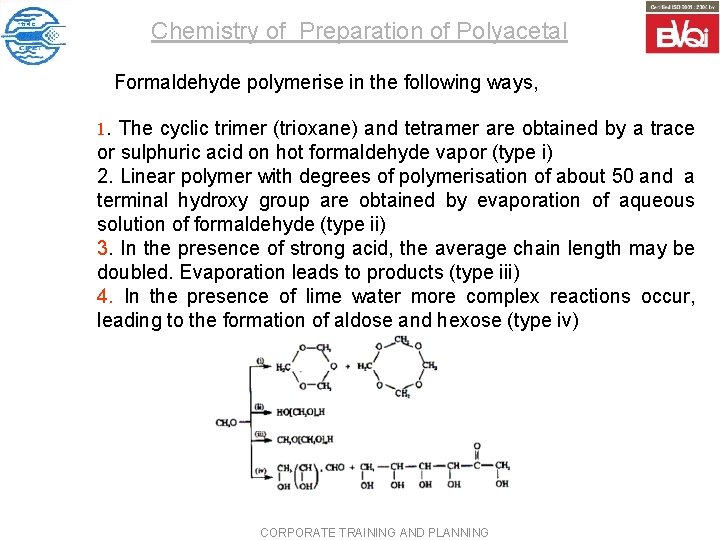
Chemistry of Preparation of Polyacetal Formaldehyde polymerise in the following ways, 1. The cyclic trimer (trioxane) and tetramer are obtained by a trace or sulphuric acid on hot formaldehyde vapor (type i) 2. Linear polymer with degrees of polymerisation of about 50 and a terminal hydroxy group are obtained by evaporation of aqueous solution of formaldehyde (type ii) 3. In the presence of strong acid, the average chain length may be doubled. Evaporation leads to products (type iii) 4. In the presence of lime water more complex reactions occur, leading to the formation of aldose and hexose (type iv) CORPORATE TRAINING AND PLANNING
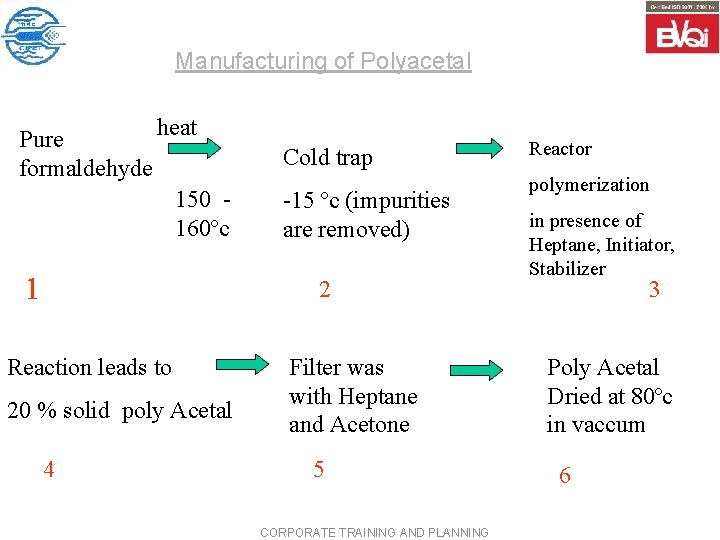
Manufacturing of Polyacetal heat Pure formaldehyde 150 160ºc 1 Cold trap -15 ºc (impurities are removed) 2 Reaction leads to 20 % solid poly Acetal 4 Filter was with Heptane and Acetone 5 CORPORATE TRAINING AND PLANNING Reactor polymerization in presence of Heptane, Initiator, Stabilizer 3 Poly Acetal Dried at 80ºc in vaccum 6
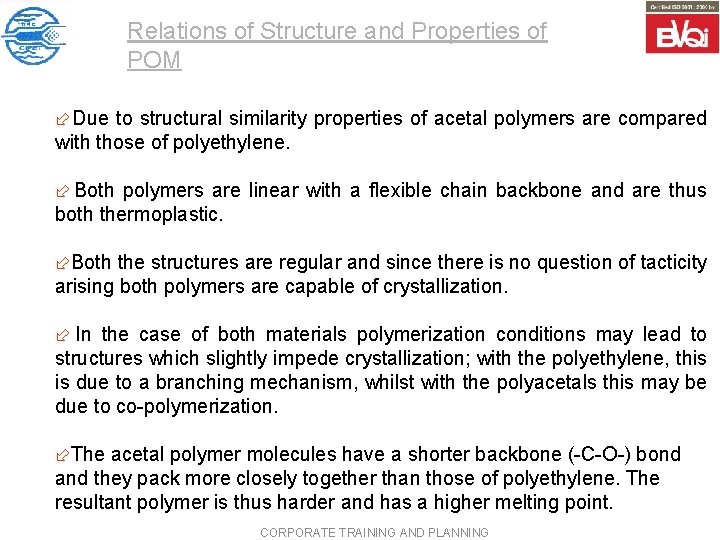
Relations of Structure and Properties of POM ÷ Due to structural similarity properties of acetal polymers are compared with those of polyethylene. ÷ Both polymers are linear with a flexible chain backbone and are thus both thermoplastic. ÷Both the structures are regular and since there is no question of tacticity arising both polymers are capable of crystallization. ÷ In the case of both materials polymerization conditions may lead to structures which slightly impede crystallization; with the polyethylene, this is due to a branching mechanism, whilst with the polyacetals this may be due to co-polymerization. ÷The acetal polymer molecules have a shorter backbone (-C-O-) bond and they pack more closely together than those of polyethylene. The resultant polymer is thus harder and has a higher melting point. CORPORATE TRAINING AND PLANNING
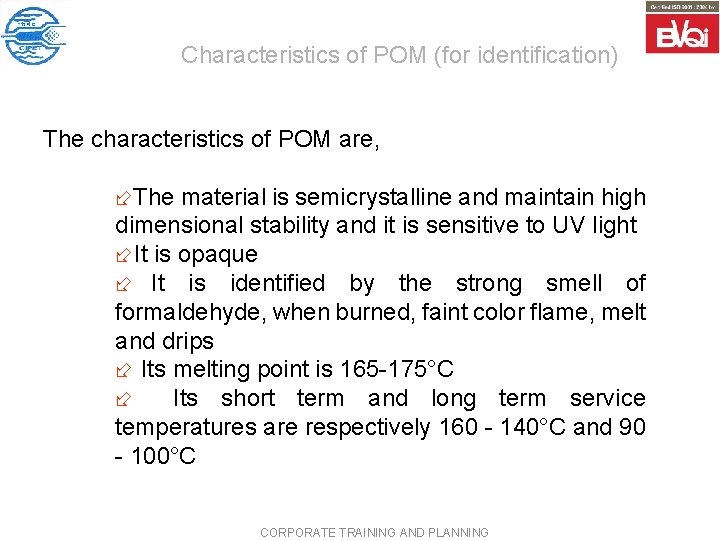
Characteristics of POM (for identification) The characteristics of POM are, ÷The material is semicrystalline and maintain high dimensional stability and it is sensitive to UV light ÷It is opaque ÷ It is identified by the strong smell of formaldehyde, when burned, faint color flame, melt and drips ÷ Its melting point is 165 -175°C ÷ Its short term and long term service temperatures are respectively 160 - 140°C and 90 - 100°C CORPORATE TRAINING AND PLANNING
Characteristics of POM øGood appearance øHomopolymer is resistant to mid acids and bases øGood electrical properties but affected by moisture øStiff and rigid øGood toughness øNotch sensitive øExcellent fatigue resistance under repeated load øExcellent creep resistance under continuous load øLow coefficient of friction øGood abrasion resistance ø Maintains the mechanical, chemical and electrical properties over broad temperature range and time CORPORATE TRAINING AND PLANNING
Characteristics of POM øHigh resistance to thermal and oxidative degradation øVery good resistance to stress relaxation øExcellent dimensional stability øGood processability øCopolymers have better thermal stability øBurn slowly without smoke generation øSusceptible to UV degradation øAttacked by phenol and aniline øDifficult to electroplate ø Degradation at high processing temperature and liberate formaldehyde CORPORATE TRAINING AND PLANNING
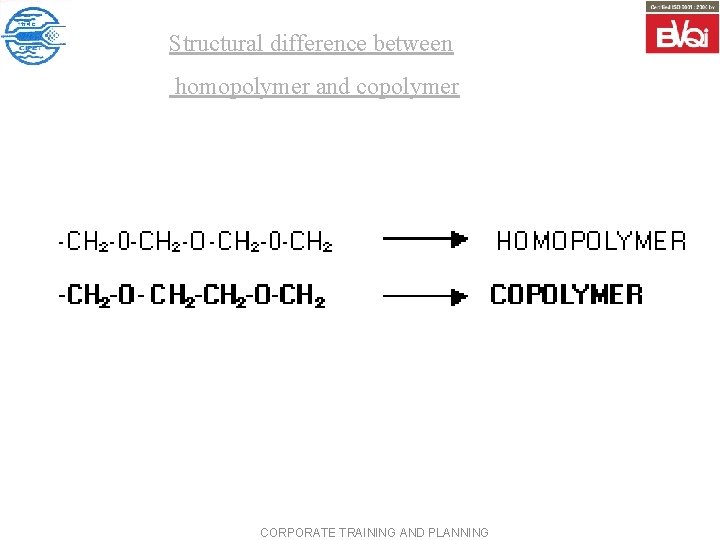
Structural difference between homopolymer and copolymer CORPORATE TRAINING AND PLANNING
Properties of Polyacetals (special features) The principal features of acetal resins leading to commercial application may be summarized as follows. ÷Stiffness ÷Fatigue endurance ÷Resistance to creep ÷Low co-efficient of friction ÷Good appearance CORPORATE TRAINING AND PLANNING
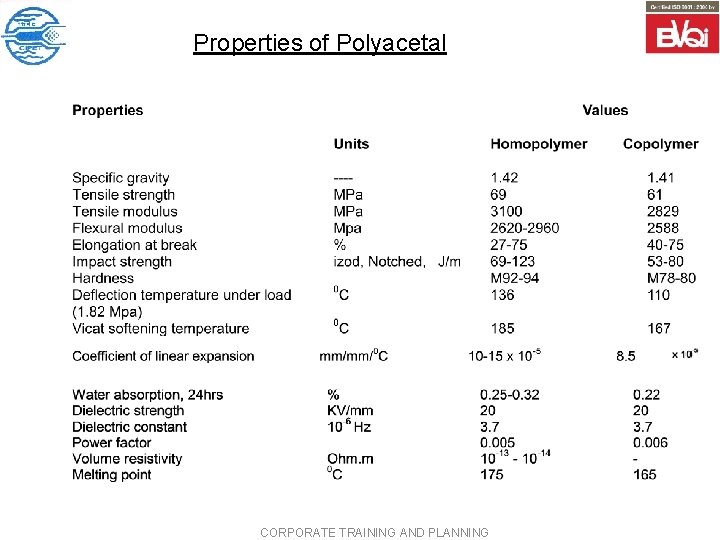
Properties of Polyacetal CORPORATE TRAINING AND PLANNING
Mechanical Properties The stress- Strain behaviour of polyacetal is such that it could be used to replace metallic materials in many precision engineering applications. CORPORATE TRAINING AND PLANNING
Thermal Properties ÷Acetals have a heat distortion temperature in excess of 110°C and can be used in applications upto this temperature intermittently. ÷However, acetal can loose strength and toughness after long exposure to hot environments. ÷Homopolymers resist deterioration upto one and a half years at 82°C in air while the copolymers may be used continuously at temperature upto 104°C in air. ÷Mouldings of acetal remain dimensionally stable over the recommended use temperature range. CORPORATE TRAINING AND PLANNING
Electrical Properties ÷ The electrical insulation properties of the acetal resins may be described as good but not particularly outstanding. ÷ However, application where impact toughness and rigidity are required along with good electrical insulation characteristics they be used. CORPORATE TRAINING AND PLANNING
Water absorption The water absorption of polyacetals is low, 15 mg after immersion for 24 hours and 30 mg after 96 hours at 200° C. CORPORATE TRAINING AND PLANNING
Optical properties ÷Polyacetal moldings are translucent to white. ÷The light transmission of 2 mm thick injection molded panels is 50%, the refractive index is 1. 48. ÷The gloss of the moldings depends on the surface finish of the mold. CORPORATE TRAINING AND PLANNING
Permeability to gases and vapours ÷The permeability of polyacetal is very low compared with that of other plastics. ÷This applies to both aliphatic and halogenated hydrocarbons. ÷Polyacetal is resistant to fuel gases and is therefore suitable for use in gas fittings and aerosol containers. CORPORATE TRAINING AND PLANNING
Chemical properties ÷ Polyacetals are resistance to weak acids, weakly alkaline solutions (strongly alkaline solutions only for copolymers), gasoline, benzene, alcohols, oils, grease, halogenated hydrocarbons, water, detergents. They are not resistance to strong acids and oxidising agents. ÷Polyacetals are not susceptible to stress cracking. CORPORATE TRAINING AND PLANNING
Weathering resistance ÷ Polyacetals are damaged by UV radiation. Resultant changes in properties occur more rapidly with smaller wall thicknesses. Degradation can be delayed by light stabilizers. ÷ Active carbon black has proved to be the most effective stabilizer. Less effective are organic light stabilizers used for natural or colored material. ÷Some pigmented grades exhibit good weathering resistance with added UV absorber. ÷Resistance to high energy radiation: - polyacetal molding should be used in situation where the total radiation dosage exceeds approx. 3. 104 kg-1 /3 mrad. Yellowing and embrittlement occur at higher dosages. CORPORATE TRAINING AND PLANNING
Flammability ÷As polymerization products of formaldehyde, polyacetals are flammable. ÷They burn with a weak bluish flame and drip. ÷After extinguishing or incomplete combustion there is a choking smell of formaldehyde. CORPORATE TRAINING AND PLANNING
Toxicity and Sterilization Toxicity Polyacetals are free of smell and taste. Sterilization Items made of plastics are usually sterilized using a dosage of 25. 104 Jkg-1 /2. 5 Mrad. This cause some degradation which is associated with a decrease in toughness. CORPORATE TRAINING AND PLANNING
Additives of POM øFunctional Additives øColorants øFillers øReinforcements CORPORATE TRAINING AND PLANNING
Functional Additives ¤The most important stabilization method is structural modification of the polymer by, for example, copolymerization with cyclic ethers and blocking the end groups. ¤Stabilization is carried out by salts of carboxylic acids. ¤Polyacetals are not UV resistant ¤Without UV stabilization, POM has a tendency to surface cracking and chalking after a short period of weathering outdoors, Provided black is acceptable, carbon black can be used to achieve excellent UV stabilization, A combination of sterically hindered amines (HALS) and UV absorbers, e. g. 22’hydroxy-5’methylphenyl) benzotriazole, is suitable for light CORPORATE TRAINING AND PLANNING
Colorants øThe pigments used to produce colored molding compounds from natural POM in house must be able to withstand processing temperatures without decomposing or changing color. ø Furthermore they must not impair thermal stability of POM. Pigment concentrates are supplied as granules. CORPORATE TRAINING AND PLANNING
Fillers ÷Filling with Mo. S 2 reduces the difference between the static and dynamic coefficient of friction and thus the tendency to stick-slip. ÷Addition of chalk improves the unlubricated abrasion resistance, a property valuable for gears and bearings. The flexural fatigue strength is also significantly increased. ÷ Addition of PTFE exploits the good slip properties of this material and the high mechanical strength of POM. Maintenance-free bearings without stickslip are important applications. ÷The slip characteristics of standard POM grades can be improved by the addition of oil concentrates in a ratio 1: 10 Aluminium and bronze can be used to increase the heat distortion temperature and electrical conductivity. CORPORATE TRAINING AND PLANNING
Reinforcements ÷The good heat distortion characteristics of reinforced grades can only be exploited for a short time. ÷The maximum service temperature even for glass- reinforced grades is only just above 100°C, 20 to 30% w/w of chopped and continuous strand doubles the tensile strength and triples the flexural modulus of elasticity. ÷Creep behavior at elevated temperatures is also improved. ÷ The downside is lower notched impact strength and higher price per volume. ÷ Glass beads can be added up to 80% w/w without significantly affecting processing conditions. CORPORATE TRAINING AND PLANNING
Grades of POM The polyacetals are available in the following grades. ÷Injection grade ÷Extrusion blow grade ÷rotational grade In addition to that the following special grades are available, ÷Improved processability grade. ÷Low friction grade. ÷Glass filled grade ÷Mineral filled grade ÷UV-Stabilized grade CORPORATE TRAINING AND PLANNING
Processing considerations of Polyacetals ÷While processing polyacetal following precautions to be taken. 1. 2. 3. depolymerization ission through Thermal 4. Stepwise thermal or based catalyzed hydrolytic depolymerization initiated from the hemiformal chain end with the evolution of formaldehyde. Oxidative attack at random along the chain leading to chain scission and subsequent depolymerization. Acid catalysed cleavage of the acteal linkages. occur catastrophically above 270°C and care must be taken not to exceed this temperature during processing. ÷The homopolymer is moulded at melt temperature of 200 -210°C while the copolymer would be moulded at melt temperature of 190 -205°C. ÷Therefore end capping is done during polymerization and antioxidants and acid acceptors are added CORPORATE TRAINING AND PLANNING
Surface Finishing of POM Hot Stamping ÷The hot stamping of POM molding is of increasing importance, e. g. in the manufacture of counter rolls. No pretreatment is necessary. ÷The surface must be clean and the embossing stamp must be applied evenly. Metallizing High vacuum metallizing imparts a reflective metal surface to polyacetal moldings. Printing Painting, Lacquring These finishes are after pretreating the surface as for polyolefins. CORPORATE TRAINING AND PLANNING
Machineability of POM Joining All joining methods apart from high frequency welding are suitable for POM moldings. Welding Heat tool, friction and ultrasonic welding. Bonding ÷Contact and solvent adhesives. The peel strength of bonded joints is surprisingly high even with unprepared surfaces, e. g. with hot milt adhesives, based on vinyl copolymers. ÷Cyanoacrylate one pack polymerization adhesives, EP resins, PU adhesives. Hexafluoroacetone sesquihydrate has been used as an adhesive for some years. Screws Self-tapping, threaded inserts are made. Rivets Hot and cold riveting systems are made. Others CORPORATE TRAINING AND PLANNING Used as snap and press connectors.
Applications of Polyacetal ø Appliances ø Agriculture & Irrigation ø Consumer Products ø Industrial ø Electrical ø Plumbing & Hardware CORPORATE TRAINING AND PLANNING
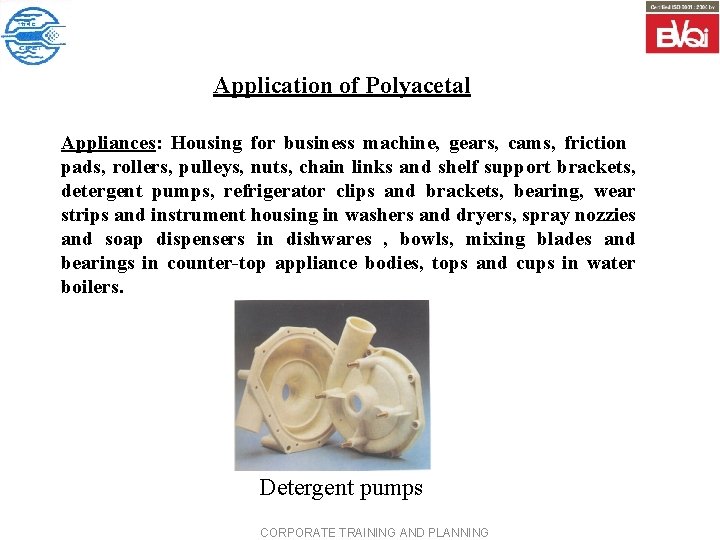
Application of Polyacetal Appliances: Housing for business machine, gears, cams, friction pads, rollers, pulleys, nuts, chain links and shelf support brackets, detergent pumps, refrigerator clips and brackets, bearing, wear strips and instrument housing in washers and dryers, spray nozzies and soap dispensers in dishwares , bowls, mixing blades and bearings in counter-top appliance bodies, tops and cups in water boilers. Detergent pumps CORPORATE TRAINING AND PLANNING
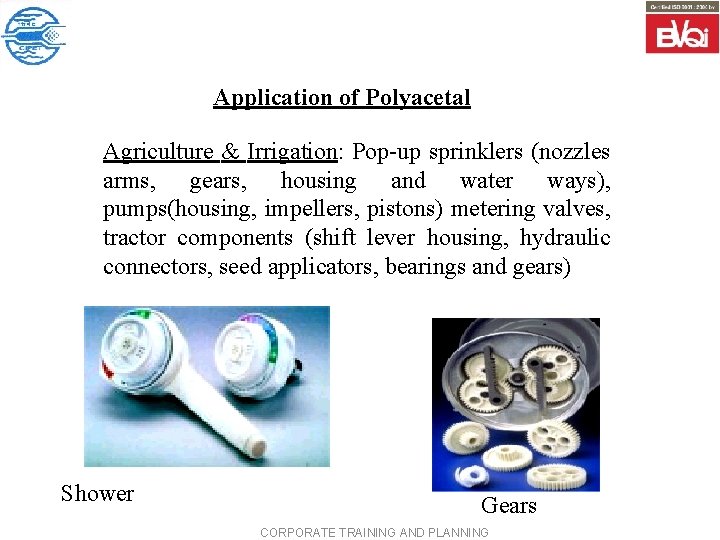
Application of Polyacetal Agriculture & Irrigation: Pop-up sprinklers (nozzles arms, gears, housing and water ways), pumps(housing, impellers, pistons) metering valves, tractor components (shift lever housing, hydraulic connectors, seed applicators, bearings and gears) Shower Gears CORPORATE TRAINING AND PLANNING
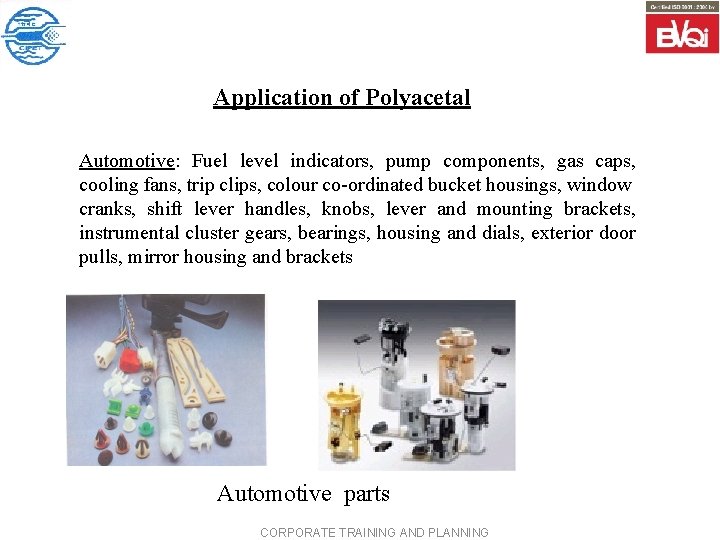
Application of Polyacetal Automotive: Fuel level indicators, pump components, gas caps, cooling fans, trip clips, colour co-ordinated bucket housings, window cranks, shift lever handles, knobs, lever and mounting brackets, instrumental cluster gears, bearings, housing and dials, exterior door pulls, mirror housing and brackets Automotive parts CORPORATE TRAINING AND PLANNING
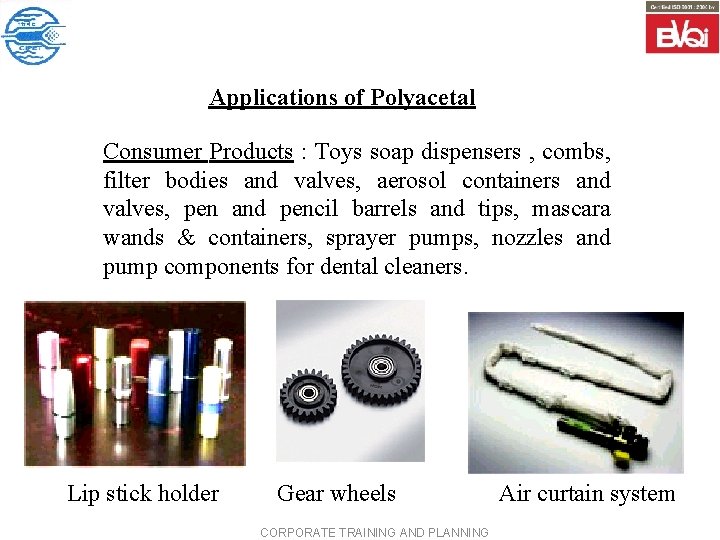
Applications of Polyacetal Consumer Products : Toys soap dispensers , combs, filter bodies and valves, aerosol containers and valves, pen and pencil barrels and tips, mascara wands & containers, sprayer pumps, nozzles and pump components for dental cleaners. Lip stick holder Gear wheels CORPORATE TRAINING AND PLANNING Air curtain system
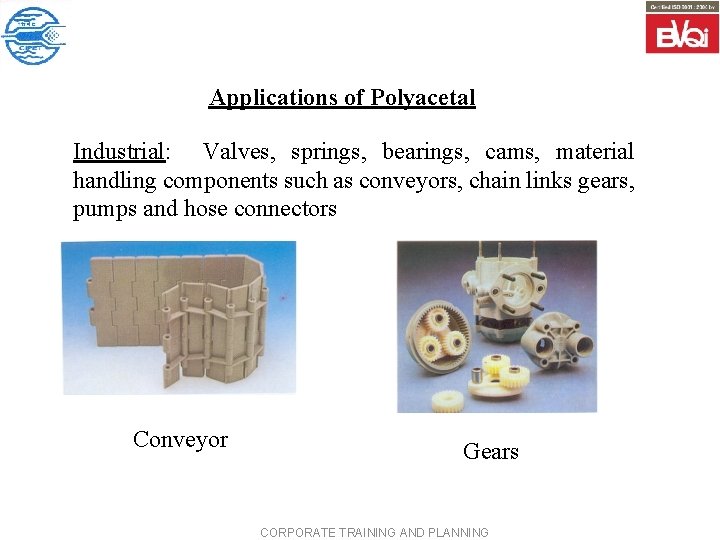
Applications of Polyacetal Industrial: Valves, springs, bearings, cams, material handling components such as conveyors, chain links gears, pumps and hose connectors Conveyor Gears CORPORATE TRAINING AND PLANNING
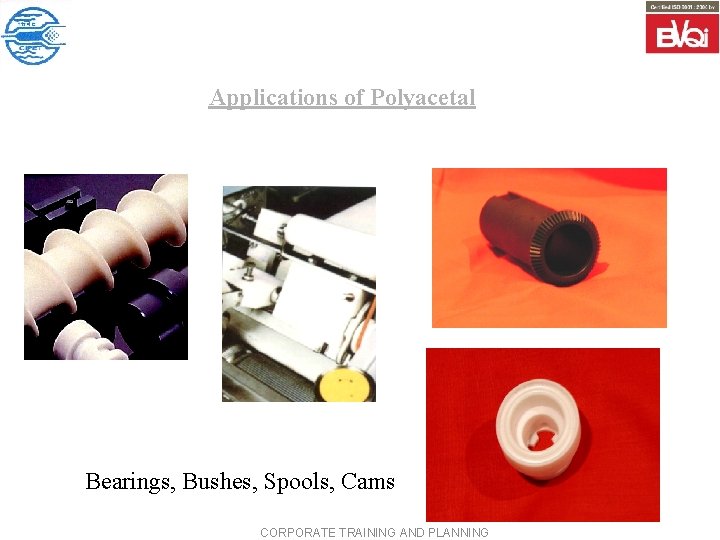
Applications of Polyacetal Bearings, Bushes, Spools, Cams CORPORATE TRAINING AND PLANNING
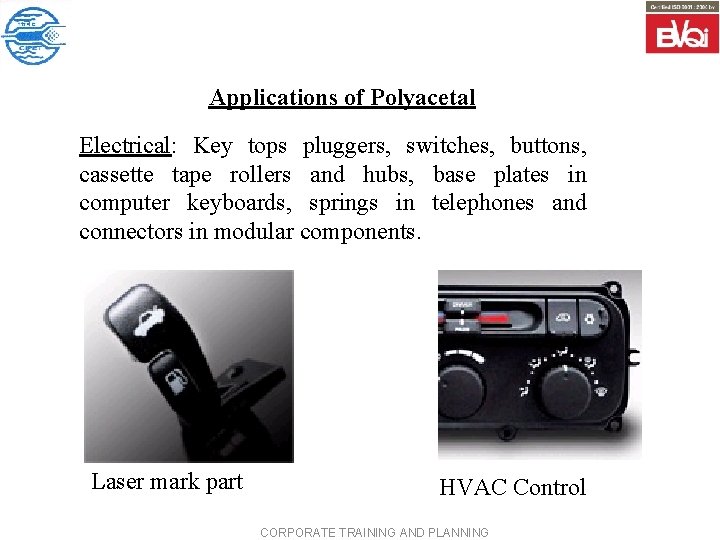
Applications of Polyacetal Electrical: Key tops pluggers, switches, buttons, cassette tape rollers and hubs, base plates in computer keyboards, springs in telephones and connectors in modular components. Laser mark part HVAC Control CORPORATE TRAINING AND PLANNING
Applications of Polyacetal Plumbing & Hardware: Water –meters, cams, gears, dials and pressure plates, pressure regulator valves, drapery and venetian blind guide rollers, furniture , casters, slid plates and locks, tool holders, bearing in adapters, shower heads, sprayers, garden hoses and nozzles, irrigation gates, impellers, pumps and hangers. CORPORATE TRAINING AND PLANNING
Blends of POM ÷Although unmodified polyacetals already have high inherent toughness they exhibit a certain notch sensitivity. That is by virtue of the stress concentration that arises, sharp notches effect a substantial drop in impact strength. ÷Blending polyacetal with elastomer brings a noticeable improvement not only in the notched impact strength, but also in the ability to bear multiaxial impact loading. CORPORATE TRAINING AND PLANNING
Blends of POM Polyacetal/TPU Among the elastomers, thermoplastic polyurethane have the greatest significance for the impact modification of polyacetals. Such blends are formulated for extrusion, injection, blow, compression and transfer moulding. ¤They show excellent processability, rigidity high impact strength, high fatigue, flexural and tensile strength, low water absorbency and resistance to chemicals. Mostly contain 10 -30 wt of TPU, and have co continuous morphology for especially good performance. Polyacetal/ Butadiene ¤Elastomers based on polybutadiene or poly acrylates are important modifiers. ¤The essential advantage of modification with polybutadiene is better cold impact strength. CORPORATE TRAINING AND PLANNING
Blends of POM Polyacetal/Acrylate ¤In the case of modification of polyacetal with polyacrylate the advantages are better heat aging and better weathering. CORPORATE TRAINING AND PLANNING
List of Manufacturers/Suppliers Homopolymer of Polyacetal Copolymer CORPORATE TRAINING AND PLANNING