
Polyester Polyester History The discovery of polyester was

- Slides: 30
Polyester
Polyester History: The discovery of polyester was made by Dr. J. T. Dickson and Mr. J. R. Whinfield in 1941 in the laboratories of Calico Printers Assosiation Ltd in Lancashire England. In Britain, Britain the manufacture of PET fiber began in 1948 by Imperial Chemical Industries Limited and the fiber is marketed under the name Terylene
Polyester In January 1955, a large plant came into production with an annual capacity of 5 million kg divided almost equally between filament yarn and staple yarn. In USA Du. Pont company began producing PET fiber in 1950 under the name Dacron
Polyester The generic term polyester was adopted by the U. S. Federal Trade Commission for fibers; “A manufactured fiber in which the fiber forming substance is any long chain synthetic polymer composed of at least 85% by weight of an ester of ethylene glycol and terephthalic acid. It is also called polyethylene terephthalate (PET)
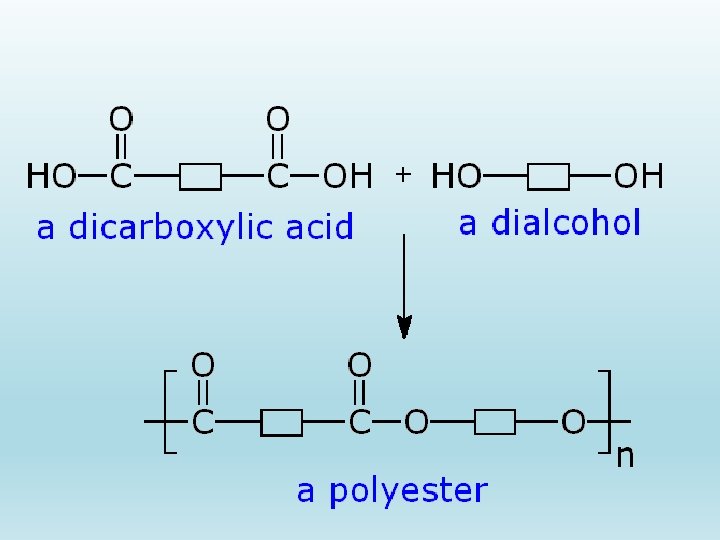
Polyester is a polymer which is made through condensation reaction taking place between two molecules and linkages of molecules occur through the formation of ester groups Made by interaction of a dibasic acid with dihydric alcohol Mono ethylene glycol + Terephthlic acid Polyester + H 2 O
Polyester fiber, specifically poly(ethylene terephthalate) (PET), is the largest volume synthetic fiber produced worldwide Du. Pont and Eastman are the two world largest polyester producers The reasons for the dominating success of PET fiber are: 1. Low cost 2. Convenient process ability 3. Excellent performance
Polyester Raw Material: Ø Ethylene glycol Ø Terephthalic Acid / Dimethyl terephthalate Ø Catalyst: Zn, Pb, Cd, Co
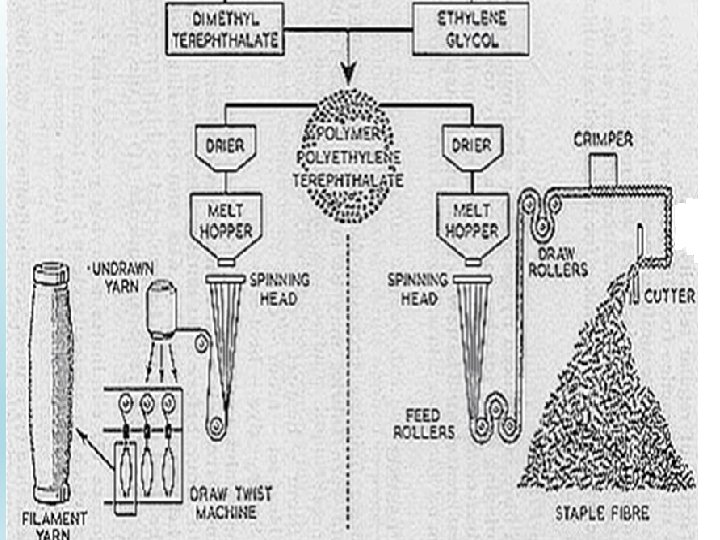
Polyester Manufacturing and processing of polyester: Polyethylene Terephthalate (PET) is industrially produced by either terephthalic acid or Dimethyl terephthalate with ethylene glycol. The reaction between terephthalic acid and ethylene glycol started at just above the melting point of reactants in the presence of Nitrogen Catalyst are used to accelerate the reaction
Polyester • The ester exchange reaction is carried out under high pressure • Ester exchange reaction is carried out at 197 -200 ◦C • The resulting low molecular weight Ethylene glycol terephthalate is heated at 280 ◦C for 30 minutes at atmospheric pressure so that Polycondensation reaction takes place. • The pressure is remove from time to remove water/ methanol
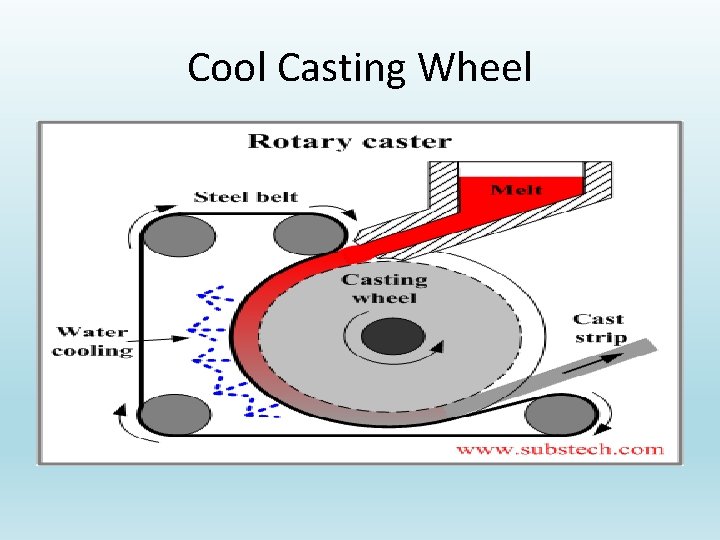
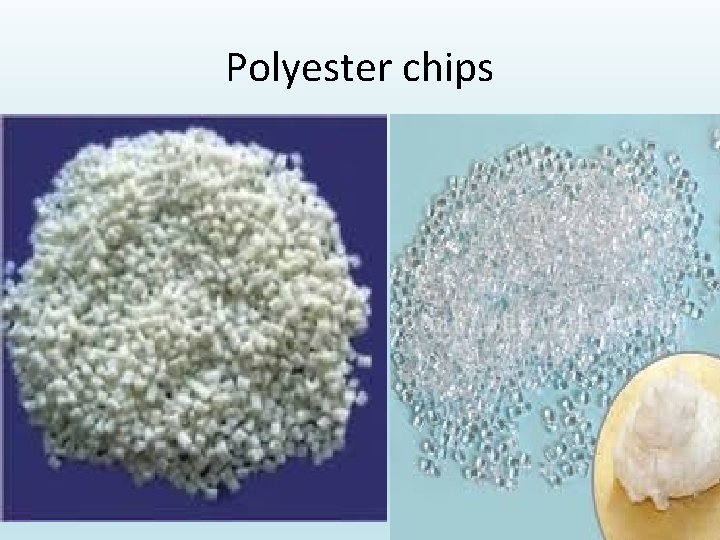
Polyester is obtained as high molecular weight product. Its melting point is 260 ◦C Spinning of filament yarn: The polymer is extruded from autoclave onto water cooled casting wheel in the form of thick ribbon The polymer ribbons solidify on to casting wheel The ribbons are cut into chips by dicing machine the wet chips are dried in air operated rotary driers
Cool Casting Wheel
Polyester chips
Polyester Polymer chips are discharged from hopper reservoirs to spinneret Polymer chips are melted at 260 -270°C and a delustering agent (Ti. O 2), lubricating oil and antistatic agent are added to form a syrup-like solution. The solution is put in a metal container called a spinneret and forced through its tiny holes, which are usually round, the emerging filaments are cool down and solid filaments are obtained.
Polyester • Undrawn filaments are drawn/drafting on electrically or steam heated rollers • The filaments are drawn at least to five times to their original length • This increases the strength of the filament
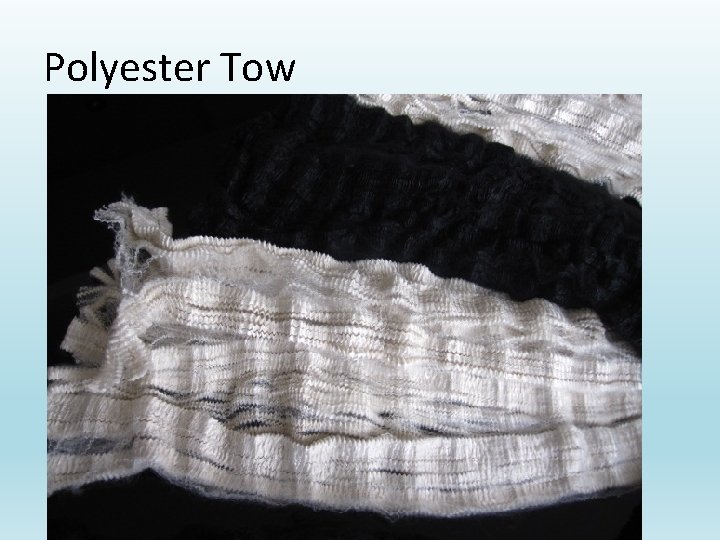
Polyester Production of staple fibers: Extrusion of filaments takes place from spinneret The filaments are brought together to form a thick tow The tow is drawn to get high strength The tow passes through crimping machine The crimps are stabilized by passing tow through heating ovens The tow is cut into specified length
Polyester Tow
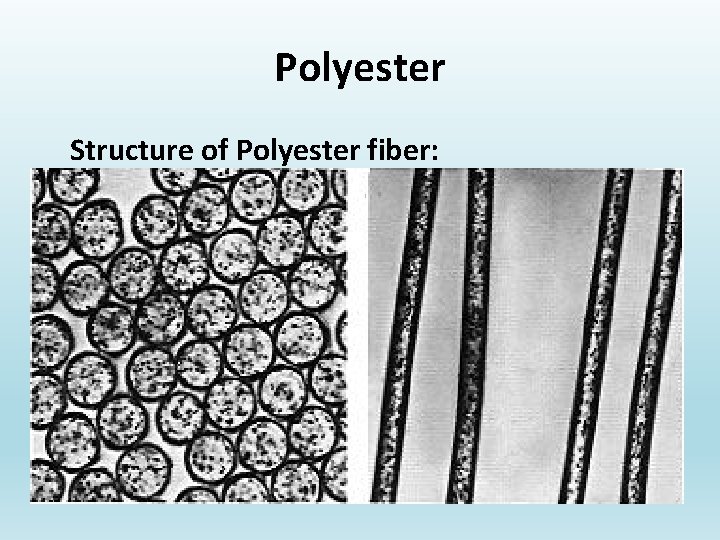
Polyester Structure of Polyester fiber:
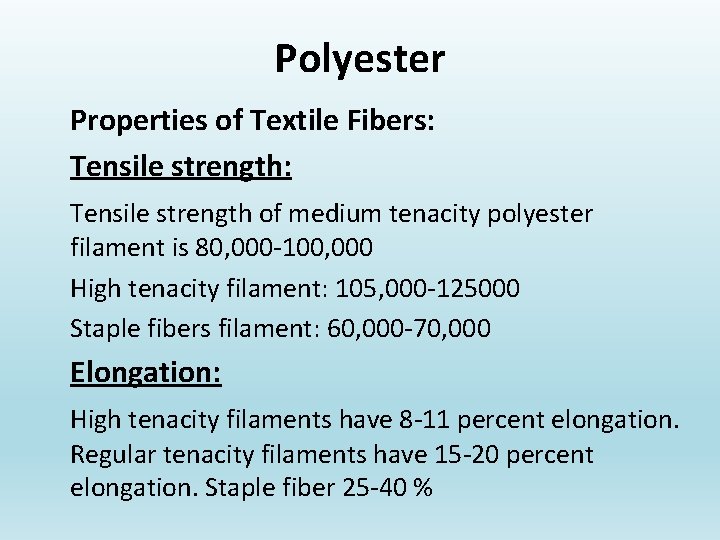
Polyester Properties of Textile Fibers: Tensile strength of medium tenacity polyester filament is 80, 000 -100, 000 High tenacity filament: 105, 000 -125000 Staple fibers filament: 60, 000 -70, 000 Elongation: High tenacity filaments have 8 -11 percent elongation. Regular tenacity filaments have 15 -20 percent elongation. Staple fiber 25 -40 %
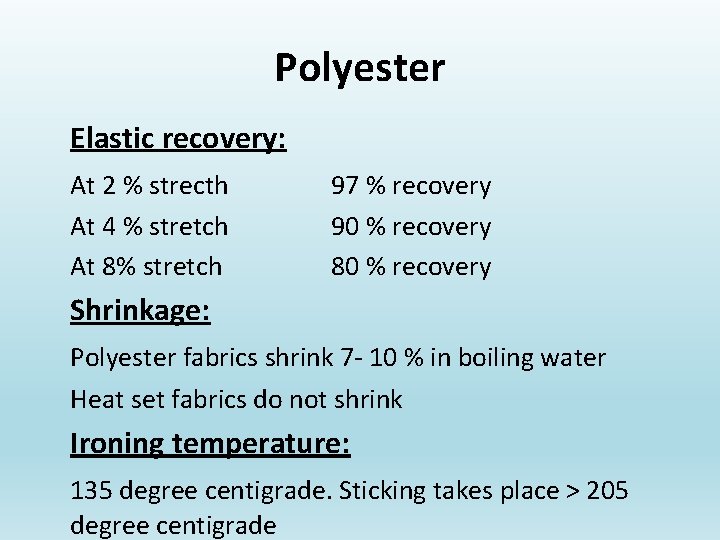
Polyester Elastic recovery: At 2 % strecth At 4 % stretch At 8% stretch 97 % recovery 90 % recovery 80 % recovery Shrinkage: Polyester fabrics shrink 7 - 10 % in boiling water Heat set fabrics do not shrink Ironing temperature: 135 degree centigrade. Sticking takes place > 205 degree centigrade
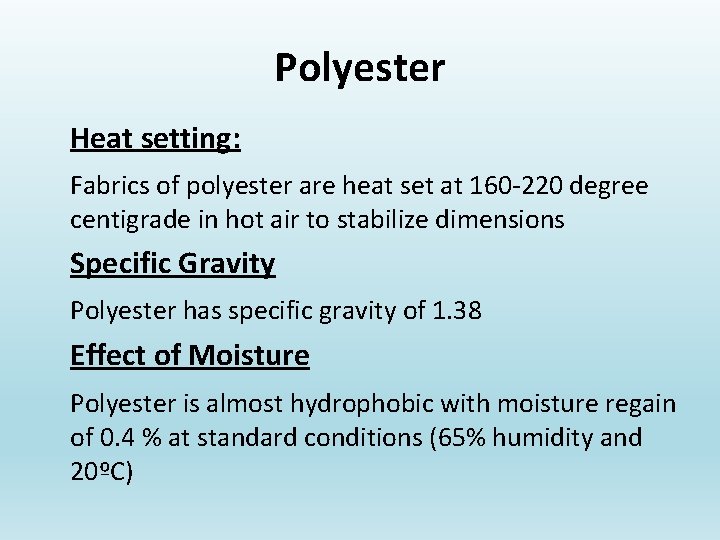
Polyester Heat setting: Fabrics of polyester are heat set at 160 -220 degree centigrade in hot air to stabilize dimensions Specific Gravity Polyester has specific gravity of 1. 38 Effect of Moisture Polyester is almost hydrophobic with moisture regain of 0. 4 % at standard conditions (65% humidity and 20ºC)
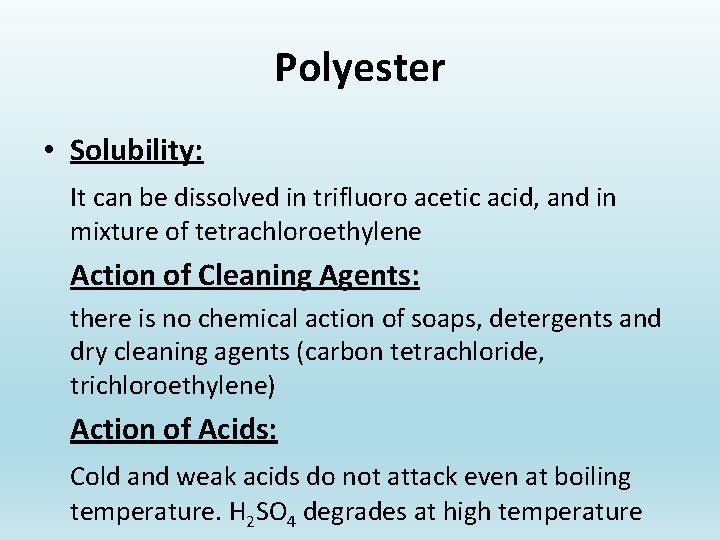
Polyester • Solubility: It can be dissolved in trifluoro acetic acid, and in mixture of tetrachloroethylene Action of Cleaning Agents: there is no chemical action of soaps, detergents and dry cleaning agents (carbon tetrachloride, trichloroethylene) Action of Acids: Cold and weak acids do not attack even at boiling temperature. H 2 SO 4 degrades at high temperature
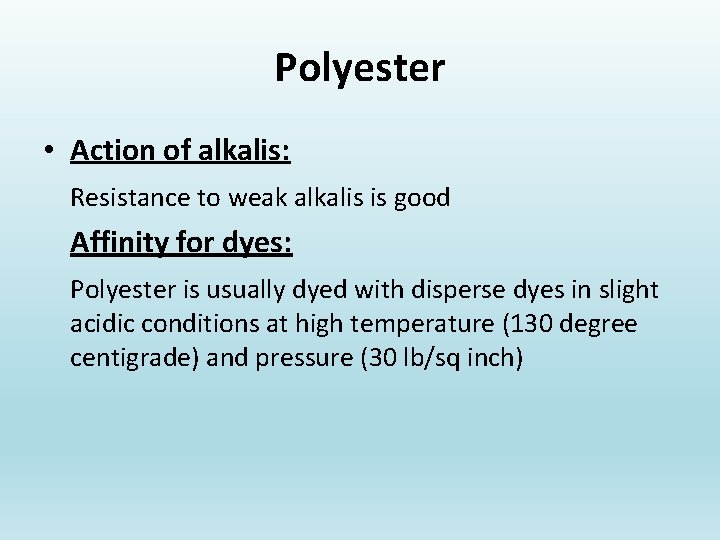
Polyester • Action of alkalis: Resistance to weak alkalis is good Affinity for dyes: Polyester is usually dyed with disperse dyes in slight acidic conditions at high temperature (130 degree centigrade) and pressure (30 lb/sq inch)
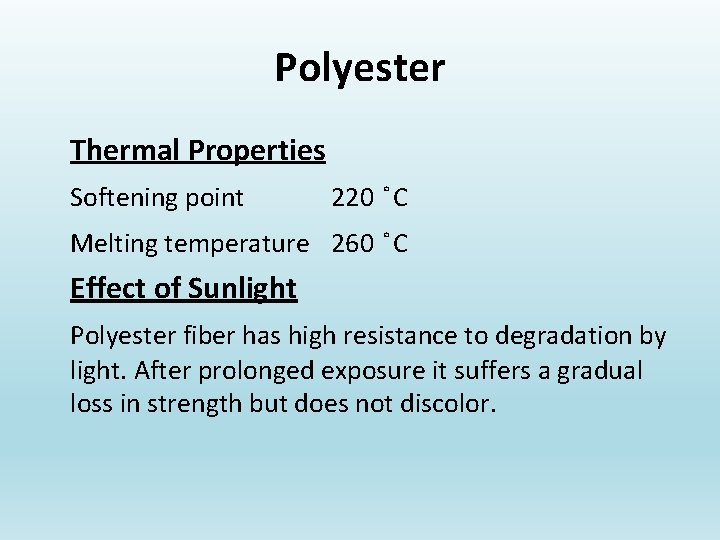
Polyester Thermal Properties Softening point 220 C Melting temperature 260 C Effect of Sunlight Polyester fiber has high resistance to degradation by light. After prolonged exposure it suffers a gradual loss in strength but does not discolor.
Polyester Electrical Properties Polyester having very low moisture regain so it is a very good insulator.
Polyester Behind glass this fiber shows good resistance against sunlight even after prolonged exposure. This gives it marked superiority over other fibers under these conditions. Insects and micro-organisms polyester is not a source of nourishment for living creature and show excellent resistance to insects, fungi and bacteria
Polyester Uses: Apparel Every form of clothing. • Home Furnishings Carpets, curtains, sheets and pillowcases, wall coverings, and upholstery.
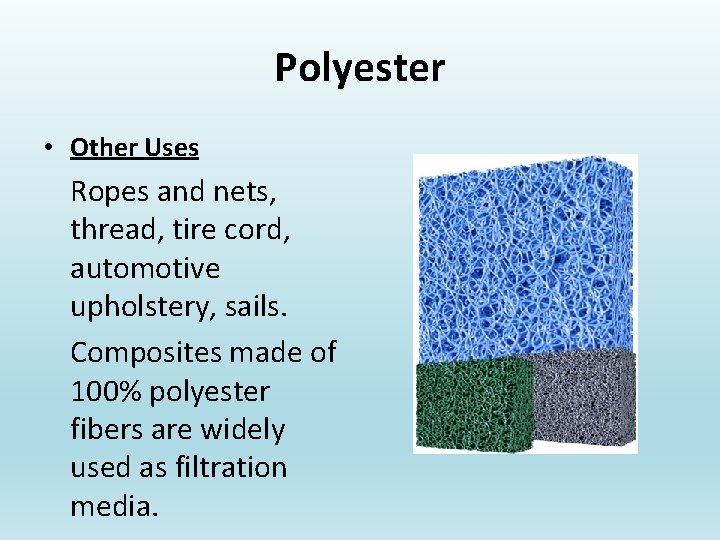
Polyester • Other Uses Ropes and nets, thread, tire cord, automotive upholstery, sails. Composites made of 100% polyester fibers are widely used as filtration media.
Polyester Fiberfill applications In Fiberfill applications polyester fibers are used inside seat cushions, back pillows and mattresses.