
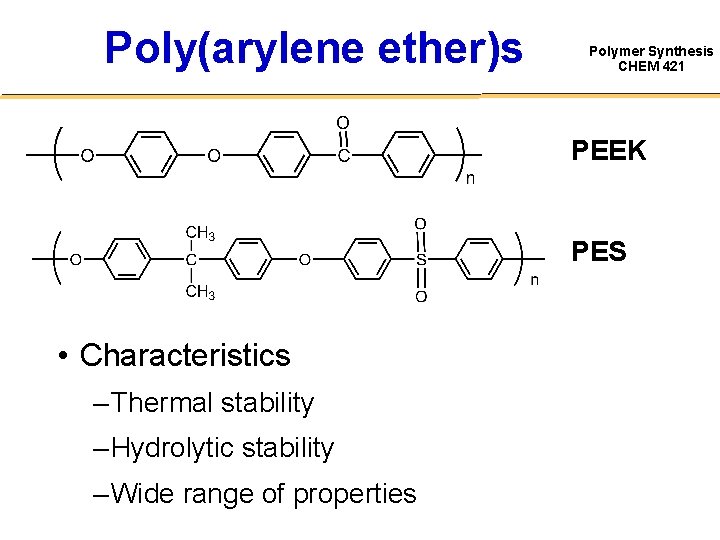
Polyarylene ethers Polymer Synthesis CHEM 421 PEEK PES

- Slides: 20
Poly(arylene ether)s Polymer Synthesis CHEM 421 PEEK PES • Characteristics – Thermal stability – Hydrolytic stability – Wide range of properties
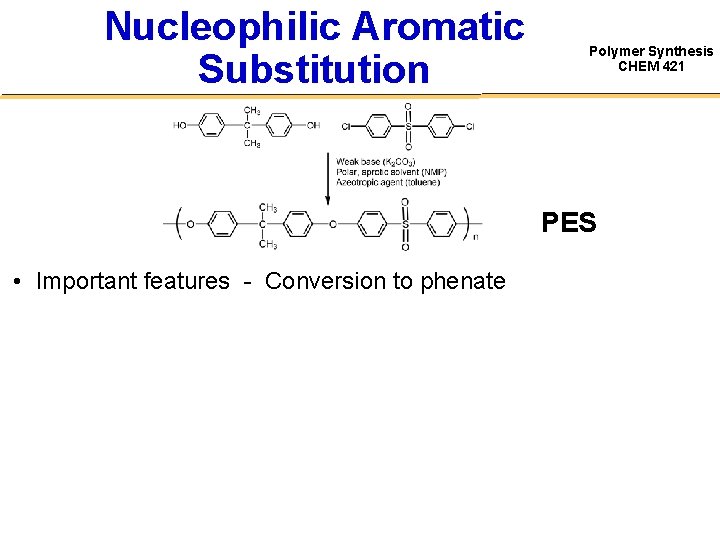
Nucleophilic Aromatic Substitution Polymer Synthesis CHEM 421 PES
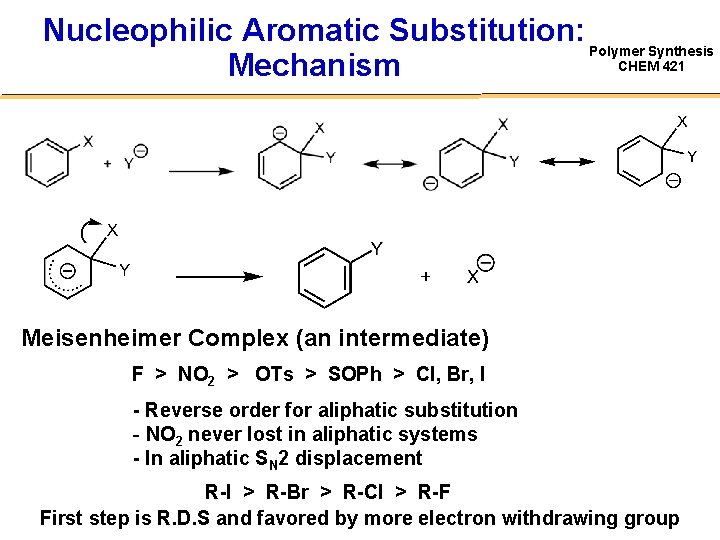
Nucleophilic Aromatic Substitution: Polymer Synthesis CHEM 421 Mechanism Meisenheimer Complex (an intermediate) F > NO 2 > OTs > SOPh > Cl, Br, I - Reverse order for aliphatic substitution - NO 2 never lost in aliphatic systems - In aliphatic SN 2 displacement R-I > R-Br > R-Cl > R-F First step is R. D. S and favored by more electron withdrawing group
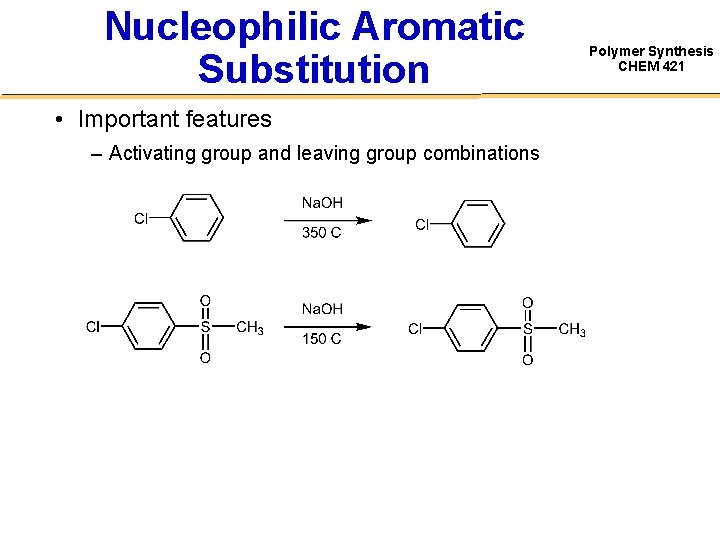
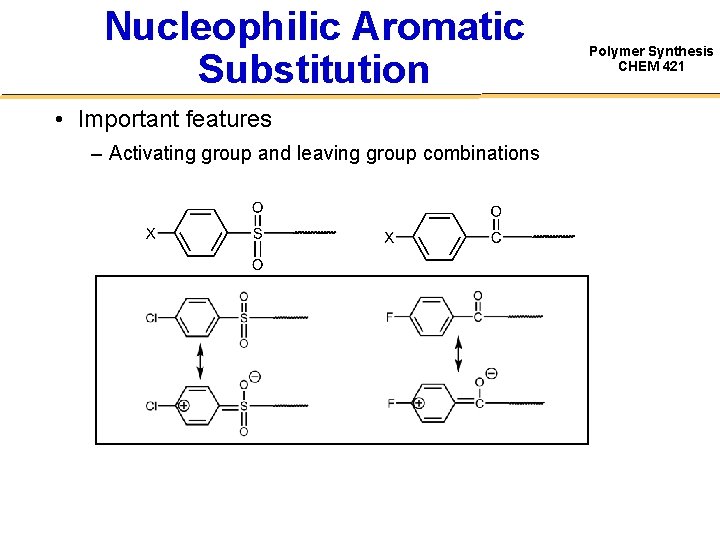
Nucleophilic Aromatic Substitution • Important features – Activating group and leaving group combinations Polymer Synthesis CHEM 421
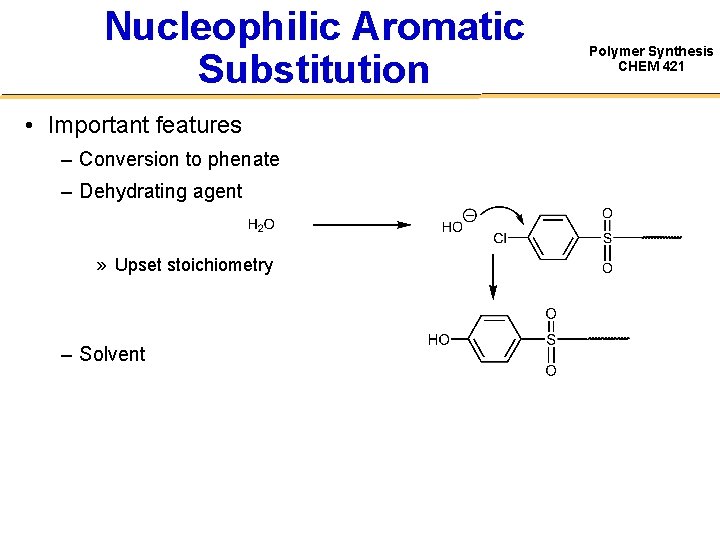
Nucleophilic Aromatic Substitution Polymer Synthesis CHEM 421 PES • Important features - Conversion to phenate
Nucleophilic Aromatic Substitution • Important features – Conversion to phenate – Dehydrating agent » Upset stoichiometry – Solvent Polymer Synthesis CHEM 421
Nucleophilic Aromatic Substitution • Important features – Activating group and leaving group combinations Polymer Synthesis CHEM 421
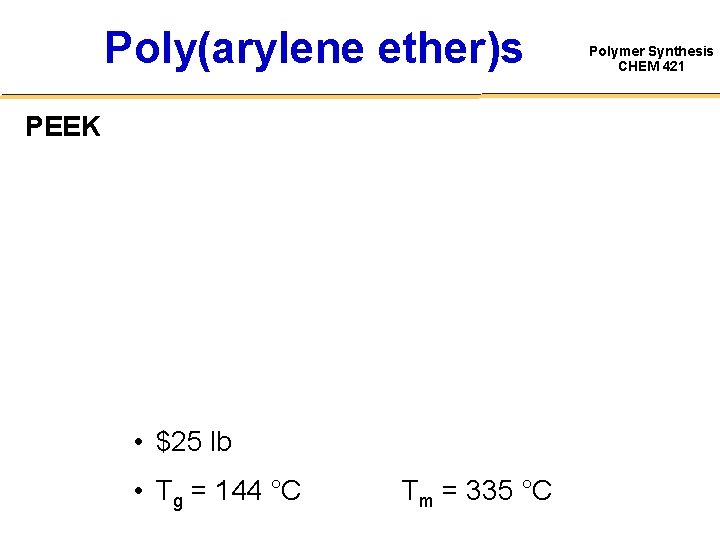
Poly(arylene ether)s PEEK • $25 lb • Tg = 144 °C Tm = 335 °C Polymer Synthesis CHEM 421
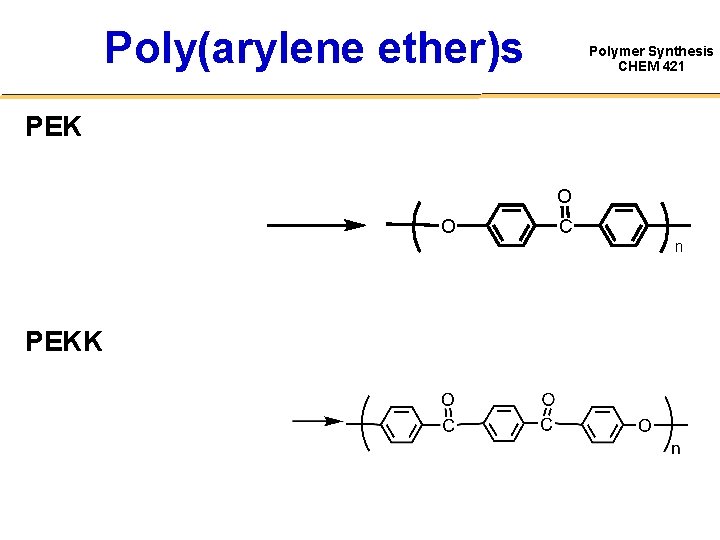
Poly(arylene ether)s Polymer Synthesis CHEM 421 PEK O O C n PEKK
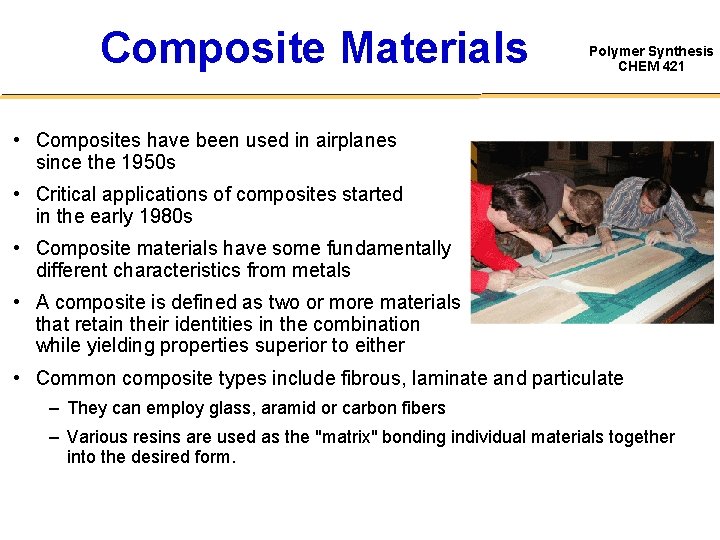
Composite Materials Polymer Synthesis CHEM 421 • Composites have been used in airplanes since the 1950 s • Critical applications of composites started in the early 1980 s • Composite materials have some fundamentally different characteristics from metals • A composite is defined as two or more materials that retain their identities in the combination while yielding properties superior to either • Common composite types include fibrous, laminate and particulate – They can employ glass, aramid or carbon fibers – Various resins are used as the "matrix" bonding individual materials together into the desired form.
Advantages of Composite Construction Polymer Synthesis CHEM 421 • Structural Tailorability – Fibers are able to be oriented in directions that are best for the design. – Metals have the same properties in all directions. • Lightweight Strength – The advantage of being lighter than metals is usually misunderstood – Composites indeed have lower density than most metals – But for structural stability and with other design reasons, composite airplanes usually weigh the same as metal airplanes – By using a greater amount of lighter material, structural parts like skins are relatively thicker – A composite aircraft has the feel of a more sturdy airplane, and also has better dampening (less vibration transmission)
Advantages of Composite Construction Polymer Synthesis CHEM 421 • Better aerodynamics – Composite manufacturing more readily allows complex curved surfaces with fewer joints, seams and rivets – Easier to get smooth surfaces for laminar flow designs which contributes to additional speed. • Stealth Potential – Ability to minimize radar cross section – Electronic transparency means antennas can be hidden inside for streamlining without loss of reception. • Simple assembly – Aircraft assembly simplified, since many of the fasteners and small parts can be replaced with larger, more integrated structures.
General Beliefs… Polymer Synthesis CHEM 421 • Composites are thought to be corrosion and fatigue resistant – “…Composites are not subject to corrosion from natural or man made elements…” – “…Certainly with composites, fatigue is less of an issue than with metals" Scott W. Beckwith Technical director Society for the Advancement of Material & Process Engineering
General Knowledge about Composites Polymer Synthesis CHEM 421 • Things that mitigate the ESC problem include: – Crystallinity – Filled systems – Crosslinking
Example from the Scientific Literature Polymer Synthesis CHEM 421 • “Environmental Stress Cracking and Solvent Effects in High-Performance Polymeric Composites” Dillard, Kander, et. al Composite Materials ASTM, 1996 • ESC of carbon fiber-reinforced thermoplastic and thermoset composite systems were investigated
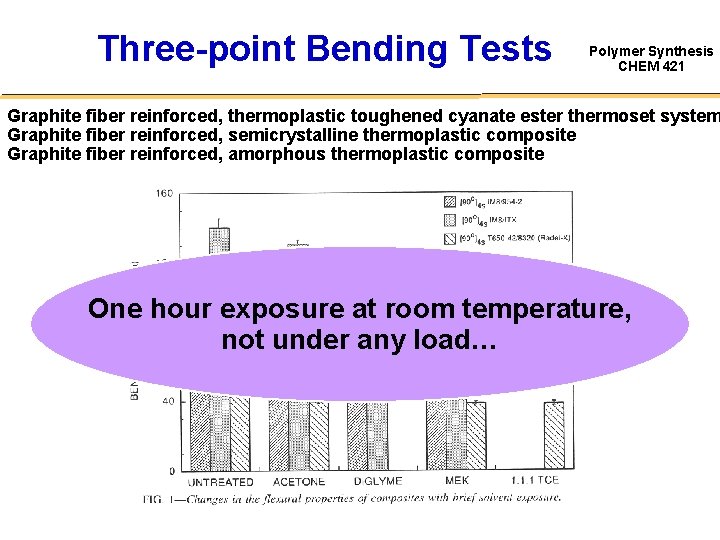
Three-point Bending Tests Polymer Synthesis CHEM 421 Graphite fiber reinforced, thermoplastic toughened cyanate ester thermoset system Graphite fiber reinforced, semicrystalline thermoplastic composite Graphite fiber reinforced, amorphous thermoplastic composite One hour exposure at room temperature, not under any load…
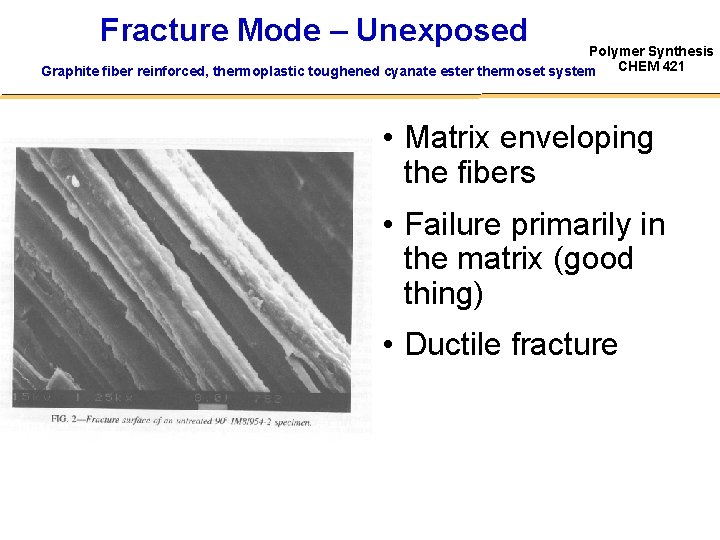
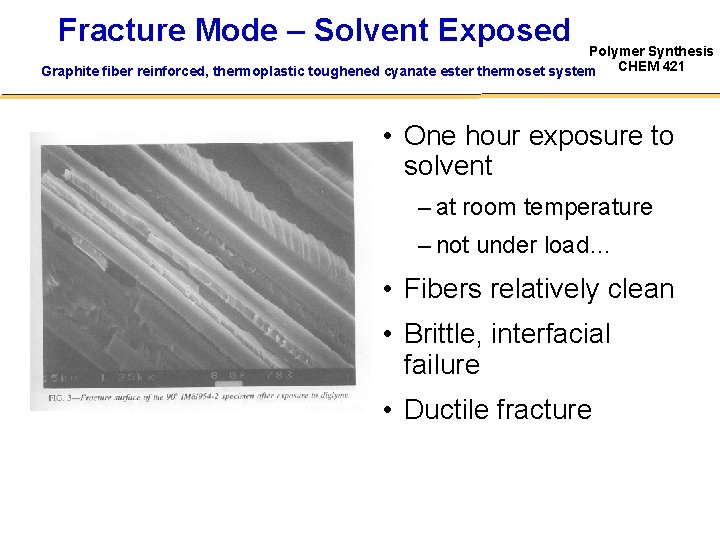
Fracture Mode – Unexposed Polymer Synthesis Graphite fiber reinforced, thermoplastic toughened cyanate ester thermoset system CHEM 421 • Matrix enveloping the fibers • Failure primarily in the matrix (good thing) • Ductile fracture
Fracture Mode – Solvent Exposed Polymer Synthesis Graphite fiber reinforced, thermoplastic toughened cyanate ester thermoset system CHEM 421 • One hour exposure to solvent – at room temperature – not under load… • Fibers relatively clean • Brittle, interfacial failure • Ductile fracture
Conclusions Polymer Synthesis CHEM 421 • “Environmental Stress Cracking and Solvent Effects in High-Performance Polymeric Composites” • 10 – 30% drop in bending strength under “safe” experimental conditions • Differences in failure modes upon solvent exposure • Propensity for interfacial failure
Research Questions Polymer Synthesis CHEM 421 • Are the long-term prospects clear for structural, load-bearing composites immersed in jet fuel in the F-22, JSF and Comanche? • What are the most appropriate methods for long-term aging studies of environmental stress cracking of composites for such applications? • Are there effective, easily implementable methods for mitigating solvent-induced ESC in composites?