
Pollinator Power Why should we care about pollinators
Pollinator Power! Why should we care about pollinators? Presented by: In partnership with:
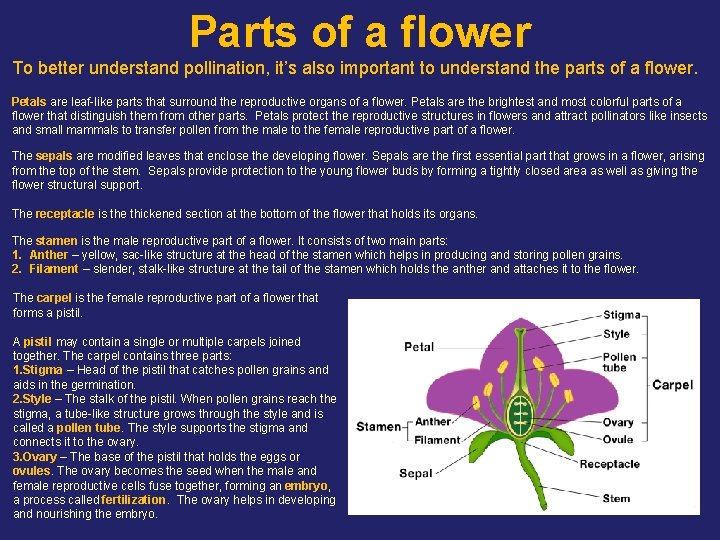
Parts of a flower To better understand pollination, it’s also important to understand the parts of a flower. Petals are leaf-like parts that surround the reproductive organs of a flower. Petals are the brightest and most colorful parts of a flower that distinguish them from other parts. Petals protect the reproductive structures in flowers and attract pollinators like insects and small mammals to transfer pollen from the male to the female reproductive part of a flower. The sepals are modified leaves that enclose the developing flower. Sepals are the first essential part that grows in a flower, arising from the top of the stem. Sepals provide protection to the young flower buds by forming a tightly closed area as well as giving the flower structural support. The receptacle is the thickened section at the bottom of the flower that holds its organs. The stamen is the male reproductive part of a flower. It consists of two main parts: 1. Anther – yellow, sac-like structure at the head of the stamen which helps in producing and storing pollen grains. 2. Filament – slender, stalk-like structure at the tail of the stamen which holds the anther and attaches it to the flower. The carpel is the female reproductive part of a flower that forms a pistil. A pistil may contain a single or multiple carpels joined together. The carpel contains three parts: 1. Stigma – Head of the pistil that catches pollen grains and aids in the germination. 2. Style – The stalk of the pistil. When pollen grains reach the stigma, a tube-like structure grows through the style and is called a pollen tube. The style supports the stigma and connects it to the ovary. 3. Ovary – The base of the pistil that holds the eggs or ovules. The ovary becomes the seed when the male and female reproductive cells fuse together, forming an embryo, a process called fertilization. The ovary helps in developing and nourishing the embryo.
What is Pollination? Pollination is the transfer of pollen from the male anther of a flower to the female stigma of the same species. This transfer is necessary to produce seeds and fruits. It also ensures genetic variability, which is vital to healthy plant populations. Plants can be pollinated by wind, water, and even through the actions of animals and insects. • Plants pollinated by wind produce small grains of pollen which are easily carried through the air. Since they are not trying to attract any pollinators to move the pollen, the flowers tend to be small and drab. • Animal and insect pollinated plants have a mutually beneficial relationship with their pollinators. The plants provide a resource for the pollinator such as food in the form of nectar or the pollen itself. The process of collecting that resource transfers some of the pollen from one flower to another, which benefits both the plants and the pollinators. Animal and insect pollinated flowers also “show off” through color, shape, and scent. Some insect pollinated flowers draw pollinators closer by using ultra -violet guides that cannot be seen by the human eye.
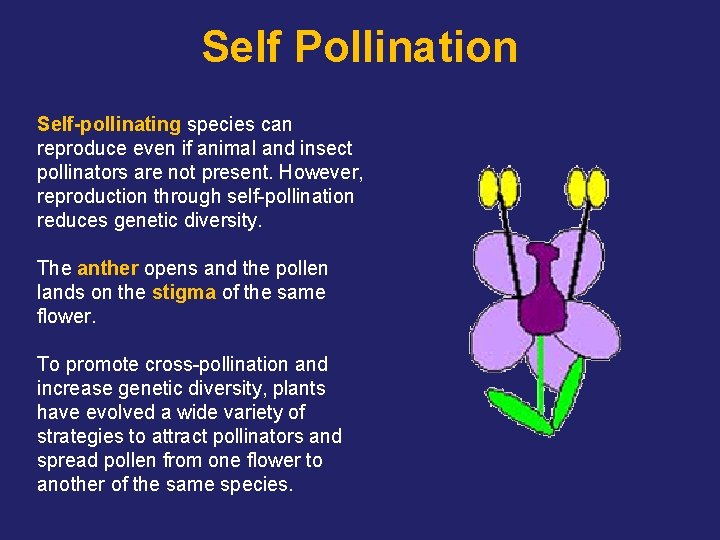
Self Pollination Self-pollinating species can reproduce even if animal and insect pollinators are not present. However, reproduction through self-pollination reduces genetic diversity. The anther opens and the pollen lands on the stigma of the same flower. To promote cross-pollination and increase genetic diversity, plants have evolved a wide variety of strategies to attract pollinators and spread pollen from one flower to another of the same species.
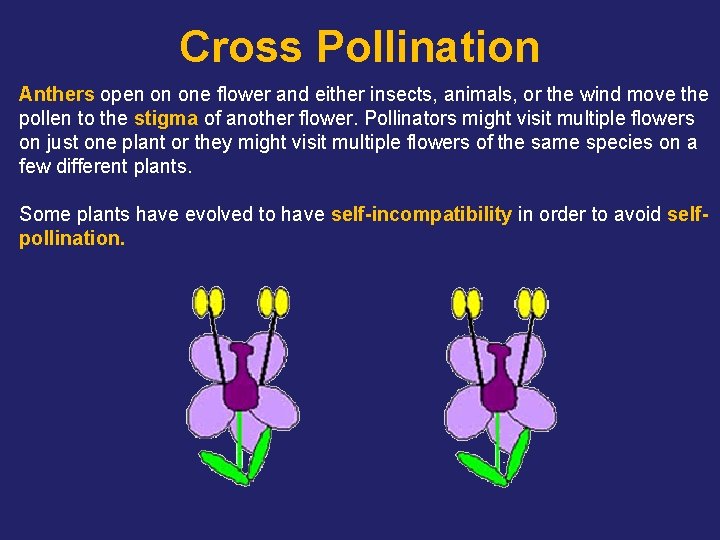
Cross Pollination Anthers open on one flower and either insects, animals, or the wind move the pollen to the stigma of another flower. Pollinators might visit multiple flowers on just one plant or they might visit multiple flowers of the same species on a few different plants. Some plants have evolved to have self-incompatibility in order to avoid selfpollination.
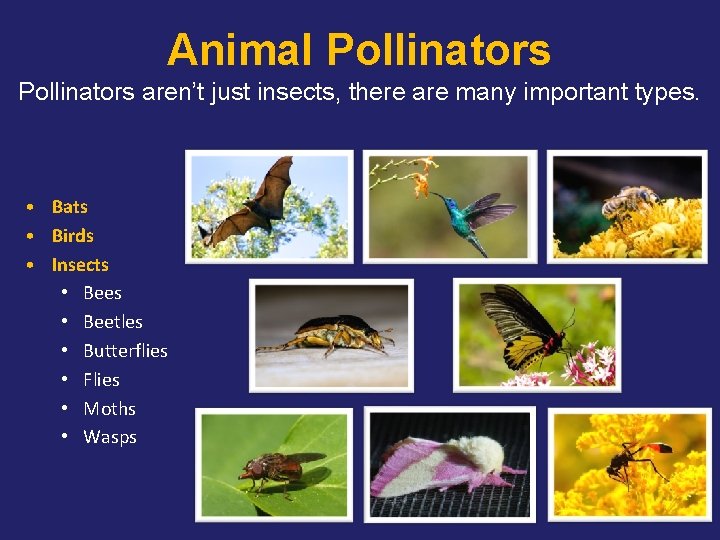
Animal Pollinators aren’t just insects, there are many important types. • Bats • Birds • Insects • Beetles • Butterflies • Flies • Moths • Wasps
Why do pollinators visit flowers? Animal and insect pollinators obtain food in the form of energy-rich nectar and/or protein-rich pollen from the flowers they visit. In return, the flowers benefit from the pollinators carrying pollen from one flower to another. Food is often a good enough lure for pollinators, but flowering plants also attract pollinators using petal shapes, scents, and colors. Pollination syndromes have been described to depict the attraction of certain types, shapes, colors, and fragrances of flowers to a range of pollinators. Both the plants and pollinators have co-developed characteristics that make them more likely to interact well. • The plants benefit from attracting a certain type of pollinator to its flower. This helps ensure that its pollen will be carried to another flower of the same species and hopefully resulting in successful reproduction. • The pollinator benefits from its adaptation to a particular flower type by ensuring that it will be able to find access important food resources - nectar and pollen. These relationships are considered mutualistic. Animals, wind, and water can all carry pollen. The flower type, shape, color, odor, nectar, and structure vary by the type of pollinator that visits them. These characteristics are considered pollination syndromes and can be used to predict the type of pollinator that will aid the flower in successful reproduction.
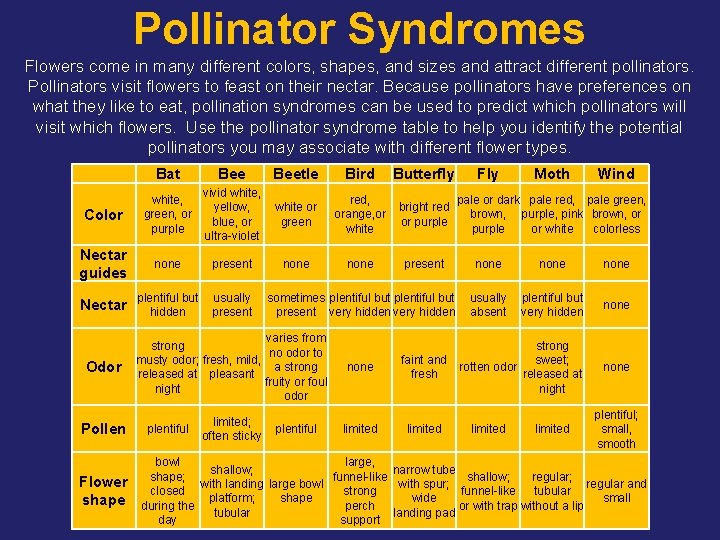
Pollinator Syndromes Flowers come in many different colors, shapes, and sizes and attract different pollinators. Pollinators visit flowers to feast on their nectar. Because pollinators have preferences on what they like to eat, pollination syndromes can be used to predict which pollinators will visit which flowers. Use the pollinator syndrome table to help you identify the potential pollinators you may associate with different flower types. Bat Beetle Bird Butterfly Color white, green, or purple vivid white, yellow, blue, or ultra-violet white or green red, orange, or white bright red or purple Nectar guides none present Nectar plentiful but hidden usually present sometimes plentiful but present very hidden Odor varies from strong no odor to musty odor; fresh, mild, a strong released at pleasant fruity or foul night odor Pollen limited; often sticky Flower shape plentiful none limited faint and fresh limited Fly Moth Wind pale or dark pale red, pale green, brown, purple, pink brown, or purple or white colorless none usually absent plentiful but very hidden none strong sweet; rotten odor released at night none limited plentiful; small, smooth bowl large, shallow; narrow tube shape; funnel-like shallow; regular; with landing large bowl with spur; regular and closed strong funnel-like tubular platform; wide shape small during the perch or with trap without a lip tubular landing pad day support
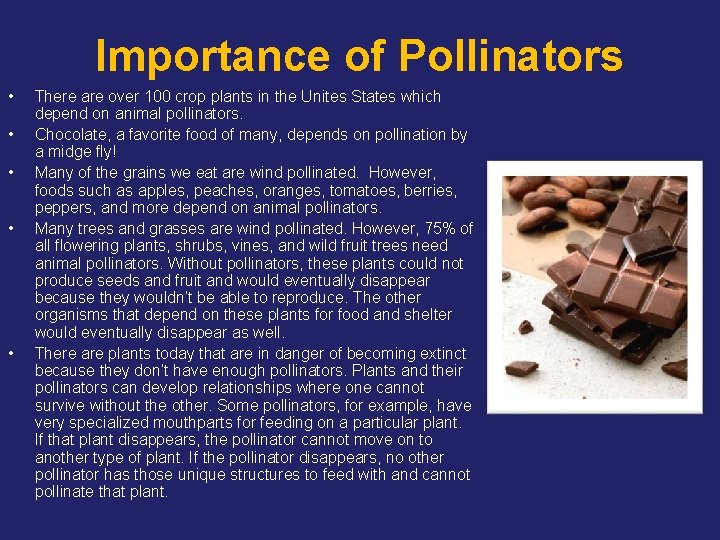
Importance of Pollinators • • • There are over 100 crop plants in the Unites States which depend on animal pollinators. Chocolate, a favorite food of many, depends on pollination by a midge fly! Many of the grains we eat are wind pollinated. However, foods such as apples, peaches, oranges, tomatoes, berries, peppers, and more depend on animal pollinators. Many trees and grasses are wind pollinated. However, 75% of all flowering plants, shrubs, vines, and wild fruit trees need animal pollinators. Without pollinators, these plants could not produce seeds and fruit and would eventually disappear because they wouldn’t be able to reproduce. The other organisms that depend on these plants for food and shelter would eventually disappear as well. There are plants today that are in danger of becoming extinct because they don’t have enough pollinators. Plants and their pollinators can develop relationships where one cannot survive without the other. Some pollinators, for example, have very specialized mouthparts for feeding on a particular plant. If that plant disappears, the pollinator cannot move on to another type of plant. If the pollinator disappears, no other pollinator has those unique structures to feed with and cannot pollinate that plant.
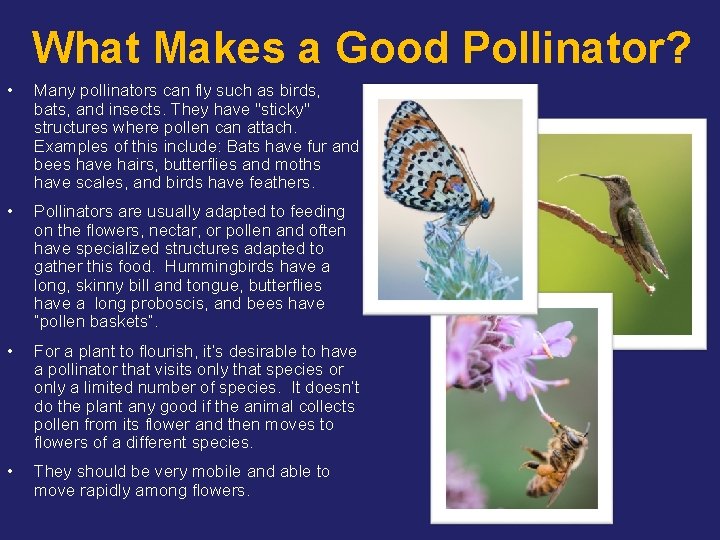
What Makes a Good Pollinator? • Many pollinators can fly such as birds, bats, and insects. They have "sticky" structures where pollen can attach. Examples of this include: Bats have fur and bees have hairs, butterflies and moths have scales, and birds have feathers. • Pollinators are usually adapted to feeding on the flowers, nectar, or pollen and often have specialized structures adapted to gather this food. Hummingbirds have a long, skinny bill and tongue, butterflies have a long proboscis, and bees have “pollen baskets”. • For a plant to flourish, it’s desirable to have a pollinator that visits only that species or only a limited number of species. It doesn’t do the plant any good if the animal collects pollen from its flower and then moves to flowers of a different species. • They should be very mobile and able to move rapidly among flowers.
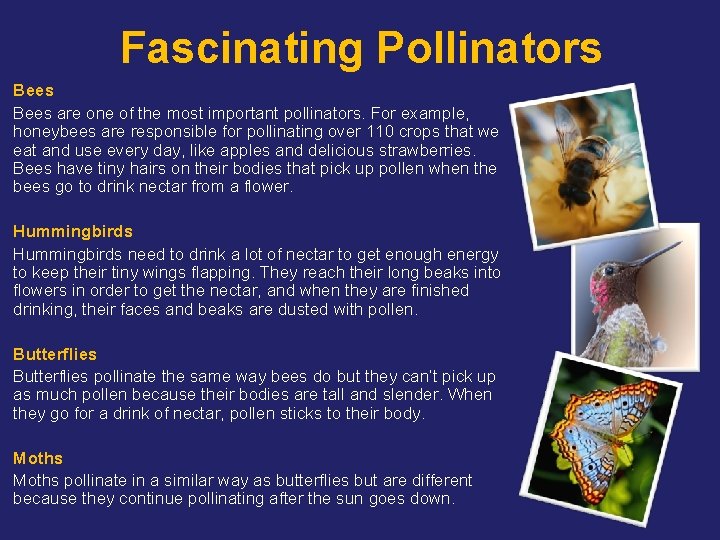
Fascinating Pollinators Bees are one of the most important pollinators. For example, honeybees are responsible for pollinating over 110 crops that we eat and use every day, like apples and delicious strawberries. Bees have tiny hairs on their bodies that pick up pollen when the bees go to drink nectar from a flower. Hummingbirds need to drink a lot of nectar to get enough energy to keep their tiny wings flapping. They reach their long beaks into flowers in order to get the nectar, and when they are finished drinking, their faces and beaks are dusted with pollen. Butterflies pollinate the same way bees do but they can’t pick up as much pollen because their bodies are tall and slender. When they go for a drink of nectar, pollen sticks to their body. Moths pollinate in a similar way as butterflies but are different because they continue pollinating after the sun goes down.
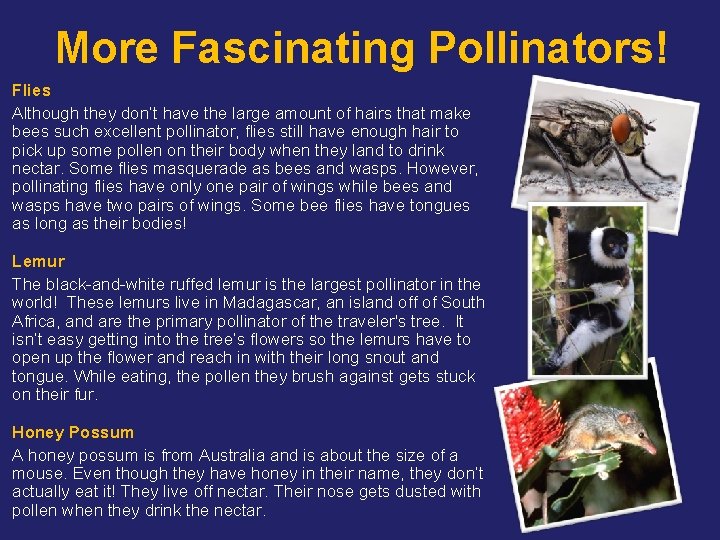
More Fascinating Pollinators! Flies Although they don’t have the large amount of hairs that make bees such excellent pollinator, flies still have enough hair to pick up some pollen on their body when they land to drink nectar. Some flies masquerade as bees and wasps. However, pollinating flies have only one pair of wings while bees and wasps have two pairs of wings. Some bee flies have tongues as long as their bodies! Lemur The black-and-white ruffed lemur is the largest pollinator in the world! These lemurs live in Madagascar, an island off of South Africa, and are the primary pollinator of the traveler's tree. It isn’t easy getting into the tree’s flowers so the lemurs have to open up the flower and reach in with their long snout and tongue. While eating, the pollen they brush against gets stuck on their fur. Honey Possum A honey possum is from Australia and is about the size of a mouse. Even though they have honey in their name, they don’t actually eat it! They live off nectar. Their nose gets dusted with pollen when they drink the nectar.
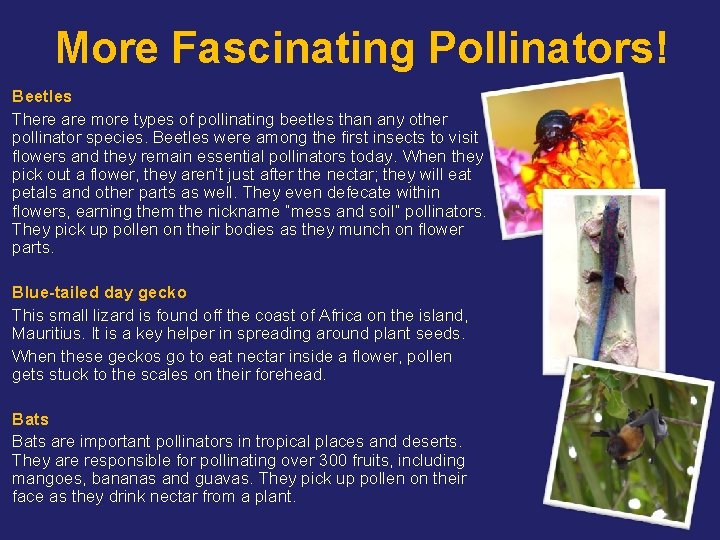
More Fascinating Pollinators! Beetles There are more types of pollinating beetles than any other pollinator species. Beetles were among the first insects to visit flowers and they remain essential pollinators today. When they pick out a flower, they aren’t just after the nectar; they will eat petals and other parts as well. They even defecate within flowers, earning them the nickname “mess and soil” pollinators. They pick up pollen on their bodies as they munch on flower parts. Blue-tailed day gecko This small lizard is found off the coast of Africa on the island, Mauritius. It is a key helper in spreading around plant seeds. When these geckos go to eat nectar inside a flower, pollen gets stuck to the scales on their forehead. Bats are important pollinators in tropical places and deserts. They are responsible for pollinating over 300 fruits, including mangoes, bananas and guavas. They pick up pollen on their face as they drink nectar from a plant.
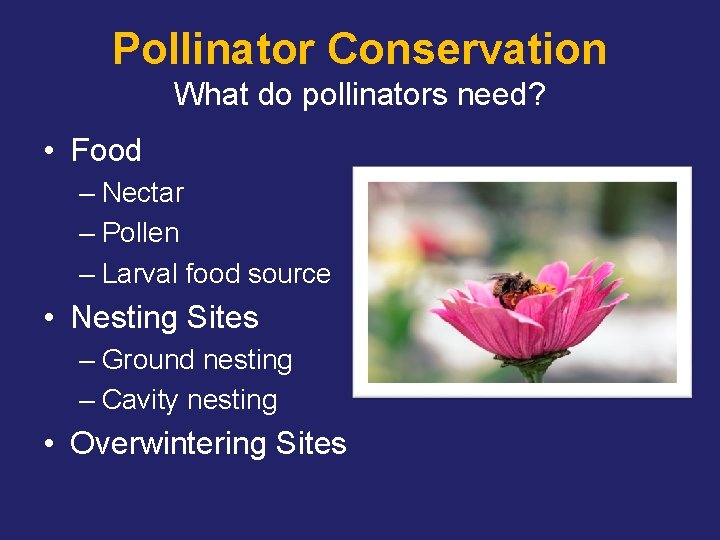
Pollinator Conservation What do pollinators need? • Food – Nectar – Pollen – Larval food source • Nesting Sites – Ground nesting – Cavity nesting • Overwintering Sites
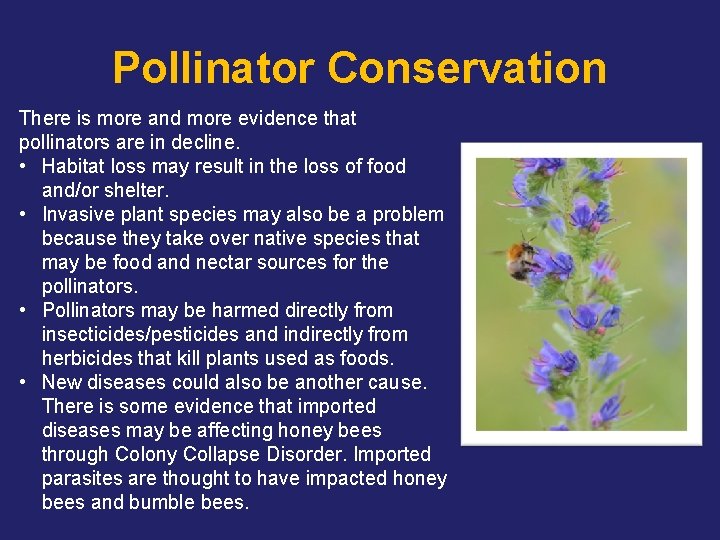
Pollinator Conservation There is more and more evidence that pollinators are in decline. • Habitat loss may result in the loss of food and/or shelter. • Invasive plant species may also be a problem because they take over native species that may be food and nectar sources for the pollinators. • Pollinators may be harmed directly from insecticides/pesticides and indirectly from herbicides that kill plants used as foods. • New diseases could also be another cause. There is some evidence that imported diseases may be affecting honey bees through Colony Collapse Disorder. Imported parasites are thought to have impacted honey bees and bumble bees.
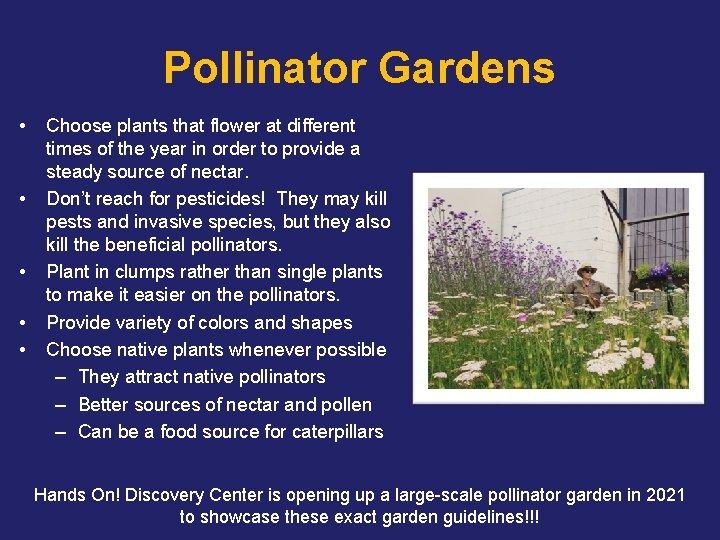
Pollinator Gardens • • • Choose plants that flower at different times of the year in order to provide a steady source of nectar. Don’t reach for pesticides! They may kill pests and invasive species, but they also kill the beneficial pollinators. Plant in clumps rather than single plants to make it easier on the pollinators. Provide variety of colors and shapes Choose native plants whenever possible – They attract native pollinators – Better sources of nectar and pollen – Can be a food source for caterpillars Hands On! Discovery Center is opening up a large-scale pollinator garden in 2021 to showcase these exact garden guidelines!!!
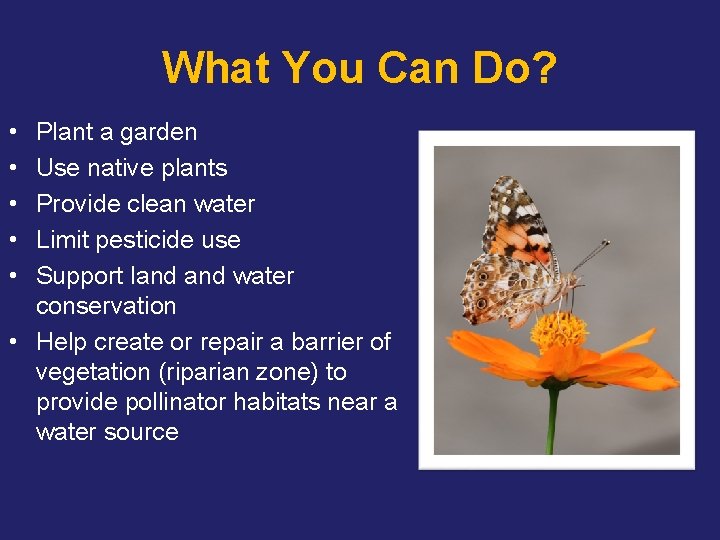
What You Can Do? • • • Plant a garden Use native plants Provide clean water Limit pesticide use Support land water conservation • Help create or repair a barrier of vegetation (riparian zone) to provide pollinator habitats near a water source
Riparian Zones Riparian zones are the habitat between land a river or stream. They are full of diversity and many plants and animals make it their home. The diverse vegetation that grows along streams and rivers acts as a protective buffer between the land the water. Native vegetation that occurs along waterfronts provide an attractive landscape with many important benefits and helps preserve plants and animals that make our area unique. Riparian zones can be very valuable for pollinators. Plants that live in the Riparian zone are used to a life around water. These plants have many beneficial qualities for the rivers and surrounding habitats. Riparian zones do many things for ecosystems above and below the water: – – – – – Create opportunities for animal movement along the rivers Shade the water creating a variety of water temperatures for wildlife to thrive Root systems create pockets for fish and other invertebrates to find shelter Help slow the flow of water, making life easier for certain animals and helps distribute nutrients Filter out excess sediment from flowing into rivers and streams Filter out runoff of nutrients and fertilizers from farms and other agricultural establishments Preserve the soil and prevent soil erosion, as well as undercutting of banks Branches, stems, and leaves absorb impact of rain Groundcover (decaying leaves and low growing vegetation) increase absorption by slowing runoff Provide habitats for wildlife including pollinators The Tennessee Valley Authority (TVA) has long recognized the need to promote protection and restoration of riparian zones. TVA encourages streambank and reservoir shoreline property owners to protect and enhance riparian zones, as well as, restore native vegetation.
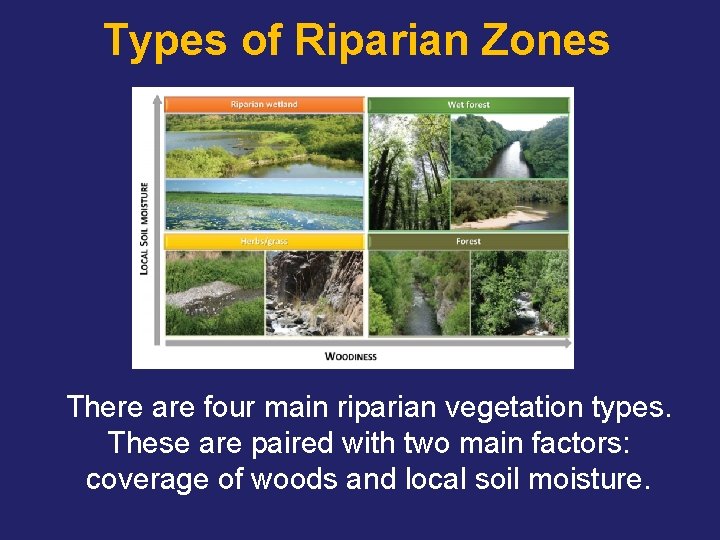
Types of Riparian Zones There are four main riparian vegetation types. These are paired with two main factors: coverage of woods and local soil moisture.
Thank you for bringing us into your classroom! “Bee” sure to check out the corresponding activities located on the Hands On! Discovery Center website! Presented by: Sponsored by:
- Slides: 20