
Poll Question Instructions Please follow the instructions below
Poll Question Instructions Please follow the instructions below to participate in our poll on homestay companies. Answers will be aggregated and shown during the presentation. 1. Go To Menti. com (works on phone or laptop) 2. Use The Code 98 26 4 3. Answer The Questions
Poll Questions: Go To Menti. com And Use Code 98 26 4 The Law Offices of Mark A. Cuthbertson 434 New York Avenue Huntington, NY 11743 Tel: (631) 351 -3501 Fax: (631) 427 -9507 www. cuthbertsonlaw. com
Poll Questions: Go To Menti. com And Use Code 98 26 4 Short-Term Rental Regulations East End Supervisors And Mayors Association
Poll Questions: Go To Menti. com And Use Code 98 26 4 A Guide To Short-Term Rental Regulations CNBC Reports On Air. Bn. B In Miami Beach
Poll Questions: Go To Menti. com And Use Code 98 26 4 A Guide To Short-Term Rental Regulations Background
Poll Questions: Go To Menti. com And Use Code 98 26 4 A Guide To Short-Term Rental Regulations Technology Brings Change Technology companies have revolutionized modern society. Amazon created a paradigm shift in how people shop. Google has become so ubiquitous, its very name is a verb meaning “to search. ” Netflix has redefined television. The common thread is that tech companies challenge the status quo, and while consumers may ultimately benefit from their actions, these disruptive forces inevitably create problems for society at large.
Poll Questions: Go To Menti. com And Use Code 98 26 4 A Guide To Short-Term Rental Regulations Technology Brings Change This presentation concerns “homestay companies” like Air. Bn. B, with a focus on the challenges these companies pose, and how municipalities have attempted to regulate these short-term rentals, a commercial use, in residential dwellings.
A Guide To Short-Term Rental Regulations Poll: Have You Ever Used A Homestay Company App or Website? 1. Yes 2. No
A Guide To Short-Term Rental Regulations Poll: Have You Ever Booked A Reservation Through A Homestay Company? 1. Yes 2. No
A Guide To Short-Term Rental Regulations Poll: Have You Ever Posted A Listing Through A Homestay Company? 1. Yes 2. No
A Guide To Short-Term Rental Regulations Poll: Have You Drafted Or Been Involved With Adopting Homestay Regulations? 1. Drafted 2. Adopted 3. Neither
A Guide To Short-Term Rental Regulations
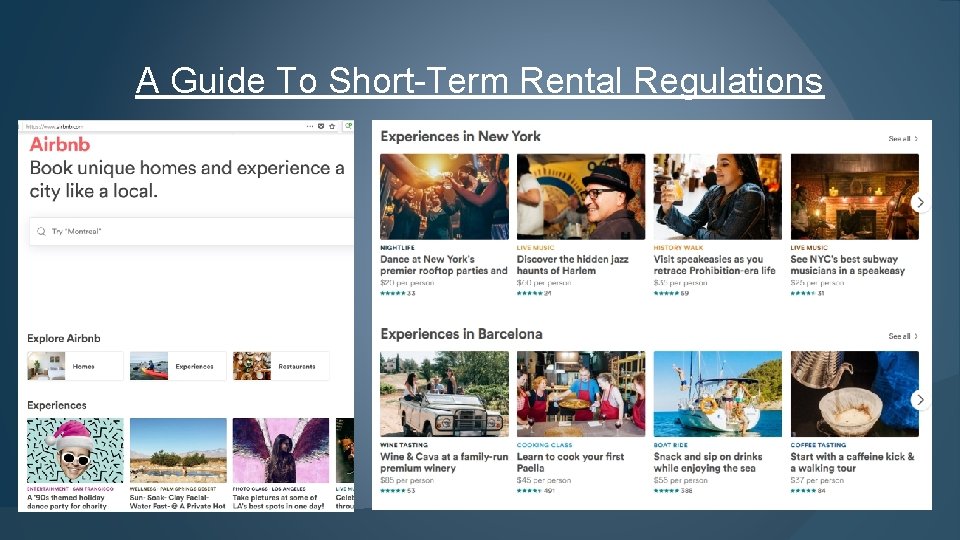
A Guide To Short-Term Rental Regulations Homestay Companies – How They Work Most homestay companies follow the Air. Bn. B model, where “hosts” rent to guests by listing their accommodations on the company’s website or mobile app. Such rentals can range from a couch in an apartment to an entire single-family home, and can be rented on anywhere from a nightly to monthly basis. Hosts set their own prices, with homestay companies taking a fee from both guest and host.
A Guide To Short-Term Rental Regulations Homestay Companies – How They Work Homestay companies also provide safety features like background checks on both hosts and guests, identity verification, secure payment services, and secondary insurance (with hosts required to carry their own primary insurance). Air. Bn. B also includes a logged private messaging system, and allows hosts to decline or cancel reservations, subject to limits like anti-discrimination laws. A detailed explanation of how homestay companies work can be found in the case Airbnb, Inc. v. City of New York, 2019 WL 91990 (S. D. N. Y. Jan. 3, 2019).
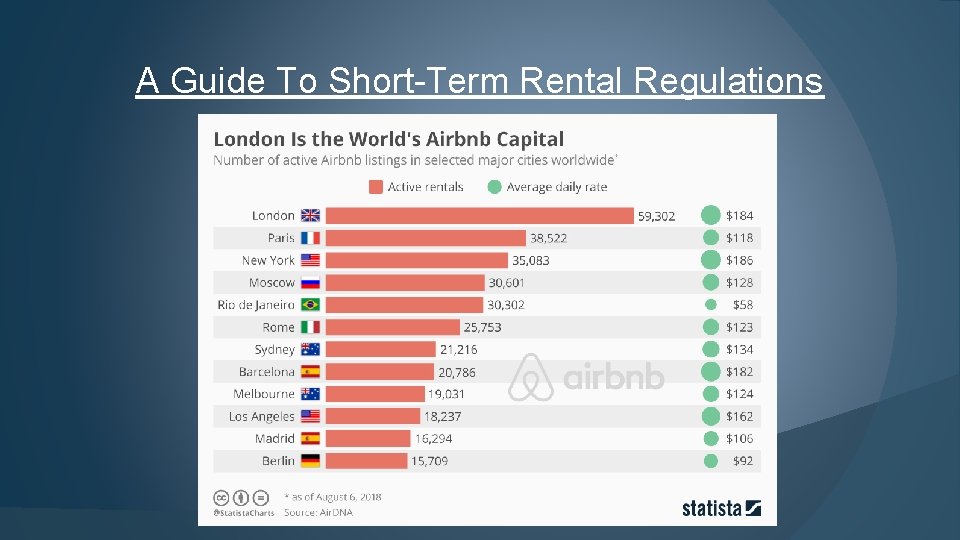
A Guide To Short-Term Rental Regulations How Widespread Are Homestay Companies? Air. Bn. B is valued at over $31 billion, and generated $2. 6 billion in revenue in 2017. The company boasts over 4 million listings across 65, 000 cities in 190 countries. It also claims to have 150 million registered users globally, and it maintains offices in 21 cities around the world. There also numerous smaller homestay companies, such as VRBO, Home. Away, Be. Welcome, and Couch. Surfing, that provide similar services.
A Guide To Short-Term Rental Regulations
A Guide To Short-Term Rental Regulations Homestay Companies In New York State In 2018, Air. Bn. B reported that a record 139, 200 guests stayed on Long Island, including 25, 000 guests in Nassau County and 114, 200 guests in Suffolk County. This is a huge increase from the 74, 000 guests reported in 2016, largely driven by the 38% increase in year-over-year bookings between May 25 and September 3. Air. Bn. B also reported that while guests came from 76 countries, New York City and New York State remained the top city and state of origin for guests.
A Guide To Short-Term Rental Regulations Homestay Companies In New York State The number of hosts also increased in 2018, with Air. Bn. B reporting hundreds of first-time renters. There are now 560 hosts in Nassau, earning an average of $7, 800 annually, and 3, 600 hosts in Suffolk, earning an average of $11, 400 annually. In total, Long Island hosts took in nearly $50 million in revenue in 2018. Notably, Air. Bn. B officials have testified before several Town Boards that the vast majority of its hosts only rent their homes or apartments on a part-time basis, rather than operating a full-time commercial enterprise.
A Guide To Short-Term Rental Regulations Benefits and Criticisms
A Guide To Short-Term Rental Regulations Benefits and Criticisms - Introduction As discussed in the following slides, homestay companies have faced criticism on several fronts, particularly at the local level. Yet Air. Bn. B’s rapid growth despite this pushback, both in New York and globally, shows that demand for its services remains high, and that its users are largely content with how it operates. Before examining possible regulatory approaches to short-term rentals, it is important to understand both the benefits and drawbacks of homestay companies and the explosion in the number of short-term rentals that they have created.
A Guide To Short-Term Rental Regulations Benefits For Hosts For hosts, Air. Bn. B provides a significant supplemental source of income. As previously noted, Air. Bn. B hosts in Suffolk nade an average of $11, 400 in 2018. These funds can be used to offset the high cost of living by helping to pay the property’s mortgage, property taxes, or to fund home renovations. Some hosts also rent socially, using Air. Bn. B as a medium for meeting new people with a variety of backgrounds.
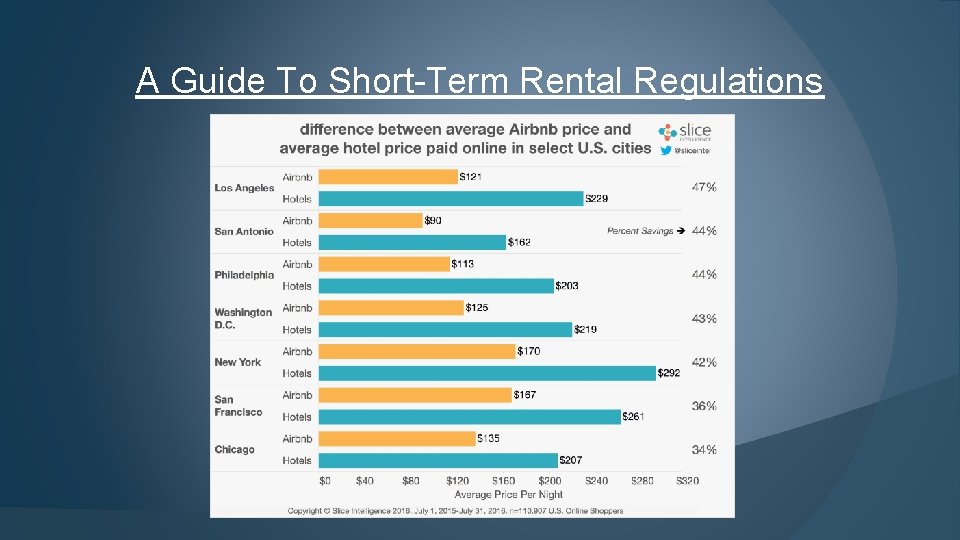
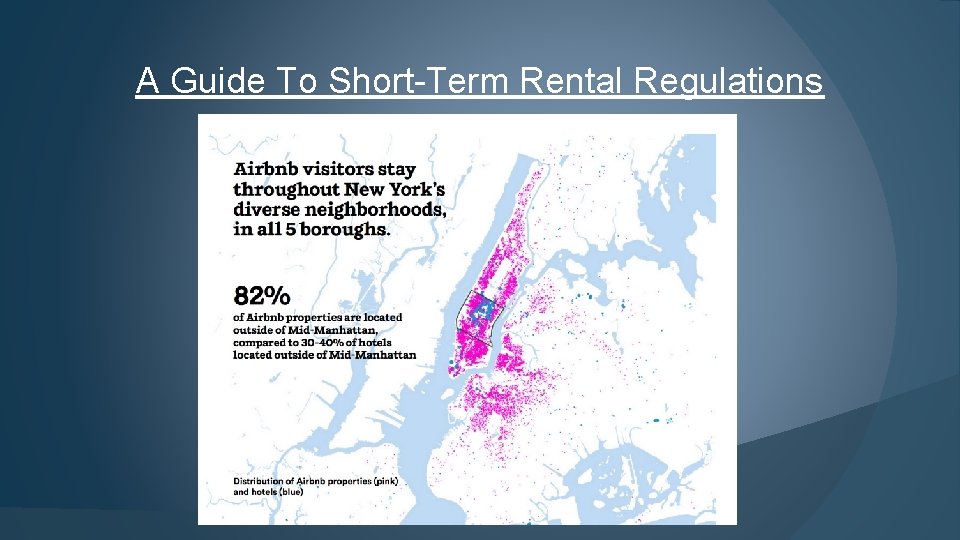
A Guide To Short-Term Rental Regulations Benefits For Guests For guests, Air. Bn. B provides an alternative to traditional hotels that better fit their individual needs. While some guests may seek cheaper or more conveniently located accommodations than a hotel, others may place more value on the “feel” or “experience” of a given neighborhood. In sum, guests benefit from the greater flexibility homestay companies offer, while having security measures that make renting simple and safe.
A Guide To Short-Term Rental Regulations
A Guide To Short-Term Rental Regulations
A Guide To Short-Term Rental Regulations
A Guide To Short-Term Rental Regulations Criticisms – Quality Of Life Though beloved by users, Air. Bn. B has come under fire for the negative impacts, whether real or perceived, associated with short-term rentals. Such criticisms are often made by local officials and civic associations concerned about how shortterm rentals impact the character of the neighborhood and quality of life. Common complaints include excessive noise (both day and night), large gatherings, reduced parking, and other impacts adversely affecting residents.

A Guide To Short-Term Rental Regulations
A Guide To Short-Term Rental Regulations Criticisms – Quality Of Life There are numerous examples of quality of life complaints across Long Island: • In Lido Beach, residents testified before the Hempstead Town Board that Air. Bn. B had created “unsafe party houses” near their beachfront homes. • In the Town of Islip, residents testified that Air. Bn. B has resulted in “car overcrowding, loud music and noise from parties well into the late-night hours. ”
A Guide To Short-Term Rental Regulations Criticisms – Quality Of Life Faced with these testimonials, Air. Bn. B and its supporters maintain that these incidents represent a few bad actors, and not the majority of user experiences. Regardless, these impacts have upset local residents concerned that the peace and quiet of their neighborhood is being disturbed, leading some municipalities to ban or severely restrict short-term rentals. The practice of buying properties to use as short-term rentals also raises the ire of municipalities, which object to the full-time commercial use in residential areas.
A Guide To Short-Term Rental Regulations Criticisms – Housing Concerns Critics also allege homestay companies adversely impact housing by encouraging investors to buy multiple dwellings to use as short-term rentals on a full-time basis. They argue this contributes to housing shortages and rising rental costs, particularly in places where affordable rental housing is already in short supply. For example, the New York State Attorney General’s Office reported that in 2013, more than 4, 600 units were booked in New York City as short-term rentals for at least a quarter of the year, with 2, 000 units having been rented at least 182 days. This prevented these dwellings from being occupied by long-term residents.
A Guide To Short-Term Rental Regulations Criticisms – Housing Concerns The Attorney General’s Office also found that “few Air. Bn. B hosts appear to have filed the paperwork with New York City necessary to remit hotel occupancy taxes, ” nor had Air. Bn. B collected it on their behalf. However, Air. Bn. B has since entered into agreements with various national, state, and county governments (but not Nassau or Suffolk County) to collect such taxes as part of the reservation fee.
A Guide To Short-Term Rental Regulations Criticisms – Accountability Finally, investor-owners of short-term rental properties, who are largely absentee owners, are often criticized as being unaccountable to the neighbors and communities where the rentals are located. Critics claim that the absence of these owners amplifies the adverse quality of life impacts discussed above, arguing that such impacts might be prevented if a host was present to oversee guests and respond to neighbor complaints.
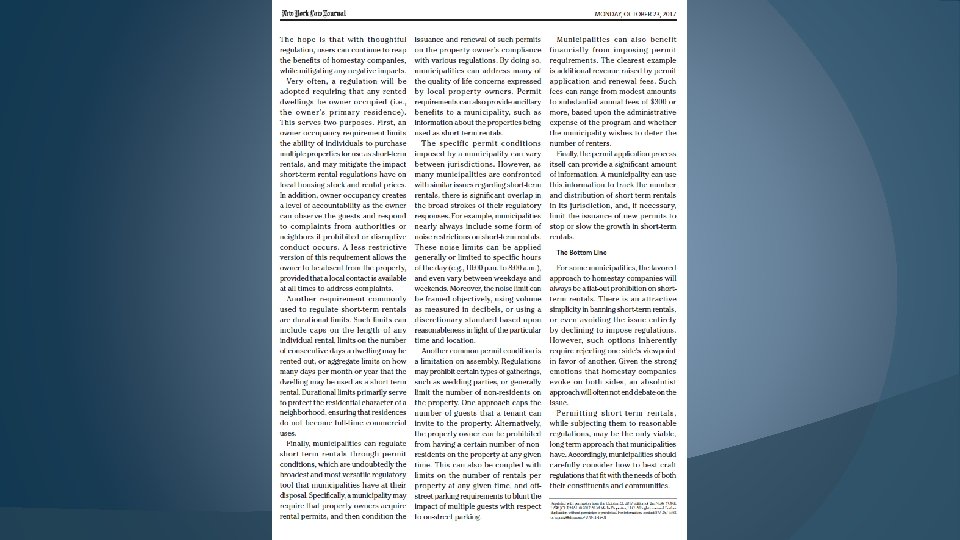
A Guide To Short-Term Rental Regulations The Need For Regulation Given the sheer size and reach of companies like Air. Bn. B, there is little doubt that the short-term rental market will continue to grow. However, the criticism from local residents is driving many municipalities to reexamine their short-term rental laws in light of the challenges that homestay companies pose. The hope is that with thoughtful regulation, users can continue to reap the benefits of Air. Bn. B, while mitigating any associated negative impacts in their communities.
A Guide To Short-Term Rental Regulations Areas Of Potential Municipal Regulation
A Guide To Short-Term Rental Regulations
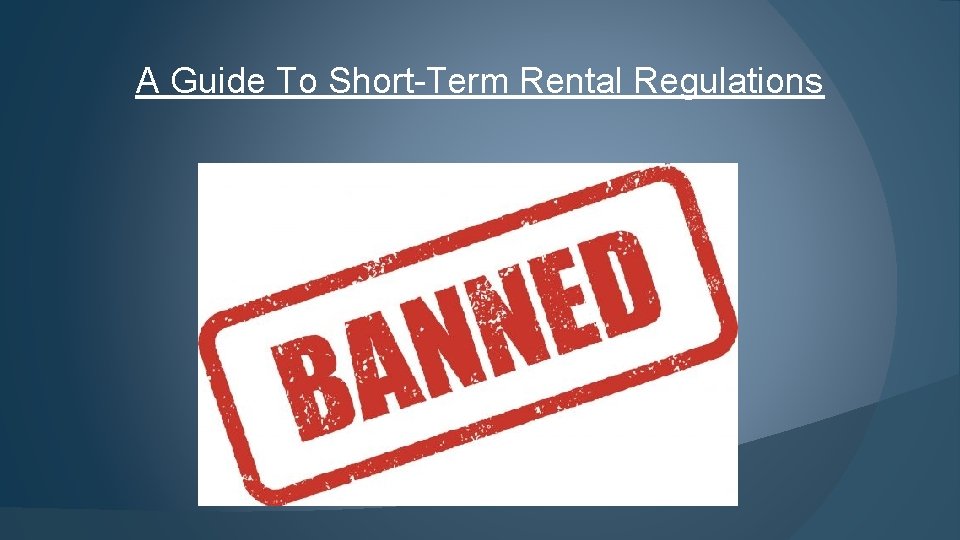
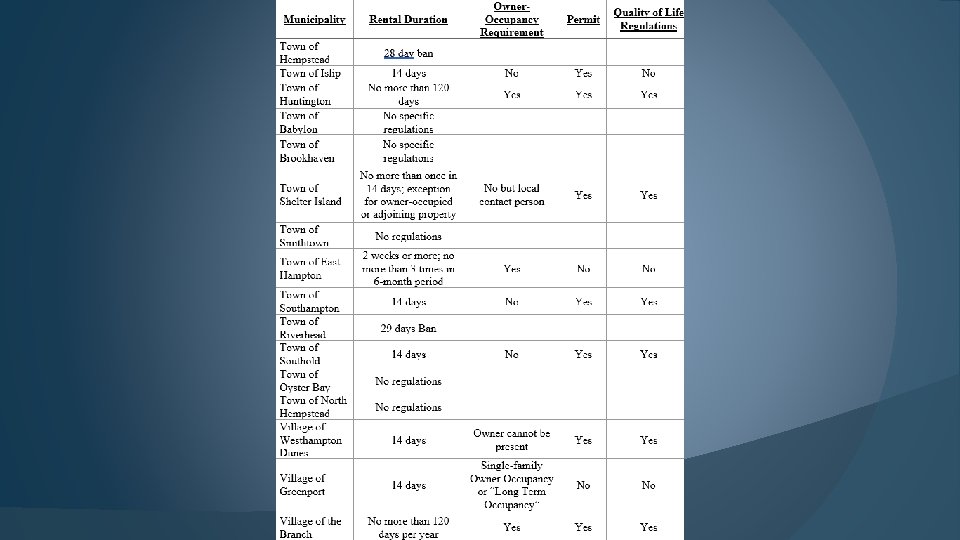
A Guide To Short-Term Rental Regulations Regulatory Issue Overview Whether regulations on short-term rentals (i. e. rentals for less than 30 days) are being considered at the Town or Village level, there are many options available. Municipalities can impose an absolute prohibition on short-term rentals, adopt any of a wide variety of regulations, or even leave such rentals totally unregulated.
A Guide To Short-Term Rental Regulations Regulatory Issue Overview Very often, regulations will depend upon context. Tourist areas are more likely to consider permitting regulations due to the positive economic impact that shortterm rentals have on the local economy, particularly in the summer months. In contrast, residential and/or affluent villages are more likely to ban short-term rentals or impose strict regulations to protect quality of life. Other municipalities may seek to strike a middle ground between the two positions.
A Guide To Short-Term Rental Regulations Poll: What Kind Of Regulations Does Your Municipality Currently Have? 1. Absolute Ban 2. Regulatory Scheme 3. No regulations
A Guide To Short-Term Rental Regulations Poll: Is Your Municipality Looking To Change Or Update Its Short Term Rental Laws? 1. Yes 2. No 3. Unsure
A Guide To Short-Term Rental Regulations Regulatory Issue Overview Assuming that a municipality opts against an outright ban in favor of regulations, there are several issues that deserve particular attention: 1. Whether Rentals Must Be Owner-Occupied; 2. Individual And/Or Aggregate Limits On Rental Duration; 3. Whether To Require Rental Permits; 4. Qualify Of Life Regulations; and 5. Penalties And Procedures For Violations.
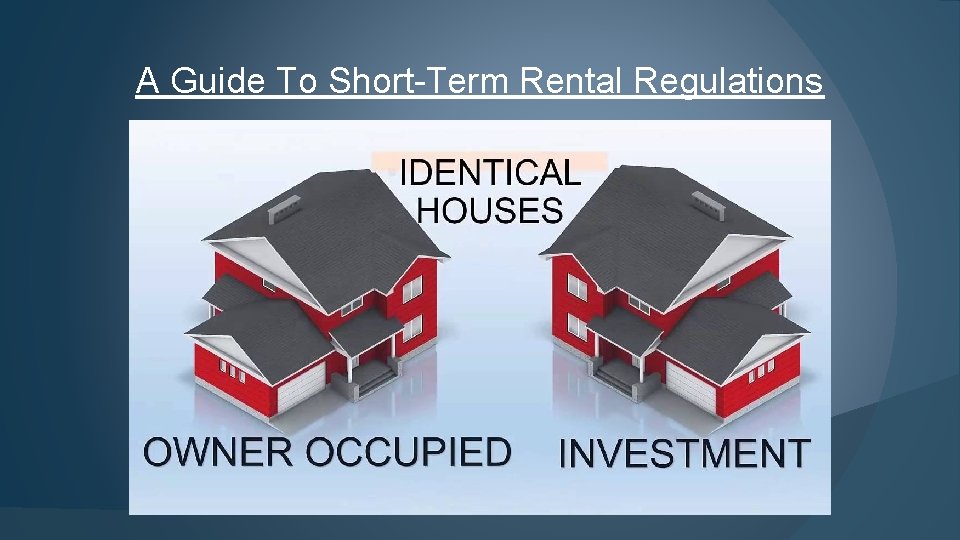
A Guide To Short-Term Rental Regulations Owner-Occupied Dwellings Owner occupancy requirements (i. e. the dwelling is the owner’s primary residence and the owner is present during the rental term) serve three purposes: • Creates a level of accountability for guests’ behavior, as the owner can respond to complaints from authorities or neighbors about illegal/disruptive conduct; • Limits the ability of individuals to purchase multiple properties for use as a short -term rental, addressing the housing concerns discussed earlier; • Limits the total number of short-term rentals.
A Guide To Short-Term Rental Regulations
A Guide To Short-Term Rental Regulations Owner-Occupied Dwellings In an odd twist, some municipalities actually prohibit owner occupancy for the duration of a rental. For example, a proposal by the Village of Bellport to prohibit rentals of less than 16 days between May 1 st and September 30 th would also bar homeowners from personally using their property during visitors’ stays at other times of the year. However, such provisions remain regulatory outliers.
A Guide To Short-Term Rental Regulations Owner-Occupied Dwellings There is nothing that requires a municipality to allow short-term rentals. However, given that such rentals are unlikely to go away, particularly in larger municipalities, adopting a regulatory scheme allows the municipality to place reasonable limits on short-term rentals. If short-terms rentals are banned, a municipality can still use its code enforcement mechanisms to enforce its ban. However, as seen in our introductory video, there will likely be many residents who fail to adhere to such prohibitions.
A Guide To Short-Term Rental Regulations Limits on Rental Durational limits on short-term rentals are closely tied to owner-occupation requirements, in that they seek to prevent absentee owners or housing issues. Such limits can include: • Limits on the length of individual short-term rentals; • Limits on the number of consecutive days a dwelling may be rented; and/or • Aggregate limits on the days per month or year that a dwelling may be rented.
A Guide To Short-Term Rental Regulations Limits on Rental Durational limits allow municipalities to prevent the conversion of residential units to full-time commercial use, while still allowing homestay companies to operate. However, strict limits can functionally ban short-term rentals. Generally speaking: • Prohibits rentals of less than 28 days = Ban • Prohibits rentals of less than 14 days = Vacation Area or Compromise • Allows rentals of less than 14 days = Allows or Compromise
A Guide To Short-Term Rental Regulations
A Guide To Short-Term Rental Regulations Permitting Requirements - Overview Municipalities can also regulate short-term rentals through regulations requiring permits, particularly the conditions for obtaining and renewing such permits. Benefits of permit requirements can include application fees, providing the municipality information about the property and its owner, insurance requirements, and ensuring that minimum standards for health and safety are being met.
A Guide To Short-Term Rental Regulations Permitting Requirements - Overview Permits can also provide municipalities with a powerful tool to compel compliance with short-term rental regulations, as the issuance and retention of rental permits can be conditioned on compliance with regulations on quality of life issues. Given the negative impacts, both real and perceived, associated with short-term rentals, codifying regulations on how guests and hosts must conduct themselves can potentially preempt a host of issues from arising. This has made permits a popular regulatory tool for municipalities.
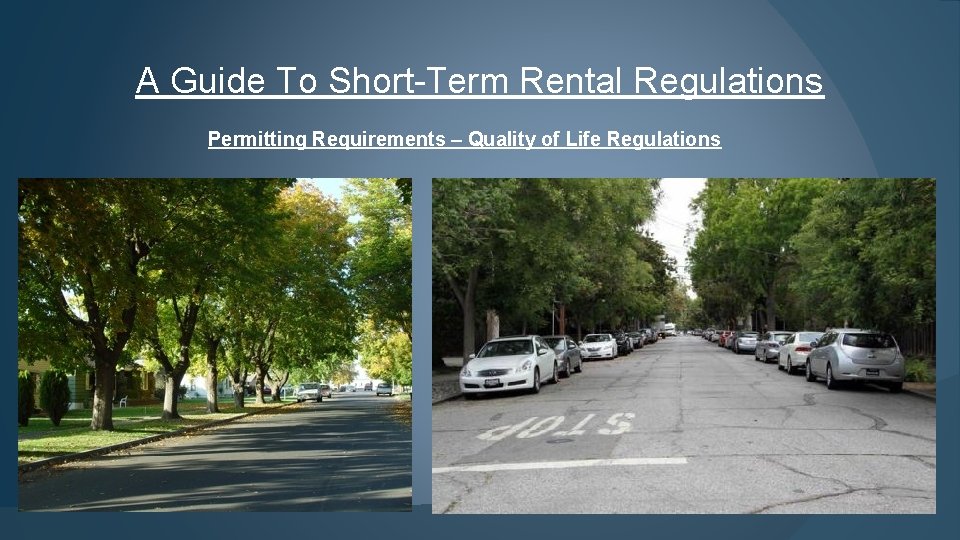
A Guide To Short-Term Rental Regulations Permitting Requirements – Quality of Life Regulations Some examples of possible quality of life regulations include: 1. 2. 3. 4. 5. Noise restrictions between certain hours; Limits on people congregating in or around a dwelling; On- or off-street parking requirements; Prohibitions on signage or advertising; and Limits on the number of rooms that may be rented at once.
A Guide To Short-Term Rental Regulations Permitting Requirements – Quality of Life Regulations
A Guide To Short-Term Rental Regulations Permitting Requirements – Ancillary Benefits Permitting requirements can also bring several ancillary benefits to a municipality, such as by providing a new source of revenue through permit fees. Such funds can go to the general treasury or be dedicated to specific programs, such as maintaining community spaces or expanding affordable housing in the area. This can also help blunt community pushback by providing a tangible benefit for officials to highlight and tout to their constituents.
A Guide To Short-Term Rental Regulations Permitting Requirements – Ancillary Benefits Information gathering is another critical, if low-key, benefit. By requiring permit applicants to provide a range of information during the application and renewal process, municipalities track the number and distribution of short-term rentals. Such information helps quantify short-term rentals trends, and can guide policy actions to stop or slow their growth by issuing fewer permits as needed. Such local control can be critical to maintaining the proper balance for a community.
A Guide To Short-Term Rental Regulations Permitting Requirements – Application Process and Penalties for Violations As most short-term renters are laymen, clear and concise regulations are key to ensuring compliance. This should include both the process and criteria for permit applications or renewals, and the conditions and regulations attached to a permit. The code should also detail what constitutes a violation, and the related penalties. This should include the procedure and grounds for revoking a permit, including notice and hearing requirements and any appeal or reapplication process. Such procedures may preempt any legal challenges to specific permitting decisions.
A Guide To Short-Term Rental Regulations Can Be Changed In deciding how to address short-term rentals, it is worth remembering that no law is set in stone. If specific provisions prove to be overly burdensome or have unintended consequences, they can be removed or amended. By the same token, the rapidly shifting nature of homestay companies and their business practices may necessitate periodically altering your regulatory scheme to incorporate changes in the short-term rental landscape.
A Guide To Short-Term Rental Regulations Southamption Mulls Exemptions From Short-Term Rental Law The Town of Southampton provides an excellent example of how short-term rental laws can change or be adapted to shifting economic circumstances. The Town first passed a short-term rental law in 2007 requiring, among other things, that rentals be at least one month. In 2013, that restriction was halved to 2 weeks. More recently, the Town Board debated issuing a blanket exemption from the law for the duration of 2018 U. S. Open Championship being held at Shinnecock Golf Course, citing the economic opportunity the tournament offered to residents.
A Guide To Short-Term Rental Regulations The Risks of Imposing Regulation
A Guide To Short-Term Rental Regulations The Risks Of Imposing Regulations Notably, seeking to ban or impose regulations on homestay companies also carries a degree of risk. As shown by Uber, app-based companies are adept at leveraging their large user base to oppose legislation. Through email and pushing notifications, companies can organize vocal opposition, making efforts to impose a ban or regulations significantly more difficult. Air. Bn. B also spent $404, 200 on lobbying New York lawmakers in the first half of 2017 alone in an effort to increase its political clout on these issues.
A Guide To Short-Term Rental Regulations The Risks Of Imposing Regulations Homestay companies have also used legal and administrative remedies to fight back against potential regulations. On July 17, 2017, Air. Bn. B filed an ethics complaint with state regulators alleging state lobbying law violations by hotel industry-backed groups. Air. Bn. B has also filed lawsuits challenging laws banning or regulating short-term rentals in several jurisdictions, including against New York City. In fact, Air. Bn. B recently obtained an injunction stopping a New York City law that would have required Air. Bn. B to turn over user data to authorities every month.
A Guide To Short-Term Rental Regulations Examples Of Municipal Regulation
A Guide To Short-Term Rental Regulations Introduction A decade after Air. Bn. B was created, some municipalities have already changed their short-term rental laws. At one end of the spectrum, municipalities like the Town of Hempstead have adopted a total ban on short-term rentals, while other jurisdictions have declined to impose any regulation at all. Many municipalities, however, opt to allow short-term rentals while imposing certain limitations. This part of the presentation looks at such regulations in three areas: Hempstead, Shelter island; and the regulations in the Town that I represent, Huntington.
A Guide To Short-Term Rental Regulations
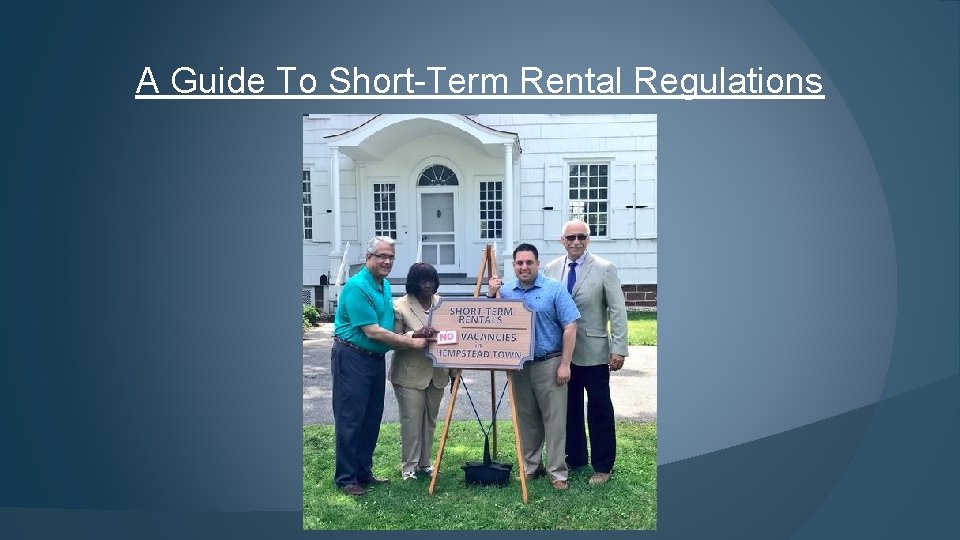
A Guide To Short-Term Rental Regulations Town of Hempstead As noted above, the Town of Hempstead has banned “transient” (i. e. short-term) rentals within its jurisdiction. The Town Code defines such rentals as: A rental dwelling or dwelling unit occupied by persons other than the owner or a family member of the owner and for which rent is received by the owner, directly or indirectly, in exchange for such rental occupation for a period of less than 28 nights….
A Guide To Short-Term Rental Regulations Town of Hempstead Moreover, the Town Code expressly targets homestay companies by creating a presumption that a dwelling is being used as a transient rental property where: The dwelling unit or any room therein is offered for lease on a short-term rental website, including Airbnb, Home Away, VRBO and the like for a period of less than 28 days;
A Guide To Short-Term Rental Regulations Town of Shelter Island
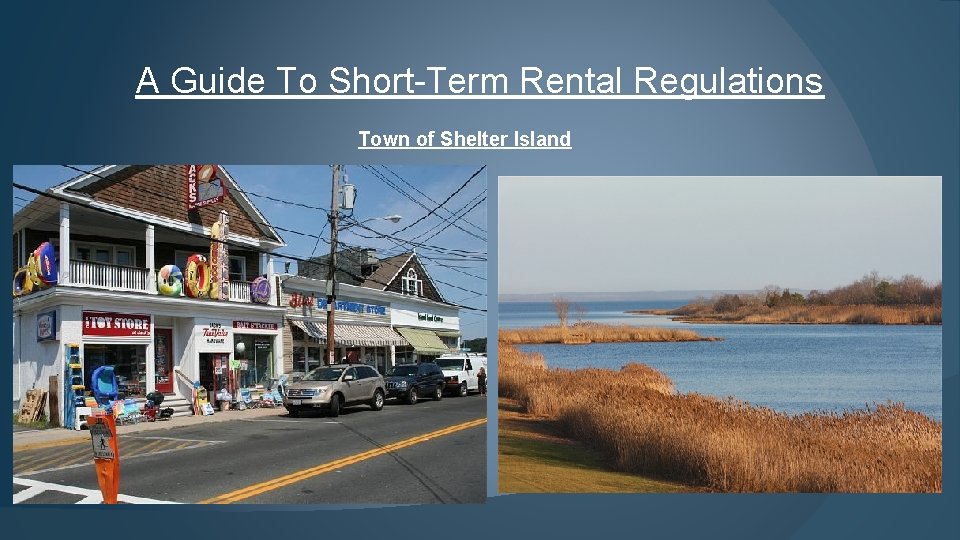
A Guide To Short-Term Rental Regulations Town of Shelter Island The Town of Shelter Island has taken a far more nuanced approach to regulating short-term rentals. It has adopted regulations that require a minimum rental period of fourteen (14) days and no property may be rented more than once in any fourteen (14) day period (ex: multiple rooms in same property). However, these limits do not apply to homeowners who will be living on the same or adjacent premises.
A Guide To Short-Term Rental Regulations Town of Shelter Island Other provisions of Shelter Island’s short-term rental laws require: • Identifying a local contact person during rentals • Obtaining an annual license based on a detailed application • Maintaining a rental registration for three (3) years • Providing a “Good Neighbor Brochure” to each tenant The law also provides for the suspension of a rental license after reasonable opportunity to appear and be heard.
A Guide To Short-Term Rental Regulations Town of Huntington
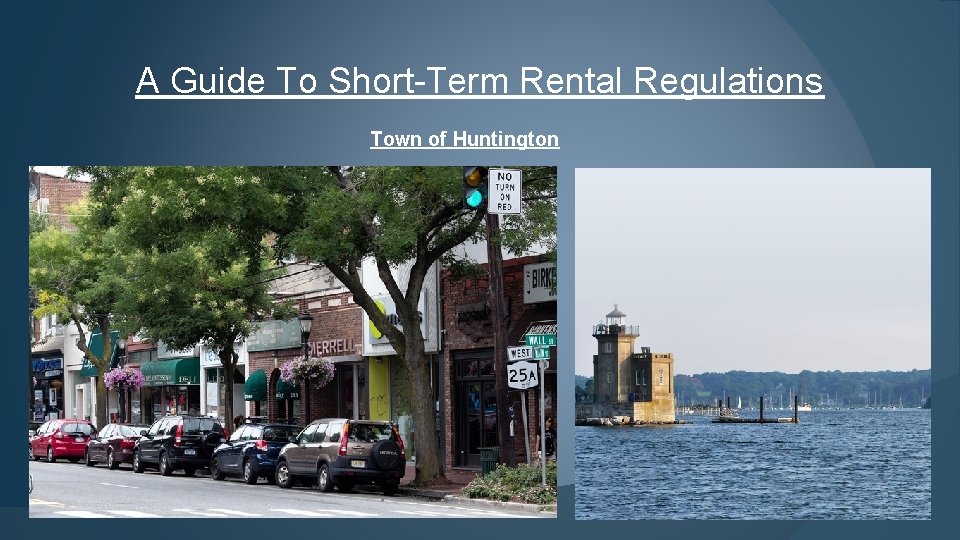
A Guide To Short-Term Rental Regulations Town of Huntington The Town of Huntington recently passed a new law, which I sponsored, to revamp its approach to regulating short-term rentals. Through the use of a permit requirement, conditioned on various quality of life regulations, the law tries to strike a proper balance between preserving the benefits of companies like Air. Bn. B, while protecting the health, safety, and character of our neighborhoods.
A Guide To Short-Term Rental Regulations Town of Huntington Under the new law, all short-term rentals must be owner-occupied. Such rentals require a permit, which authorize the holder to rent up to two bedrooms, for an aggregate total of no more than 120 days per calendar year. This ensures accountability from owners, and that their use of companies like Air. Bn. B does not rise to the level of a full-time commercial enterprise.
A Guide To Short-Term Rental Regulations Town of Huntington As in Austin and Key West, the Town issues renewable one-year permits for short - term rentals. Applicants must provide a variety of information about themselves and the property, and pay an application fee of $50 per property. They must also provide on-site parking for any renters, and submit a signed and notarized certification that they meet and will comply with the conditions for the permit. Owners are prohibited from listing the property on sites such as Air. Bn. B, Home. Away, etc. without a permit, and such listing are explicitly deemed presumptive evidence of operating an unpermitted short-term rental.
A Guide To Short-Term Rental Regulations Town of Huntington Once a permit is issued, owners are subject to various conditions to protect the character of the neighborhood. As noted above, the property must be owneroccupied at all times, and must have adequate on-site parking. The law also prohibits signage or commercial lighting on the property, or making alternations (such as adding a second entrance) to accommodate use as a rental after the permit is issued.
A Guide To Short-Term Rental Regulations Town of Huntington As to the guests, the law prohibits assembly on the property between 10: 00 pm and 7: 00 am. The owner must also keep a registry of the names and dates of short -term rental occupants. Finally, the law requires compliance with the Town’s existing noise, waste management, and property maintenance standards, which are incorporated by reference.
A Guide To Short-Term Rental Regulations Conclusion For some municipalities, the favored approach to homestay companies like Air. Bn. B will be all-or nothing options, such as banning the companies or declining to impose any regulations at all. Yet as demonstrated by these municipalities, there a diverse variety of regulatory schemes that can serve as a middle ground. It is simply a matter of tailoring these regulations to fit with the needs of your constituents and community.
The Law Offices of Mark A. Cuthbertson 434 New York Avenue Huntington, NY 11743 Tel: (631) 351 -3501 Fax: (631) 427 -9507 www. cuthbertsonlaw. com
- Slides: 78