
Politics Who Gets What and How What is

- Slides: 30
Politics: Who Gets What and How? • What is politics? 1
Politics: Who Gets What and How? • Choices invariably breed conflict, for example: – conflicting interests – conflicting values – conflicting ideas about how to allocate limited resources
Politics: Who Gets What and How? • Politics: the process through which individuals and groups reach agreement on a course of common, or collective, action— even if they disagree on the intended goals of that action. – “Who gets what when and how” – A peaceful process of determining how power and resources are distributed in a society
Politics: Who Gets What and How? • Politics involves cooperation, bargaining, and compromise • Politics matters because each party need to find a solution to the conflict – Reconciling preferences (givens) represents a fundamental problem of governance – Produces winners and losers – Determines how has influence or power • The ability to get other people to do what you want • Creates a social order, the way we organize and live our lives • Provides consistency, stability, resolution
Politics: Who Gets What and How? • Alternative to politics? – Hobbes’ brute force to settle disputes and allocate resources
The Importance of Institutional Design • Institution=a structure or mechanism of social order governing the behavior of a set of individuals within a given community • Effective political institutions have a set of rules and procedures for reaching and enforcing collective agreements. – Rules= directives that specify how resources will be distributed or what procedures govern collective action – Examples of rules and procedures that promote collective action: • The Constitution
The Importance of Institutional Design • Effective political institutions require and generate legitimacy – Legitimacy= accepted as right or proper • Government has monopoly over legitimate use of force to exercise authority over a body of people • Eg. Constitution is the standard to which Supreme Court determines whether new laws are legitimate – Authority = power that is recognized as legitimate • acknowledged right to make particular decisions
Constitutions and Governments • A Constitution establishes a nation’s governing institutions and the set of rules and procedures these institutions must (and must not) follow to reach and enforce collective agreements. – Formal (eg. United States) or informal (eg. Britain) • A government consists of these institutions and the legally prescribed process for making and enforcing collective agreements.
Governments and Political Systems • Different types of governments associated with different political systems – Authoritarian • • • Totalitarian Monarchy Dictatorship Theocracy Fascism Oligarchy – Non-authoritarian • Anarchy • Democracy
Democracy • Government vests power in the people – Based on popular sovereignty = the concept that citizens are the ultimate source of political power – Social contract = notion that society is based on an agreement between government and governed in which people agree to give up some rights in exchange for the protection of others • Constitution
Representative Democratic Government • Representative government: a blend of delegation with majority (voting) rule • Direct democracy: a form of government in which citizens participate directly in collective decision making – Reserved for small communities and organization
Republic versus Majority Rule • Republic: government in which decisions are made through representatives of the people • Parliamentary government: Decisive authority is lodged in a popularly elected legislature that, in turn, elects a cabinet of which one member serves as the premier or prime minister. – Eg. France and Germany (most democracies)
The Logic Behind American Politics • Core values embedded in American institutions include – Republic, representative democracy – periodic elections – protection of individual liberties – principles of how members of a community should engage one another politically to identify and pursue their common goals (political engagement) • Collective action
Collective Action Problems • Successful collective action challenges participants to figure out what to do and how to do it, and involves – comparing preferences – agreeing on a course of action (alternative) that is preferable to doing nothing – implementing and enforcing the collective choice
Institutional Durability • Institutions tend to be stable and resist change. – Institutions persist beyond the tenure of office holders who occupy them. – The people who are affected by them make plans based on the expectation that current arrangements will remain (the status quo). – Those who seek change typically cannot agree on alternatives.
Coordination Problems • Arise from uncertainty and insufficient information • May prevent collection action even when majority agrees on a course of action • Often simply requires direction and information
Prisoner’s Dilemma • Type of coordination problem • Arises when individuals privately calculate that they would be better off by not contributing to the collective action EVEN when they completely agree with its purpose • When individuals, who ultimately would benefit from cooperating with each other have a powerful incentive to break from the agreement and exploit the other side
Prisoner’s Dilemma • Often requires monitoring and threat of coercion • Examples: – prisoners who are separately interrogated – Nuclear arms proliferation – https: //www. youtube. com/watch? v=t 9 Lo 2 fgx. WHw
Free-Rider Problem • Free-rider problem = the temptation to defect from agreements by withholding contribution to group’s undertaking while enjoying the benefits of the collective effort • With increasing size, individual contributions to the collective action become increasingly inconsequential—hence individuals realize their individual contribution will not affect the collective success or failure • But everyone has this option, and if everyone takes it then no successful collective action
Free-Riding: Tragedy of the Commons • (Costless) consumption of a public good results in its ruin • Large numbers of participants encourages each to renege on contributing to public good (freerider problem) but still consume the public good which becomes destroyed • Examples: fishing industry, cattle raising, Internet, water conservation, Wikipedia
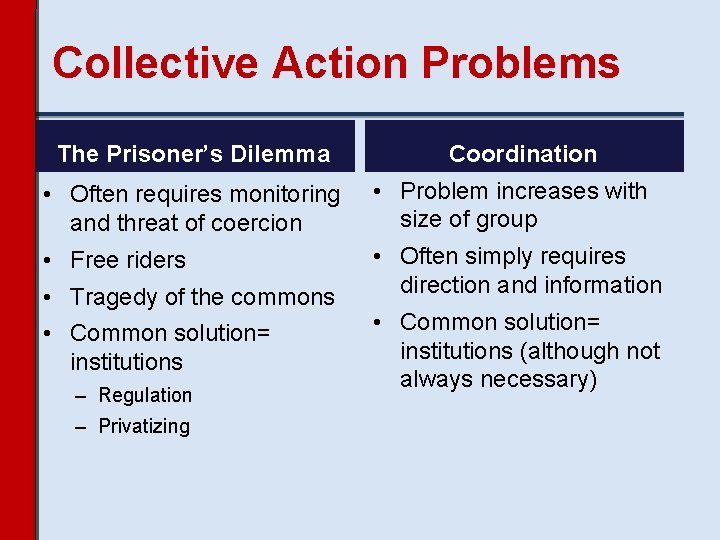
Collective Action Problems The Prisoner’s Dilemma Coordination • Often requires monitoring and threat of coercion • Problem increases with size of group • Free riders • Often simply requires direction and information • Tragedy of the commons • Common solution= institutions – Regulation – Privatizing • Common solution= institutions (although not always necessary)
The Costs of Collective Action • Collective action offers participants benefits they cannot achieve on their own. • Governments help achieve and enforce these agreements • Associated costs: – – monetary contribution (eg. taxes) overhead costs (costs for enforcement) transaction costs conformity costs
The Costs of Collective Action: Transaction Costs • Transaction costs: the time, effort, and resources required to make collective decisions. • They can be a barrier to political agreements. • Transaction costs increase as the number of participants increase. • High transaction costs are sometimes instituted to make certain activities more difficult. – Constitution (2/3 Congress and ¾ states)
The Costs of Collective Action: Conformity Costs • Conformity costs: the difference between what any one party prefers and what the collective body requires. • Losers in politics: the parties whose preferences receive little accommodation but who must still contribute to the collective undertaking. – Eg. taxes for programs one opposes • The two costs are inversely related. – Eg. dictator (low transaction, high conformity) versus consensus (high, low)
Role of Government • Enables and enforces collective action • Provides positive public goods while corrects or minimizes negative public goods – Resources and coercive authority
Role of Government • Public goods – costs are borne collectively – no one is excluded from the benefits • Positive versus negative public goods – positive public goods (e. g. , national defense and public order) – negative public goods (e. g. , pollution) • Public goods with private aspect (privatized public goods) – Conserves by incentivizing contributions to collective goal – tax deductions (e. g. , charitable contributions and energy-efficient heating) – public education
Mitigating “Popular Passions” • The Framers designed a government that – minimized conformity costs – escalated transaction costs – constrained majority rule
Mitigating “Popular Passions” • Majority rule is visibly present, but is constrained by powerful rules: – separation of powers – staggered legislative terms – an unelected judiciary – limited national authority
Representative Government: Politicians • Politicians are professionals who specialize in identifying collective enterprises that unite citizens with varied interests and values. • Are they ‘public servants’ or ‘entrepreneurs’ (assembling coalitions)? • Is their behavior sincere or strategic?
Representative Government: Politicians • How well do politicians represent voters and citizens? • Are they better at achieving collective action? Why or why not? • Ideas that unite versus those that divide – Freedom, liberty, democracy – Social issues, economic issues, immigration, government role,