
Political Theory Political Theory Plato Aristotle St Augustin

- Slides: 38
Political Theory
Political Theory • Plato • Aristotle • St. Augustin • St. Thomas Aquinas • Machiavelli Thomas Hobbes n John Locke n Montesquieu n Adam Smith n
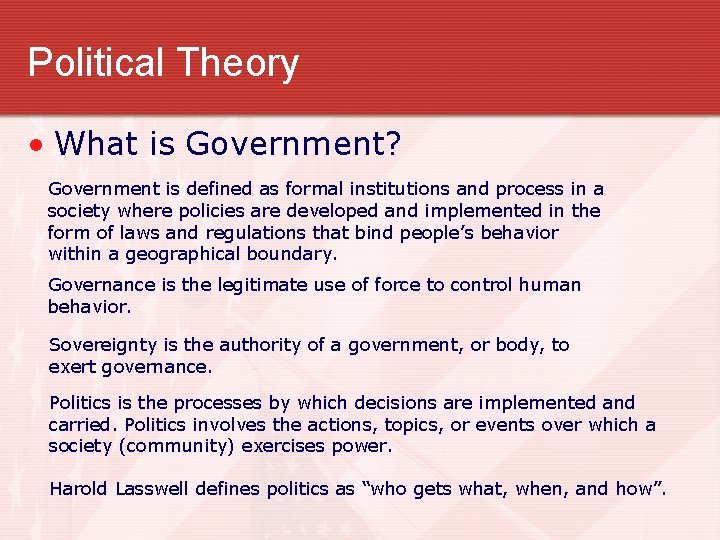
Political Theory • What is Government? Government is defined as formal institutions and process in a society where policies are developed and implemented in the form of laws and regulations that bind people’s behavior within a geographical boundary. Governance is the legitimate use of force to control human behavior. Sovereignty is the authority of a government, or body, to exert governance. Politics is the processes by which decisions are implemented and carried. Politics involves the actions, topics, or events over which a society (community) exercises power. Harold Lasswell defines politics as “who gets what, when, and how”.
Plato and The Republic • The Republic was the first work of political science to describe a governmental system. • Assumes that the “right” form of government can be created through a rigorous application of reasoning and logic
Plato and The Republic • His perfect form of government is very rigid with an established hierarchy. • The arts are suppressed for the good of the state. • The size of the city and its social classes are determined by a formula. • There is a lottery to determine who will have children; this is rigged to produce the best. Early genetic engineering.
Plato and The Republic • Three functions of society as well as the soul. • Productive – This is the working class of people who are equipped with technical knowledge, e. g. farmers, and blacksmiths. • These correspond to the “appetite” of the soul. The souls longing to produce something for economic well-being or survival.
Plato and The Republic • Three functions of society as well as the soul. • Protective – These are the warriors or soldiers in society. They are also known as the auxiliaries. They are adventurous, strong, brave, in love with danger. • Correspond to the “spirit” part of the soul; or their characteristic is courage.
Plato and The Republic • Three functions of society as well as the soul. • Governing – These are the rulers or leaders of society. Also called the guardians. They are intelligent, rational, self-controlled, in love with wisdom, well suited to make decisions. • This group corresponds with the “reason” part of the soul. Their characteristic is political wisdom.
Plato and The Republic • For a person to act justly, all three parts of the soul must be in balance. • Plato felt that justice in the state mirrored justice in an individual. • The individual must rule himself, but government is needed to ensure that balance and therefore, justice is maintained. • These individuals are the guardians, who are carefully educated and don’t follow self-interest.
Plato and The Republic • Plato did not like democracy: • He felt that gives the greatest power to the most people. • People are easily swayed by rhetoric and argument and may not rule properly.
Plato and The Republic • Plato believed in heredity as being the basis of determining leadership • Believed, also, that a city/state should be governed by reason and not by politics. Felt that the leader should be a philosopher-king. • Also felt that education was the method of which to create a perfect society.
Aristotle • View on Human Nature • Everything a person does is directed towards a purpose. • There are “superior” and “subordinate” aims. • The final aim is the Good, both for oneself and for Humanity. • The Supreme Good is Happiness.
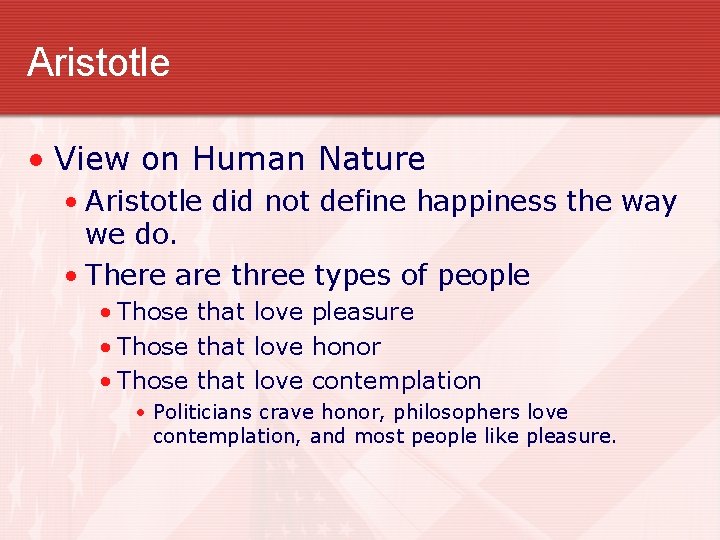
Aristotle • View on Human Nature • Aristotle did not define happiness the way we do. • There are three types of people • Those that love pleasure • Those that love honor • Those that love contemplation • Politicians crave honor, philosophers love contemplation, and most people like pleasure.
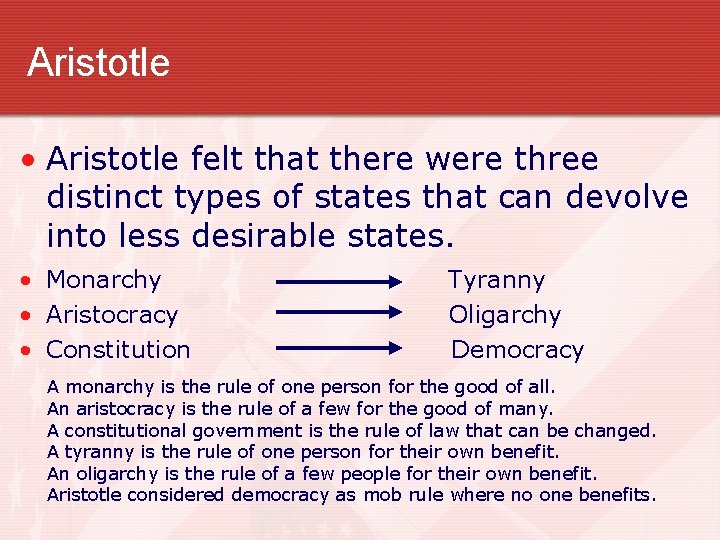
Aristotle • Aristotle felt that there were three distinct types of states that can devolve into less desirable states. • Monarchy Tyranny • Aristocracy Oligarchy • Constitution Democracy A monarchy is the rule of one person for the good of all. An aristocracy is the rule of a few for the good of many. A constitutional government is the rule of law that can be changed. A tyranny is the rule of one person for their own benefit. An oligarchy is the rule of a few people for their own benefit. Aristotle considered democracy as mob rule where no one benefits.
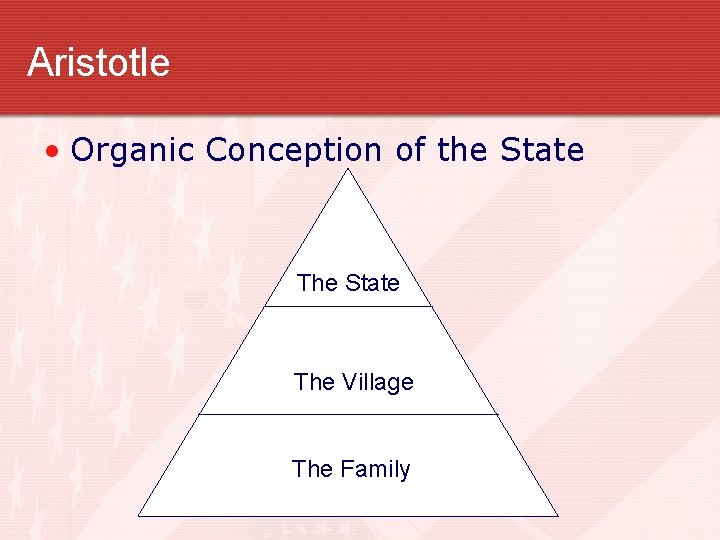
Aristotle • Organic Conception of the State • - Aristotle believed that the state functions similarly to an organism. Distinct parts work together to make the whole function. The state also acts as an instrument to be used for higher purposes.
Aristotle • Organic Conception of the State The Village The Family
St. Augustine • A very influential theologian in the Catholic Church. • Was alive when Rome fell, which threw the world into the Dark Ages. • Wrote “The City of God”.
St. Augustine – The City of God • Augustine wrote this to try to explain the role of Christianity in a secular world. • When Rome was sacked, many felt it was because the Romans turned from paganism. • There are two kingdoms – the City of God and the City of Man. Citizens of the City of God are those that forego earthly pleasures and promote Christian values. The citizens of the City of Man are those that have left the City of God.
St. Augustine – The City of God • Augustine wrote this to try to explain the role of Christianity in a secular world. • This was one of the first works to suggest that there be a separation of church and state. • He was concerned with that separation at the highest levels, where spiritual and political affairs were intertwined.
St. Thomas Aquinas • Two reasons to have government: • One, man is a social being, and therefore must have organization to his life. So, government emerges. • Second, those individuals with superior virtues or knowledge have an obligation to lead others.
St. Thomas Aquinas • He was much more unequivocal about his choice for a monarchy as the best form of government. • He felt it is the most similar relationship on earth (king to subject) that we have with God.
Machiavelli – The Prince • Machiavelli wrote The Prince to Lorenzo de Medici. • It served almost as a memo to a new leader on how to achieve power and retain it. • He did not pass judgment on good or evil. He was amoral. Goodness is determined rather by effectiveness. • Political decisions should be made based on how it will gain or reduce power. In other words, the ends justify the means.
Machiavelli – The Prince • The Prince does not seek to pass judgment on right or wrong but seeks to look at the world as it is. This is called realism. • If you are going to do evil, do it all at once.
Thomas Hobbes - Leviathan • Wrote Leviathan, the first political work in the English language. • Described The State of Nature. • The State of Nature is a theoretical place where there are no rules governing man’s behavior. • Self defense against a violent death is the highest human necessity. • Because of limited resources, there is an ongoing “war of all against all”. • Life in the state of nature is “solitary, poor, nasty brutish and short”.
Thomas Hobbes - Leviathan • To escape from the state of nature, man creates a social contract. • A society surrenders some of their rights to the authority, i. e. government, in return for a guarantee of protection of property and life. • The authority should be a Leviathan, or an absolute monarch. • The enforcement of the law is the enforcement of contracts. It is these contracts that keep society from degrading back to the state of nature.
Thomas Hobbes - Leviathan • The government has absolute authority to keep order and protect its power. • As long as one man does not coerce another, then the government should not interfere in his life. • However, there is nothing to prevent the government from breaking this rule. • Contrary to St. Augustin, Hobbes believes that the government should assert power over religious matters in order to protect itself. • The book was written during the English Civil War and a time when religious cleavages created political divisions.
John Locke – Second Treatiste on Government • Locke is probably the most influential writer of the American Constitutional framers. • He begins with the state of nature, but holds a different view of human nature, I. e. people in the state of nature have morals and standards.
John Locke – Second Treatiste on Government • Natural rights • The belief that all people possess certain basic rights that may not be abridged by the government. • He reasoned that people were born free and had natural rights in the state of nature. Some, not all, of those rights are given to the government through the social contract. • This was like the gospel truth to the Founders
John Locke – Second Treatiste on Government • Locke’s view of the social contract. • Where Locke and Hobbes differ the most is their view on the social contract. • Society enters the social contract through the consent of the goverened • Locke felt that the contract was more of a trust, where the government has duties and the people have rights. • Locke had more confidence in the legislative branch than the executive.
John Locke – Second Treatiste on Government • Right of Revolution • Since government is formed through a contract and there is a trust involved, if that trust is broken, then the people have a right to change the government through revolution.
Montesquieu – The Spirit of the Laws • A French aristocrat who traveled widely, he spent a good amount of time in England observing Parliament. • Most notable contribution is the idea of the separation of powers. • Government should be divided into the executive, legislative, and judicial branches.
Montesquieu – The Spirit of the Laws • Also provided commentary on French society. • Divided society into three estates: the monarchy, aristocracy, and the commons. • Government powers were supposed to be divided among the three groups. • He did not include the clergy in this calculus.
Montesquieu – The Spirit of the Laws • Three main forms of government and a virtue that corresponds to it. • Monarchies relied on the spirits of honor. • Republics relied on the spirit of virtue. • Despotisms which are ruled by fear. • He felt that a monarchy is best and held the British model as ideal.
Montesquieu – The Spirit of the Laws • Also had a idea that climate affects government. • He hypothesized that conditions such as weather, geography, soil and vegetation, etc, all work together to influence people’s behavior and is manifested in their government. • For example, those people that live in a hot climate are hot tempered and those in a cold climate are icy.
Adam Smith – The Wealth of Nations • Smith wrote the work that is the foundation of capitalism. • The Wealth of Nations was published in 1776. • Believed that labor and production was of chief importance in gaining wealth.
Adam Smith – The Wealth of Nations • New ideas • Division of Labor – Believed that production would be enhanced by dividing the labor among specialized groups. • The “invisible hand” that controls a chaotic free market. • Law of supply and demand • Laizze faire role of the government
American Political Theory • Since we have borrowed major theories to create our system, there is very little unique of American political theory. • However, we have greatly contributed to the field of administration and studying democracy. • Essentially, the question of the “best government system” has been answered. Now, they are studying ways to manage that system better.