
Political Spectrum Left Wing vs Right Wing Democratic

- Slides: 18
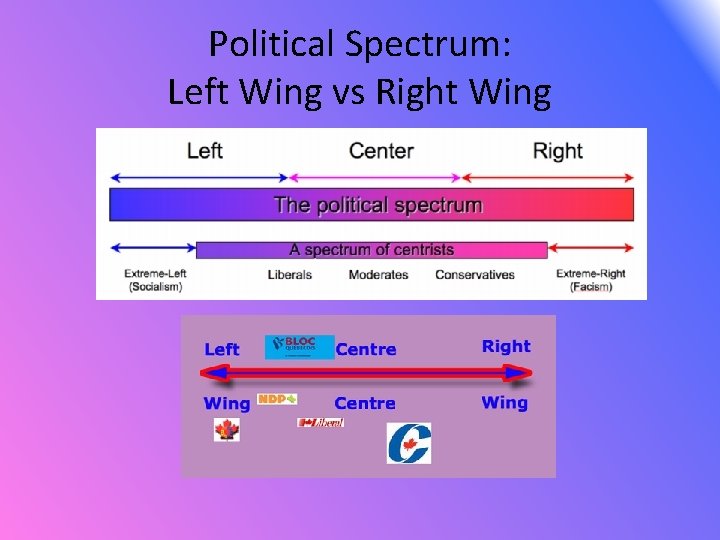
Political Spectrum: Left Wing vs Right Wing
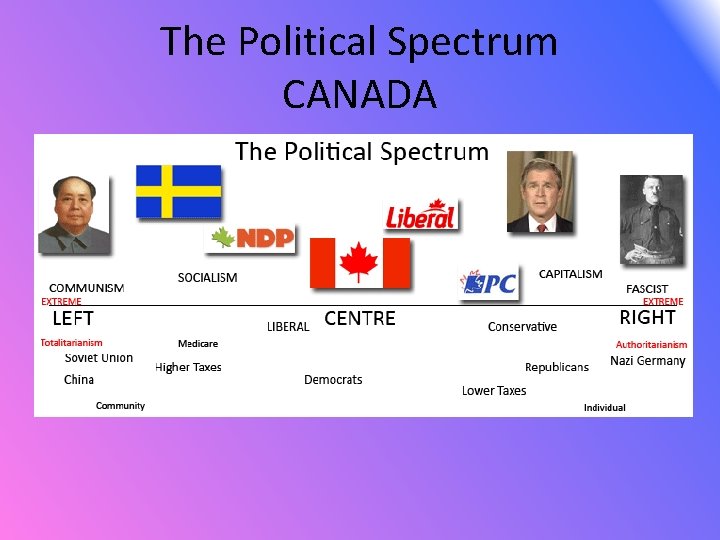
Democratic countries believe in Liberal Democracy (liberalism) which is a commitment to the individual and the desire to construct a society which people can satisfy their interest and achieve fulfillment. In other words to be free and happy. • To simplify things for now, let us ignore the extreme left (communists) and the extreme right (fascists)… they are not liberals • We will be looking at the liberal left (NDP) and the liberal right (Conservatives)
The position on the Left and Right spectrum revolves around the following issues: • Speed of Change in Society • Government Control of the Economy • Sharing of wealth through social programs • Government’s role in citizens’ lives • Political Freedom vs. Political Control
Political Spectrum Split Page Notetaking LEFT RIGHT
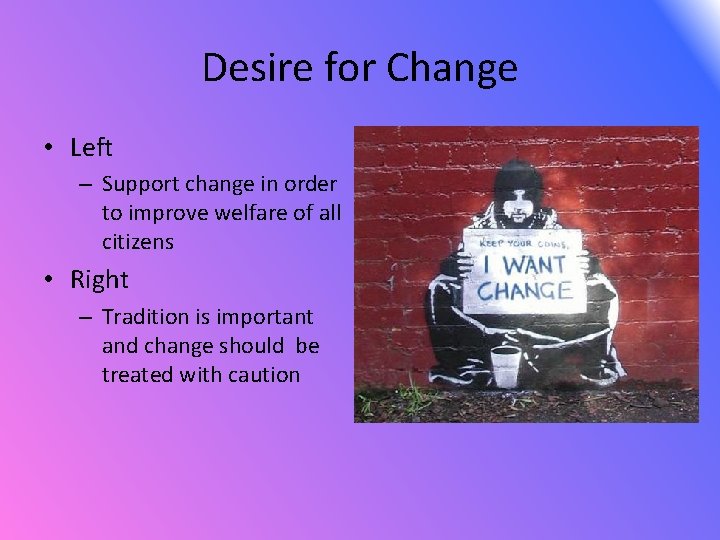
Desire for Change • Left – Support change in order to improve welfare of all citizens • Right – Tradition is important and change should be treated with caution
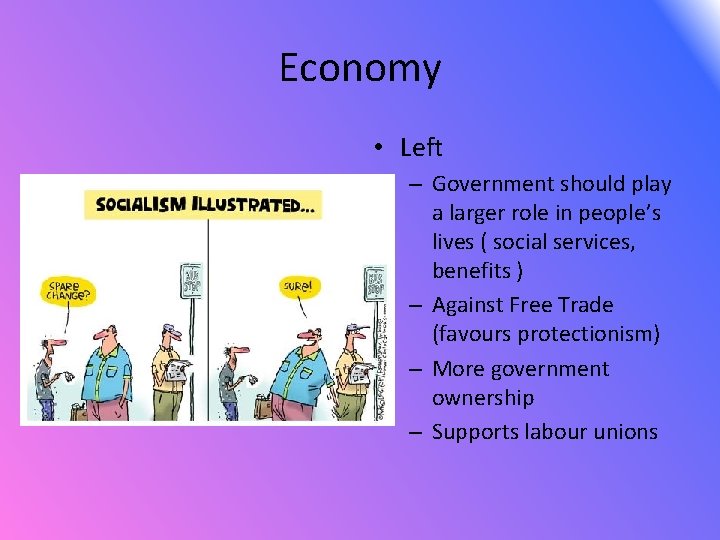
Economy • Left – Government should play a larger role in people’s lives ( social services, benefits ) – Against Free Trade (favours protectionism) – More government ownership – Supports labour unions
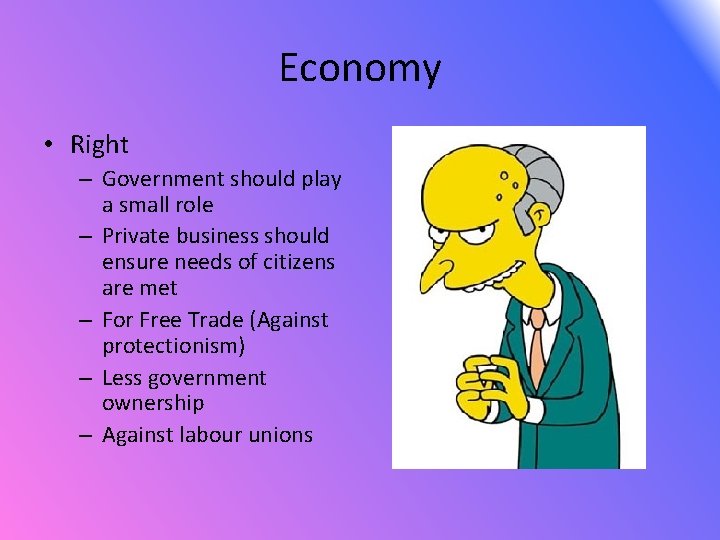
Economy • Right – Government should play a small role – Private business should ensure needs of citizens are met – For Free Trade (Against protectionism) – Less government ownership – Against labour unions
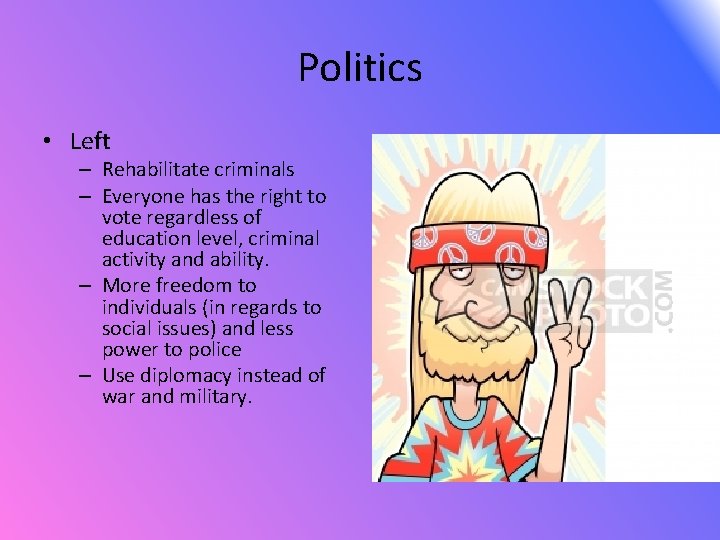
Politics • Left – Rehabilitate criminals – Everyone has the right to vote regardless of education level, criminal activity and ability. – More freedom to individuals (in regards to social issues) and less power to police – Use diplomacy instead of war and military.
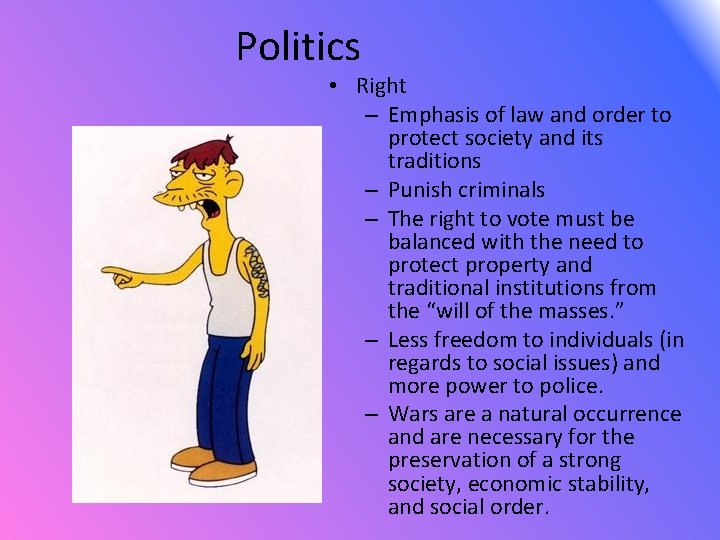
Politics • Right – Emphasis of law and order to protect society and its traditions – Punish criminals – The right to vote must be balanced with the need to protect property and traditional institutions from the “will of the masses. ” – Less freedom to individuals (in regards to social issues) and more power to police. – Wars are a natural occurrence and are necessary for the preservation of a strong society, economic stability, and social order.
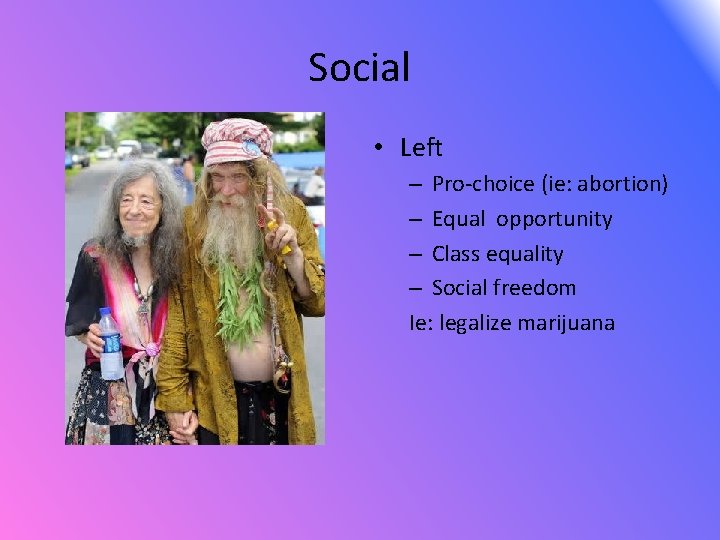
Social • Left – Pro-choice (ie: abortion) – Equal opportunity – Class equality – Social freedom Ie: legalize marijuana
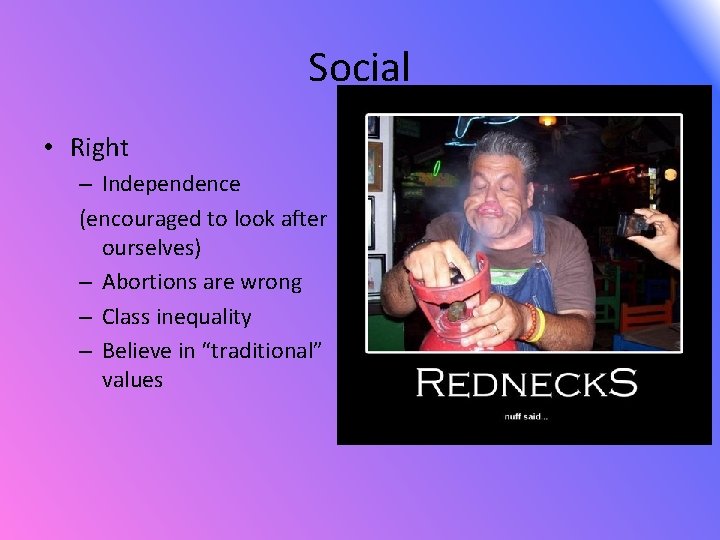
Social • Right – Independence (encouraged to look after ourselves) – Abortions are wrong – Class inequality – Believe in “traditional” values
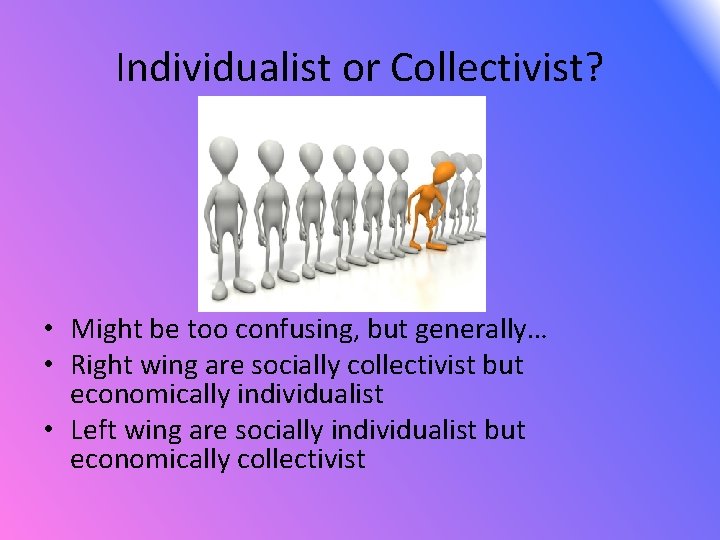
Individualist or Collectivist? • Might be too confusing, but generally… • Right wing are socially collectivist but economically individualist • Left wing are socially individualist but economically collectivist
The Political Spectrum CANADA
Which Party Would You Choose to Represent your Interests? • Write down 5 values (what is most important to you in life). Remember values are not material things, rather what you feel strongly about and • Next write down three issues for Canadians (think nationally) that concern you the most. You should see a connection between your values and your concerns. • Finally, read the Parties of Canada info sheet and choose a party that you would likely vote for and support. Also think about if you fell to the left or right on the spectrum. Feel free to do more research on the net. • Write down on the piece of paper supplied the party that you would at this time support with an explanation for why. Hand in your ballot.
The Voting Problem http: //www. elections. ca/content. aspx? section=ele&dir=turn&document=index&lan g=e
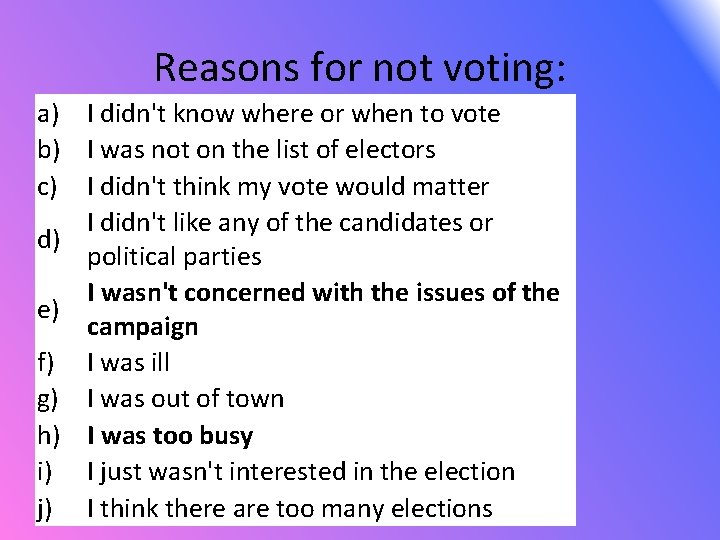
Reasons for not voting: a) I didn't know where or when to vote b) I was not on the list of electors c) I didn't think my vote would matter I didn't like any of the candidates or d) political parties I wasn't concerned with the issues of the e) campaign f) I was ill g) I was out of town h) I was too busy i) I just wasn't interested in the election j) I think there are too many elections
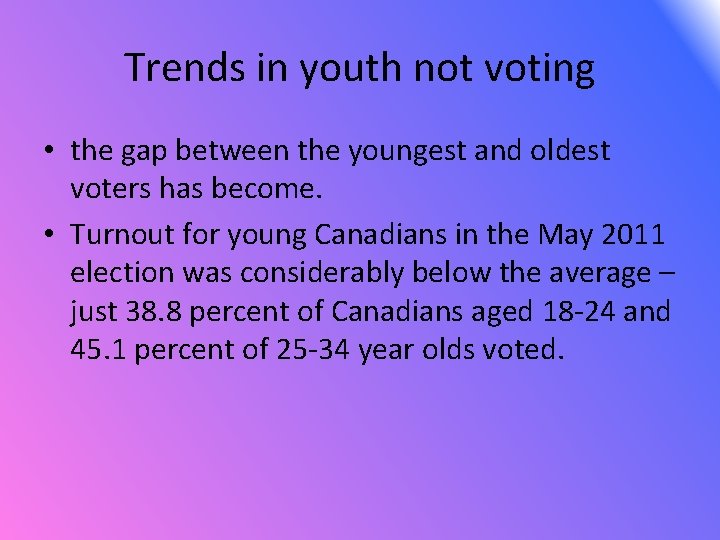
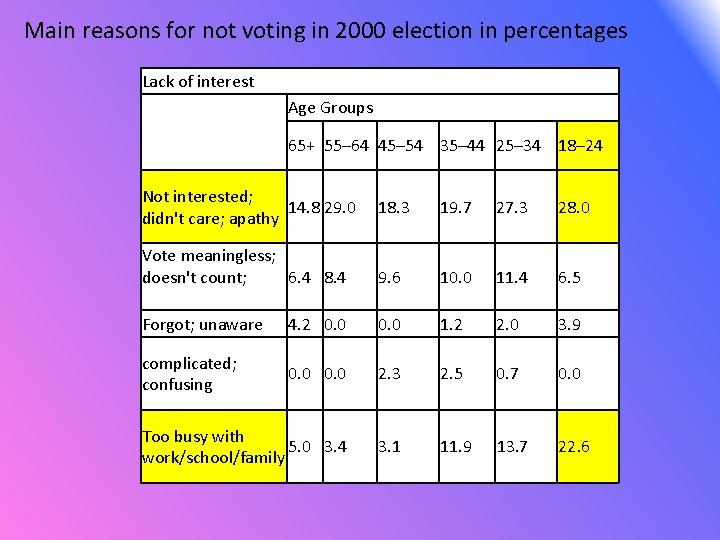
Trends in youth not voting • the gap between the youngest and oldest voters has become. • Turnout for young Canadians in the May 2011 election was considerably below the average – just 38. 8 percent of Canadians aged 18 -24 and 45. 1 percent of 25 -34 year olds voted.
Main reasons for not voting in 2000 election in percentages Lack of interest Age Groups 65+ 55– 64 45– 54 35– 44 25– 34 18– 24 Not interested; 14. 8 29. 0 didn't care; apathy 18. 3 19. 7 27. 3 28. 0 Vote meaningless; doesn't count; 6. 4 8. 4 9. 6 10. 0 11. 4 6. 5 Forgot; unaware 4. 2 0. 0 1. 2 2. 0 3. 9 complicated; confusing 0. 0 2. 3 2. 5 0. 7 0. 0 Too busy with 5. 0 3. 4 work/school/family 3. 1 11. 9 13. 7 22. 6