
Political Science An Introduction Fourteenth Edition Roskin Cord
- Slides: 14
Political Science: An Introduction Fourteenth Edition Roskin | Cord | Medeiros | Jones Chapter 2 Political Ideologies Copyright © 2017, 2014, 2012 Pearson Education, Inc. All Rights Reserved.
What Is Ideology? 2. 1 Explain the difference between a political theory and an ideology. • In general, an ideology is a plan or a vision for how to improve society. – Anthony Downs definition § A verbal image of the good society and the chief means of constructing that society. • Idealogue – someone who believes “PASSIONATELY” in an ideology Copyright © 2017, 2014, 2012 Pearson Education, Inc. All Rights Reserved.
What Is Ideology? (3 of 3) 2. 1 Explain the difference between a political theory and an ideology. • Americans used to be very ideological and now are much more pragmatic. – Pragmatism – Using what works • Ideologies rarely work out as their advocates intend and many contain wishful thinking that collapses in the face of reality. Copyright © 2017, 2014, 2012 Pearson Education, Inc. All Rights Reserved.
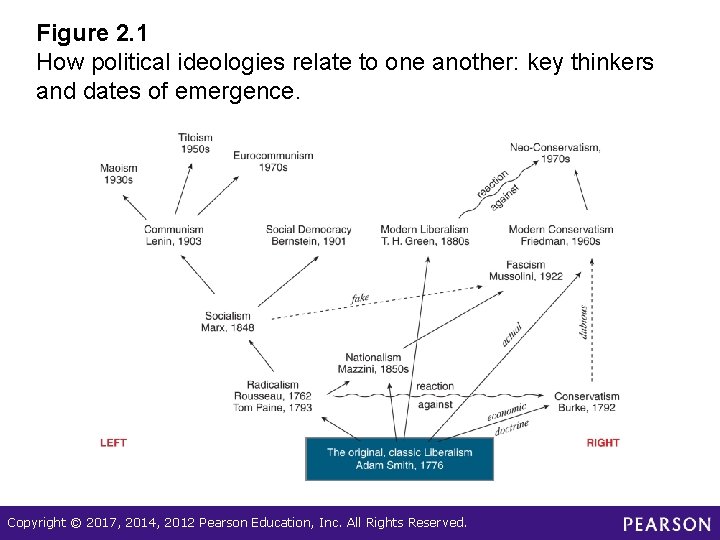
Figure 2. 1 How political ideologies relate to one another: key thinkers and dates of emergence. Copyright © 2017, 2014, 2012 Pearson Education, Inc. All Rights Reserved.
Classic Liberalism (1 of 2) 2. 2 Distinguish between classic and modern liberalism. • Adam Smith (1723 -1790) and The Wealth of Nations – The publication of The Wealth of Nations by Adam Smith introduces classical liberalism. – The core idea of Smith's work was that the market did not need government to regulate it. Copyright © 2017, 2014, 2012 Pearson Education, Inc. All Rights Reserved.
Classic Liberalism (2 of 2) 2. 2 Distinguish between classic and modern liberalism. • The idea was expanded to a much broader notion about government not regulating all aspects of society. – Society should be as free from government regulation as possible • Classical liberalism is closer to conservatism than to modern liberalism. Copyright © 2017, 2014, 2012 Pearson Education, Inc. All Rights Reserved.
Modern Liberalism (1 of 2) • Modern liberalism differs from classical liberalism in its emphasis on the necessity of government intervention and economic regulation. • Classic Liberalism = little to none government regulation or economic involvement • Modern Liberalism = Want to see government intervention and economic regulation Copyright © 2017, 2014, 2012 Pearson Education, Inc. All Rights Reserved.
Classic Conservatism 2. 3 Contrast Burkean conservatism with its current variety. • The father of conservatism is English thinker Edmund Burke (1729 -1797). – Burke opposed the British attempts to crush the American Revolution but did not like the radicalism of the French Revolution. – He was heavily influenced by the writings of Rousseau. • Institutions are created to compensate for human irrationality and are the products of centuries of trial and error. – Change is okay but it should happen slowly and gradually. Copyright © 2017, 2014, 2012 Pearson Education, Inc. All Rights Reserved.
Modern Conservatism • The roots of this ideology are in the free market approach of Smith and the strong emphasis on family and tradition that comes from the writings of Burke. Copyright © 2017, 2014, 2012 Pearson Education, Inc. All Rights Reserved.
Socialism 2. 4 Explain how socialism split into several varieties. • Socialism begins with the writings of Karl Marx (1818 -1883) in which he argued that capitalism would be overthrown by socialism. • Bourgeoisie – own the means of production • Proletariat – middle, working class • Marx argued capitalism would be overthrown by the middle class, then would become socialism… a classless society. Copyright © 2017, 2014, 2012 Pearson Education, Inc. All Rights Reserved.
Other Ideologies Social Democracy • Mildest form of socialism, promoting welfare measures but not state ownership of industry. Communism • Vladimir Lenin (1870 -1924) – a socioeconomic order structured on the common ownership of the means of production and the absence of social class. Copyright © 2017, 2014, 2012 Pearson Education, Inc. All Rights Reserved.
Nationalism 2. 5 Trace the origins of nationalism until the present day. • Nationalism is an exaggerated belief in the greatness of one's country. • Sovereignty brought about the idea of nationality that provides the core of nationalism. • Nationalism first appears after the French Revolution, a revolution of "we the people" that highlighted a sense of greatness about the French people. Copyright © 2017, 2014, 2012 Pearson Education, Inc. All Rights Reserved.
Fascism (1 of 2) • Benito Mussolini (1883 -1945) - Fascism takes nationalism and combines it with militarism and a love for order. • Mussolini used to be a socialist but military service turned him into a nationalist. He took that nationalism, combines it with his military service to form fascism. Copyright © 2017, 2014, 2012 Pearson Education, Inc. All Rights Reserved.
Ideology in Our Day 2. 6 List and define as many current ideologies as you can. • Neoconservatism – liberal turning conservative because of problems with social programs. They reject the “if it feels good, do it” attitude • Libertarianism - U. S. ideology in favor of shrinking all government power in favor of individual freedom. • Feminism – Fight for gender equality • Environmentalism – Fight against overdevelopment, promote regulation and a clean environment as a means for a healthy society/earth. Copyright © 2017, 2014, 2012 Pearson Education, Inc. All Rights Reserved.