Political Science An Introduction Fourteenth Edition Roskin Cord
- Slides: 16
Political Science: An Introduction Fourteenth Edition Roskin | Cord | Medeiros | Jones Chapter 7 Public Opinion Copyright © 2017, 2014, 2012 Pearson Education, Inc. All Rights Reserved.
What Public Opinion Is and Isn't (1 of 5) 7. 1 Distinguish between anecdotal and survey evidence. • When political scientists study public opinion, they are studying how citizens view politicians and public policy in the short term. – This is what distinguishes it from political culture, as studied in the previous chapter, which focuses on deep values and beliefs that are the foundation of government legitimacy. – It is sometimes the case that public opinion may not be the true opinion of the public. – Sometimes government or the media can work to manufacture public opinion. Copyright © 2017, 2014, 2012 Pearson Education, Inc. All Rights Reserved.
What Public Opinion Is and Isn't (4 of 5) 7. 1 Distinguish between anecdotal and survey evidence. • The big question is how much public opinion should drive the form and content of public policy decisions. – Often groups will work to shape and mold public opinion in their favor. § A good illustration is ads run by oil companies that discuss all the wonderful things that petroleum does. § Another example would be the post-Deepwater Horizon ads run by British Petroleum detailing how well the cleanup was going on the Louisiana coast. § But environmentalists counter that with pictures of oil covered birds and dead fish Copyright © 2017, 2014, 2012 Pearson Education, Inc. All Rights Reserved.
The Shape of Public Opinion 7. 2 List the main factors that produce public-opinion views. • Public opinion is shaped by a wide range of interrelated factors. • salience: Literally, that which jumps out; the importance of given issues at different times in public opinion. • Often highlighted when there are differences in society (Confederate flag/monuments in 2017) • The following factors help shape public opinion Copyright © 2017, 2014, 2012 Pearson Education, Inc. All Rights Reserved.
Social Class & Education • Social class is incredibly important, even in the United States, which has relatively low levels of class awareness. – Manual workers tend to vote Democratic in the United States, white-collar workers vote Republican. • Education is another important factor that shapes public opinion. – Education can also contribute to the polarization of opinion. In the United States, education has a split effect in that it tends to make people more liberal on social issues and more conservative on fiscal issues. Copyright © 2017, 2014, 2012 Pearson Education, Inc. All Rights Reserved.
Region & Religion • Region also matters in the shape of public opinion and certain regions tend to vote in relatively stable patterns. – Greater the population density the more liberal – Smaller populations tend to be more conservative • Religion is probably the most explosive issue in structuring public opinion. – Churchgoers tend to vote conservative, nonchurchgoers more liberal Copyright © 2017, 2014, 2012 Pearson Education, Inc. All Rights Reserved.
Age & Gender • Age seems to affect public opinion in two ways: – Life cycle theory suggests that people's opinions change as they get older; young people are naturally more radical, older people are more conservative. – Generational Theory (aka) Political Generations - suggests that each generation's views are shaped by important events that they have witnessed, such as war or economic crisis – Women's views tend to be different from men's. The United States saw the development of a Gender gap in voting beginning in the 1980 s, with women being several percentage points more liberal than men. Copyright © 2017, 2014, 2012 Pearson Education, Inc. All Rights Reserved.
Race and Ethnicity • Ethnic groups can contribute to the structuring of public opinion, especially in multiethnic societies with minority subcultures (Miami or Deep South). • African Americans used to be Republicans but now they vote Democratic. • Deep South has a unique voting identity Copyright © 2017, 2014, 2012 Pearson Education, Inc. All Rights Reserved.
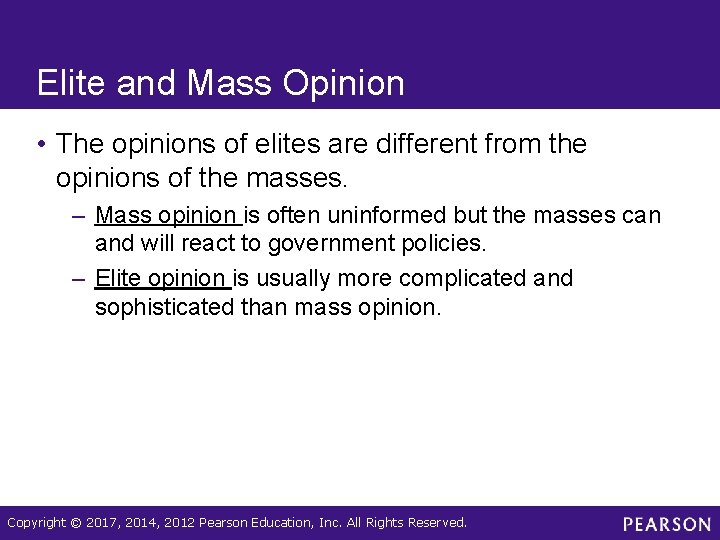
Elite and Mass Opinion • The opinions of elites are different from the opinions of the masses. – Mass opinion is often uninformed but the masses can and will react to government policies. – Elite opinion is usually more complicated and sophisticated than mass opinion. Copyright © 2017, 2014, 2012 Pearson Education, Inc. All Rights Reserved.
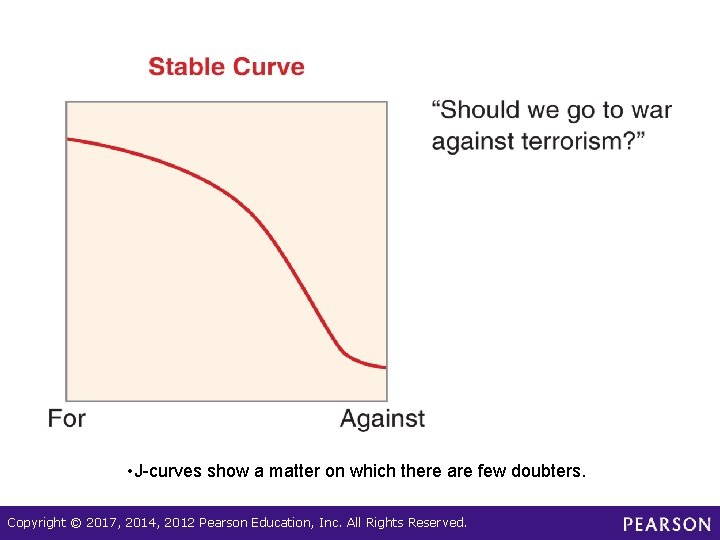
• J-curves show a matter on which there are few doubters. Copyright © 2017, 2014, 2012 Pearson Education, Inc. All Rights Reserved.
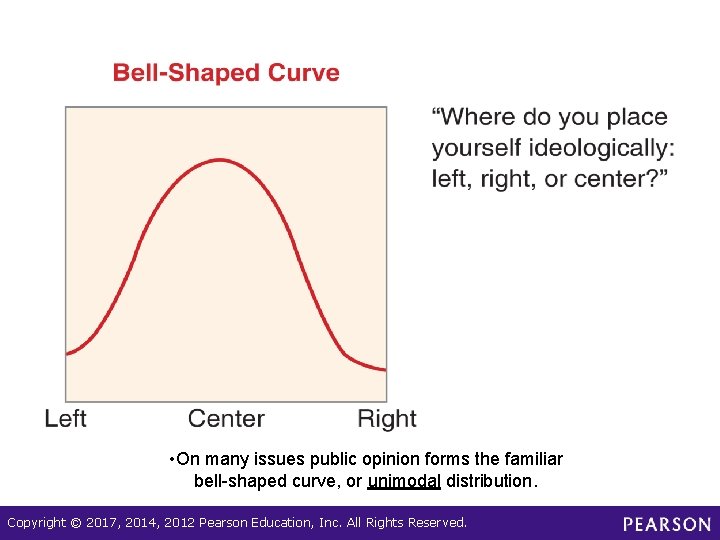
• On many issues public opinion forms the familiar bell-shaped curve, or unimodal distribution. Copyright © 2017, 2014, 2012 Pearson Education, Inc. All Rights Reserved.
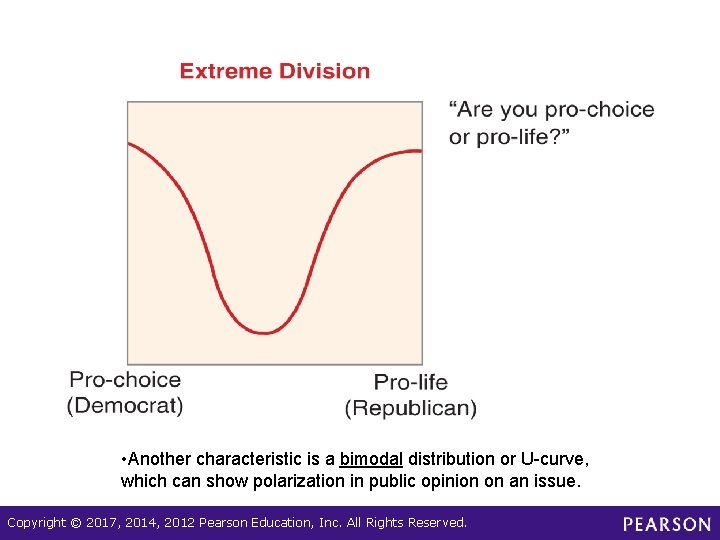
• Another characteristic is a bimodal distribution or U-curve, which can show polarization in public opinion on an issue. Copyright © 2017, 2014, 2012 Pearson Education, Inc. All Rights Reserved.
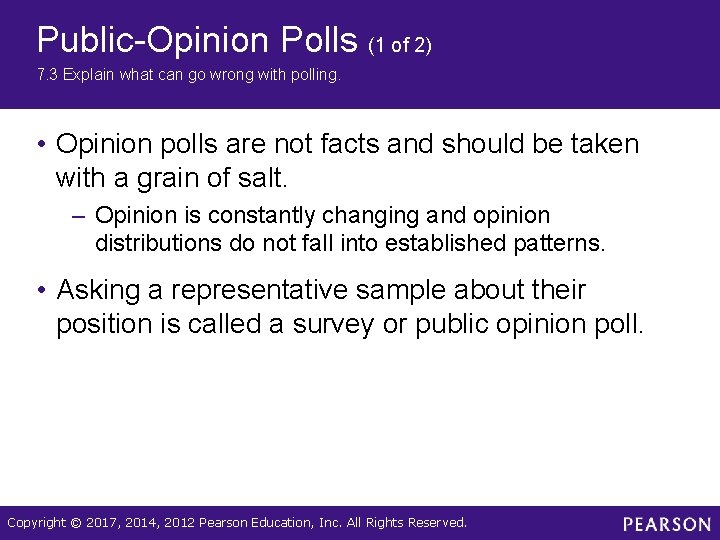
Public-Opinion Polls (1 of 2) 7. 3 Explain what can go wrong with polling. • Opinion polls are not facts and should be taken with a grain of salt. – Opinion is constantly changing and opinion distributions do not fall into established patterns. • Asking a representative sample about their position is called a survey or public opinion poll. Copyright © 2017, 2014, 2012 Pearson Education, Inc. All Rights Reserved.
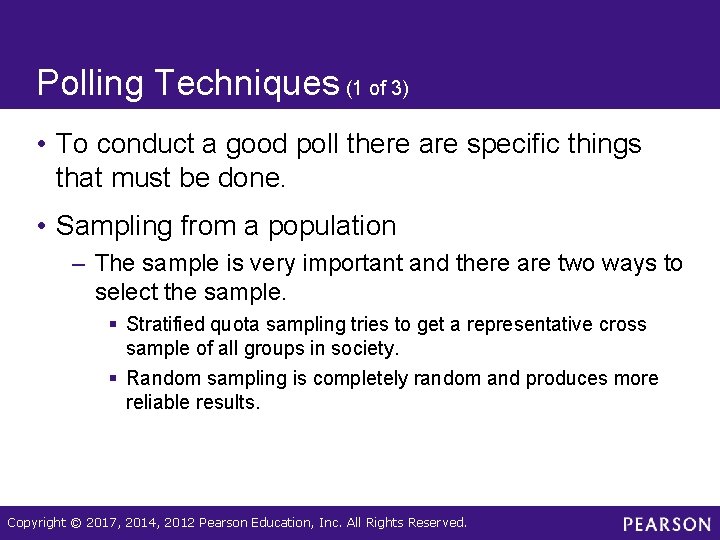
Polling Techniques (1 of 3) • To conduct a good poll there are specific things that must be done. • Sampling from a population – The sample is very important and there are two ways to select the sample. § Stratified quota sampling tries to get a representative cross sample of all groups in society. § Random sampling is completely random and produces more reliable results. Copyright © 2017, 2014, 2012 Pearson Education, Inc. All Rights Reserved.
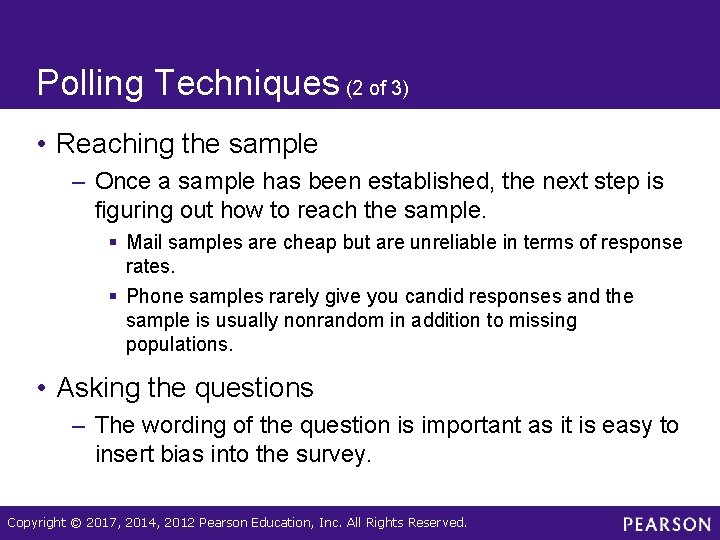
Polling Techniques (2 of 3) • Reaching the sample – Once a sample has been established, the next step is figuring out how to reach the sample. § Mail samples are cheap but are unreliable in terms of response rates. § Phone samples rarely give you candid responses and the sample is usually nonrandom in addition to missing populations. • Asking the questions – The wording of the question is important as it is easy to insert bias into the survey. Copyright © 2017, 2014, 2012 Pearson Education, Inc. All Rights Reserved.
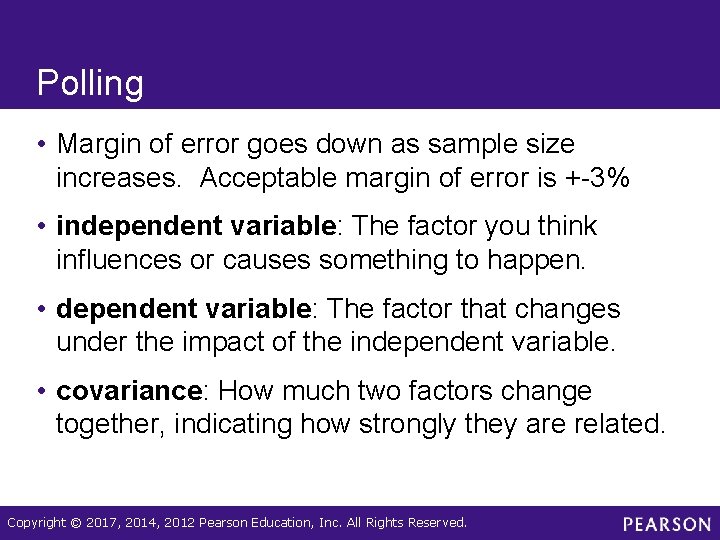
Polling • Margin of error goes down as sample size increases. Acceptable margin of error is +-3% • independent variable: The factor you think influences or causes something to happen. • dependent variable: The factor that changes under the impact of the independent variable. • covariance: How much two factors change together, indicating how strongly they are related. Copyright © 2017, 2014, 2012 Pearson Education, Inc. All Rights Reserved.