
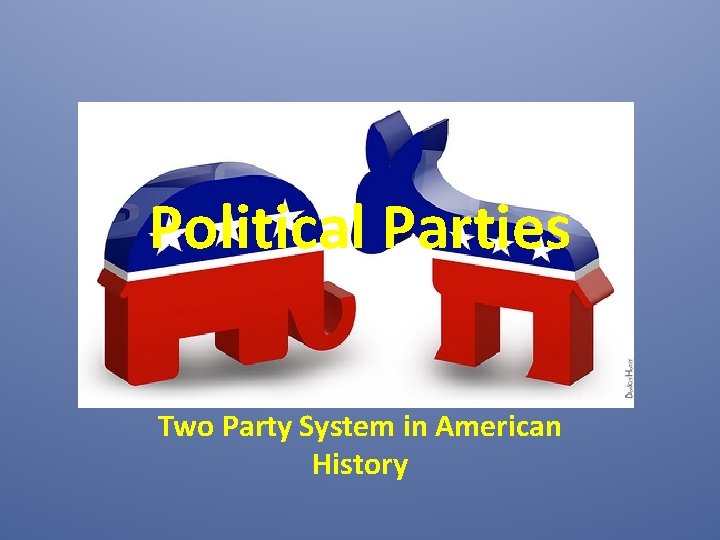
Political Parties Two Party System in American History
- Slides: 16
Political Parties Two Party System in American History
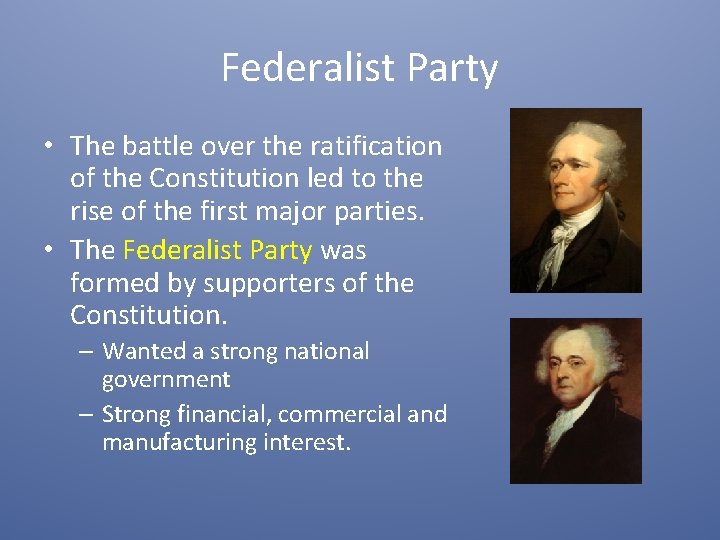
Federalist Party • The battle over the ratification of the Constitution led to the rise of the first major parties. • The Federalist Party was formed by supporters of the Constitution. – Wanted a strong national government – Strong financial, commercial and manufacturing interest.
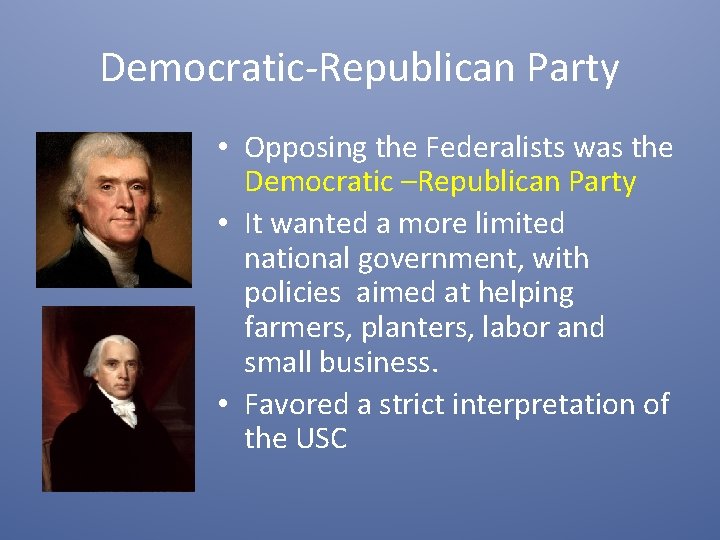
Democratic-Republican Party • Opposing the Federalists was the Democratic –Republican Party • It wanted a more limited national government, with policies aimed at helping farmers, planters, labor and small business. • Favored a strict interpretation of the USC
Democratic Party • The election of 1796 was the first time two parties fought for the presidency. • Federalist won with the election of John Adams – but faded after losing the 1800 election • Democratic-Republicans later split and gave rise to the Democratic Party of today.
Era of the Democrats • The Democratic Party won 13 of 15 presidential elections from 1800 to 1860. • In the 1830 s, President Jackson began a period of so-called Jacksonian Democracy, marked by three major political changes: – Voting rights extended to all white males (not just property owners) – Increase in the number of elected offices – Spread of the Spoils system
Spoils System • Practice of awarding the public offices, contracts, and other governmental favors to those who supported the party in power – Corrupt practice eventually replaced with civil service system
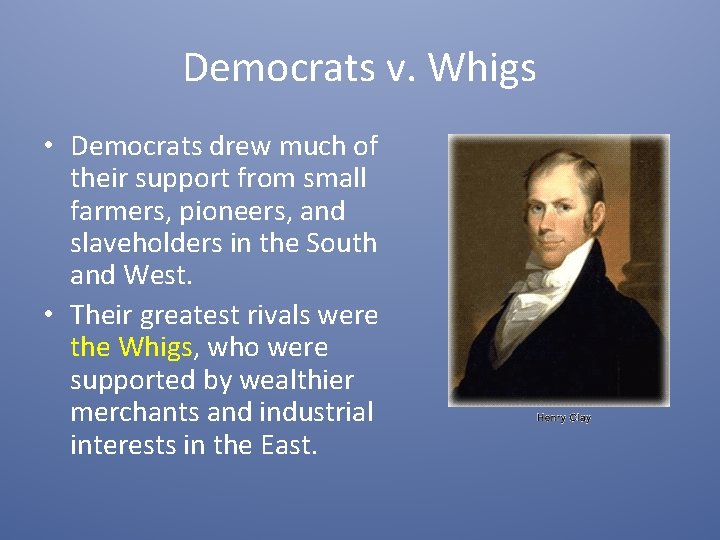
Democrats v. Whigs • Democrats drew much of their support from small farmers, pioneers, and slaveholders in the South and West. • Their greatest rivals were the Whigs, who were supported by wealthier merchants and industrial interests in the East.
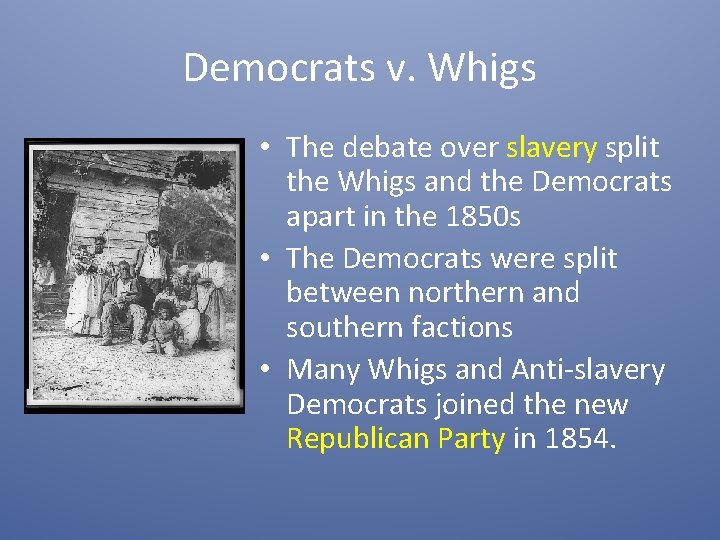
Democrats v. Whigs • The debate over slavery split the Whigs and the Democrats apart in the 1850 s • The Democrats were split between northern and southern factions • Many Whigs and Anti-slavery Democrats joined the new Republican Party in 1854.
Era of the Republicans • The Republican Party won 14 of 18 elections from 1860 to 1932. • The Civil War crippled the Democrats. – All their power was concentrated in the South, which they controlled for 100 years after Reconstruction ended. • The Republican dominated nationally – Supported by famers, laborers, business, and freed African Americans – Benefited from years of economic prosperity.
Economic Turmoil • An Economic Panic of 1896 made the election of 1896 critical. • Labor Unions joined small farmers and business owners to back the Democrats. • Republicans won by appealing to a wider range of voters, but the Democrats gained support outside of the South.
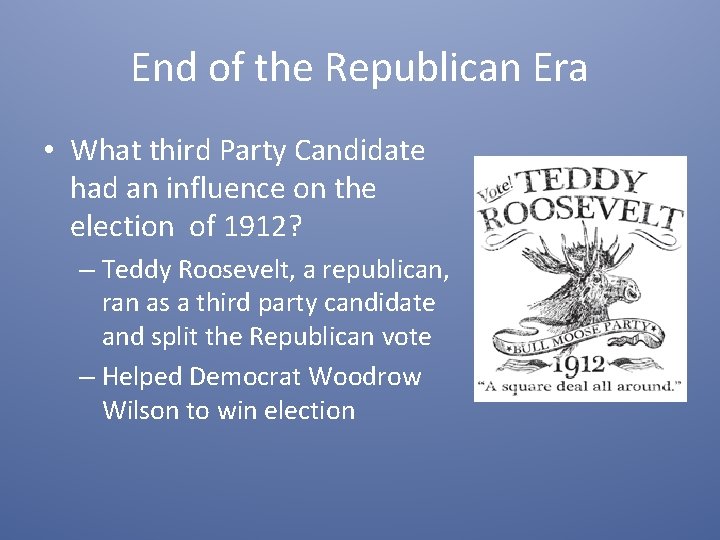
End of the Republican Era • What third Party Candidate had an influence on the election of 1912? – Teddy Roosevelt, a republican, ran as a third party candidate and split the Republican vote – Helped Democrat Woodrow Wilson to win election
Return of the Democrats • The Democrats won 7 out of 9 presidential elections from 1932 -1968 • The Great Depression sparked the comeback of the Democrats – With the economy in ruins, democrats gained support of: • Southerners, small farmers, big-city politicians, labor unions, and minority groups.
Era of Divided Government • The Republicans won 7 out of 10 presidential elections from 1968 -2004 • The Democrats controlled Congress for most of this time. – Republicans controlled Congress from 1995 -2000 while Bill Clinton was in office. • The division of power meant that neither party could easily control the agenda of the government – compromise not easy!
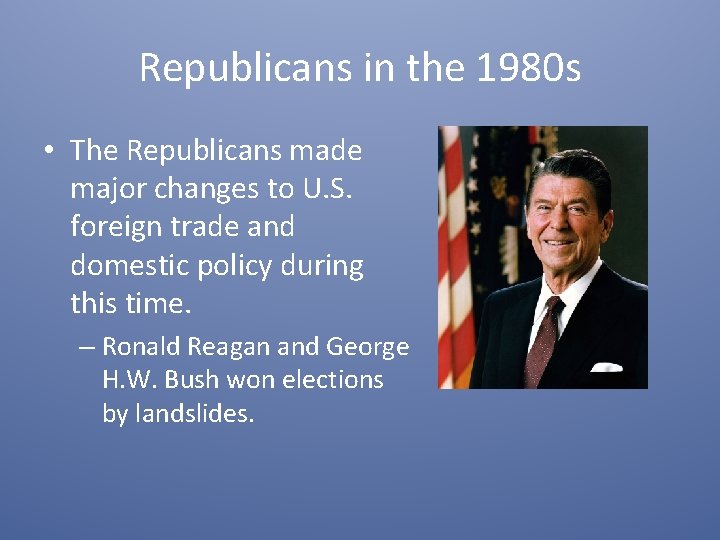
Republicans in the 1980 s • The Republicans made major changes to U. S. foreign trade and domestic policy during this time. – Ronald Reagan and George H. W. Bush won elections by landslides.
Political Parties Today • In recent years, Control of Congress, particularly the Senate, has shifted back and forth between the major parties. • Typically, newly elected Presidents have a “coattail” effect that brings other candidates from his party to Congress • Recently, this has not been the case – leading to gridlock in Washington D. C.
Questions to Ponder • What does divided government mean? • What characterizes the present political era that began in 1968? (explain) • Do you think divided government comes closer to the ideal the Framers intended? WHY?