
Political Parties Past v Present Party Competition is
- Slides: 28
Political Parties
Past v. Present • Party Competition is the battle between Democrats and Republicans for control of public office. • Without this competition there would be no choice, and without choice there would be no democracy. [At least this is the justification for the political parties today; remember that the founding fathers were against parties. ]
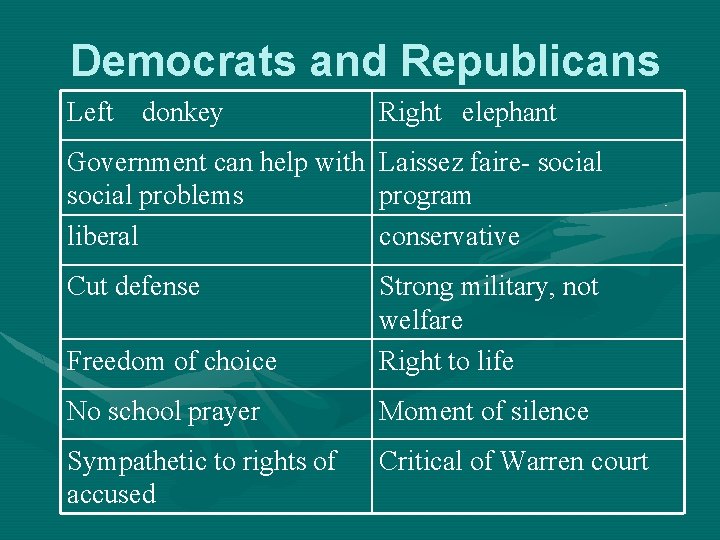
Democrats and Republicans Left donkey Right elephant Government can help with Laissez faire- social problems program liberal conservative Cut defense Freedom of choice Strong military, not welfare Right to life No school prayer Moment of silence Sympathetic to rights of accused Critical of Warren court
• Political Parties - a group of persons seeking to control the governing apparatus by gaining office in a duly constituted election. • 1. They will endorse candidates for public office and try to win elections. • 2. Party leaders often disagree about policy, and between elections the parties are nearly invisible.
Linkage Institutions • In a large democracy linkage institutions (institutions such as (1) parties, (2) elections, (3) interest groups, and the (4) media translate inputs from the public into outputs from policymakers) translate inputs from the public into outputs from the policymakers.
Tasks of Linkage Institutions • Pick Candidates – Almost no one gets elected to a public office without winning a party’s endorsement. • (1) A nomination is the party’s endorsement of a candidate. • (2) Sometimes candidates will run as independents. Look at Roanoke’s city council.
Tasks – run campaigns • Through their national, state, and local organizations, parties coordinate political campaigns; however, recent technology has made it easier for candidates to campaign on their own.
Tasks • Give Cues to Voters - Even though party ties have weakened, most voters have a party image (what the voters know or think they know about what each party stands for) of each party; and many voters still rely on a party to give them cues for voting.
Tasks • Articulate Policies - Within the electorate and in the government, each political party advocates specific policy alternatives. • Coordinate Policymaking – Parties are essential for coordination among the branches of government. When they need support to get something done, the first place they look is to their fellow partisans (members of the same group; i. e. , Republicans or Democrats).
Three headed giant • Party in the electorate – people who vote • Party as an organization • Party in government
Party in the Electorate • The party in the electorate consists largely of symbolic images. • 1. There is no formal “membership” in American parties. • 2. For most people, the party is a psychological label.
PARTY IN THE ELECTORATE • 2. Virtually every major social group (except African-American voters) has moved toward a position of increased independence. • 3. By contrast, African-Americans have moved even more solidly into the Democratic party (currently only five percent of African-Americans identify themselves as Republicans).
Party Organization • The National Party Organizations (pg 246) • 1. The national convention of each party meets every four years to write the party’s platform and nominate its candidates for president and vice president. • 2. The national committee is composed of representatives from the states and territories to keep the party operating between conventions. • 3. National Chairperson is responsible for taking care of the day-to-day activities and daily duties of the party. They hire staff, raise money, pay bills, and attends to the daily duties of the party. The President normally selects the chairperson for their party.
Party in Governance • A. Party control DOES matter because each party and the elected officials who represent it generally try to turn campaign promises into action. • B. The party that has control over the most government offices will have the most influence in determining who gets what, where, when, and how. • C. The parties winning the presidency have done a fairly good job over the years of translating their platform promises into public policy – nearly 75% of all promises resulted in policy actions while only 10% were ignored altogether.
Two Party System • Throughout American history, one party has been the dominant majority party for long periods of time (referred to as party eras). • 1. Critical Elections are an electoral “earthquake” where new issues emerge, new coalitions (a set of individuals or groups supporting the party) replace old ones, and the minority party often displaces the majority party. • 2. A party realignment (a rare event) is typically associated with a major crisis or trauma in the nation’s history (such as the Civil War and the great Depression, both of which led to realignments).
The Federalists • 1796 -1824: The First Party System – Federalist and Democratic-Republicans (pg 249) • 1. Alexander Hamilton needed congressional support for policies he favored (particularly a national bank), and the foundation of the Federalist party came from his politicking and coalition building. • a) The Federalists were America’s shortest-lived major party. • b) They were poorly organized • c) They faded after John Adams was defeated in his reelection bid of 1800 • d) They no longer even had a candidate for president after 1820
Republicans b) Eventually called Democratic-Republicans hoping to convince the electorate that they believed in a more democratic approach to the governing of the • Republic. • c) The coalition was derived from agrarian interests – which made the party popular in the rural South. • d) The coalition was torn apart by factionalism.
Jacksonian Democrats vs. Whigs • General Andrew Jackson was originally a Democratic. Republican, but soon after his election (1828) his party became known simply as the Democratic party (which continues to this day). • Opposition was provided by the Whigs, but the Whig party was only able to win the presidency when it nominated popular military heroes such as William Henry Harrison (1840) and Zachary Taylor (1848). The Whigs had two distinct wings – northern industrialists and southern planters – who were brought together more by the Democratic policies they opposed than by issues on which they agreed
Republicans • The issue of slavery dominated American politics and split both the Whigs and the Democrats in the 1850 s • 2. The Republican party rose in the late 1850 s as the antislavery party. • a) The Republicans forged a coalition out of the remnants of several minor parties (antislavery Democrats and the Know-Nothings) and elected Abraham Lincoln as president in 1860.
Republicans until Great Depression • The Civil War brought a party realignment, and the Republican party was in ascendancy for more than sixty years (though the Democrats controlled the South) • c) The election of 1896 was a watershed during this era – a period when party coalitions shifted and the Republicans were entrenched for another generation. • d) The Republicans continued as the nation’s majority party until the stock market crash of 1929 and the ensuing Great Depression
New Deal Democrats • President Herbert Hoover’s handling of the Great Depression was disastrous for the Republicans. He took the position that “economic depression cannot be cured by legislative action. ” • 2. Franklin D. Roosevelt promised a New Deal easily defeating Hoover in 1932. • a) Congress passed scores of Roosevelt’s anti. Depression measures during his first hundred days in office. • b) Party realignment began in earnest after the Roosevelt administration got the country moving again, and Roosevelt forged the New Deal • Coalition from such diverse groups as union members, southerners, intellectuals, liberals, the poor, and African-Americans.
Divided Government • Although the Democrats have been the majority party ever since Roosevelt’s time, the coalition has steadily weakened since the mid-1960 s. • 2. An unprecedented period of divided government (when the executive and legislative branches are controlled by different parties) has existed since 1968. • 3. The House of Representatives had been consistently controlled by the Democrats from 1968 to 1994. • 4. After the 2000 election, political scientists began referring to the nation as divided into the “blue states” won by Democrats and the “red states” won by the Republicans.
Party Realignment? • 1. Republicans have won six of eight presidential elections but were unable to • control Congress until 1994. • 2. In 1980, Ronald Reagan began attracting a traditional Democratic base of • middle-class workers to his candidacy (“Reagan Democrats”). • 3. In 1992, however, Bill Clinton introduced the “New Democrat” aiming to • entice those liberal Republicans and conservative Democrats. • 4. In 2002, under Republican President George W. Bush, the Republicans were able to take control of the Senate, and become stronger in the House. • 5. In 2004, George W. Bush was reelected solidifying Republican control of the executive and legislative branches. • 6. Republican gains in the once Democratic South suggest a major party • realignment in that area of the country; the Democrats’ Solid South no longer • exists in national elections.
Dealignment • Many political scientists believe that the recent pattern of divided government means that the party system has dealigned rather than realigned. • Those who do identify with a party are more likely to belong to the party that matches their ideology – the parties have become ideologically differentiated, • and people who call themselves conservatives are more likely to be in the Republican party while liberals are concentrated in the Democratic party.
Third Parties • minor parties which either promote narrow ideological issues or are splinter groups from the major parties • Bull Moose (Roosevelt) and Dixiecrats (Strom Thurmond) • Also, people who just want to be president – Ross Perot
Why third parties are important 1. controlled enough votes in one-third of the last 36 presidential elections to have decisively tipped the electoral college vote. • 2. brought new groups into the electorate and have served as “safety valves” for popular discontent. • 3. brought new issues to the political agenda.
Gridlock • Created a system where it’s common for the president and legislative majority to come from different parties. • Hard to make decisions.
Divided Government • Neither party is in charge, and both finger point. • Leads to difficulty in making decisions on big issues, like healthcare, and solving problems, like the budget.