
Political Parties Objectives 1 Describe the roles functions
Political Parties Objectives: 1. Describe the roles, functions and organizations of American political parties 2. Explain how they differ from other democracies 3. Describe the evolution of the party system.
Political Parties • Political Party - a group that seeks to elect candidates to public office by supplying them with a label (party identification), by which they are known to the electorate • Parties are: • • • Necessary perform vital functions Complicated full of internal conflict disorganized and decentralized rigid but capable of being taken over by reformers.
4 Functions of Parties 1. Organization: - Candidate Recruitment • Parties need to find viable candidates for a whole range of elected positions at the federal and state level • Obstacles to recruitment include: • • Time Privacy Finances Prospects • State and local parties run many recruitment efforts, however, more and more power has been given to the national party leaders.

4 Functions of Parties 2. Nominating Candidates Through Primaries • Closed primary – only registered party members may vote for the party’s nominee • This tends to lead to a stronger party system • Open primary – all voters (regardless of party membership) may vote for a party’s nominee • Moderate candidates may tend to win these, however, there is no empirical evidence to support this assertion • IL has an open primary • Still can only vote in one party’s primary, not both

4 Functions of Parties • Nominating Conventions • Candidates for president are officially nominated • Conventions are held after primaries are held in all 50 states ( happened in July 2016 ) • In these primaries, delegates are chosen to represent one candidate based on the vote in each state • Each party has different rules for delegate selection • Democrats = Proportional allocation • Republicans = Proportional and winner-take-all • Each state has a different number of delegates based on party rules for each party • Democrats and Republicans also have delegates that are “unpledged” and may vote however they wish. • Democrats = super-delegates (party leaders/elected officials) • Republicans = “un-bound” delegates

4 Functions of Parties • Nominating Conventions (cont. ): • The delegate system was implemented to reduce the power of party bosses to choose the nominee • Unintended consequences: • Empowering party activists • Candidates choose the delegates that will represent them • To reassert themselves, party leaders have worked to put themselves back in the process in 3 ways: • Democrats have super-delegates • Invisible primary - Process by which candidates try to attract the support of key party leaders (endorsements) before the elections begin • Raising money – more money = more likely chance of winning.
4 Functions of Parties 3. Winning Elections • Labels to help voters decide • Get out the Vote campaigns • Mobilize and register voters to vote for your candidates • • Supporter lists Providing polling data Campaign staff Money • Donations from the party to a specific candidate sends a signal that this person is worthy of other donors to give money

4 Functions of Parties 4. Operating the Government • Appointments to Judicial and executive branches • Providing organized “loyal” opposition to government • Make sure, if not in power, that party is ready for next election • Leaders • Issues • Policies
Party Systems • European parties are disciplined gatekeepers, to which voters are very loyal, though this has been declining recently • Candidates for elective office usually nominated by party leaders • Campaigns are run by the party • Elected officials expected to vote and act together with members of his/her party • In a parliamentary system, the legislative and executive branches are one, so one party controls it all. In the U. S. , the President is elected separately from the legislature, so two parties can be in power at once • The federal system decentralizes power in U. S. • Parties are closely regulated by state and federal laws, which weaken them • Candidates are now chosen through primaries, not by party leaders
History of Parties in the U. S. • The Founding/Post G. Washington • Federalists (Hamilton) vs Democratic. Republicans (Jefferson) • Issues: • • Size and power of national government State’s rights • Voters: • • Federalist: New England, Wealthy, Merchants Republican: South, Artisans, Farmers • Adams (Federalist) wins over Jefferson (Republicans) • 1804 - Jefferson Inaugural Address: • “We are all Republicans, we are all Federalists” • U. S. became pretty much one party (Republicans) after Jefferson (Madison, Monroe)
History of Parties in the U. S. • Jacksonian Era: • Birth of Modern Democratic Party • 1824 - Republican Party splits • Andrew Jackson leaves party to form his own • Republicans change name to National Republicans • Jackson helps form the Democratic Party • This is the same Democratic Party we have today • 1828 - Jackson wins • National Republicans rename themselves Whigs • During the Jacksonian era political participation became a mass phenomenon • Eliminated caucus-based nominations • Members of Congress nominated Pres. candidates • Moved to Party conventions to nominate • Voter Bases: • Dems – Rural/South • Whigs – North/Urban centers
History of Parties in the U. S. • Civil War/Sectionalism • Birth of the Republican Party • 1856 - modern Republican Party forms • Remnant of Whig party split, anti-slavery Democrats, and the Free Soil Party • First and only time that a third party transitioned into a major party in the U. S. • From 1860 through 1932 • Republicans control White House and to a lesser extent Congress • Exceptions: • Grover Cleveland (1885 -1889; 1883 -1897) • Woodrow Wilson (1913 -1921) • There were splits within the Republican Party based on reformers who opposed patronage • Mugwumps and Progressives • Voter bases: • Republicans: North/Urban • Democrats: South
History of Parties in the U. S. • Era of Reform • This is part of the Republican dominance (early 1900 s), but many changes in the parties and elections happened • Republicans – coalition of big business and working class • Democrats – rural interests • Progressives pushed measures to curtail parties’ power and influence • Primary elections for candidates • To try and get rid of political machines and bosses • Voter requirements to reduce fraud • Adoption of the standard ballot (Australian) • Civil service reform to get rid of patronage • Results: • The worst forms of political corruption were reduced • All political parties were weakened • Parties became less able to hold officeholders accountable or to coordinate across the branches of government
History of Parties in the U. S. • New Deal Era (1932 -1964) • Democratic dominance • Grand coalition of • • Urban dwellers Labor Unions Catholics Jews The Poor Southerners African Americans Farmers
History of Parties in the U. S • Polarization and Resurgence • Mid to late 20 th century • Elections had come to be more about candidates than parties • More independent voters • Lot of split-ticket voting • With the civil rights legislation in the 1960 s, parties began to take certain stands on racial issues • Shortly after, each party started to take stands on many other social issues (abortion, taxes, women’s rights, etc. ) • This made ideology the main glue that holds the parties together, instead of the patronage of the past • This allowed for the era of polarization on issues between the parties to be ushered in

Party Realignments • Critical or realignment periods • Periods when a major, lasting shift occurs in the popular coalition supporting one or both parties • Occurs when a very important issue cuts across party divisions • Two kinds of realignments: • A major party is defeated so badly that it disappears and a new party emerges (Federalists and Whigs) • Two existing parties continue but voters shift their loyalty from one to another (1896 and 1932)
Five Realigning Periods • 1800 – Jeffersonian Republicans defeat Federalists • 1828 – Jacksonian Democrats come to power • 1860 – Republicans replace Whigs as second party • 1896 – Republicans defeated Democrat William Jennings Bryan • Economic issues shifted loyalties to East/West, city/farm split • 1932 – FDR is elected and Democratic resurgence • Economic depression triggered new coalition for Democrats
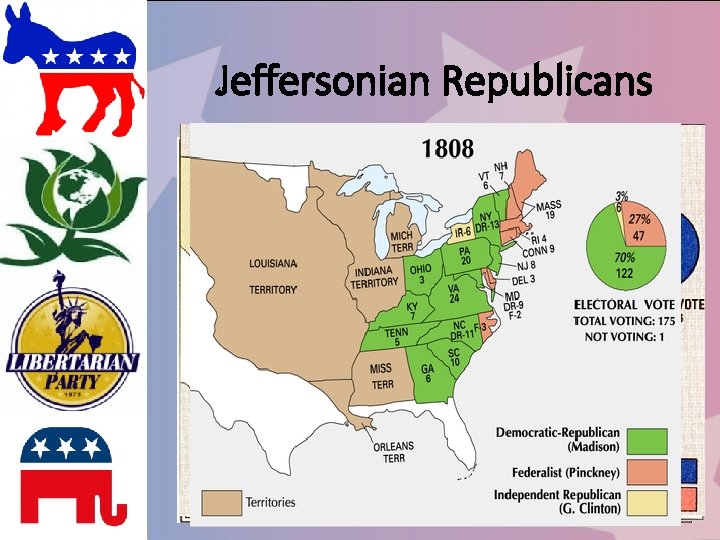
Jeffersonian Republicans
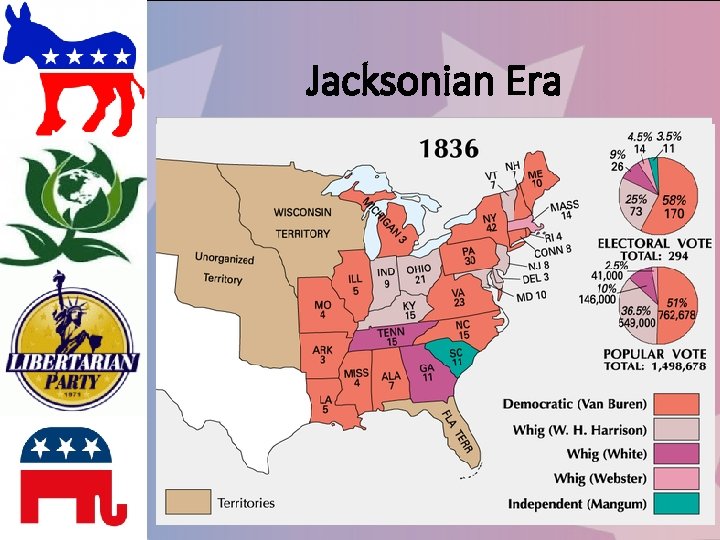
Jacksonian Era
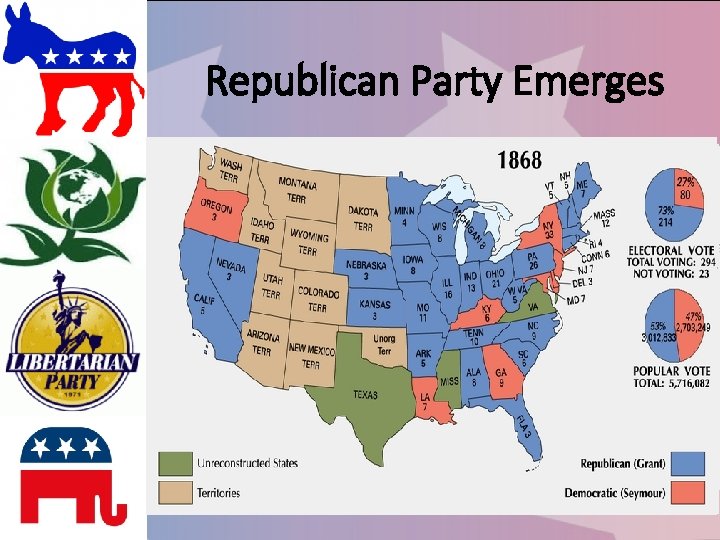
Republican Party Emerges
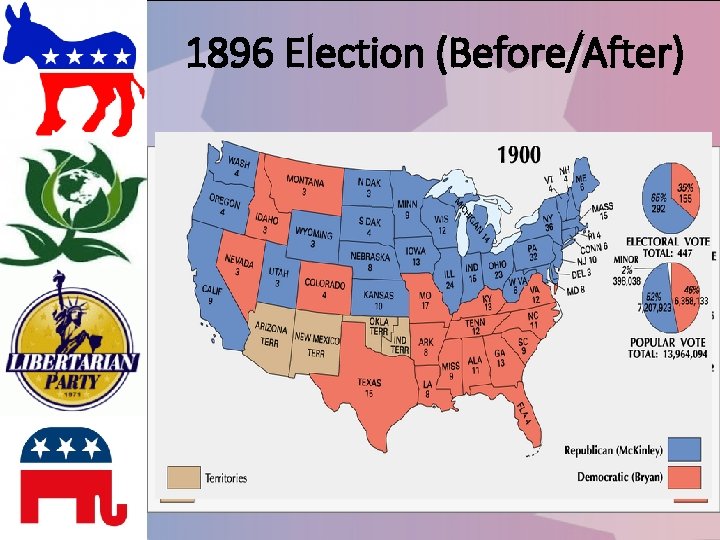
1896 Election (Before/After)

1932 Election (Before/After)
Realignments: Still Relevant? • While the historical realignments are helpful in explaining the growth of parties, many scholars question the usefulness of using theory to describe modern elections • While parties in the past tended to change drastically, most change today occurs gradually.
Dealignment? • Dealignment • Process whereby a large portion of the electorate abandons its previous partisan affiliation without developing a new one to replace it • It is contrasted with realignment • Are we experiencing dealignment? • People have abandoned both parties to become Independents • However, most Independents are really partisans in their voting behavior and attitudes • Dealignment has led to ticket splitting in recent times
Dealignment? • Other factors that have weakened the parties and contributed to dealignment • Candidate-centered campaigns (especially after FECA) • Public disenchantment with parties and politics during the 60's • Growth of interest groups – have taken on some party functions • Development of mass media – candidates rely on media rather than party organization to get message across • Growth of political independents • Trend to “vote the man, not the party” and rise of ticket splitting (voting for candidates from both political parties)
Organization of Parties National Organization: • Every four years – National Convention • Meeting of party delegates to nominate Pres. Candidate and set direction of the party (platform) • Between conventions, affairs managed by national committee • Delegates who run the day to day affairs of the party • National chair – day to day manager of the party elected by the national committee Reince Priebus and Debbie Wasserman-Schultz • Congressional Campaign Committees • Party committee in Congress that provides funds and direction for members and wanna-be members • Overall, the main role of the national party organization is to fundraise and represent the party in the media between conventions
Organization of Parties State and Local Parties: (Very different from what they used to be) • Political machines • Party organizations that recruited members through money, jobs, etc. • Very hierarchical in structure • Weakened by the Progressive Era election reforms • Hatch Act (1939) – illegal for federal employees to serve in political campaigns as officers, fundraising, endorsing, etc. They could only vote and donate money • New-style machine → fueled by campaign contributions • More donors are giving money to state parties to boost chances of winning elections locally
Partisanship • Partisan identification – a voter’s long-term, stable attachment to a political party • Same as partisanship • Think back to political socialization • Underlying stability with changes in response to major events (economy, terrorism, etc. ) • Polling indicates that partisans tend to “trust” the government more when their party is power. • During Clinton’s presidency, both the crime rate and budget deficit had fallen sharply, but when they asked Republican voters, they said that crime and the budget had increased. • Parties shape how ordinary Americans interpret the political world
Voter’s Partisanship, 1952 -2012 • This chart includes “leaners” as party of each party’s id (i. e. someone who says they are independent but tend to vote Republican) • Partisanship indicates loyalty for candidates (around 90%)
Two Party System • A two party system - two dominant parties compete in national elections • It is unique; by some estimates fewer than 30 countries have it • Most countries have multi-party systems • Reasons for the Two Party System in the U. S. Electoral College – winner takes all Single member districts – one man one vote Distribution of Public Opinion Plurality system stacks the deck against third parties • Money from interest groups • Media Coverage • Exclusion from TV debates • •
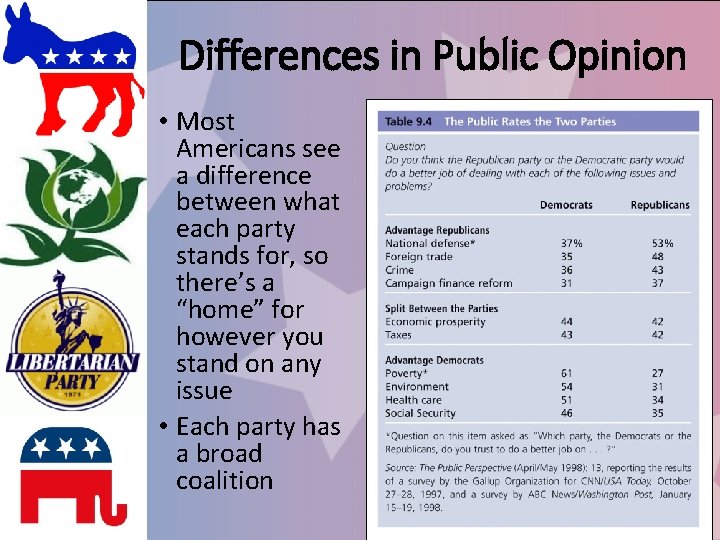
Differences in Public Opinion • Most Americans see a difference between what each party stands for, so there’s a “home” for however you stand on any issue • Each party has a broad coalition

Minor Parties • Our electoral system may prevent minor parties from winning, but not from forming • There are four major types of minor parties • Ideological parties: comprehensive view of American society and government that is radically different from both parties; most enduring type • Libertarian Party, Green Party, Communist Party • One-issue parties: address one concern, avoid others • Free Soil Party, Know-Nothing Party, Prohibition Party • Economic protest parties: regional, protest economic conditions (disappear if conditions chg) • Greenback Party, Populist Party • Factional parties: form split in a major party, usually over the party’s presidential nominee • “Bull Moose” Party, “Dixiecrat” Party, Reform Party

Minor Parties in the U. S.
Impact of Minor Parties • Why aren’t there more? Most party members are able to influence their own party before becoming so disaffected that they leave • Throughout history - minor parties have little chance of winning, but they can mess things up for the major parties by taking votes (Ross Perot, Ralph Nader) • Major parties may adopt minor party ideas into their own party • Factional parties tend to have the most impact • Mugwumps made the Republicans more responsive to civil service reform • Progressive Parties caused the parties to take up business and electoral regulation • Tea Party has been successful in influencing Republican Party policies and candidates
![Washington’s Warning • “However [political parties] may now and then answer popular ends, they](http://slidetodoc.com/presentation_image_h2/4091faa9510e7515d4cba3f02eb86a7d/image-35.jpg "Washington’s Warning • “However [political parties] may now and then answer popular ends, they")
Washington’s Warning • “However [political parties] may now and then answer popular ends, they are likely in the course of time and things, to become potent engines, by which cunning, ambitious, and unprincipled men will be enabled to subvert the power of the people and to usurp for themselves the reins of government, destroying afterwards the very engines which have lifted them to unjust dominion. ” ~ Farewell Address, September, 1796
- Slides: 36